
Snitchnotes Team
How Do QR Codes Work When Part of the Code Is Damaged?
How Do QR Codes Work When Part of the Code Is Damaged?
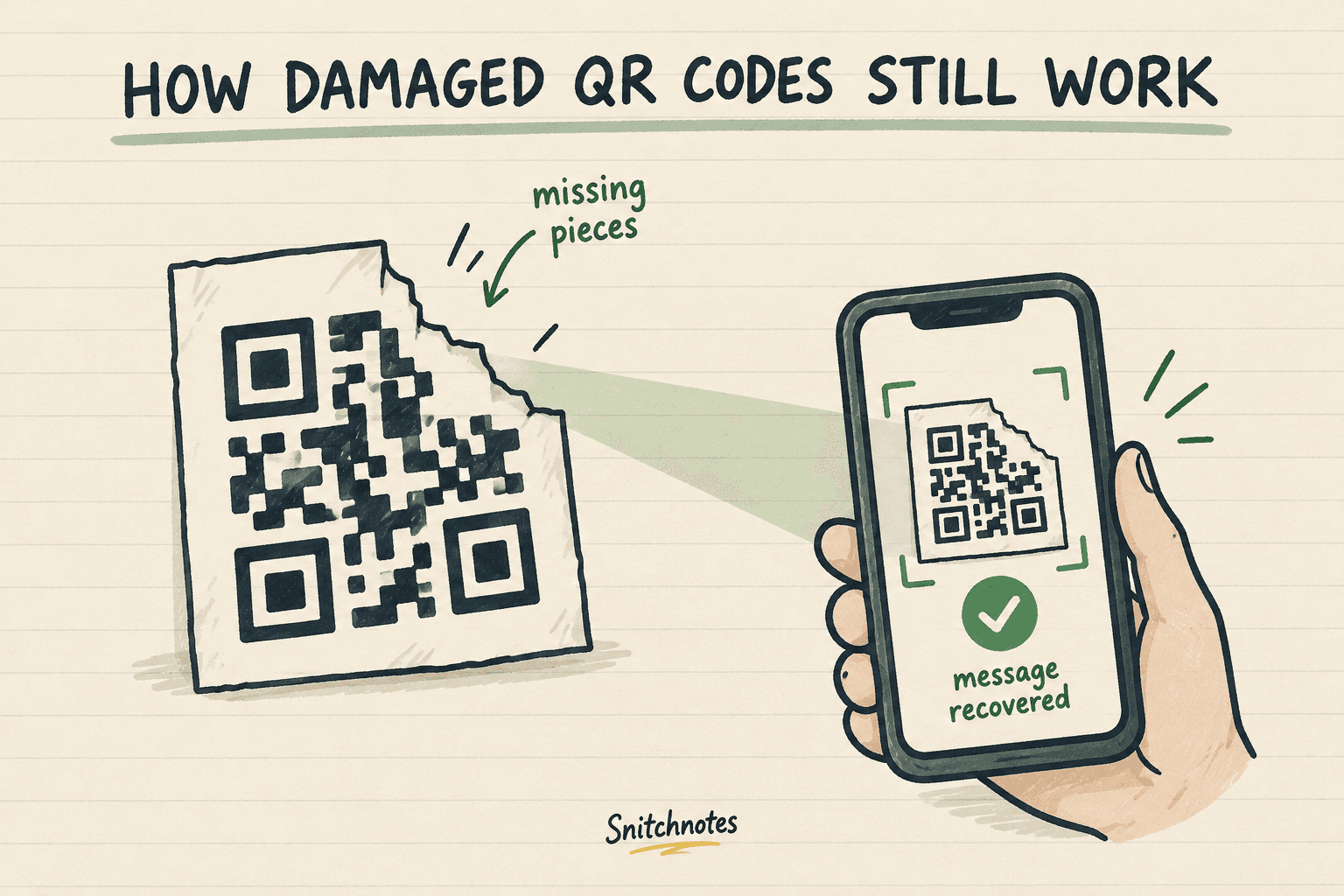
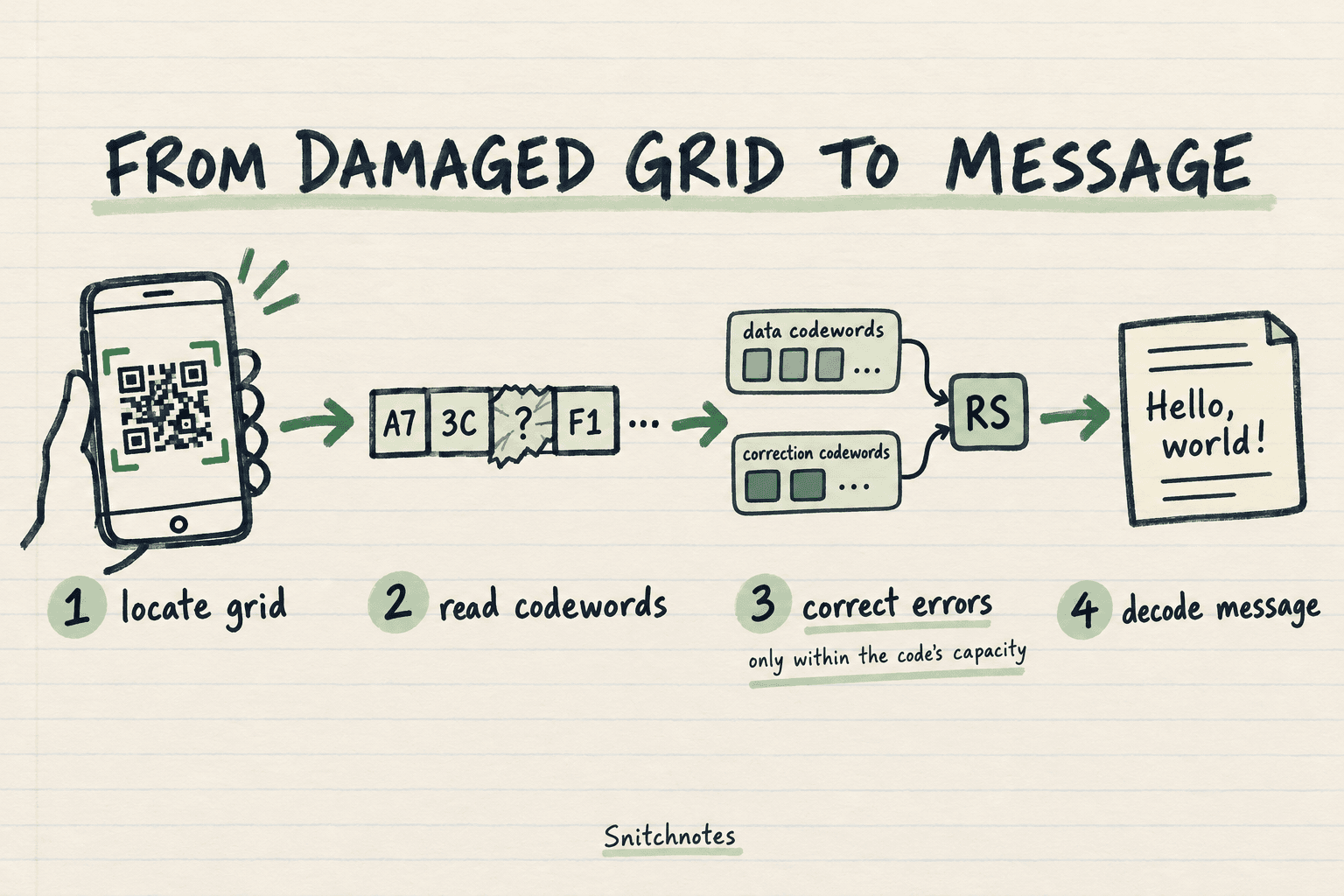
QR codes can work when damaged because they store extra error-correction information alongside the actual message. A scanner uses that redundancy to reconstruct some unreadable or incorrect codewords before decoding the link or text. It works only if the scanner can still locate the grid and the damage stays within the code's correction capacity.
That is why a scratched parcel label may scan perfectly while a cleaner-looking code refuses to cooperate. The size, position, and type of damage matter more than a simple estimate of how much black-and-white area has disappeared.
Why damage tolerance matters
QR codes live in an untidy world: packaging bends, posters fade, phone screens catch glare, and labels collect scratches. A code that failed after one wrong square would be fragile. Error correction makes the symbol useful in ordinary conditions, while its distinctive layout helps a camera find and straighten a code viewed at an angle.
The governing standard is ISO/IEC 18004. It defines the QR symbol, data encoding, format information, and error-correction rules. A compliant reader is therefore not improvising from the picture; it is following a known map and a defined mathematical recovery process.
A QR code is a structured grid
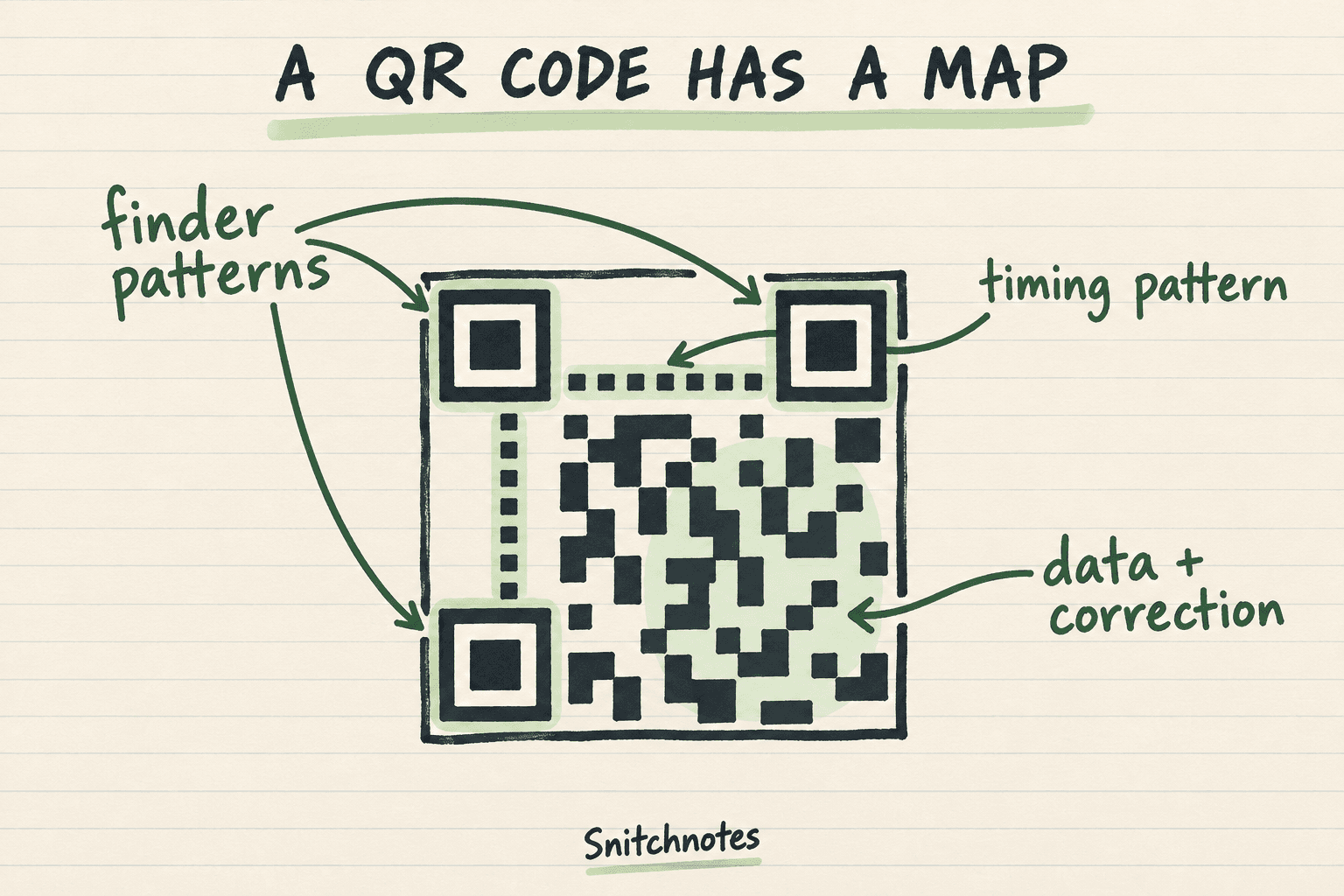
Each tiny black or white square is a module. The three large finder patterns near the corners let the reader locate and orient the symbol. Timing patterns help it establish the rows and columns, while alignment patterns in larger versions help compensate for distortion. A clear quiet zone around the outside separates the code from nearby printing.
Other reserved areas describe the version, mask, and selected error-correction level. The remaining modules contain a woven sequence of data codewords and error-correction codewords. Because the reader knows which locations have which jobs, it can sample the grid, undo the mask, and rebuild the ordered codeword stream.
Reed–Solomon correction is the repair kit
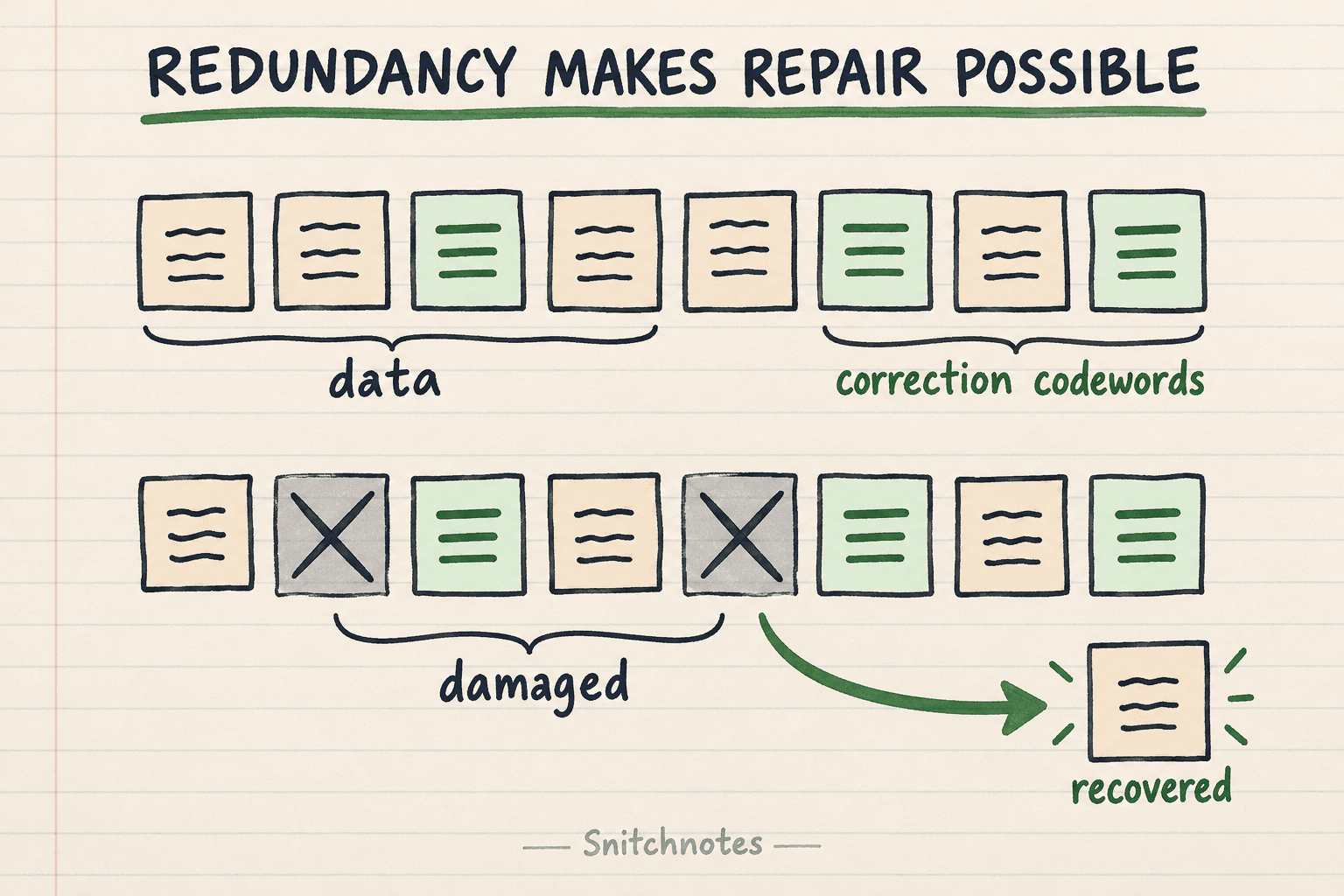
QR codes use Reed–Solomon error-correcting codes. During encoding, the message is divided into codewords and processed mathematically to create additional correction codewords. Those extras are not a second copy of the picture. They are compact relationships among the data that allow a decoder to detect disagreement and solve for some missing or corrupted values.
In a basic Reed–Solomon block with n total symbols and k data symbols, n minus k symbols are redundant. When the locations of errors are unknown, two redundant symbols are generally needed to correct one erroneous symbol. QR codes may use several blocks and interleave their codewords across the symbol, helping prevent one localized blemish from overwhelming a single block.
The four error-correction levels
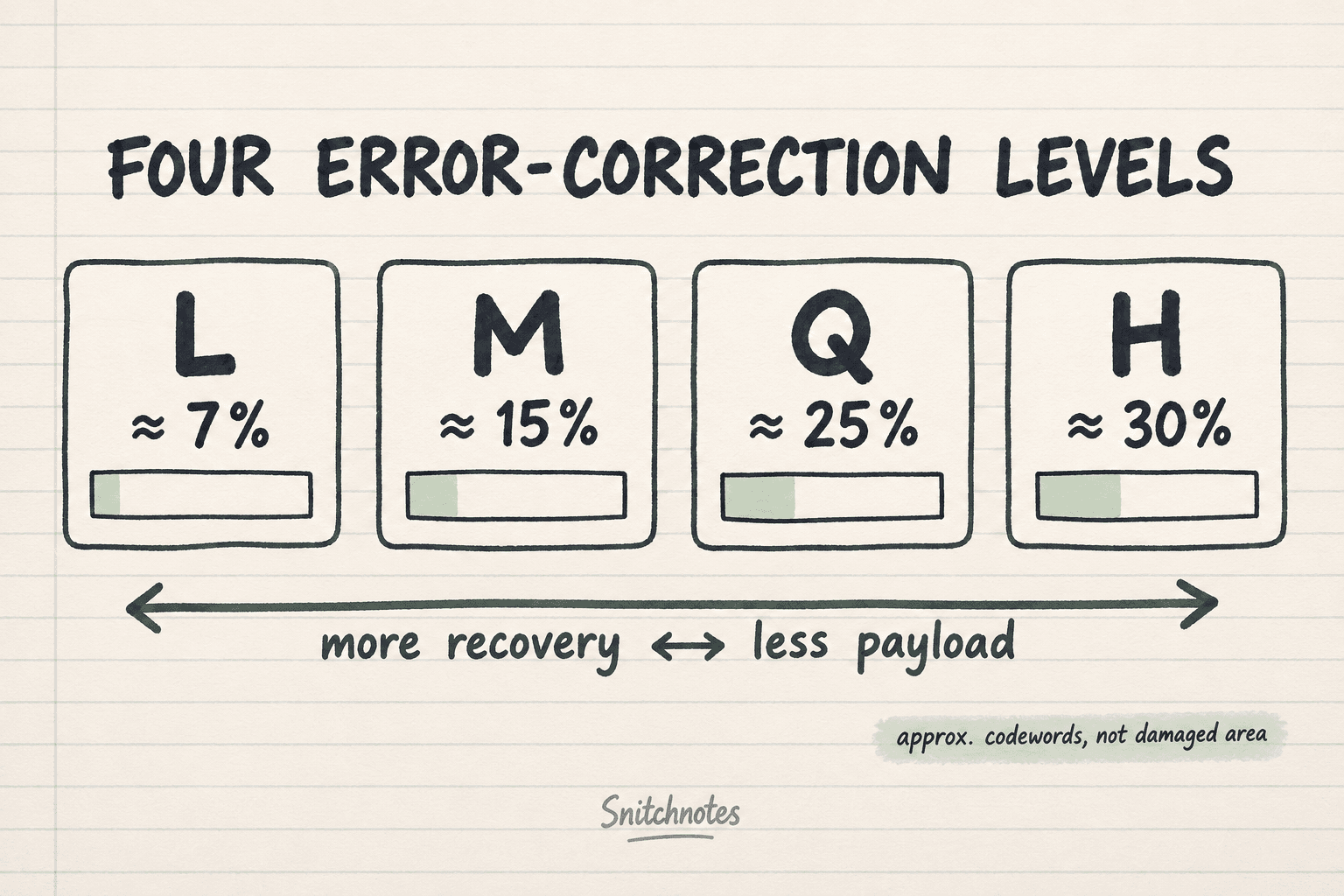
A QR encoder can choose one of four levels. DENSO WAVE describes their approximate codeword restoration capacities as L at 7%, M at 15%, Q at 25%, and H at 30%. Higher correction uses more modules for redundancy, leaving less capacity for the payload at the same symbol size.
- Level L: the most payload capacity and the least recovery margin.
- Level M: a common middle setting with about 15% codeword recovery.
- Levels Q and H: more redundancy for environments where dirt or damage is more likely.
These percentages are not permission to cover the same percentage of the visible square. They refer approximately to damaged codewords, not physical surface area. A small mark across critical layout features can be worse than a larger mark across well-distributed data modules.
What the scanner does, step by step
- Locate and normalize the symbol using the finder, timing, and alignment information.
- Sample the module grid and read the format information, which identifies the mask and correction level.
- Extract and deinterleave the data and correction codewords into their blocks.
- Run Reed–Solomon decoding to detect and correct errors that remain within each block's capacity.
- Interpret the repaired data as text, a URL, contact information, or another supported payload.
A useful example
Imagine a café menu printed as a level H QR code. A drop of coffee hides several neighboring modules in the data region, but the finder patterns, timing pattern, and quiet zone remain visible. The phone can establish the grid, identify inconsistent codewords, and use the correction codewords to recover the URL. The stain does not contain the answer; the intact redundancy makes reconstruction possible.
Now move the same stain over a finder pattern, add glare, or enlarge it until one Reed–Solomon block exceeds its limit. The scan may fail even though less than 30% of the picture appears covered. Error correction is a budget with structure, not a magical damage shield.
Check your understanding
Does a scanner recreate the missing squares by copying nearby patterns?
No. It uses the defined layout to recover codewords and Reed–Solomon relationships to correct certain missing or wrong values. Nearby squares may look similar, but visual symmetry is not the recovery method.
Does level H guarantee a scan with 30% of the image covered?
No. The figure is an approximate codeword restoration capacity. Damage location, block distribution, blur, glare, distortion, and harm to functional patterns can all cause failure sooner.
What trade-off comes with stronger correction?
More of the symbol is devoted to correction codewords, so less capacity remains for the actual payload at the same QR version.
If a technical topic in your lecture notes feels like a wall of little squares, Snitchnotes can turn the material into clearer study notes, flashcards, quizzes, and audio for review.
Related concepts
- Error detection versus correction: detecting a problem requires less information than identifying and repairing it.
- Interleaving: distributing neighboring pieces of a data block across different physical locations to make burst damage easier to handle.
- Data redundancy: extra information that improves reliability at the cost of storage capacity.
- Binary search step by step: another visual guide to how an algorithm narrows a problem.
Sources
DENSO WAVE: QR Code error correction feature
University of Memphis AutoID Lab: Designer QR Codes—Ensuring the Beep
Convierte tus clases en material listo para el examen.
Apuntes, quizzes, podcasts, flashcards y chat — con solo subir un archivo.
Prueba tu primer apunte gratis