
Snitchnotes Team
Ionic vs Covalent Bonds: Differences and Examples
Ionic vs Covalent Bonds: Differences and Examples
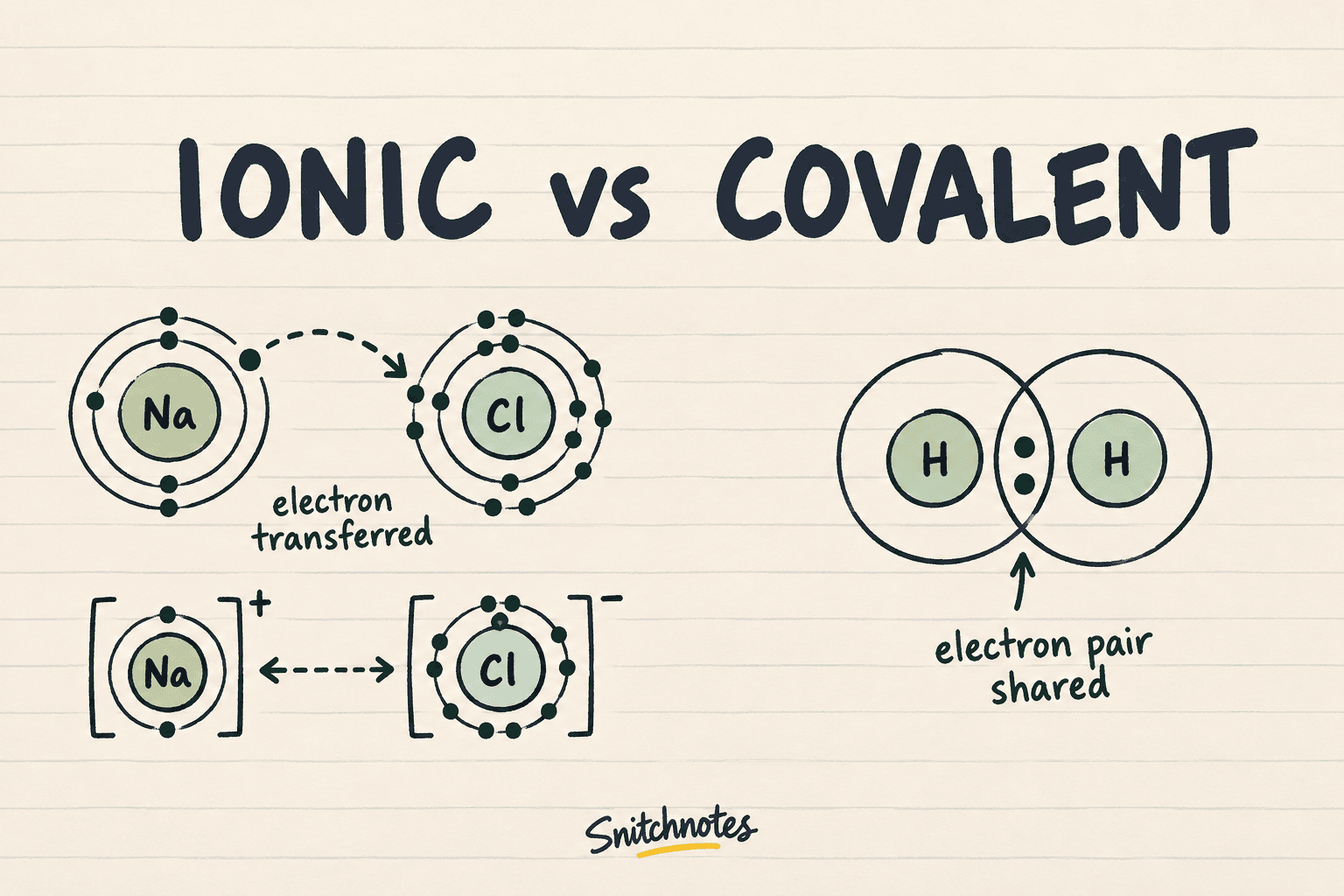
Ionic bonds are electrostatic attractions between positively and negatively charged ions, usually formed after electrons move from one atom to another. Covalent bonds form when atoms share electron density. That difference creates two common particle structures: repeating ionic lattices and discrete covalent molecules, although network covalent solids are an important exception.
In practice, compare ionic vs covalent bonds by asking three questions: What happens to the valence electrons? What particles make up the substance? Can charged particles move? Those answers explain far more than memorizing “metal plus nonmetal.”
Why the distinction matters
Bonding connects the invisible arrangement of electrons to properties you can observe. It helps predict whether a material is likely to be a crystal or a collection of molecules, whether it melts easily, and whether it conducts electricity as a solid, liquid, or solution. It also prevents a common exam mistake: using a property rule without first identifying the particles involved.
The comparison is a model, not a wall between two perfect categories. Real bonds can have both ionic and covalent character. The model remains useful because it gives you a clear starting point for explaining structure and behavior.
How ionic and covalent bonds form
Ionic bonding: ions first, attraction second
Take sodium chloride. A neutral sodium atom has 11 protons and 11 electrons. If it loses one electron, it becomes Na+, with 11 protons and 10 electrons. A chlorine atom can gain that electron and become Cl−. The ionic bond is the electrostatic attraction between the resulting oppositely charged ions, which assemble into a three-dimensional lattice rather than separate NaCl molecules.
Covalent bonding: shared electron density
Now take H2. Each hydrogen atom contributes one electron to a shared pair located between the two nuclei. Attraction between both positive nuclei and the shared electrons holds the atoms together. Covalent bonding often creates separate molecules such as H2O and CO2, but it can also extend through a giant network, as in diamond or quartz.
Ionic vs covalent properties
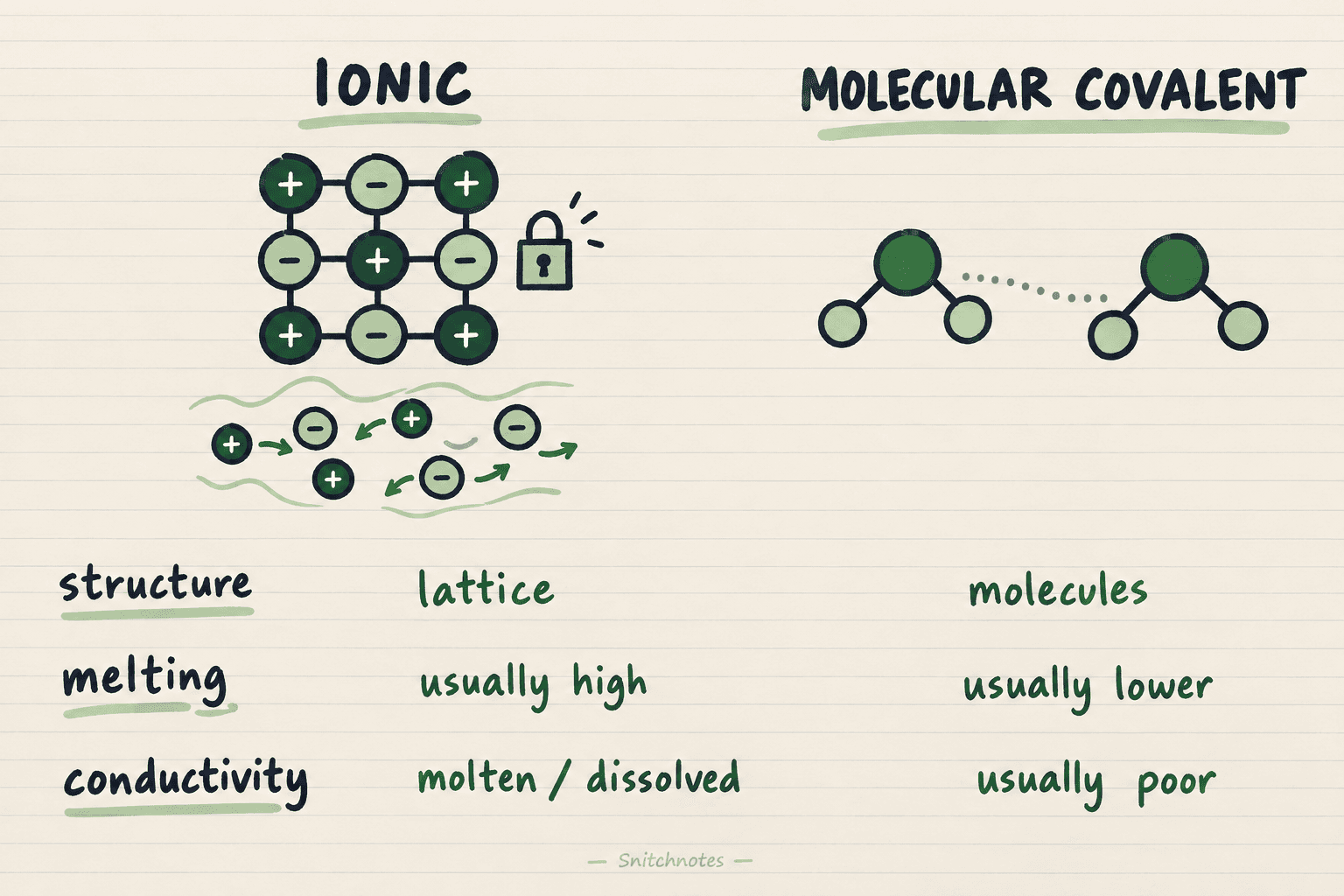
- Particles: ionic compounds contain cations and anions in an extended lattice; molecular covalent substances contain neutral molecules.
- Melting behavior: ionic compounds usually have relatively high melting points because many ion–ion attractions must be overcome. Molecular substances often melt or boil at lower temperatures because separating molecules does not require breaking their internal covalent bonds.
- Conductivity: solid ionic compounds do not conduct because their ions are fixed. Many conduct when molten or dissolved because ions can move. Most molecular covalent substances lack mobile charged particles and conduct poorly.
- Room-temperature state: ionic compounds are commonly crystalline solids. Molecular covalent substances may be solids, liquids, or gases because intermolecular forces vary widely.
Solubility is not a safe one-line test. Many ionic compounds dissolve in water, but not all do; covalent substances range from water-soluble sugar to water-insoluble oils. Solubility depends on the balance of attractions among solute particles and solvent molecules.
Six compounds, classified step by step
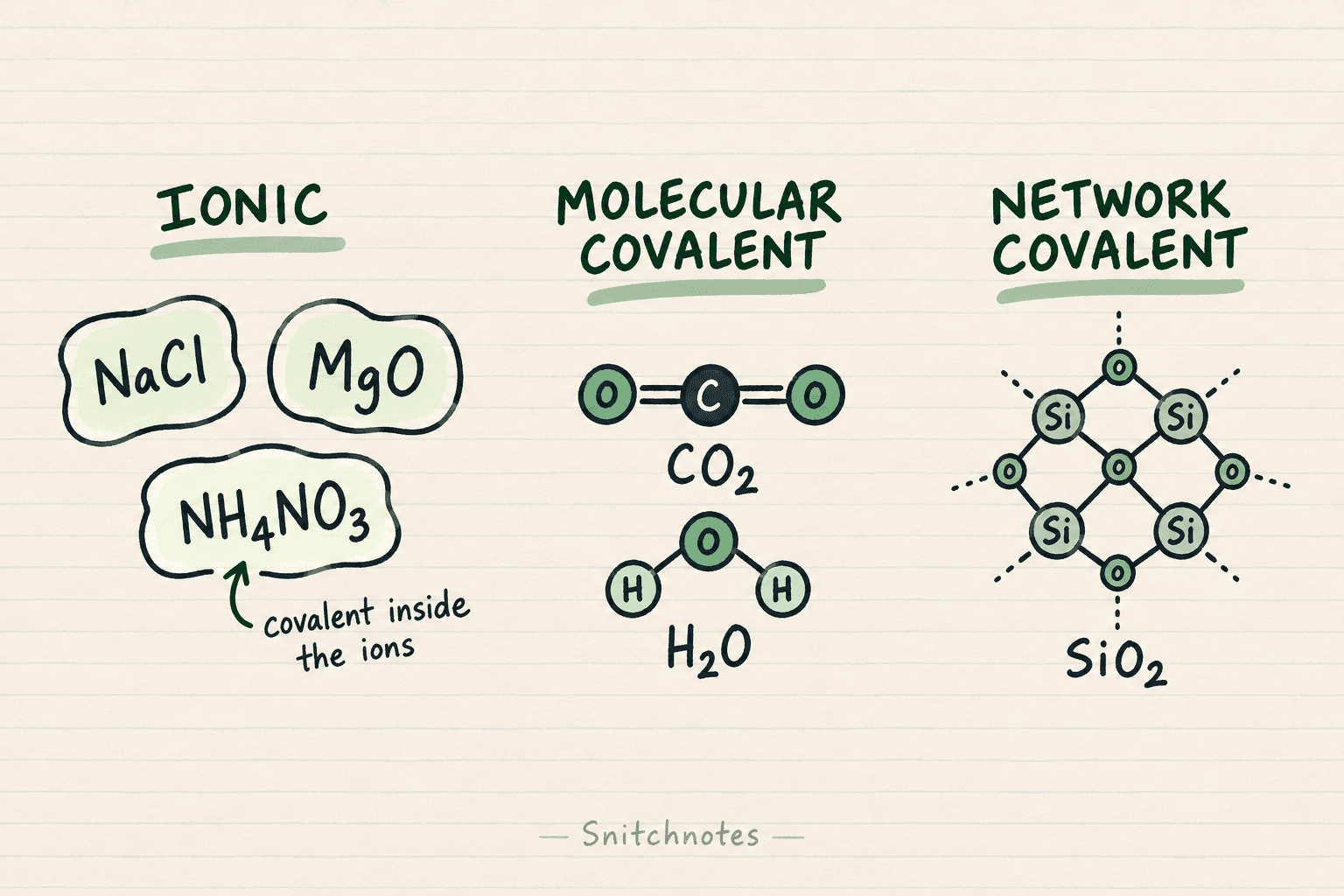
Imagine six formula cards on a lab bench. Your constraint is simple: classify each one, then justify the answer using particles rather than pattern-matching alone.
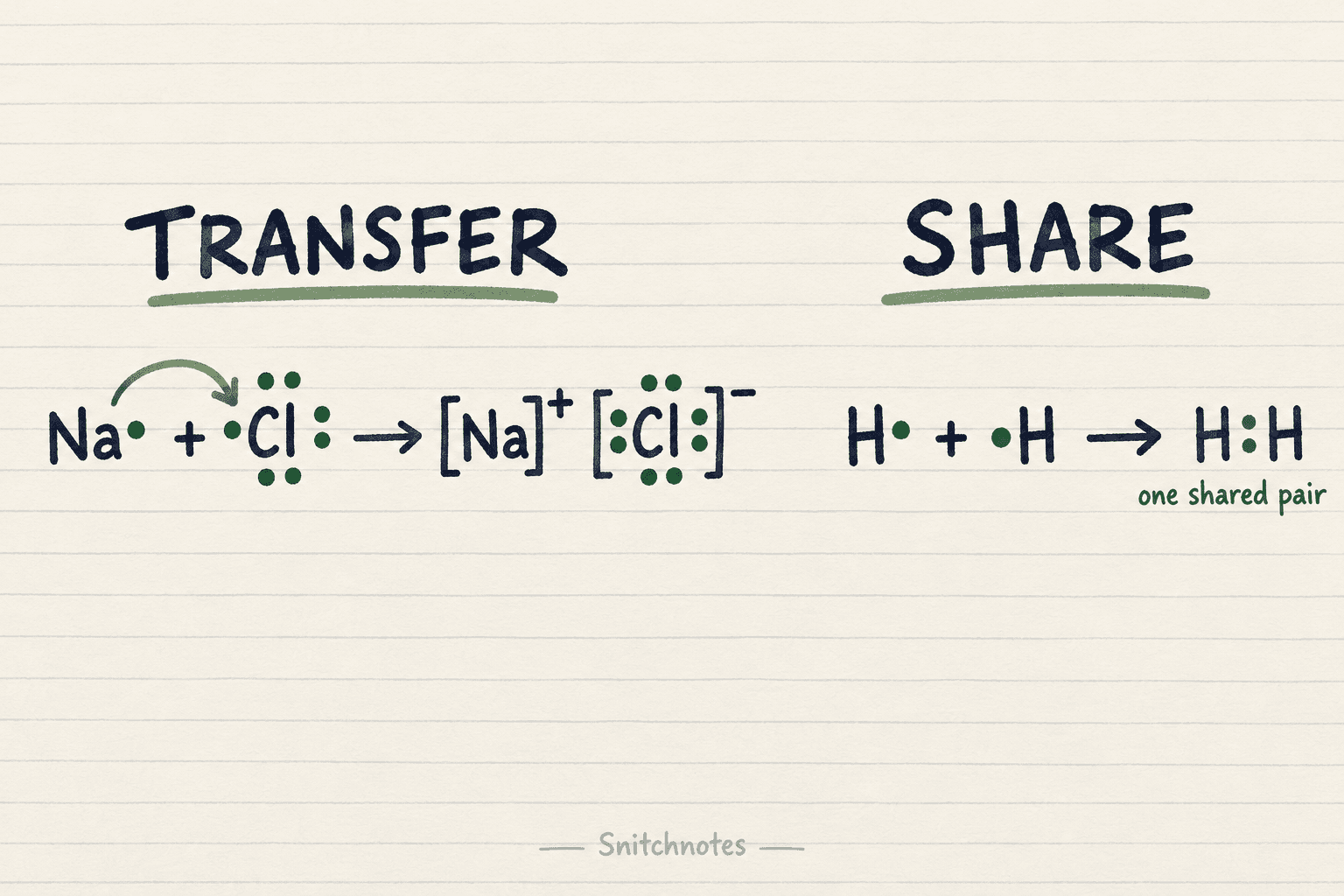
- NaCl: sodium forms Na+ and chlorine forms Cl−, so this is an ionic lattice.
- MgO: magnesium forms Mg2+ and oxygen forms O2−, so this is also ionic. The formula shows a 1:1 ion ratio.
- CO2: carbon and oxygen are nonmetals that share electrons in discrete molecules, so this is molecular covalent.
- H2O: oxygen shares electron pairs with two hydrogen atoms, producing polar covalent bonds in a molecule.
- SiO2: silicon and oxygen form an extended covalent network in quartz. It is covalent, but it is not made of little SiO2 molecules.
- NH4NO3: ammonium nitrate is ionic overall because NH4+ and NO3− form an ionic solid. Inside each polyatomic ion, the atoms are joined covalently.
The last two cards are the useful troublemakers. They show why “ionic compound” and “covalent compound” describe particle organization, not a claim that only one kind of attraction exists anywhere in the material.
The boundary: useful rules, not absolute laws
First, electron transfer versus sharing is a simplified contrast. The International Union of Pure and Applied Chemistry notes that it is preferable to consider the contribution of ionic and covalent character rather than treat every bond as perfectly one or the other. Electronegativity difference is evidence, not a universal cutoff switch.
Second, “covalent means low melting point” applies mainly to molecular substances. Diamond and silicon dioxide are network covalent solids with strong bonds extending throughout the structure. Third, conductivity depends on mobile charge carriers: an ionic solid has charges, but those charges cannot carry current until the ions can move.

A quick decision method
- Identify the particles: ions, separate molecules, or an extended covalent network.
- Describe the electrons: largely transferred in an ionic model or shared between nuclei in a covalent model.
- Predict a property from structure, such as melting behavior or conductivity, and name any condition required.
For example: “NaCl is ionic because it consists of Na+ and Cl− in a lattice. It does not conduct as a solid because the ions are fixed, but it conducts when molten or dissolved because the ions can move.” That explanation earns more trust than a bare label.
Check your understanding
Why does solid sodium chloride fail to conduct electricity?
It contains charged ions, but they are locked into lattice positions. Charge must be able to move through a material for an electric current to flow.
Does a low melting point prove that a substance is covalent?
No. A low melting point can support a molecular interpretation, but classification should use composition and particle structure too. Network covalent substances show why the shortcut has limits.
Can one compound contain ionic and covalent bonding?
Yes. Ammonium nitrate contains covalent bonds within NH4+ and NO3−, while electrostatic attraction between those polyatomic ions makes the solid ionic overall.
If bonding diagrams in your lecture notes keep blurring together, Snitchnotes can turn the material into clearer notes, flashcards, quizzes, and audio for practice.
Related concepts
- Electronegativity: an atom’s tendency to attract shared electron density in a bond.
- Lattice energy: an energy measure associated with separating an ionic solid into gaseous ions.
- Intermolecular forces: attractions between molecules that strongly affect boiling and melting behavior.
- Dimensional analysis in chemistry: a step-by-step method for keeping units and conversion factors under control.
- How to study chemistry mechanism questions by following electron movement and constraints.
Sources
Purdue University Department of Chemistry: The Covalent Bond
University of Washington Department of Chemistry: Conductivity of Ionic Solutions
OpenStax Chemistry 2e: Ionic and Molecular Compounds
Chemistry LibreTexts: Contrasting Ionic Compounds and Covalent Compounds
Turn your lectures into exam-ready materials.
Notes, quizzes, podcasts, flashcards, and chat — from one upload.
Try your first note free