
Snitchnotes Team
How to Study Database Normalization With Functional Dependency Diagrams
How to Study Database Normalization With Functional Dependency Diagrams
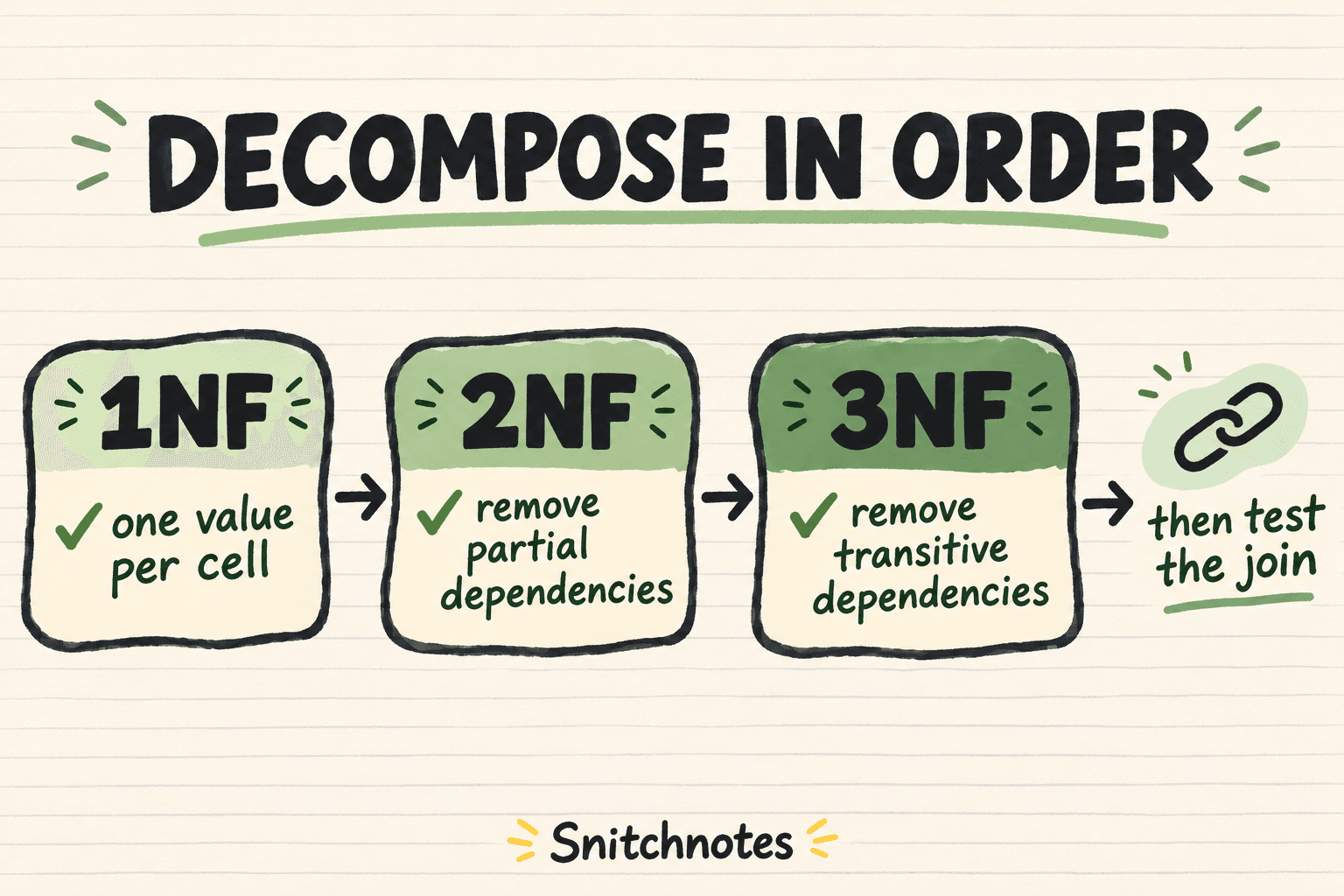
The best way to study database normalization is to stop memorizing 1NF, 2NF, and 3NF as three slogans. Start with one table, underline its candidate key, and draw an arrow X → Y whenever X determines exactly one value of Y. Then decompose the table by following those arrows: atomic values for first normal form, no partial dependencies for second normal form, and no transitive dependencies for third normal form.
This method turns normalization into a repeatable diagnosis. Instead of asking, “Which normal form does this look like?”, you ask, “What determines this attribute?” That question exposes duplicated facts, update problems, and the reason each new table needs to exist.
Why functional dependencies make normalization easier
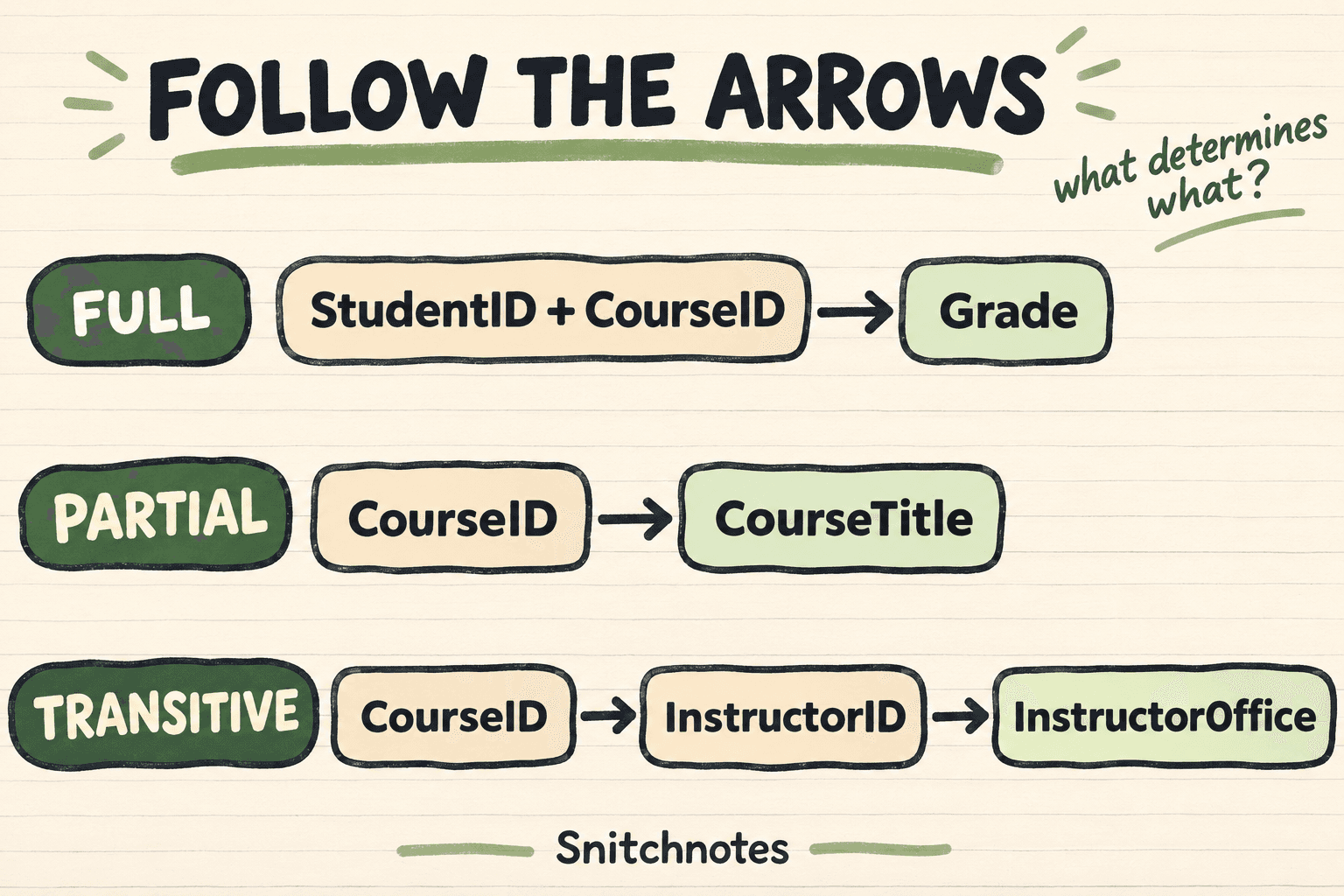
A functional dependency X → Y means that each value of X is associated with one value of Y in the rules of the data. StudentID → StudentName says a student ID identifies one student name. CourseID → CourseTitle says a course ID identifies one course title. The arrow describes a constraint, not merely a pattern that happens to appear in today’s six rows.
Normalization organizes those facts so each one has a sensible home. Microsoft describes the goal as reducing redundancy and inconsistent dependencies; Oracle’s documentation similarly links the normal forms to flexibility and less duplicated data. The practical benefit is that changing an instructor’s office should require one update, not a search through every student’s enrollment record.
Draw the functional dependencies before naming the normal form
Suppose an Enrollment sheet has six rows: Maya, Leo, and Ana each take two of three courses—C10 Databases, C20 Networks, and C30 Artificial Intelligence. Each row also stores StudentName, StudentPhone, CourseTitle, InstructorID, InstructorName, InstructorOffice, and Grade. A student can take many courses, so the row is uniquely identified by the composite key StudentID plus CourseID.
Now draw the important arrows. StudentID → StudentName. CourseID → CourseTitle and CourseID → InstructorID. InstructorID → InstructorName and InstructorOffice. The pair StudentID + CourseID → Grade because neither ID alone tells you the student’s grade in that course. That last arrow is a full dependency; the CourseID arrows are partial dependencies on part of the composite key; and CourseID → InstructorID → InstructorOffice forms a transitive chain.
Worked example: decompose the six-row enrollment table
First normal form: one value per cell
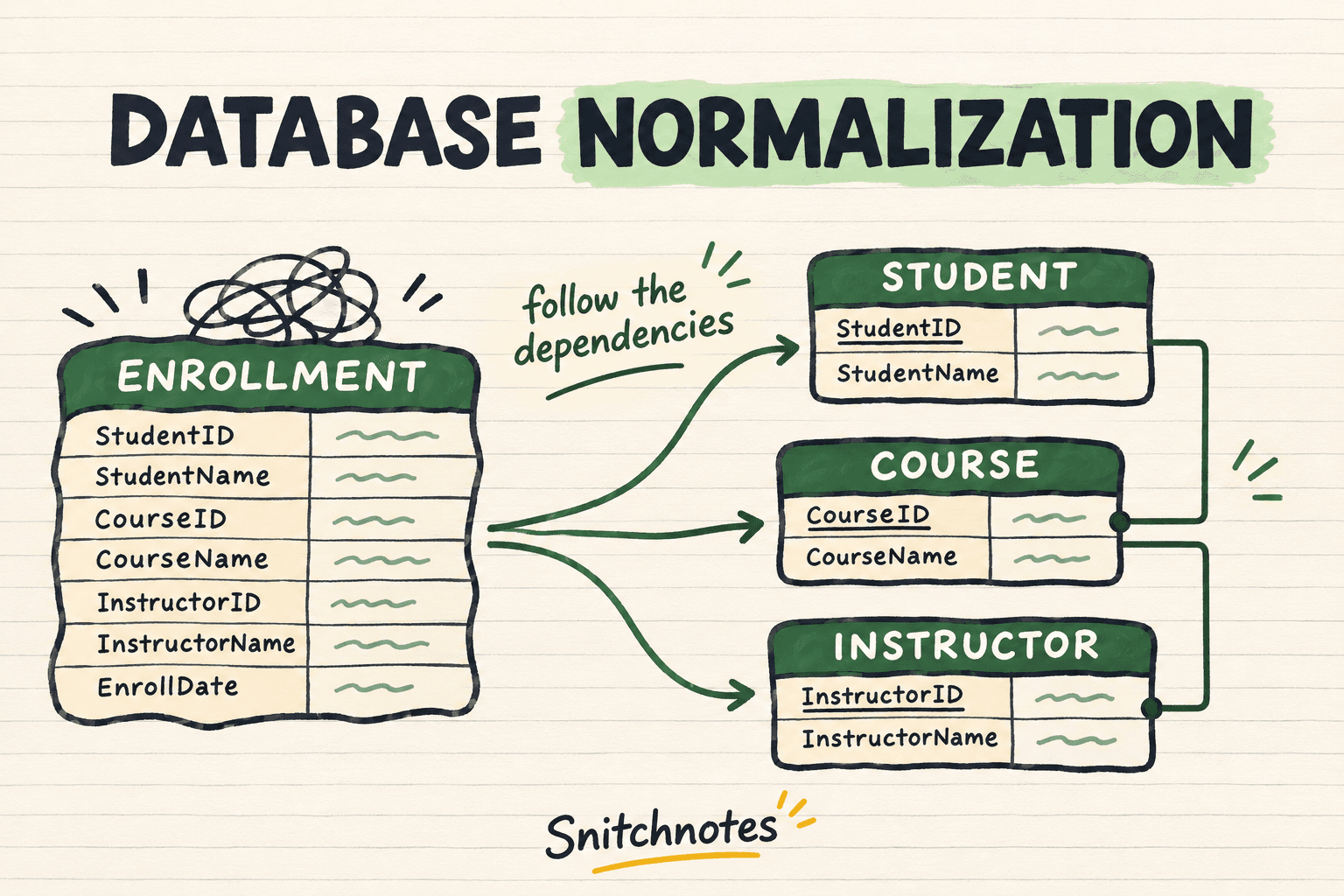
Imagine Maya’s StudentPhone cell contains “555-0141, 555-0198.” That repeating group is not atomic for this design. Move phone numbers to StudentPhone(StudentID, Phone), with one phone number per row. Keep Student(StudentID, StudentName) for student facts. First normal form fixes the shape of values; it does not yet remove every duplicate course or instructor fact.
Second normal form: remove partial dependencies
CourseTitle depends only on CourseID, not on the whole StudentID-plus-CourseID key. If C10 appears for Maya and Leo, “Databases” is repeated. Move CourseID, CourseTitle, and InstructorID to Course. Leave Enrollment(StudentID, CourseID, Grade), because Grade needs both parts of the composite key. Second normal form matters most when a candidate key is composite: a non-key attribute must depend on the whole key, not just one component.
Third normal form: remove transitive dependencies
In the Course table, InstructorOffice is determined by InstructorID rather than directly by CourseID. If Dr. Chen moves from N-108 to N-112, storing the office beside every course could create conflicting versions. Create Instructor(InstructorID, InstructorName, InstructorOffice), and keep only InstructorID as a foreign key in Course. The office fact now lives once, where InstructorID is the key.
The final design has Student, StudentPhone, Course, Instructor, and Enrollment tables. It may look like more work than one spreadsheet, but every table has a clear subject and every dependency points from a key to the facts stored with it.
Use the same decomposition checklist every time
- Mark candidate keys, including every component of a composite key.
- Write the functional dependencies as arrows before moving any columns.
- For 1NF, remove repeating groups and choose one value per cell.
- For 2NF, move facts determined by only part of a composite key.
- For 3NF, move facts determined by another non-key attribute.
- Join the new tables on their shared keys and confirm that you can reconstruct the original facts without inventing extra combinations.
The boundary: decomposition must not lose information
Splitting a table is not automatically normalization. A decomposition should be lossless: joining the new relations should recover exactly the information represented by the original relation. Kansas State University’s database-design text illustrates why arbitrary splits can lose the link between facts or create false combinations when tables are joined again.
Also remember that 3NF is a design rule, not a promise that every production database must contain the maximum possible number of tiny tables. Performance-driven denormalization can be deliberate, but it should happen after the dependencies and risks are understood. For an exam, state the assumptions—such as one instructor per course—because changing that business rule changes the dependencies and possibly the design.
Check your understanding
Why is CourseID → CourseTitle a partial dependency in Enrollment?
Enrollment uses StudentID plus CourseID as its composite key, but CourseTitle needs only CourseID. Because one component of the key determines the title, the dependency is partial and violates 2NF in that table.
Why does InstructorOffice belong in Instructor?
InstructorID determines the office. Storing the office in Course makes it transitively dependent on the course key through InstructorID and can duplicate the same office across several courses.
What should you test after decomposing?
Check that the new tables can be joined to reconstruct the original facts without missing rows or producing spurious combinations. That is the practical meaning of a lossless decomposition.
Related concepts
- Compiler vs interpreter: compare two core computing models with concrete execution examples.
- Recursion vs iteration: see how the same problem can be represented with different control structures.
- Public-key encryption explained: follow a precise technical relationship through a simple example.
Sources
Microsoft Learn: Database normalization description
Oracle PeopleTools: Normalized Relational Databases
Gordon College CPS352: Database Normalization lecture
Kansas State University CC 520 Textbook: Lossless Decomposition
University of Wisconsin–Madison CS 564: Decomposition and Schema Normalization
Convierte tus clases en material listo para el examen.
Apuntes, quizzes, podcasts, flashcards y chat — con solo subir un archivo.
Prueba tu primer apunte gratis