
Snitchnotes Team
Type I vs Type II Errors: Examples and Memory Trick
Type I vs Type II Errors: Examples and Memory Trick
A Type I error is a false positive: you reject a null hypothesis that is actually true. A Type II error is a false negative: you do not reject a null hypothesis that is actually false. In plain language, Type I says “there is an effect” when there is not; Type II misses an effect that really exists.
The difference matters because no sample can reveal the truth with perfect certainty. Researchers must balance the risk of raising a false alarm against the risk of overlooking something real. The consequences depend on context: an unnecessary follow-up and a missed dangerous condition are both errors, but they are not necessarily equally costly.
Type I vs Type II error at a glance
- Type I error: reject H₀ when H₀ is true. This is a false positive, and its long-run probability under the null is denoted by alpha, α.
- Type II error: do not reject H₀ when H₀ is false. This is a false negative, and its probability for a specified alternative is denoted by beta, β.
- Power: correctly reject H₀ when a specified alternative is true. Power equals 1 − β.
The wording “do not reject” is deliberate. A non-significant result does not prove that the null hypothesis is true; it means the study did not obtain enough evidence to reject it under the chosen rule. A small or noisy study may miss a real effect.
The truth-versus-decision matrix
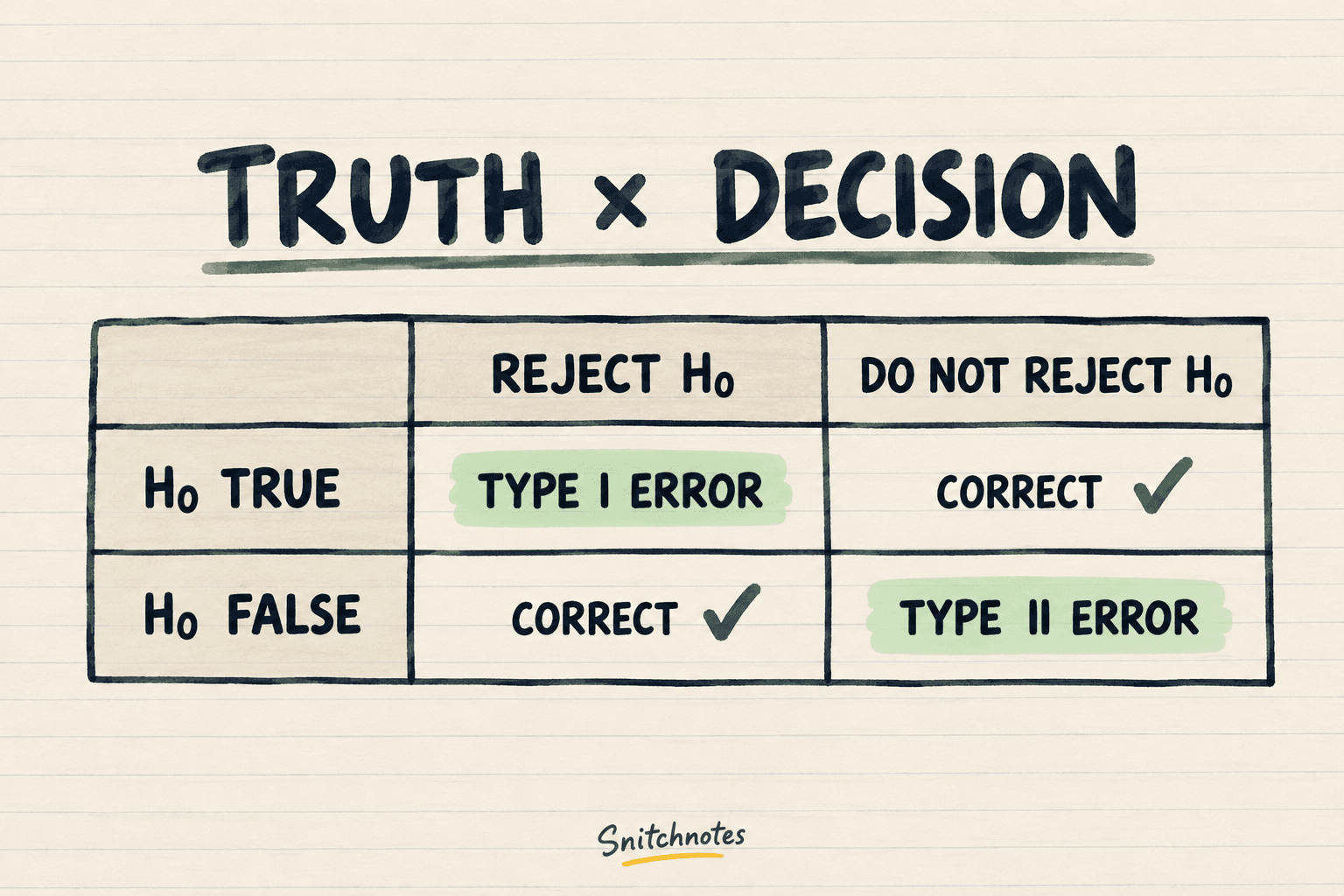
Every hypothesis test combines two possible realities with two possible decisions. If H₀ is true, rejecting it is the Type I error and not rejecting it is correct. If H₀ is false, rejecting it is correct and not rejecting it is the Type II error. The matrix works because it separates reality, which the researcher does not observe directly, from the decision made using sample evidence.
Suppose H₀ says a tutoring program produces no average improvement. A statistically significant result leads you to reject H₀. If the program truly has no effect, that decision is Type I error. If the program truly helps but the study does not reject H₀, that is Type II error.
Smoke-alarm memory trick
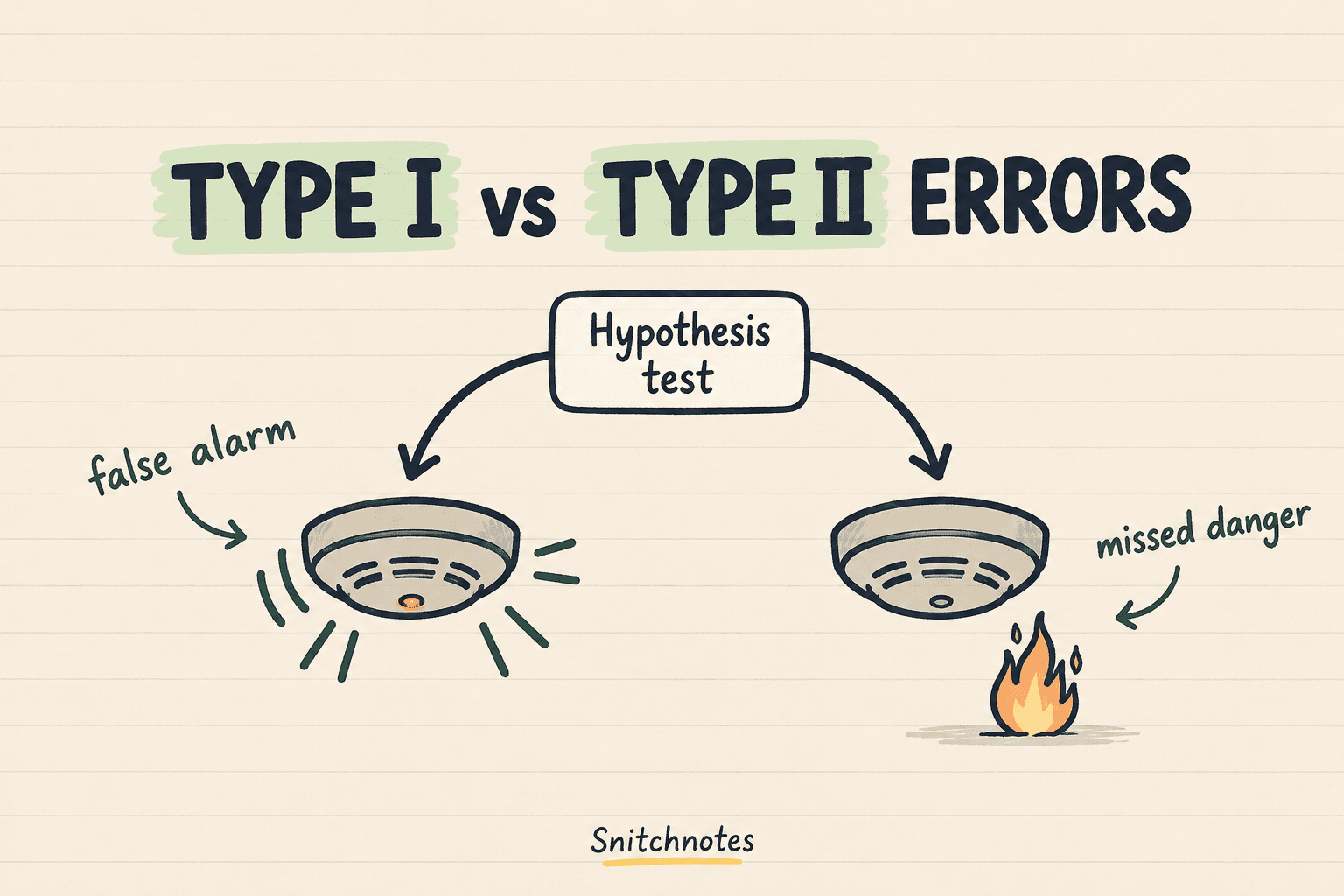
Imagine H₀ is “there is no fire.” A Type I error happens when the alarm sounds even though there is no fire: a false alarm. A Type II error happens when a fire exists but the alarm stays silent: missed danger. The analogy preserves the two key questions—what is actually true, and what decision did the system make?
For a compact verbal cue, remember: Type I invents an effect; Type II ignores an effect. “Invents” starts with I, while the second I reminds you that a real signal was ignored. The mnemonic is only a recall aid, so use the matrix when precision matters.
Medical-screening example: same test, two errors
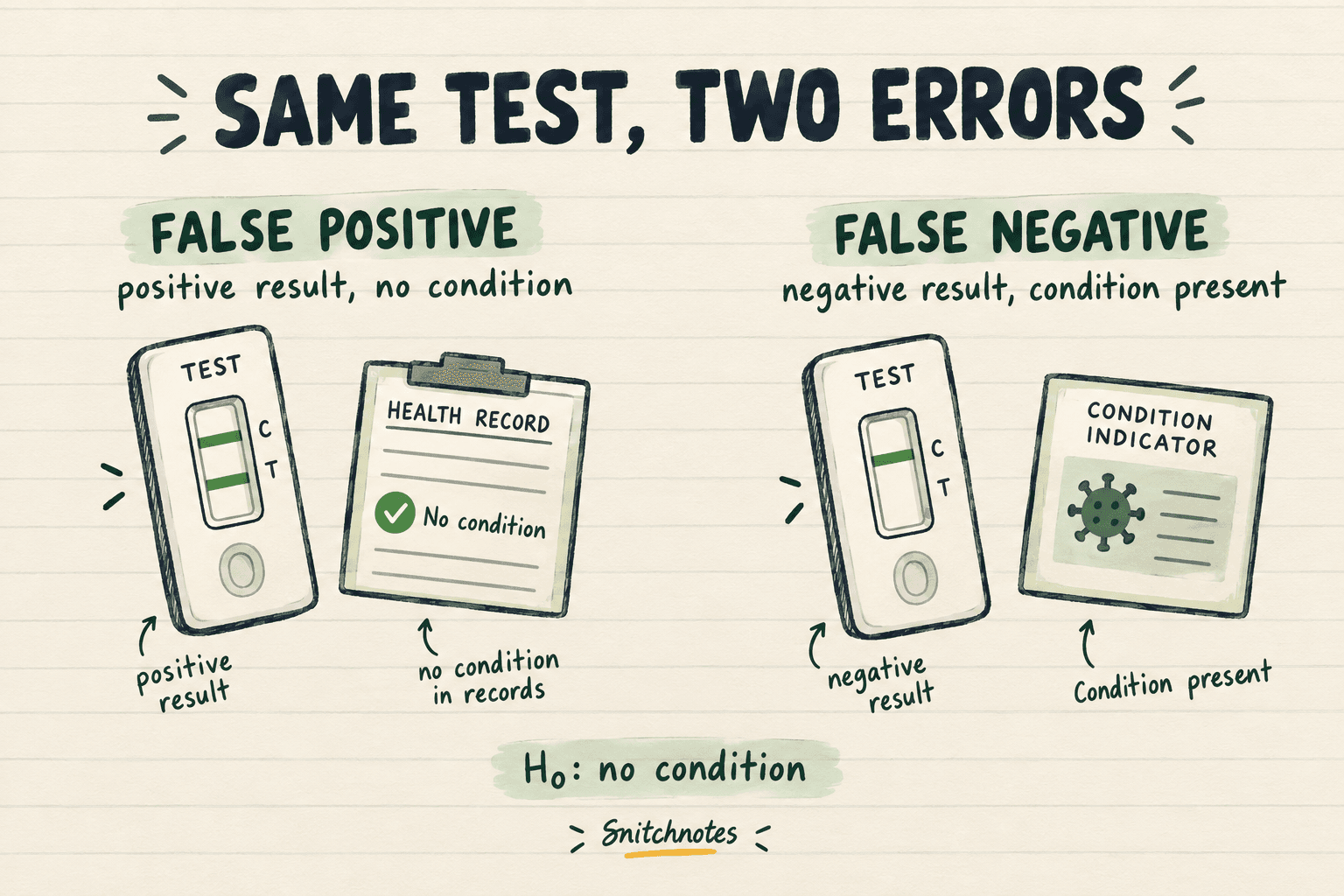
Now let H₀ be “the condition is absent.” A positive result when the condition is truly absent resembles Type I error: a false positive that may lead to worry or further testing. A negative result when the condition is truly present resembles Type II error: a false negative that may delay follow-up. Which error deserves more protection depends on the condition, treatment, confirmatory process, and harms of each outcome.
This mapping is useful but has a boundary. Sensitivity and specificity describe diagnostic classification, while alpha and beta belong to a specified statistical hypothesis test. They share the false-positive and false-negative logic, but a patient’s screening result is not automatically the same thing as a research hypothesis test.
How alpha, beta, and power connect
Researchers often set a significance level such as α = 0.05 before analyzing data. Under the null model and a correctly calibrated procedure, that rule limits the long-run Type I error rate to 5% across repeated studies. It does not mean there is a 5% probability that H₀ is true, nor that every significant finding has a 5% chance of being false.
Beta is not one universal number for a study. It depends on the particular alternative effect, sample size, variability, design, and decision threshold. Power, 1 − β, is the probability of detecting the specified effect when it is real. Larger samples often increase power because they estimate effects more precisely.
With sample size and other features fixed, making rejection easier can reduce Type II error but increase Type I error. Making rejection harder can protect against false positives while missing more real effects. Good design does not pretend the trade-off disappears; it chooses error controls that match the consequences and gathers enough information to improve power.
Common misconceptions
- A Type I error is not simply “a bad study.” It is a defined possible decision error even under a valid testing procedure.
- Failing to reject H₀ does not establish that H₀ is true. It may reflect weak evidence or low power.
- Alpha is not the probability that this particular conclusion is wrong. It is a long-run error rate under the null model and procedure.
- Type I is not always worse than Type II, or vice versa. The real costs determine which error needs tighter control.
Check your understanding
A trial concludes that a treatment works, but in reality it does not. Which error is this?
Type I error. If H₀ says the treatment has no effect, the trial rejected a true null hypothesis—a false positive.
A real effect exists, but the study reports insufficient evidence to reject H₀. Which error is this?
Type II error. The null hypothesis is false, but the study did not reject it—a false negative. Increasing power would reduce the chance of this error for the specified effect.
Related concepts
- Calculate a 95% confidence interval: worked example
- Mediator vs moderator variables: a student guide
- P-values and confidence intervals: related tools for expressing evidence and uncertainty, not shortcuts for proving a hypothesis true.
Sources
National Institute of Standards and Technology: What are statistical tests?
OpenStax Introductory Statistics 2e: Outcomes and the Type I and Type II Errors
University of California, Berkeley Statistics: Hypothesis Testing
Turn your lectures into exam-ready materials.
Notes, quizzes, podcasts, flashcards, and chat — from one upload.
Try your first note free