
Snitchnotes Team
How Do Whales Sleep Without Drowning?
How Do Whales Sleep Without Drowning?
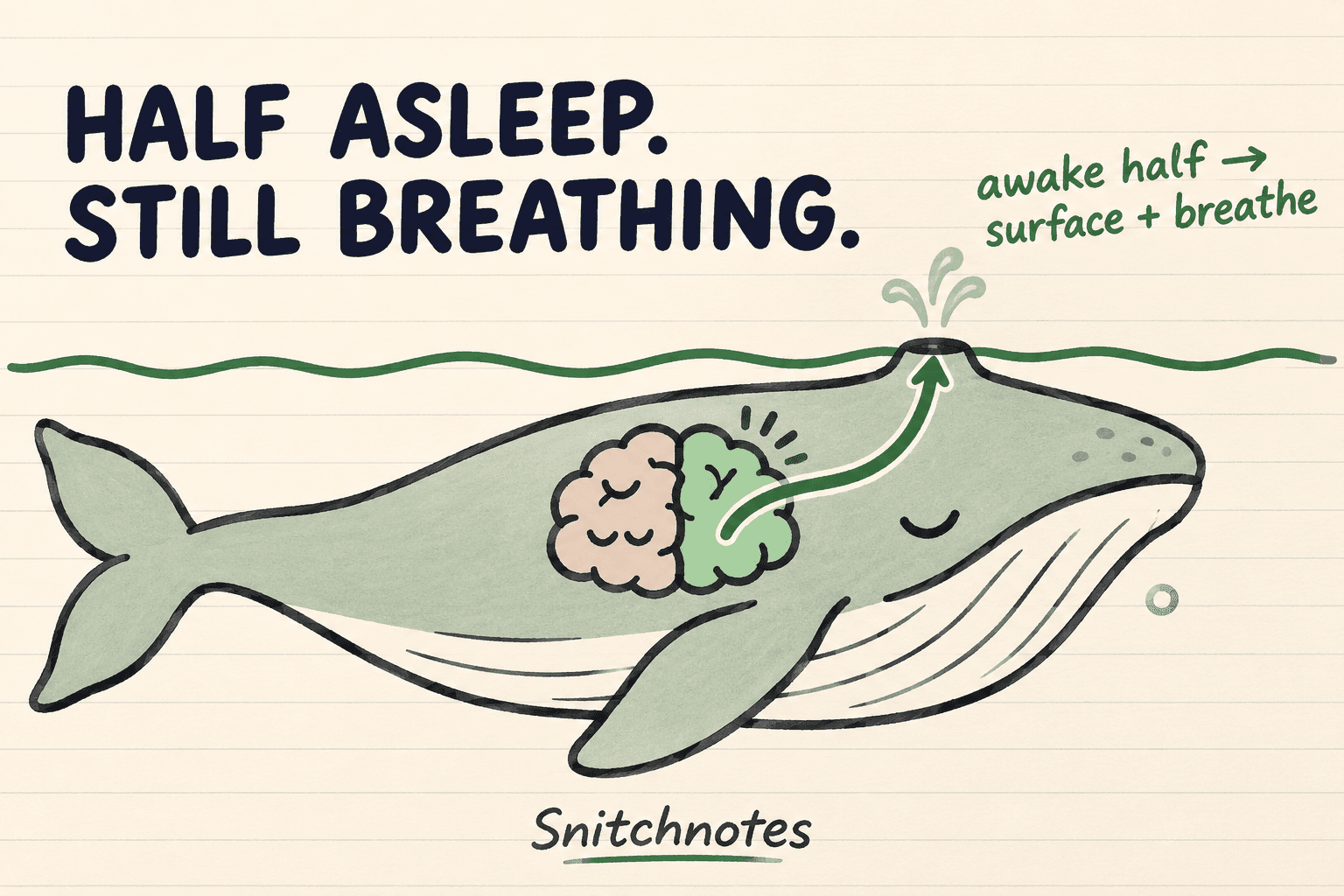
Whales sleep without drowning by avoiding the kind of full-brain shutdown humans experience. In the cetaceans scientists have measured, one brain hemisphere can enter slow-wave sleep while the other remains in a more wake-like state. This unihemispheric sleep helps the animal keep breathing, surface when needed, maintain some movement, and stay responsive to its surroundings. The two sides alternate, so both get rest.
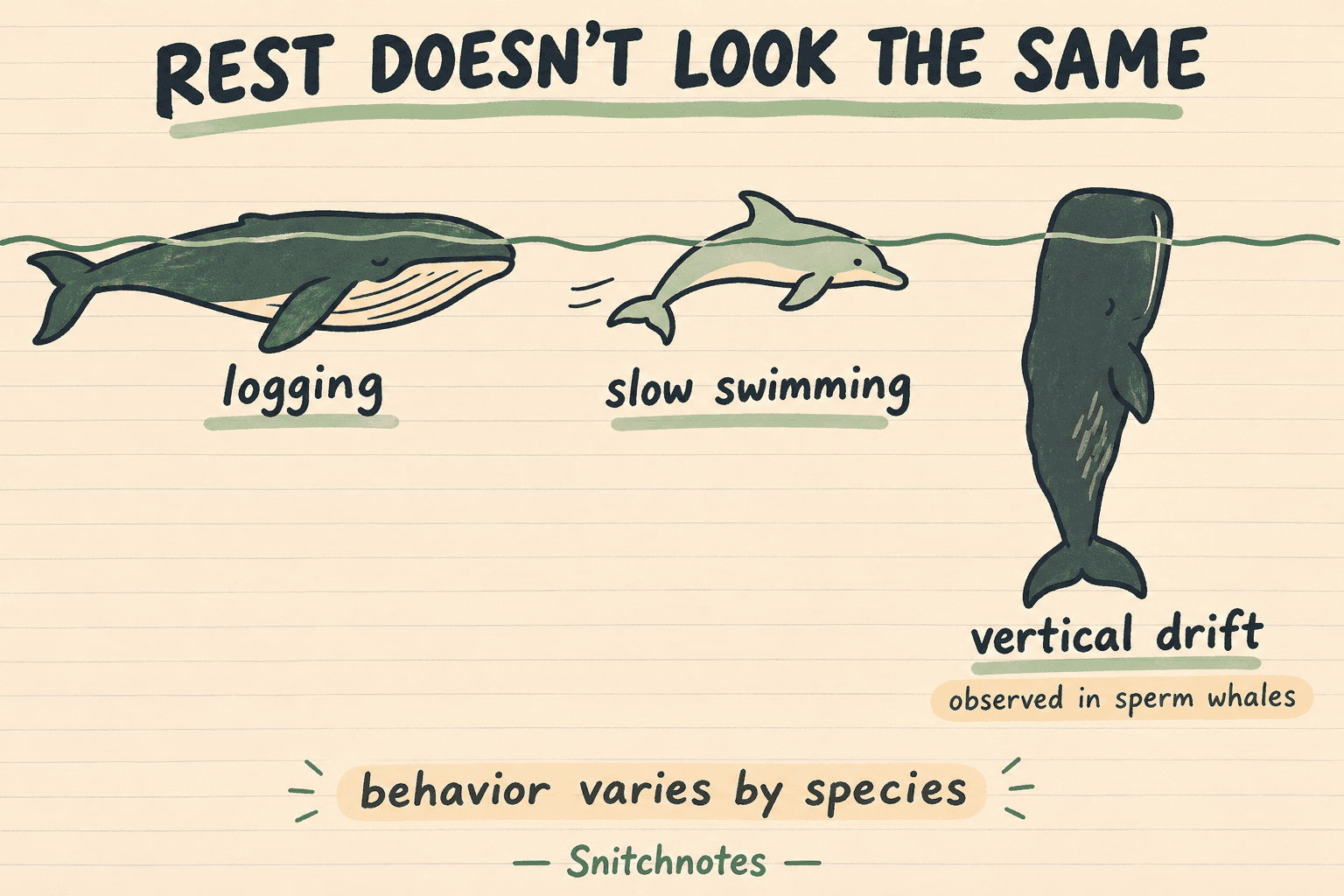
That is the short answer, but not every whale rests in the same posture. Dolphins may swim slowly or float near the surface, some large whales log quietly at the surface, and sperm whales have been observed drifting vertically below it. The mechanism and the visible behavior are related, but they are not interchangeable evidence.
Why ordinary sleep would be dangerous at sea
Whales and dolphins are mammals, so they must breathe air. Yet they spend almost their entire lives in water. A human can fall asleep without scheduling the next breath because breathing continues automatically. Cetaceans are often described as voluntary or conscious breathers: they actively coordinate a breath with reaching the surface and opening the blowhole.
A long period of deep, motionless, two-hemisphere sleep would create several problems at once. The animal could miss a breath, lose a useful swimming posture, fall behind its group, or become less alert to danger. Water also carries heat away much faster than air, so some motion can help an aquatic mammal manage its body temperature. Sleep had to fit ocean life rather than pause it.
How unihemispheric sleep works
Electroencephalogram recordings reveal the unusual solution. During unihemispheric slow-wave sleep, one cerebral hemisphere produces the slow electrical waves associated with sleep, while the other shows lower-voltage, wake-like activity. A major review reports that every cetacean studied this way showed the pattern, including bottlenose dolphins, harbor porpoises, Amazon river dolphins, a beluga, and a pilot whale.
In the studied animals, unihemispheric sleep accounted for roughly 70–90 percent of total sleep time. The sleeping side usually alternates across bouts rather than remaining off duty forever. Researchers have also linked brain asymmetry with eye state: an eye may remain open while the opposite hemisphere is more alert. “Sleeping with one eye open” is therefore a useful shorthand, although the biological pattern is more nuanced than a perfect left-right switch.
Nara’s ten-minute rest cycle
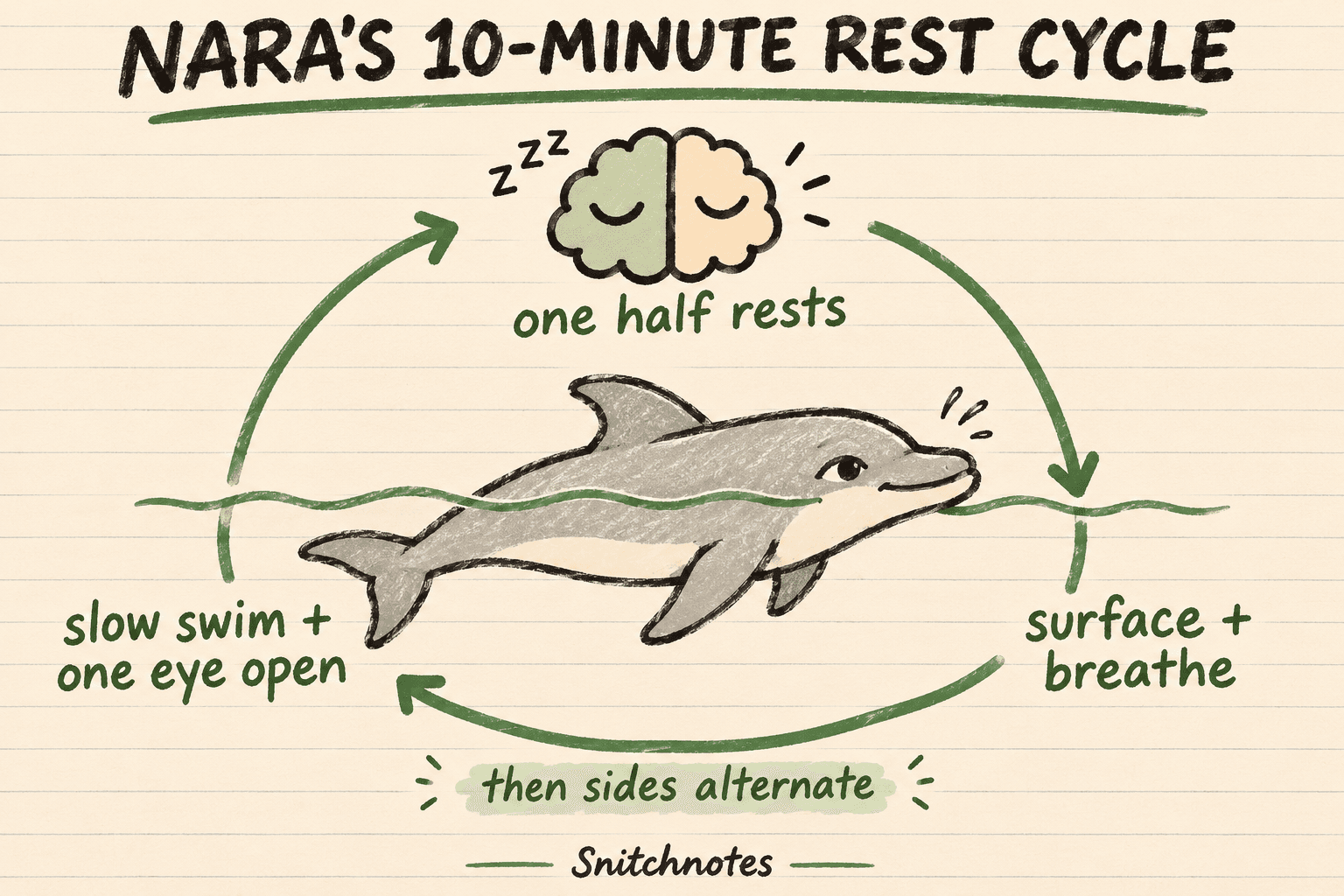
Imagine Nara, a bottlenose dolphin, beginning a ten-minute rest period. Ten minutes is an illustrative window, not a standard dolphin nap length. One hemisphere starts showing slow-wave sleep while the other stays sufficiently alert for coordinated swimming and breathing. Nara moves in a slow, familiar path, with one eye open for part of the cycle.
As she approaches the surface, the wake-like side helps coordinate the movement and breath. She exhales, inhales through her blowhole, then continues her gentle swim. In a later bout, the balance can reverse so the other hemisphere receives slow-wave sleep. Nara is not half a dolphin doing all the work; she is one integrated animal using an asymmetric brain state to combine rest with essential behavior.
How breathing and surfacing prevent drowning
The awake-like hemisphere does not act as a tiny alarm clock that simply shouts “breathe.” It participates in a wider system that preserves enough awareness and motor control for the animal to maintain posture, swim or stabilize itself, reach the surface, and time the opening of the blowhole. Underwater, the respiratory passage remains closed; breathing happens at the surface.
This is why whale sleep can look surprisingly active. In controlled studies, sleeping dolphins and porpoises continued slow circular swimming, while a beluga repeatedly submerged and surfaced in place. Some dolphins also floated at the surface while making small flipper and tail movements to stay stable. Rest and movement are not opposites when the sleeper lives in water.
Rest does not look the same across cetaceans
Logging is the name for lying quietly at the surface, a posture seen in several whale species. Other cetaceans rest while swimming slowly, sometimes in coordinated groups. The visible posture depends on species, setting, age, social behavior, and whether researchers are observing an animal in the wild or recording its brain activity in managed care.
Sperm whales add a striking example. Researchers using suction-cup tags documented passive, shallow drift-dives in which the whales held a nearly vertical posture beneath the surface. A group was unusually unresponsive to a nearby vessel, supporting the idea that these dives can be sleep. Still, a resting posture alone does not reveal exactly what both brain hemispheres are doing.
The important boundary: we know more about dolphins than every whale
It is tempting to turn a good explanation into an absolute rule: all whales sleep with exactly half their brain off, one eye open, and the same surfacing rhythm. The evidence is narrower. Direct brain recordings come from only a handful of cetacean species and are strongest for toothed whales such as dolphins, porpoises, belugas, and pilot whales. Large baleen whales are much harder to study this way.
Scientists therefore combine EEG studies, eye-state observations, movement tags, breathing patterns, and field behavior. Together, they make a strong case that unihemispheric sleep is a central cetacean adaptation. They do not prove that every species, age, and situation follows one identical script. The safest conclusion is both impressive and precise: whales rest without surrendering all the awareness needed for life at the surface of the sea.
Check your understanding
Why does one brain hemisphere stay wake-like?
It helps preserve the awareness and motor coordination needed to breathe at the surface, maintain movement or posture, and respond to the environment while the other hemisphere rests.
Do all sleeping whales float motionless?
No. Cetaceans may log at the surface, swim slowly, repeatedly surface in place, or use other species-specific patterns. Sperm whales have also been observed in vertical drift-dives.
Does seeing a still whale prove that it is asleep?
Not by itself. Behavior suggests rest, but EEG recordings are needed to identify the brain state directly. That is why researchers distinguish observed posture from confirmed unihemispheric slow-wave sleep.
If a biology lecture leaves you juggling unfamiliar terms and mechanisms, Snitchnotes can turn your slides, PDFs, and notes into clearer study notes, flashcards, quizzes, and audio for review.
Related concepts
- Slow-wave sleep: a sleep state identified by synchronized, low-frequency electrical activity in the brain.
- Cetaceans: the mammal group that includes whales, dolphins, and porpoises.
- How ants find the shortest path to food: another biological system where simple local behavior produces an effective solution.
- Why humans get goosebumps: how an inherited biological mechanism can outlast its original advantage.
Sources
National Center for Biotechnology Information: Sleep in Aquatic Mammals
NOAA Fisheries: Question of the Week — Dolphins and Whales on the High Seas
NOAA Stellwagen Bank National Marine Sanctuary: Whale Behaviors
Current Biology: Stereotypical Resting Behavior of the Sperm Whale
Mach aus deinen Vorlesungen prüfungsfertiges Lernmaterial.
Notizen, Quizze, Podcasts, Karteikarten und Chat — aus einem Upload.
Erste Notiz kostenlos testen