
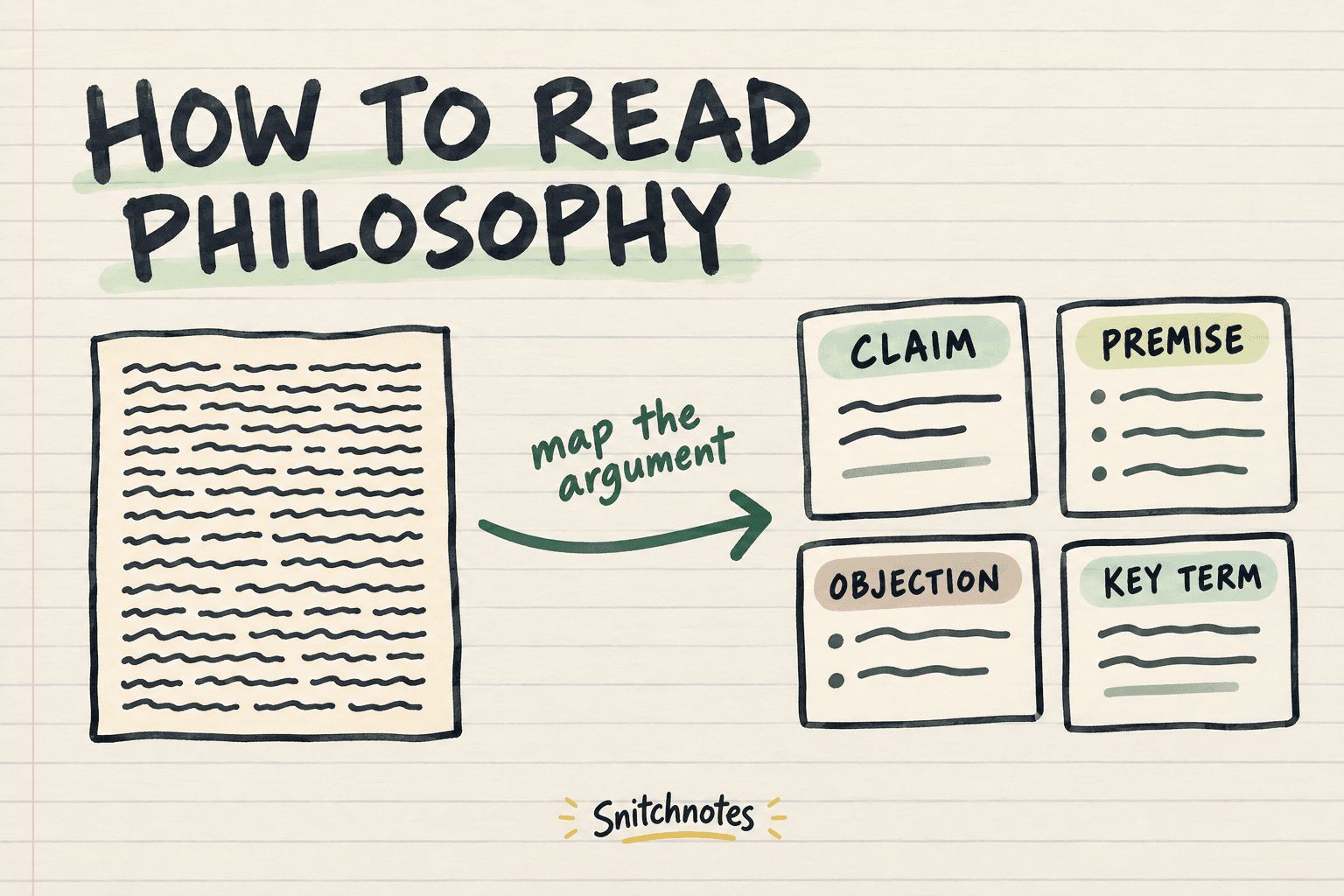
Snitchnotes Team
How to Read Dense Philosophy Texts Without Getting Lost
How to Read Dense Philosophy Texts Without Getting Lost
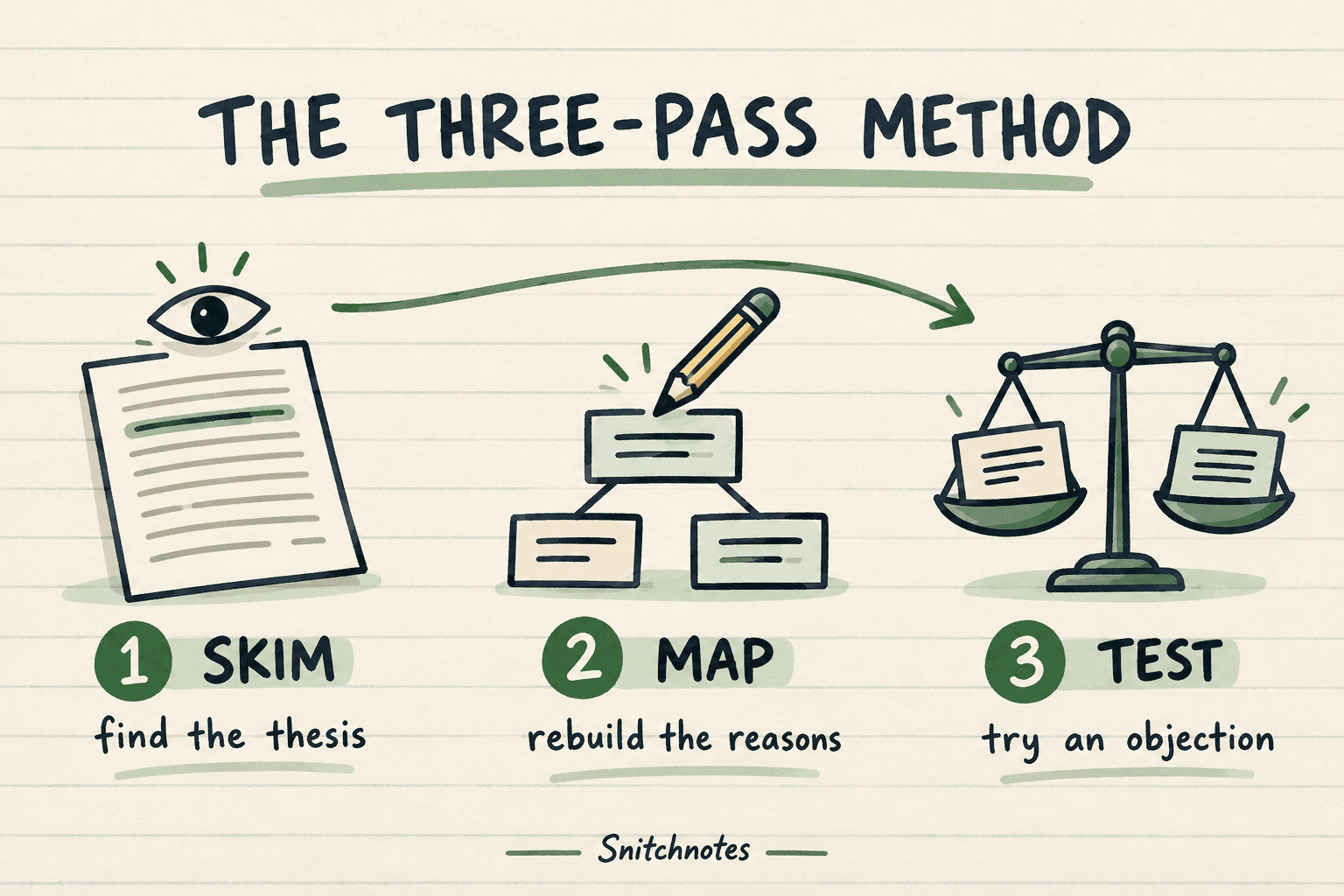
To read dense philosophy texts, do not try to absorb every sentence at the same speed. Read three times with three different jobs: find the main claim, reconstruct the reasons supporting it, and test the argument with an objection. Mark conclusions, premises, objections, and unclear terms in the margin, then paraphrase the argument without looking.
This article is for students facing a difficult primary text for class, discussion, or an essay. The goal is not faster page-turning. It is to leave the reading with a defensible account of what the author argues, why the author thinks it follows, and where the argument might fail.
Why philosophy feels unusually dense
Philosophical prose often compresses several jobs into one paragraph. A sentence may define a term, answer an imagined critic, narrow an earlier claim, or supply a reason whose conclusion appeared pages earlier. The Stanford Encyclopedia of Philosophy describes an argument as a structure in which premises support a conclusion. If you read only for topic or plot, that support structure stays hidden.
Slow reading is therefore not a sign that you are bad at philosophy. The University of South Dakota advises planning more than one reading: first for the thesis and major points, next for detailed reconstruction, and then for evaluation. Each pass asks a smaller question, so a difficult page stops feeling like one enormous decoding task.
Use a three-pass reading method
Pass 1: Find the destination
Skim the title, opening, section headings, and final paragraph. Ask one question: what is the author trying to get me to accept? Write a provisional thesis in ordinary language. It can be wrong. Its purpose is to give your second pass something to confirm or correct.
Pass 2: Rebuild the route
Read closely and reduce each important paragraph to a job: claim, reason, definition, example, objection, reply, or qualification. Circle recurring technical terms and write a short working definition. The University of North Carolina Writing Center recommends defining important terms, explaining each premise, and organizing a reconstruction so a reader can move step by step from premises to conclusion.
Pass 3: Test the bridge
Only after you can state the argument fairly should you evaluate it. Ask whether a premise is false, whether the premises really support the conclusion, whether a key word changes meaning, or whether a counterexample breaks the rule. Hamilton College recommends noting objections while reading but engaging with the strongest version of the opposing view. Understanding comes before scoring points.
Mark the argument, not every sentence
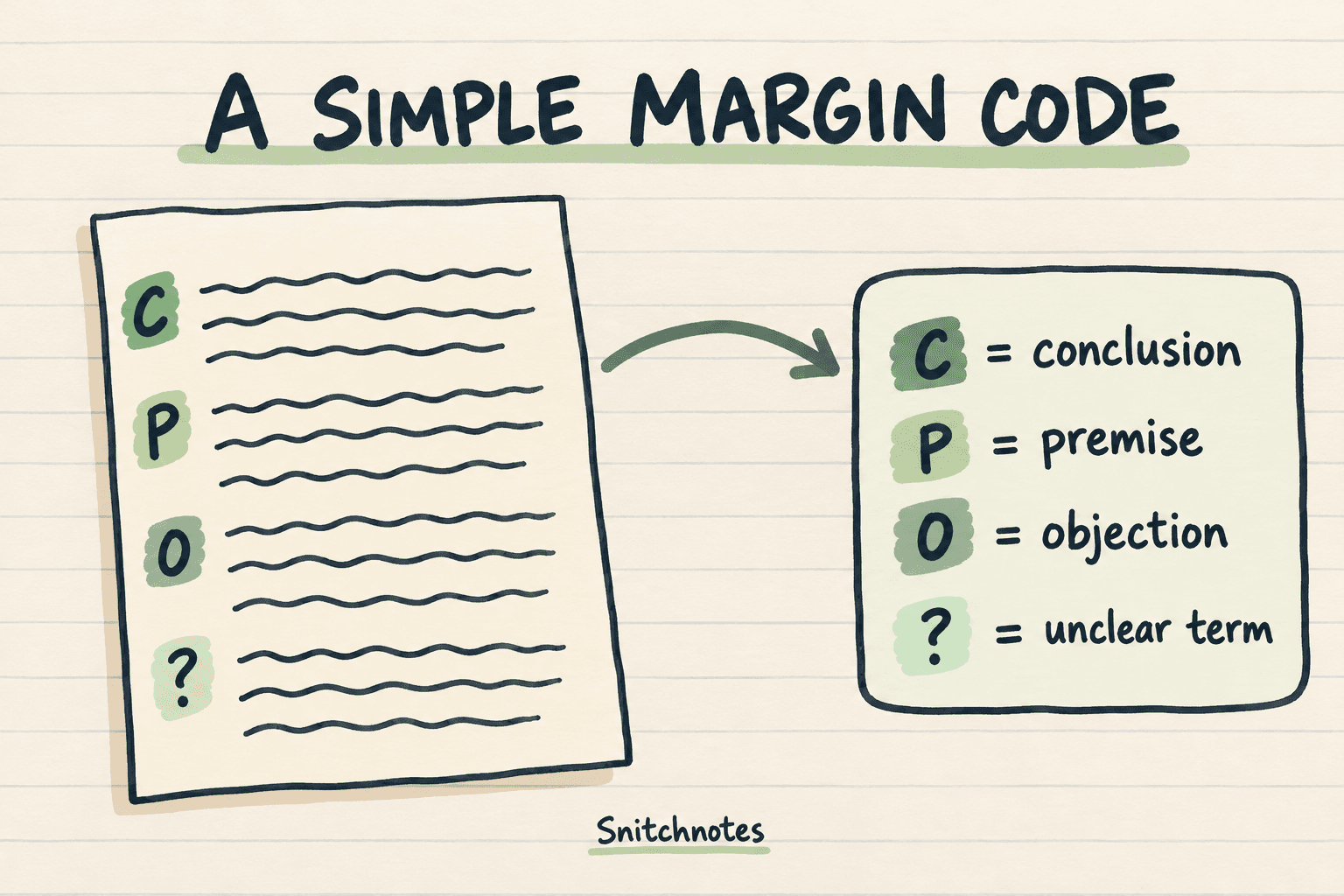
Use a tiny margin code: C for conclusion, P for premise, O for objection, and ? for an unclear term or inference. Add arrows only when one marked idea supports or answers another. This keeps annotation selective. If every line is highlighted, the page records attention but not structure.
Argument indicators such as because, therefore, since, however, and suppose can help, but they are clues rather than a mechanical answer key. A conclusion may be unstated, and a sentence beginning with because may explain a term rather than supply a premise. Always ask what logical job the sentence performs in this particular passage.
Worked example: do promises create obligations?
Read this fictional 120-word passage once before marking it:
When someone freely makes a promise, another person forms an expectation that it will be kept. Breaking it wastes that person’s plans and treats their reliance as unimportant. Therefore, freely made promises create obligations. This does not mean every promise must be kept: a promise made under threat is not free, and keeping a promise to cause harm gives us stronger reasons to refuse. Someone might object that expectations alone cannot create duties, because foolish expectations deserve no protection. Yet this expectation is not accidental; the speaker deliberately invites it by promising. The act of promising changes what the other person may demand, unless coercion, deception, or overriding harm defeats the obligation. That is why prediction differs from a promise.
Now reconstruct it without preserving the original order.
- Conclusion: freely made promises normally create obligations.
- Premise 1: promising deliberately creates another person’s expectation.
- Premise 2: breaking that invited expectation can disrupt plans and disregard reliance.
- Hidden assumption: deliberately inviting reasonable reliance gives the other person a claim on your action.
- Objection and reply: not every expectation creates a duty, but a promise is different because the speaker intentionally invites reliance.
A two-sentence paraphrase would be: Promises normally bind us because we intentionally invite another person to rely on what we say, and ignoring that reliance can damage their plans. The duty has limits when the promise is coerced, deceptive, or overridden by the need to prevent harm. If your paraphrase cannot show both the core argument and its boundary, reread the relevant lines rather than the whole page.
The main boundary: reconstruction is not agreement
You can reconstruct an argument accurately and still reject it. In fact, a fair reconstruction makes criticism sharper because you can identify the exact premise, inference, or definition you dispute. Wesleyan University describes philosophical reasoning as interpreting a concern, reconstructing the inferences between premises and conclusions, articulating an objection, and anticipating a reply. Those are separate moves, not one reaction.
Do not assume every difficult sentence hides a profound idea. Translations can be awkward, editions can use unfamiliar vocabulary, and an author can simply be unclear. After a focused attempt, check the introduction, glossary, lecture notes, or a reliable secondary source. Keep that explanation separate from the primary text so you know which ideas belong to the author and which belong to the commentator.
Check your understanding
What should you find on the first pass?
Find the provisional thesis and major stages of the discussion. Do not stop to solve every difficult sentence yet.
What makes an annotation useful?
It records a sentence’s role in the argument: conclusion, premise, objection, reply, qualification, or term. Color alone does not show that relationship.
When are you ready to criticize the author?
When you can state the conclusion, list the main supporting reasons, explain the key terms, and give the argument’s strongest plausible version without inserting your own view.
Related concepts
- Argument reconstruction: rewriting an author’s reasoning so each premise and inference is explicit.
- Principle of charity: interpreting an argument in its strongest reasonable form before evaluating it.
- How to review a marked essay before your next assignment
- Primary vs secondary sources: examples for students
Sources
University of North Carolina Writing Center: Philosophy
University of South Dakota: How to Read Philosophy
Stanford Encyclopedia of Philosophy: Argument and Argumentation
Mach aus deinen Vorlesungen prüfungsfertiges Lernmaterial.
Notizen, Quizze, Podcasts, Karteikarten und Chat — aus einem Upload.
Erste Notiz kostenlos testen