
Snitchnotes Team
What Is Stagflation and Why Is It Hard to Fix?
What Is Stagflation and Why Is It Hard to Fix?
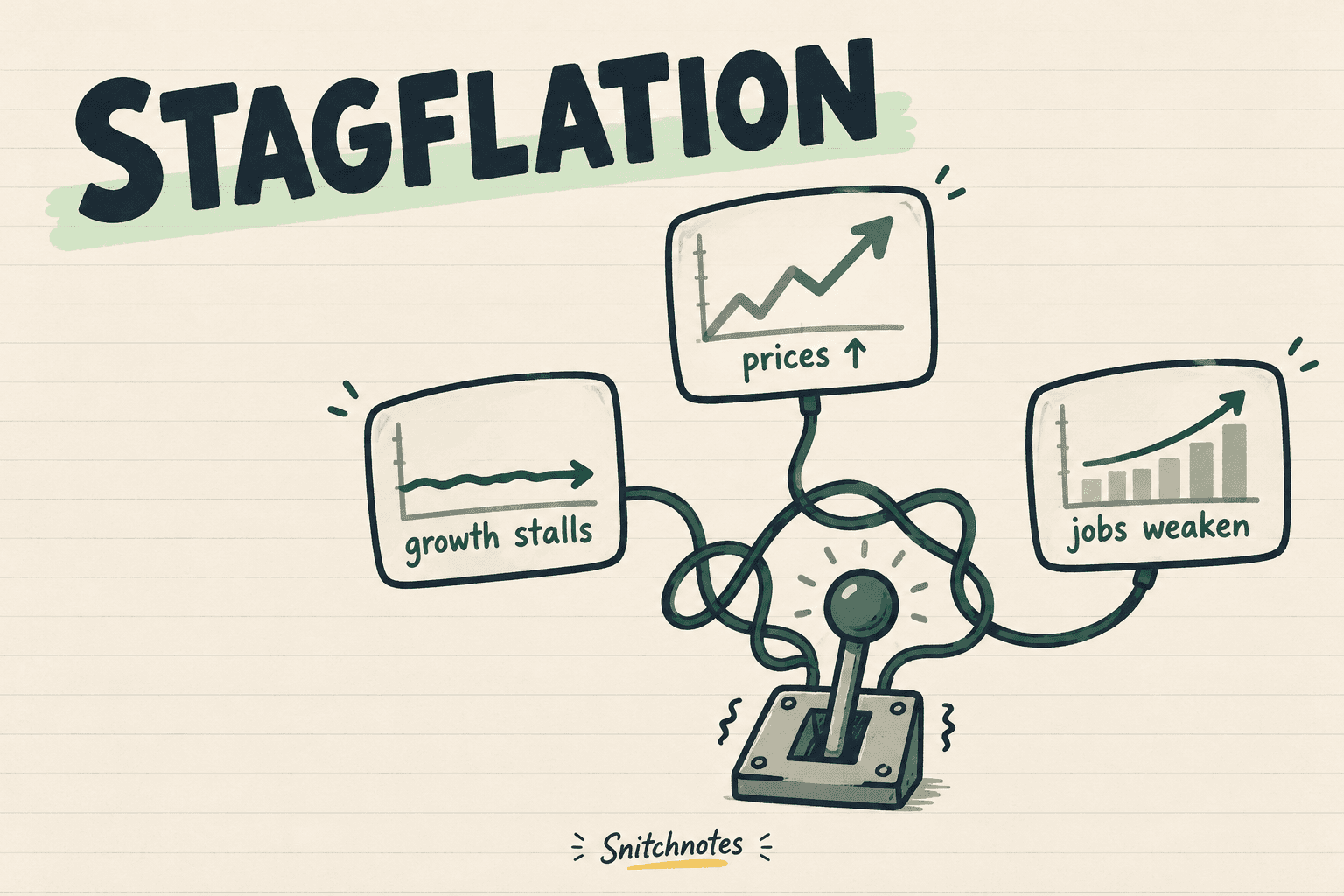
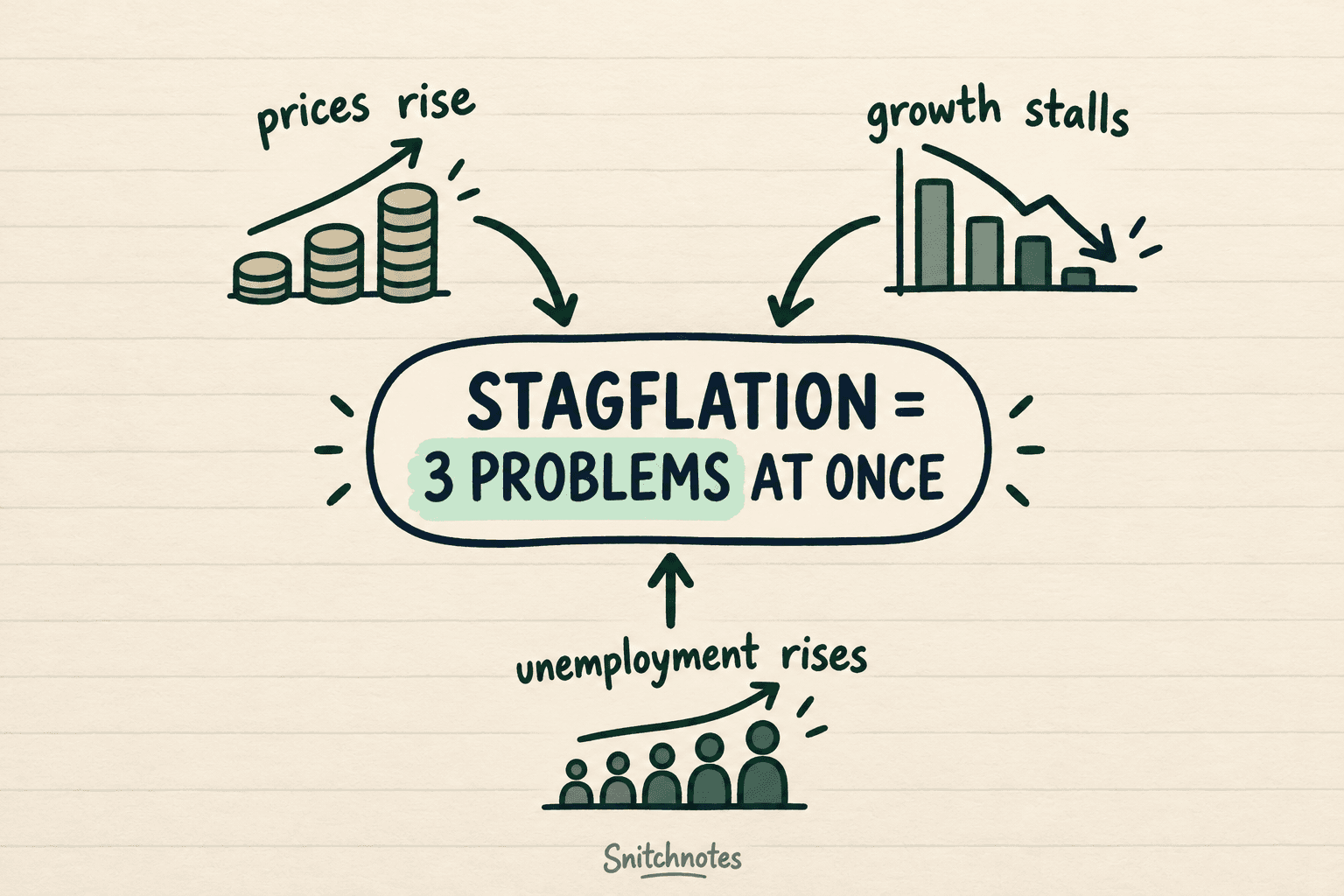
Stagflation is a period when inflation stays high while economic growth is weak and unemployment is high or rising. It is hard to fix because the standard remedies pull in opposite directions: policies that cool inflation can slow spending, output, and hiring, while policies that boost demand can make inflation worse.
That combination feels counterintuitive. In an ordinary slowdown, weak demand tends to reduce price pressure. Stagflation often involves a damaged supply side, entrenched inflation expectations, or both, so prices can rise even as the economy loses momentum.
What stagflation means
The word blends stagnation and inflation. Stagnation means little or no growth in real output; inflation means a sustained rise in the general price level. A weak labor market commonly completes the picture because slow or falling production gives employers less reason to hire.
There is no universal numerical threshold that switches a country into stagflation on one particular day. Economists look at the pattern across inflation, real gross domestic product, employment, and how long the combination lasts. One expensive month or one weak quarter is not automatically stagflation.
Why stagflation matters
Inflation erodes purchasing power, while weak growth limits income gains and job opportunities. Households can therefore face higher bills at exactly the moment bargaining power and financial security are deteriorating. Businesses face higher input costs but may be unable to pass all of them to customers whose budgets are already stretched.
The political problem is just as sharp. A government or central bank cannot promise painless action because each tool distributes costs differently across borrowers, savers, workers, firms, and taxpayers. Delay can also be costly if people start building persistent inflation into wage demands, contracts, and price decisions.
Why supply shocks can create stagflation
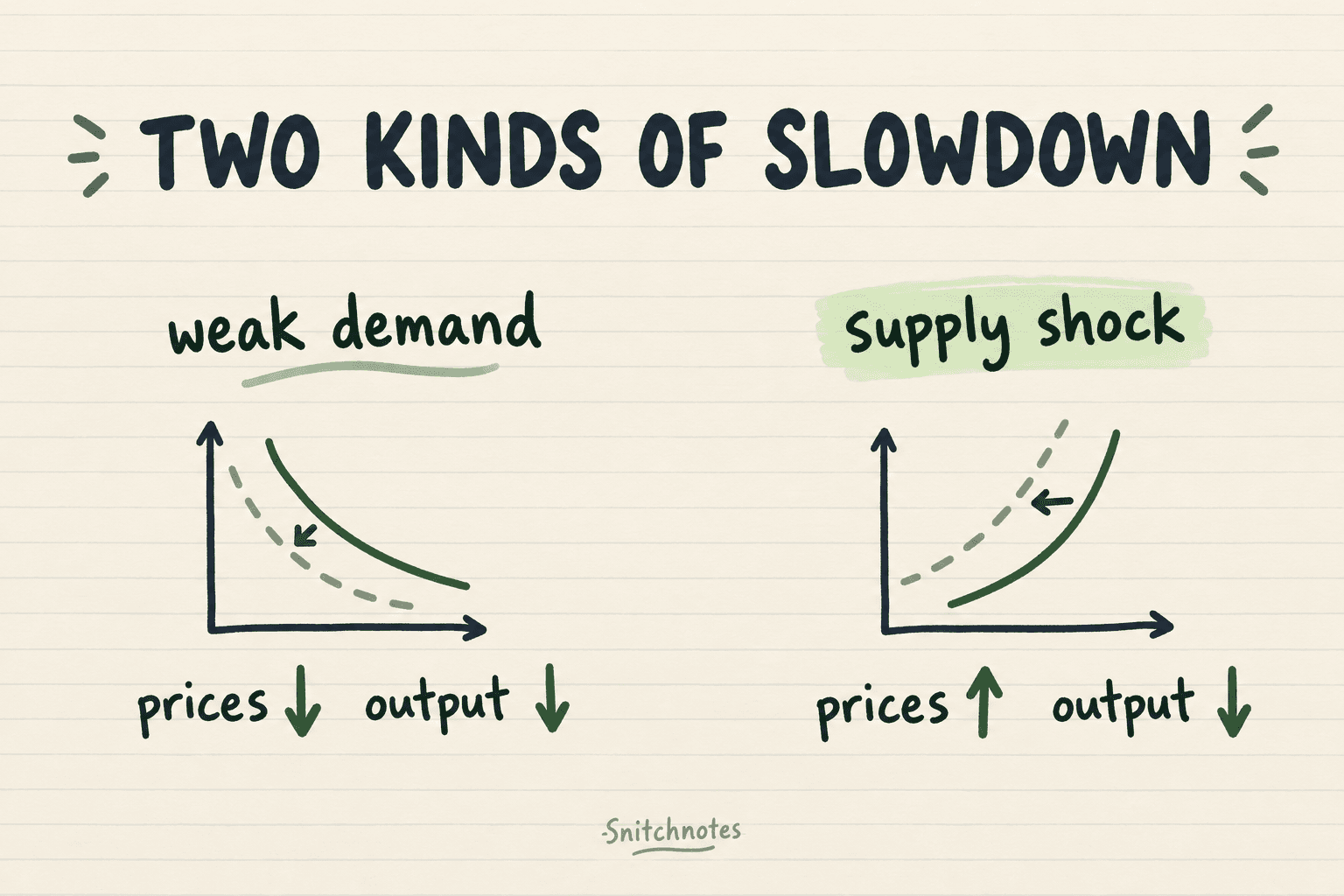
Suppose demand falls because households postpone purchases. Firms sell less, so output weakens and price pressure usually eases. A negative supply shock works differently: an essential input becomes scarcer or more expensive, raising the cost of production while reducing how much the economy can produce. Prices rise even as output falls.
Oil is the classic example because energy affects transport, heating, farming, and manufacturing. But wars, crop failures, disrupted trade, lost productive capacity, or a sharp fall in productivity can create similar pressure. A supply shock need not cause prolonged stagflation by itself; the outcome also depends on expectations and how monetary and fiscal policy respond.
Sophie’s month and the policy seesaw
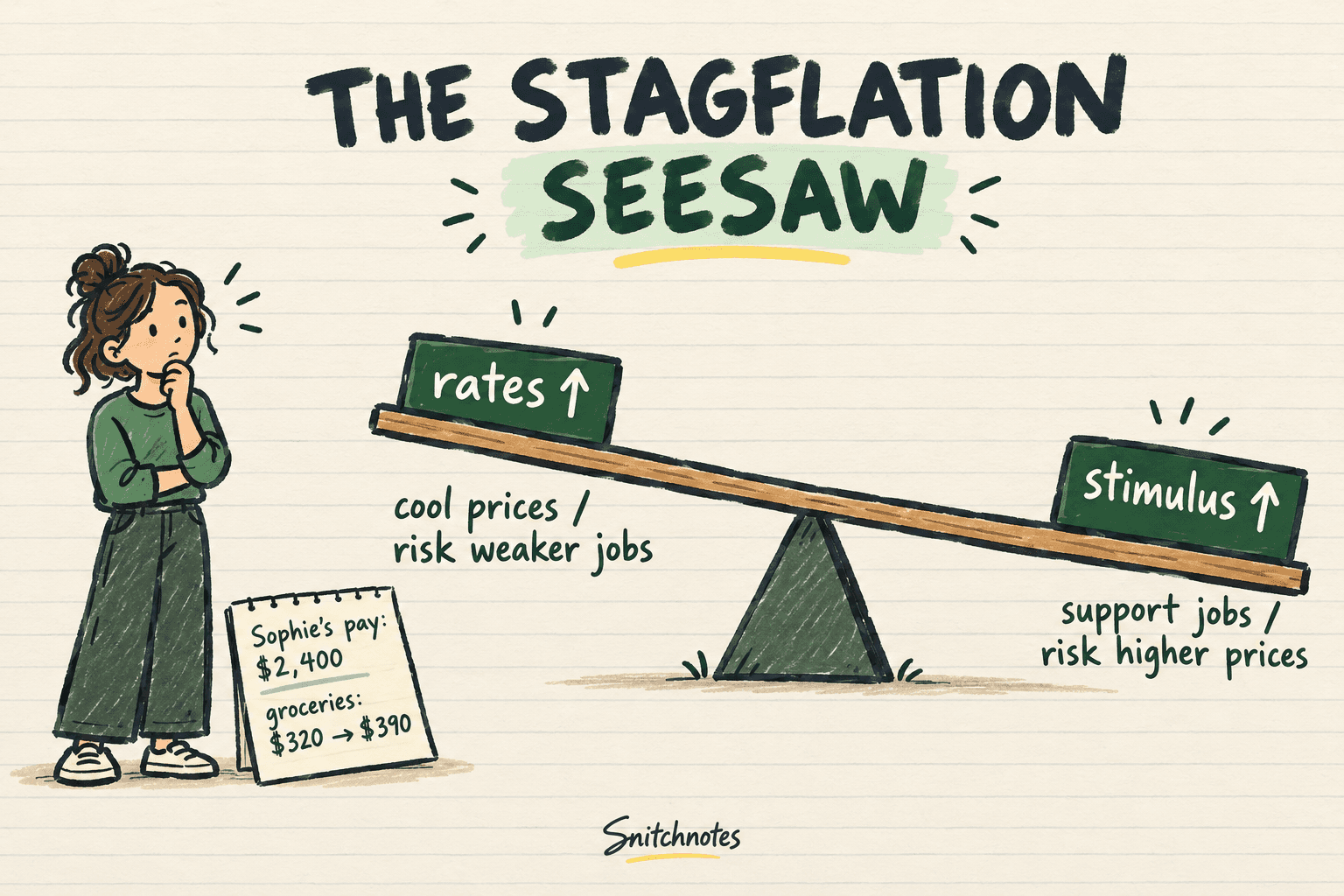
Imagine Sophie takes home $2,400 each month. Her grocery bill rises from $320 to $390 and rent climbs from $1,000 to $1,080, but her pay does not change. Meanwhile, her friend Malik has spent three months looking for full-time work because local shops are cutting hours. Sophie delays replacing her laptop, which means another lost sale for a business already facing higher costs.
Now move from the household to policy. If the central bank raises interest rates, borrowing and spending usually cool. That can restrain inflation and keep expectations anchored, but it may also weaken investment, hiring, and growth in the short run. If policymakers instead use broad stimulus to support demand, firms may hire more, yet extra spending can chase supply that is still constrained and push prices higher.
Why stagflation is hard to fix
The first difficulty is diagnosis. Demand may be too strong, supply may be impaired, expectations may be drifting, or several forces may be interacting. A tool aimed at the wrong cause can intensify another part of the problem. Interest rates can reduce overall demand, for example, but they cannot produce oil, repair a port, or grow a failed harvest.
The second difficulty is timing. Monetary tightening works with delays, while supply investments, planning reform, worker training, and infrastructure can take years. Targeted fiscal relief can protect households most exposed to an energy or food shock, but poorly targeted or permanent support may add demand and weaken the anti-inflation effort.
There is therefore no single stagflation button. A credible response often combines inflation control with carefully targeted relief and measures that expand supply. The mix depends on the shock, the credibility of institutions, public finances, and how firmly inflation expectations remain anchored.
Why the 1970s became the textbook example
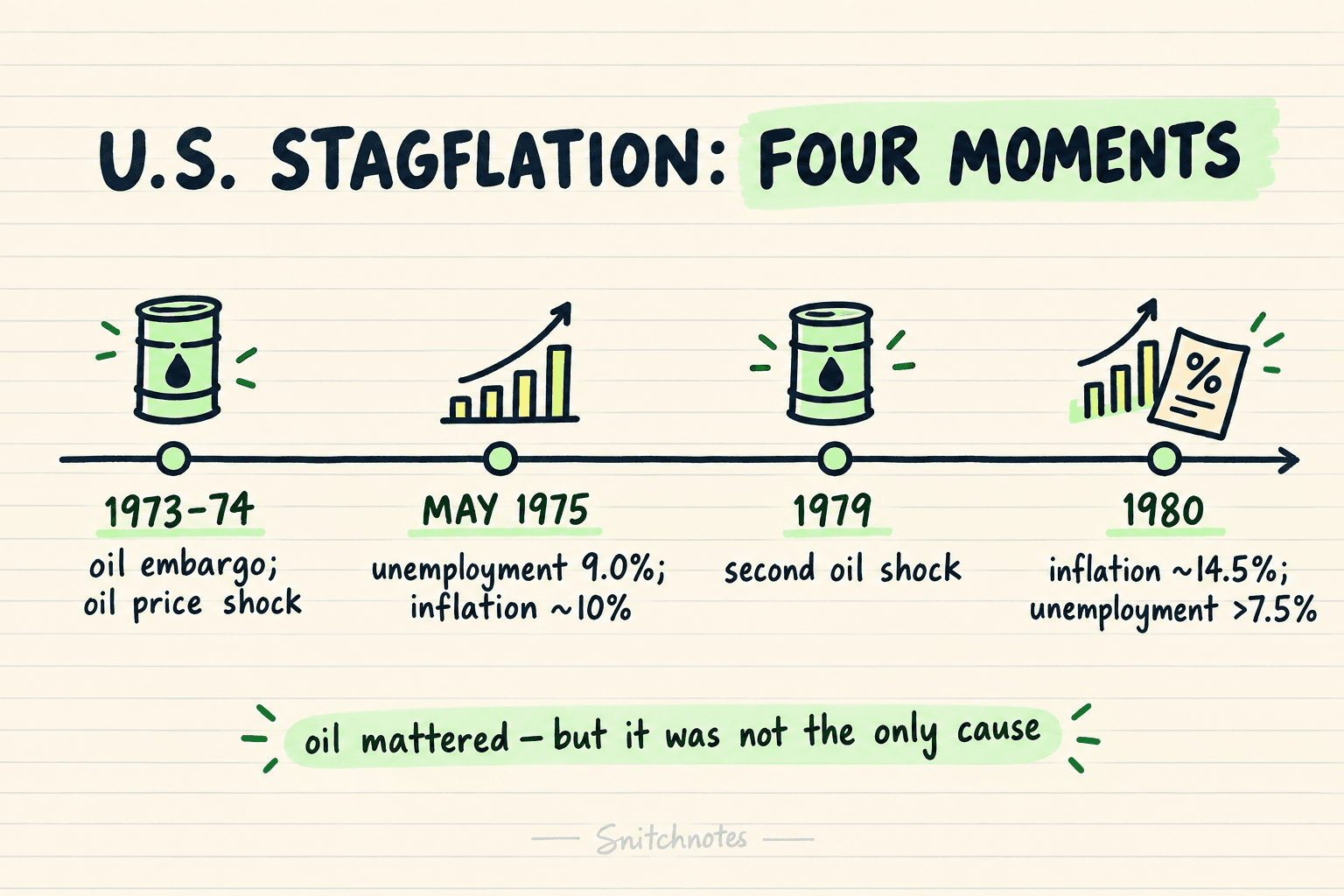
In the United States, inflation rose through the late 1960s and 1970s while recessions and energy shortages repeatedly weakened activity. The 1973–74 oil embargo helped push the price of oil from $2.90 per barrel before the embargo to $11.65 in January 1974. In May 1975, unemployment reached 9.0 percent while inflation hovered around 10 percent.
Oil was not the whole story. Federal Reserve History also points to overly expansionary monetary policy, fiscal imbalances, bad real-time estimates, unanchored expectations, and another energy crisis in 1979. By the summer of 1980, inflation was near 14.5 percent and unemployment exceeded 7.5 percent. Tight monetary policy eventually broke inflation, but the disinflation came with severe recessions and high unemployment.
A common misconception: inflation plus any slowdown equals stagflation
A brief rise in inflation during one weak quarter does not settle the question. Stagflation describes a sustained and unusually painful combination, not every mixed data release. It is also wrong to treat unemployment as the direct cause of inflation. Both can rise together when supply worsens or when past policy and expectations keep price growth elevated.
Check your understanding
Why can a negative supply shock raise prices and reduce output at the same time?
It makes production more expensive or limits productive capacity. Firms can supply less at each price, so the economy gets lower output alongside a higher overall price level.
Why not solve stagflation with a large stimulus?
Stimulus can support jobs and spending, but if supply remains constrained, additional demand may raise prices faster rather than create enough extra output. Targeting and timing matter.
Can higher interest rates repair a supply shortage?
No. They can cool demand and limit persistent inflation, but they cannot directly create missing energy, components, crops, or workers.
If your economics notes mix shocks, graphs, and policy trade-offs into one knot, Snitchnotes can turn your lectures, slides, and PDFs into clearer notes, flashcards, quizzes, and audio for review.
Related concepts
- Supply shock: an unexpected change that alters the economy’s productive capacity or input costs.
- Inflation expectations: beliefs about future price growth that can influence wage bargaining, contracts, and price setting.
- Nominal GDP vs real GDP: how economists separate changes in prices from changes in output.
- Asymmetric information: why markets can behave badly when one side knows more than the other.
Sources
Federal Reserve History: The Great Inflation
Federal Reserve History: Oil Shock of 1973–74
World Bank: Stagflation Risk Rises Amid Sharp Slowdown in Growth
Mach aus deinen Vorlesungen prüfungsfertiges Lernmaterial.
Notizen, Quizze, Podcasts, Karteikarten und Chat — aus einem Upload.
Erste Notiz kostenlos testen