
Snitchnotes Team
Cognitive Dissonance Explained With a Real-Life Example
Cognitive Dissonance Explained With a Real-Life Example
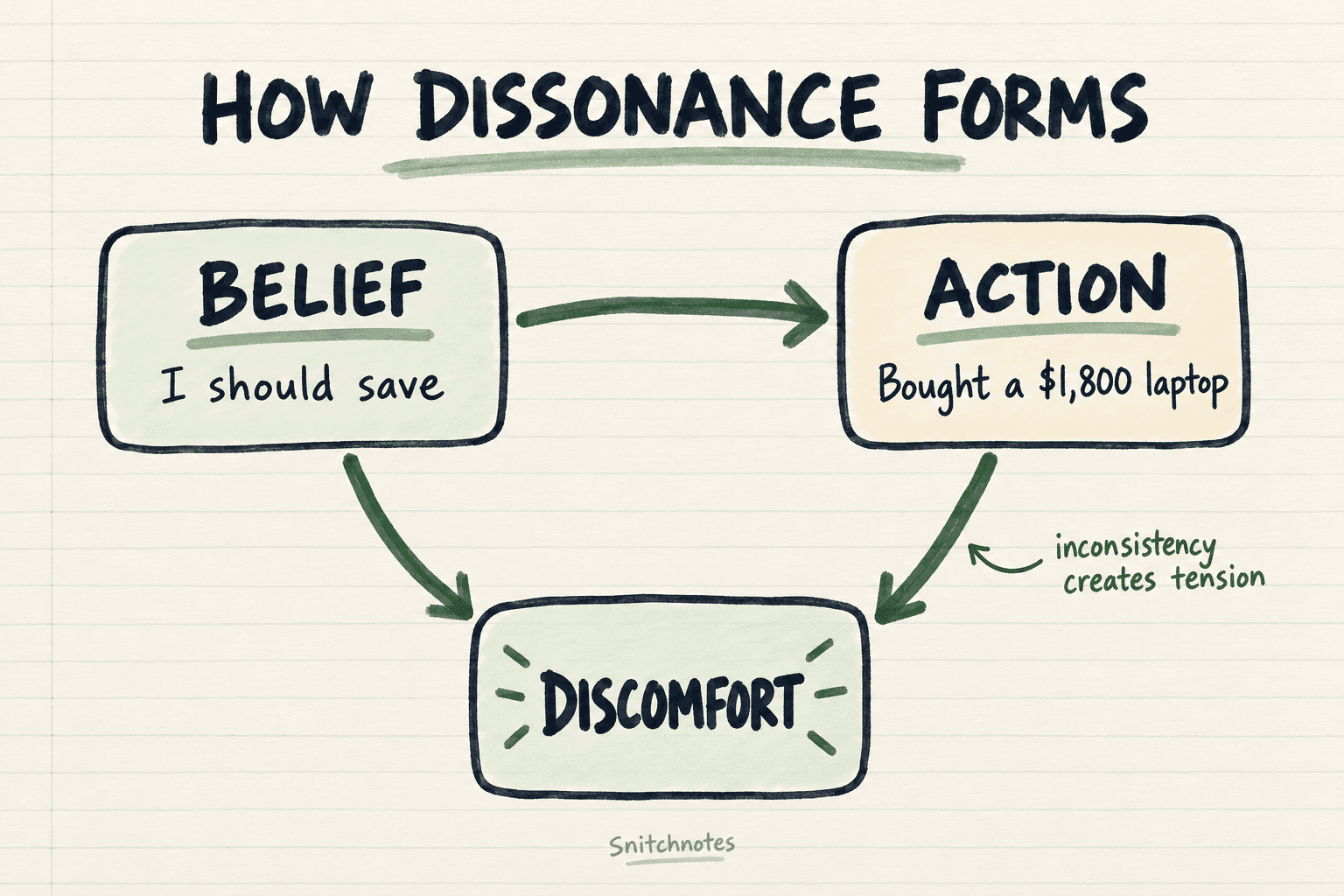
Cognitive dissonance is the psychological discomfort that can arise when a person holds inconsistent beliefs, or when an action clashes with a belief, value, or commitment. That discomfort creates motivation to make the pieces fit again. People may change what they do, change what they believe, add a justification, or decide the conflict is not very important.
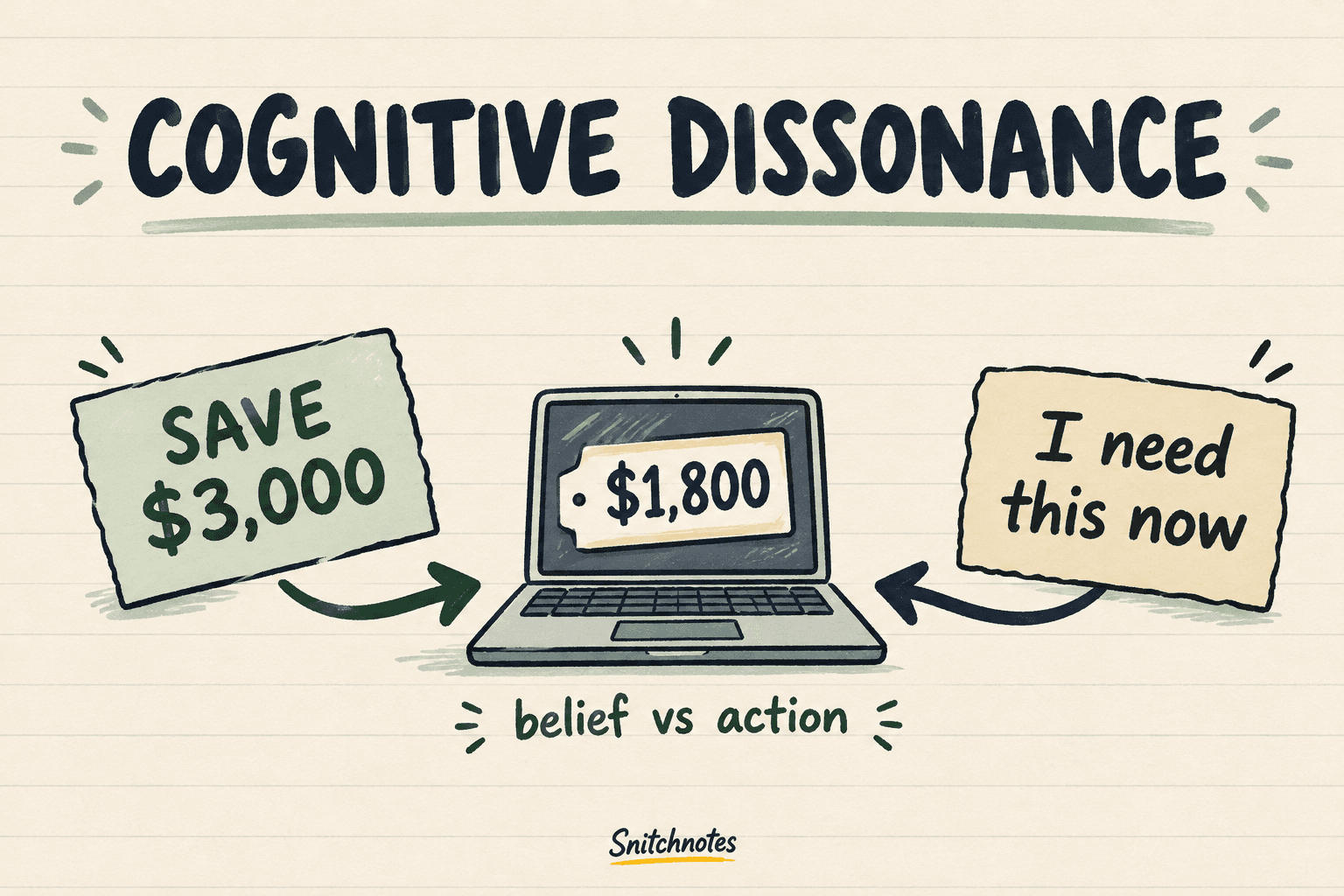
A simple cognitive dissonance example is buying something expensive while believing you should save money. The purchase is real, the savings goal still matters, and the mind now has two facts that sit badly together. What happens next is often more interesting than the purchase itself.
What cognitive dissonance means
Psychologist Leon Festinger introduced cognitive dissonance theory in 1957. In the theory, cognitions include beliefs, knowledge, attitudes, and awareness of one’s own behavior. Two cognitions are dissonant when, psychologically, one does not follow comfortably from the other.
Not every contradiction produces the same amount of tension. Dissonance tends to matter more when the issue is important, the person feels responsible for the choice, and there is not enough external justification to explain the behavior. A minor mismatch about an unimportant preference may barely register; a choice that threatens someone’s view of themselves as careful, honest, or healthy can be much harder to ignore.
Why cognitive dissonance matters
Dissonance helps explain why people do not always respond to contradictory evidence by calmly updating their beliefs. Restoring consistency can mean learning and changing, but it can also mean rationalizing a decision, dismissing inconvenient information, or searching for support that makes the original choice feel sensible.
The theory is useful in everyday decisions, health behavior, persuasion, politics, and consumer choices. It does not mean people are irrational machines. It describes a pressure toward consistency, not a single guaranteed reaction. Different people can reduce the same conflict in different ways.
A real-life cognitive dissonance example
Leon has promised himself he will build a $3,000 emergency fund before making another large purchase. He has saved $2,200. Then his laptop becomes slow during video calls, and he buys a new one for $1,800 even though the old machine still works.
The uncomfortable pair is clear: “I should protect my savings” and “I just spent most of my savings on a laptop.” Leon may feel tense, defensive, or unusually eager to explain the purchase. The discomfort is not proof that the laptop was a bad choice. It signals that his behavior and an important commitment are inconsistent.
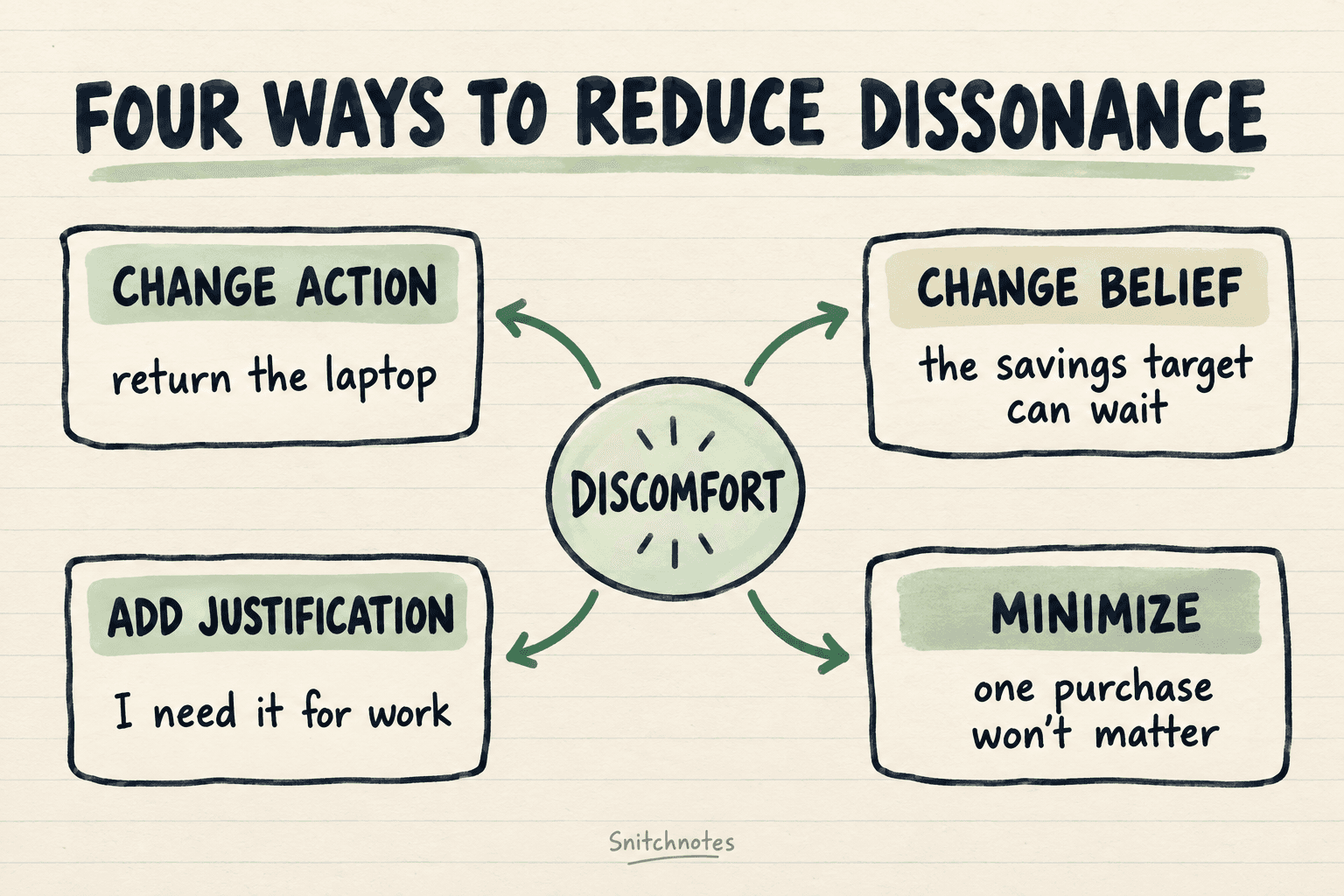
Four ways Leon can reduce the discomfort
- Change the behavior. Leon can return the laptop and restore the money to his emergency fund. This directly removes the action that conflicts with his savings goal.
- Change the belief or commitment. He can decide that reaching $3,000 before any large purchase was too rigid. The action now fits the revised rule, although the new rule may be less protective.
- Add consonant information. Leon can emphasize that reliable video calls matter for paid work and that the laptop should last five years. These reasons do not erase the spending, but they can make it feel more consistent with other goals.
- Reduce the importance of the conflict. He can tell himself that one purchase will not define his financial habits. This may lower discomfort without changing either the purchase or the original belief.
Only the first route necessarily changes what Leon did. The others change how he interprets the decision. That is why reduced discomfort does not automatically mean the underlying problem has been solved well.
What the classic experiment showed
In a 1959 experiment, Leon Festinger and James Carlsmith had 71 male Stanford students spend an hour on repetitive tasks. Some participants were then paid either $1 or $20 to tell another person the dull tasks were enjoyable. Participants paid $1 later rated the tasks more positively than those paid $20.
The result was counterintuitive because a larger reward might seem more persuasive. Dissonance theory predicted the opposite pattern: $20 supplied a strong external reason for saying something untrue, while $1 was a weak justification. With less external explanation available, some participants could reduce the inconsistency by shifting their private attitude toward the task. The study became a classic demonstration of attitude change after insufficient justification, though later research has refined how dissonance is defined and measured.
Cognitive dissonance is not the same as regret
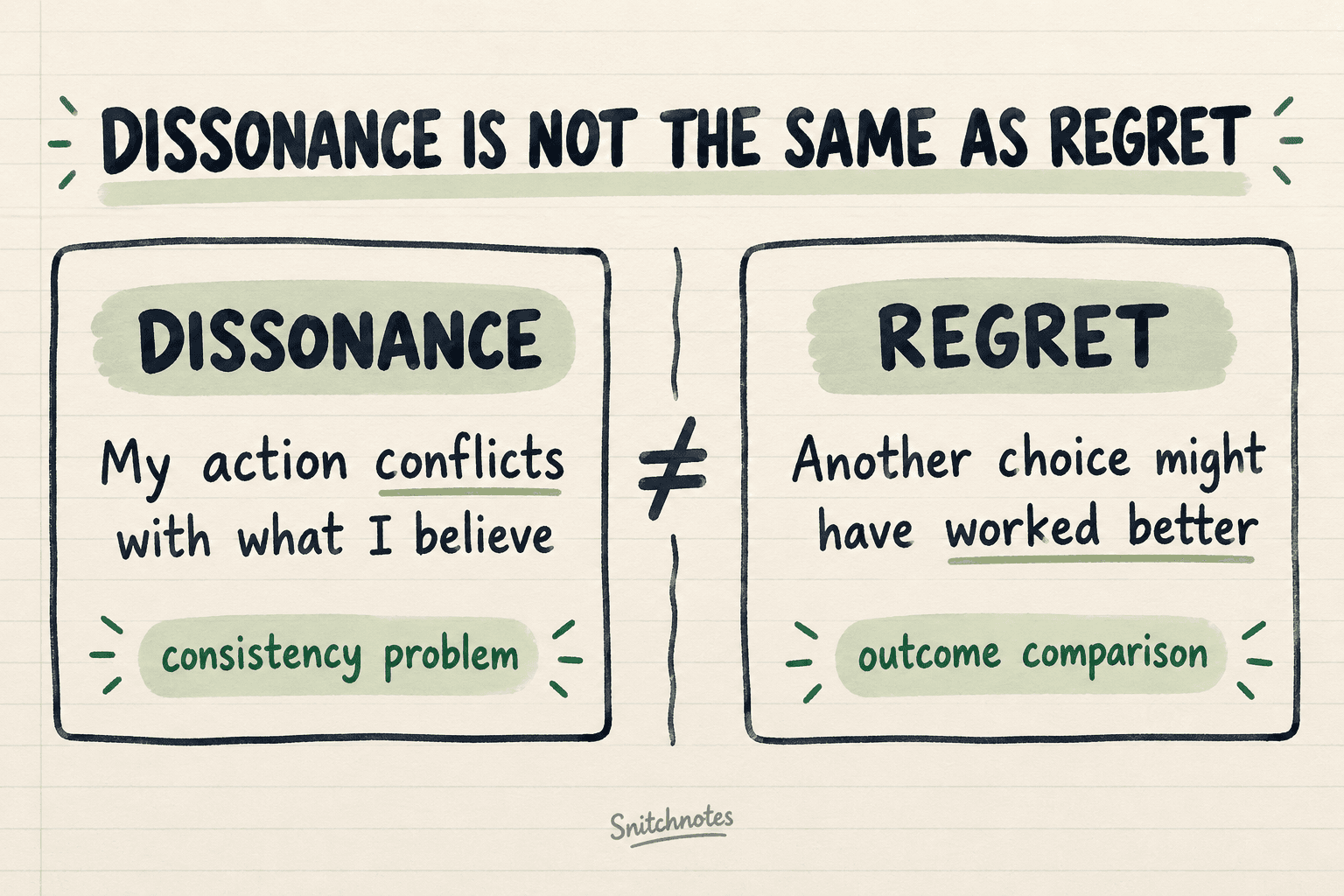
Regret focuses on a comparison between what happened and a better outcome that might have followed from another choice. Dissonance focuses on inconsistency among cognitions, including beliefs and awareness of behavior. Leon might regret the laptop if it performs badly, but he can experience dissonance even if it works perfectly because the purchase still conflicts with his savings commitment.
The two can overlap. A poor outcome can sharpen the conflict and make a choice harder to justify. But neither term is simply a formal name for feeling bad after any decision.
A common misconception: dissonance proves a belief is false
Feeling dissonance does not identify which cognition is correct. Leon’s savings rule might be wise, overly strict, or sensible except in this case. The discomfort only reveals a perceived inconsistency. Evaluating the facts still requires evidence, reflection, and sometimes a willingness to tolerate tension rather than explain it away too quickly.
Check your understanding
Where is the dissonance in Leon’s example?
It lies between his commitment to save $3,000 before another large purchase and his decision to spend $1,800 on a laptop before reaching that goal.
Which reduction route changes Leon’s original behavior?
Returning the laptop changes the behavior. Revising the savings rule, adding work-related reasons, or minimizing the purchase changes how Leon interprets the conflict.
Why did the $1 group change its attitude more than the $20 group?
One dollar gave participants less external justification for praising a boring task. Changing their private attitude offered another way to make their statement feel more consistent.
If psychology lectures leave theories, studies, and examples tangled together, Snitchnotes can turn your slides, PDFs, and notes into clearer study notes, quizzes, flashcards, and audio for review.
Related concepts
- Classical vs operant conditioning: how learning through associations differs from learning through consequences.
- Mediator vs moderator variables: two different ways a variable can explain or change a relationship.
- Confirmation bias: the tendency to seek, interpret, or remember information in ways that support an existing belief.
Sources
Festinger and Carlsmith: Cognitive Consequences of Forced Compliance (1959)
American Psychological Association: Cognitive Dissonance—Reexamining a Pivotal Theory in Psychology
York University Classics in the History of Psychology: Festinger and Carlsmith (1959)
Cambridge University Press: Action Orientation, Consistency and Feelings of Regret
Convierte tus clases en material listo para el examen.
Apuntes, quizzes, podcasts, flashcards y chat — con solo subir un archivo.
Prueba tu primer apunte gratis