
Snitchnotes Team
Dimensional Analysis in Chemistry: A Step-by-Step Method
Dimensional Analysis in Chemistry: A Step-by-Step Method
Dimensional analysis in chemistry is a method for converting quantities by multiplying them by conversion factors arranged so unwanted units cancel. Start with the quantity you know, write the unit you want, choose a relationship between those units, and orient each factor so only the wanted unit remains. Then do the arithmetic and round once at the end.
This matters because chemistry constantly moves between scales: milliliters and liters, grams and moles, moles and particles, or one substance and another in a balanced reaction. Units are not decorations beside the numbers. They are part of the calculation and provide an error check before you trust the result.
What dimensional analysis does
A conversion factor is a ratio of equivalent quantities. Because 1 liter and 1000 milliliters describe the same volume, both 1000 mL/1 L and 1 L/1000 mL are equal to one. Multiplying by either ratio does not change the physical amount; it changes how that amount is expressed. OpenStax calls this the factor-label method because numbers and their unit labels undergo the same operations.
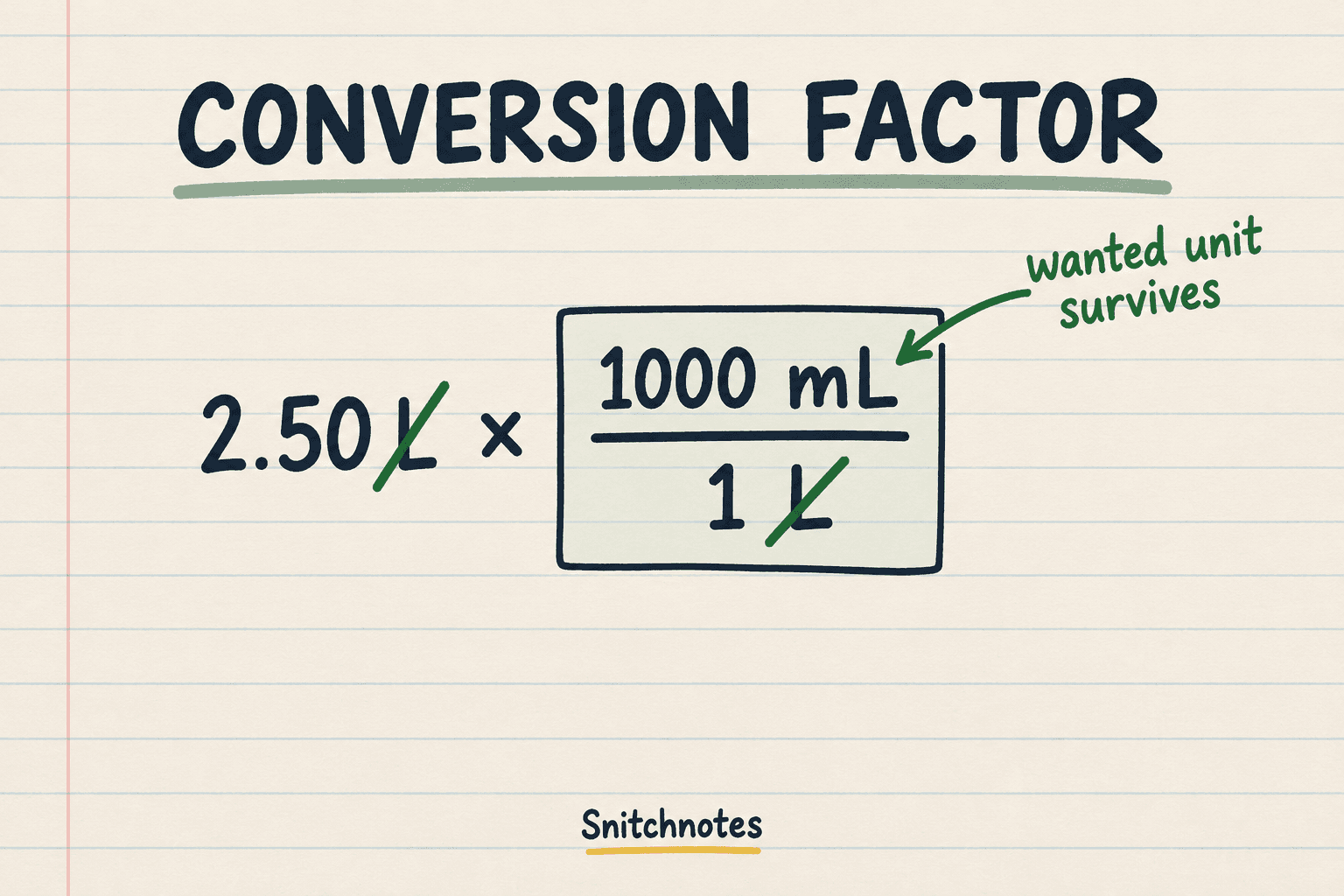
The useful version of a conversion factor is the one whose units point toward your target. If you begin with liters and need milliliters, use 1000 mL/1 L. Liters appear once above and once below the fraction line, so they cancel. The remaining unit, milliliters, tells you that the setup is facing the right way.
Step 1: Write the given quantity and target unit
Copy the given number with its unit, then state the unit the answer must use. Suppose a flask contains 2.50 L and the question asks for milliliters. Write “2.50 L → ? mL.” This tiny move prevents you from grabbing a familiar conversion and flipping it by guesswork.
Keep compound units intact. If a value is 12.0 g/mL, the denominator matters just as much as the numerator. Density, molar mass, concentration, and reaction coefficients are bridges between different kinds of quantity, so losing part of a unit can turn a sensible relationship into nonsense.
Step 2: Find an equality that connects the units
Choose a stated definition or measured relationship. Metric prefixes give equalities such as 1 L = 1000 mL. Molar mass connects grams and moles for a specific substance. Density connects mass and volume. A balanced chemical equation supplies mole ratios between reactants and products. Write the equality before turning it into a fraction.
The chemical identity must travel with the unit when it matters. “1 mol” is not enough if a problem involves several substances; write “1 mol H₂O” or “1 mol NaCl.” A molar mass of 18.02 g/mol belongs to water, not to sodium chloride.
Step 3: Orient the conversion factor
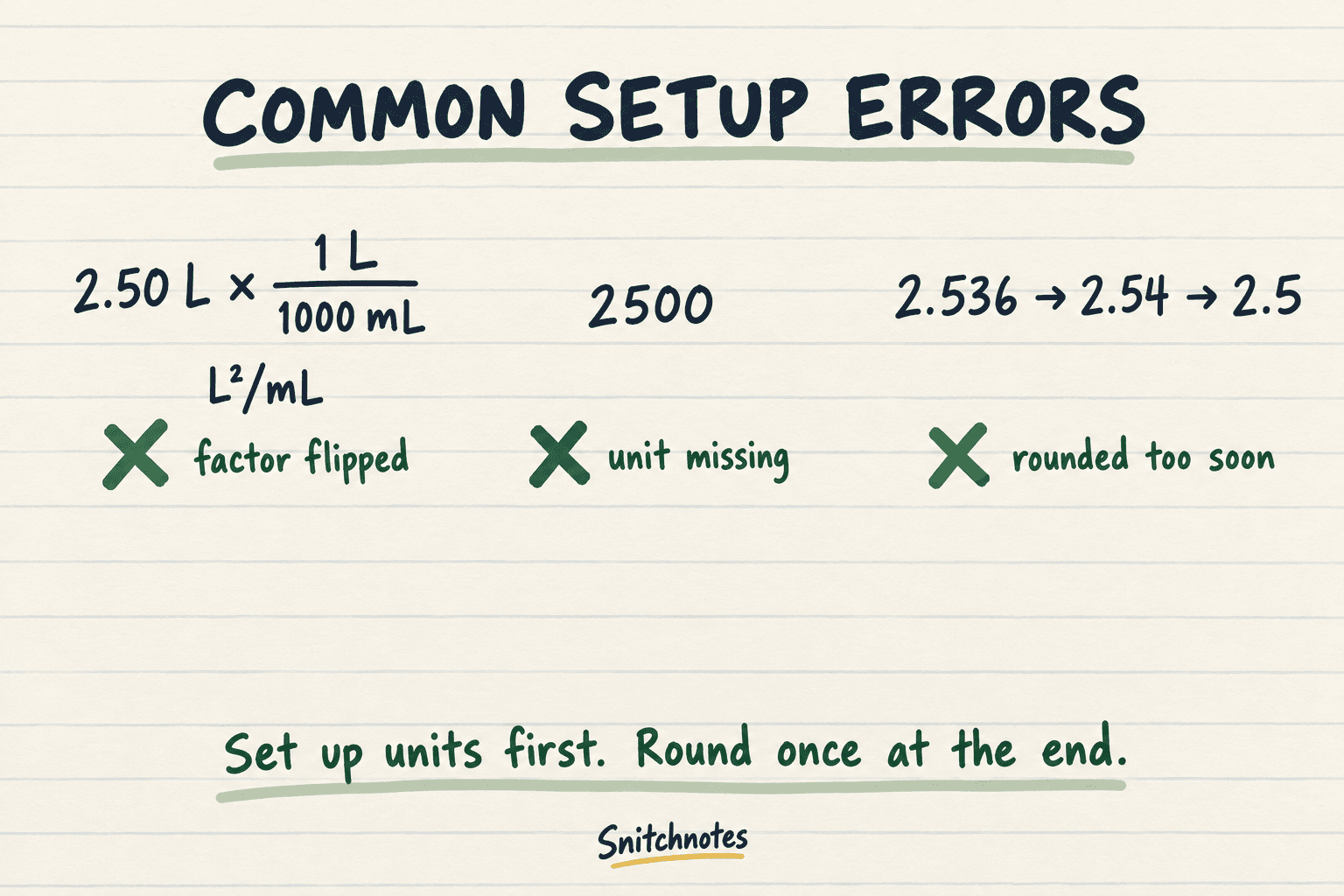
Put the unit you have on the opposite side of the fraction line so it cancels. For the flask, the setup is 2.50 L × (1000 mL/1 L). The L in the starting quantity cancels the L in the denominator, leaving mL. If you accidentally use 1 L/1000 mL, the units become L²/mL. That awkward leftover is the method warning you before the arithmetic does.
Step 4: Cancel units, calculate, and check
Cancel identical units only when one is in a numerator and the other is in a denominator. Then multiply all numerators, divide by all denominators, and attach the surviving unit. For the flask, 2.50 × 1000 = 2500, so the result is 2500 mL. Defined conversion factors such as 1 L = 1000 mL are exact; they do not limit the significant figures inherited from the measured quantity.
Finish with two checks. First, does the final unit match the question? Second, does the size make sense? Converting liters to milliliters should produce a larger number because each liter contains many milliliters. A calculator result without a unit has thrown away half the evidence.
Worked example: Convert grams of water to moles
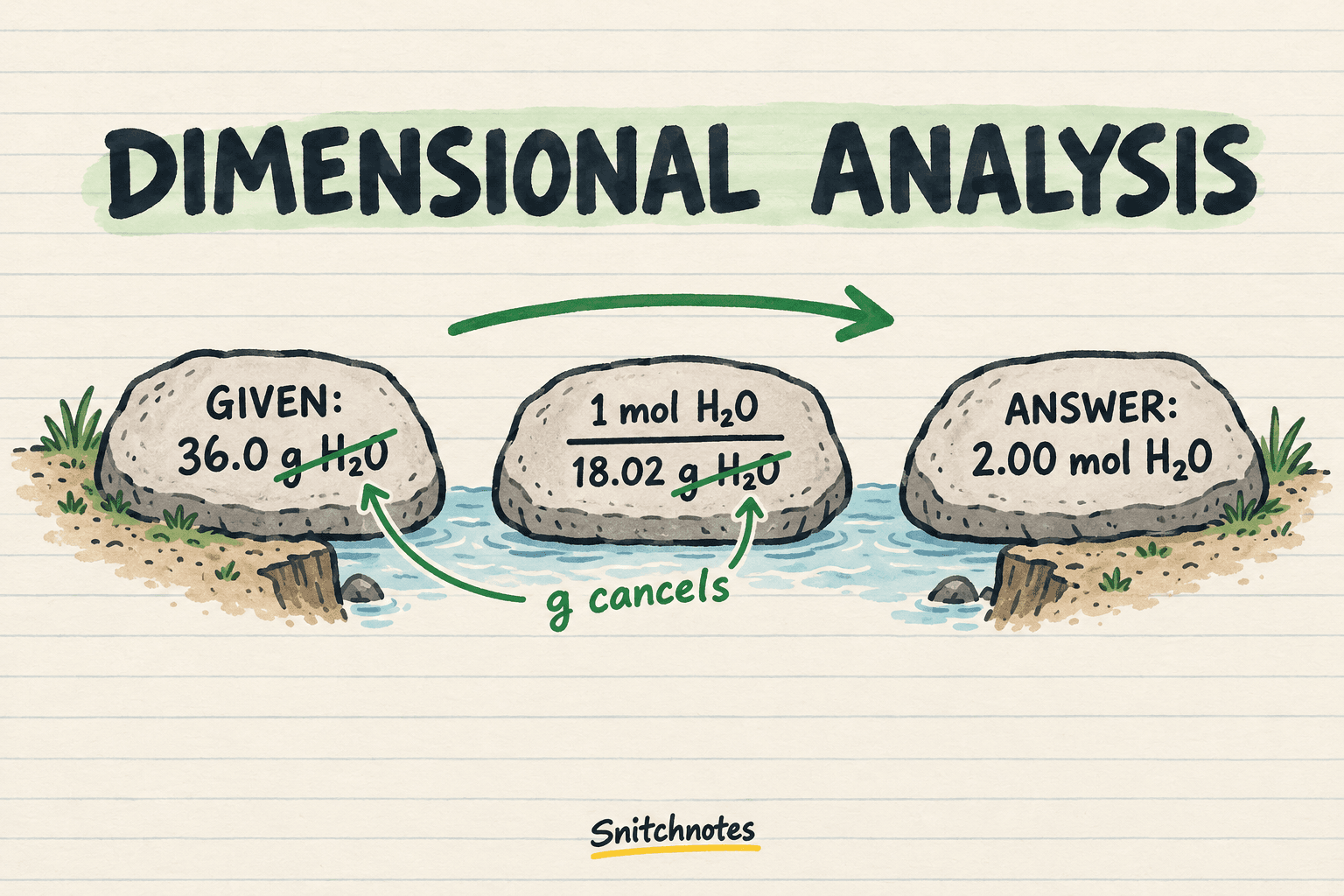
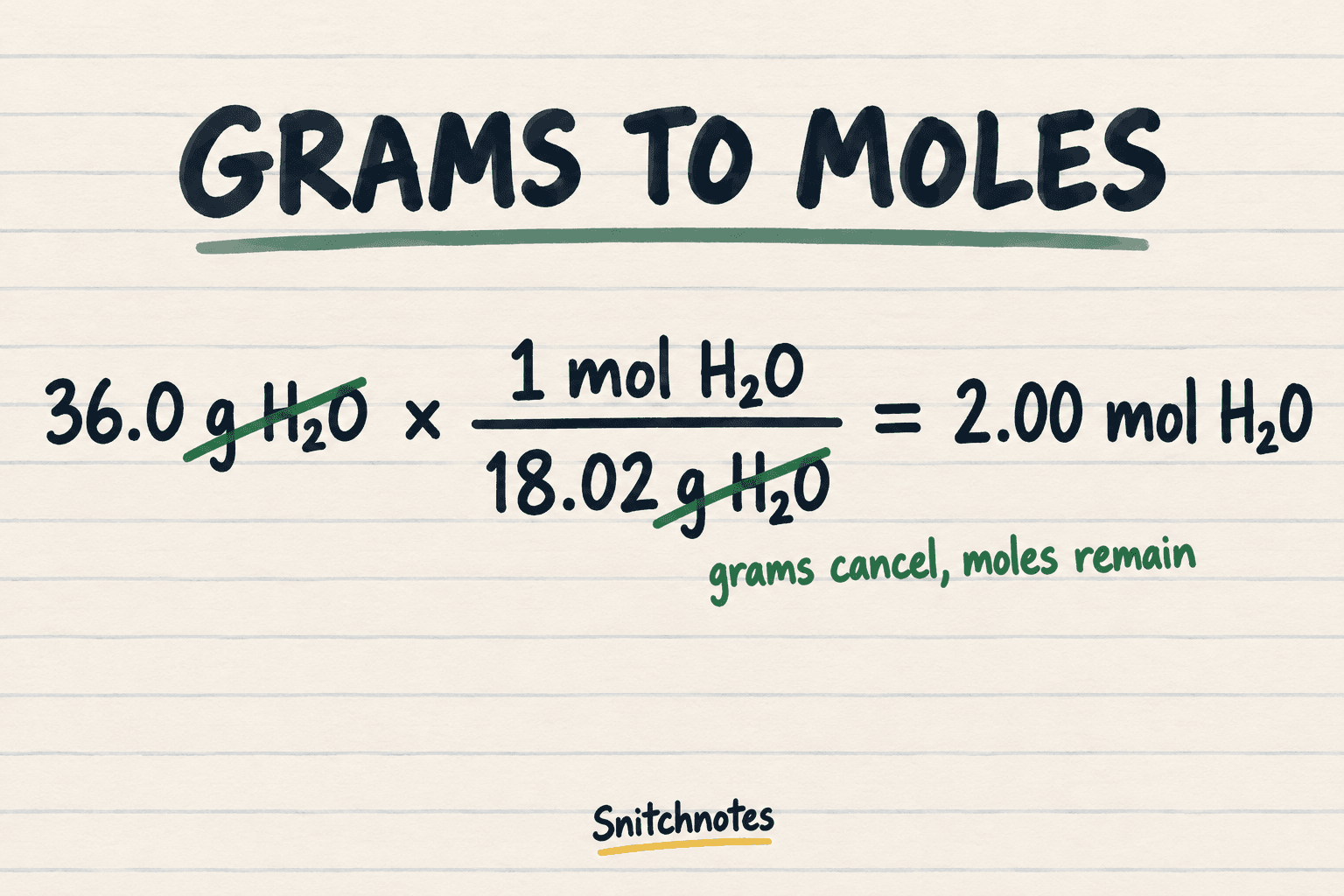
Question: How many moles are in 36.0 g H₂O? The target is moles, and the molar mass of water is approximately 18.02 g H₂O per 1 mol H₂O. Arrange the factor with grams below: 36.0 g H₂O × (1 mol H₂O/18.02 g H₂O). Grams of water cancel, leaving moles of water.
The calculation gives 36.0/18.02 = 1.997… mol H₂O, which rounds to 2.00 mol H₂O at three significant figures. Notice the order: write the units, confirm cancellation, calculate, and only then round. The method is less about memorizing whether to multiply or divide and more about building a route whose unit algebra decides that for you.
Multi-step dimensional analysis
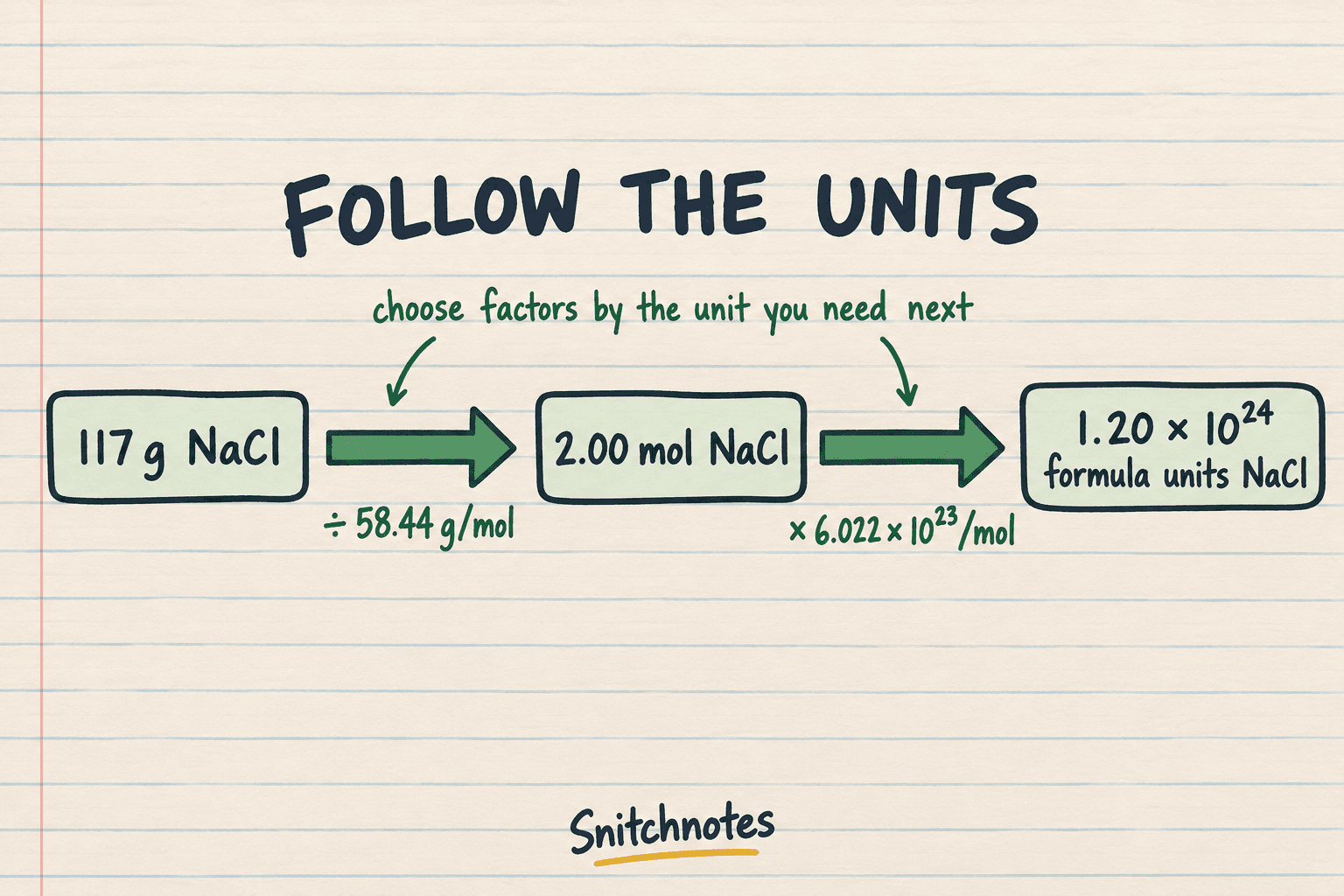
For a longer problem, link one conversion factor to the next. To estimate the number of formula units in 117 g NaCl, first convert grams to moles using 58.44 g NaCl per mole. Then convert moles to formula units using the rounded classroom value 6.022 × 10²³ formula units per mole.
The chain is 117 g NaCl × (1 mol NaCl/58.44 g NaCl) × (6.022 × 10²³ formula units NaCl/1 mol NaCl). Grams cancel, then moles cancel, leaving formula units. The result is about 1.20 × 10²⁴ formula units NaCl. You can write the whole chain before touching the calculator, which makes a missing or inverted factor easier to spot.
Common errors and important boundaries
- Flipping a factor: choose orientation by cancellation, not by whether the numbers look familiar.
- Dropping units mid-calculation: keep every unit visible until it cancels or survives.
- Rounding every step: keep guard digits and round the final result once.
- Ignoring powers: converting square or cubic units requires squaring or cubing the entire length conversion factor.
Dimensional analysis is powerful, but unit cancellation alone cannot prove that the chemistry is correct. You still need the right physical relationship, chemical formula, molar mass, or balanced equation. A dimensionally tidy setup can use the wrong substance or coefficient. Temperature scales are another boundary: Celsius and Fahrenheit have different zero points, so converting between them requires an offset as well as a scale factor, not a simple multiplying ratio.
Check your understanding
How would you convert 750 mL to liters?
Use 750 mL × (1 L/1000 mL). Milliliters cancel, leaving 0.750 L. The factor is oriented correctly because liters are the surviving target unit.
What should you do if the final unit is not the requested unit?
Do not repair only the number. Return to the factor chain and find the unit that failed to cancel or the missing bridge to the target. The leftover units usually identify the broken step.
If your chemistry notes contain several conversion paths, Snitchnotes can turn them into organized study notes, flashcards, and practice questions so you can rehearse choosing factors instead of merely rereading examples.
Related concepts
- Checking units in equations: use dimensional consistency to test whether a formula could be valid.
- Chemistry mechanism questions: organize multistep chemical reasoning without losing the purpose of each step.
- Molar mass: the mass of one mole of a specified substance, commonly expressed in grams per mole.
- Stoichiometry: using balanced-equation mole ratios to connect amounts of reactants and products.
Sources
OpenStax Chemistry 2e: Mathematical Treatment of Measurement Results
Chemistry LibreTexts: Dimensional Analysis (Unit Conversions)
National Institute of Standards and Technology: NIST Guide to the SI, Chapter 8
Kingsborough Community College: Dimensional Analysis and Unit Conversions
Gonzaga University Chemistry 101: Dimensional Analysis and Unit Conversions
Convierte tus clases en material listo para el examen.
Apuntes, quizzes, podcasts, flashcards y chat — con solo subir un archivo.
Prueba tu primer apunte gratis