
Snitchnotes Team
How Do Electric Eels Produce Electricity?
How Do Electric Eels Produce Electricity?
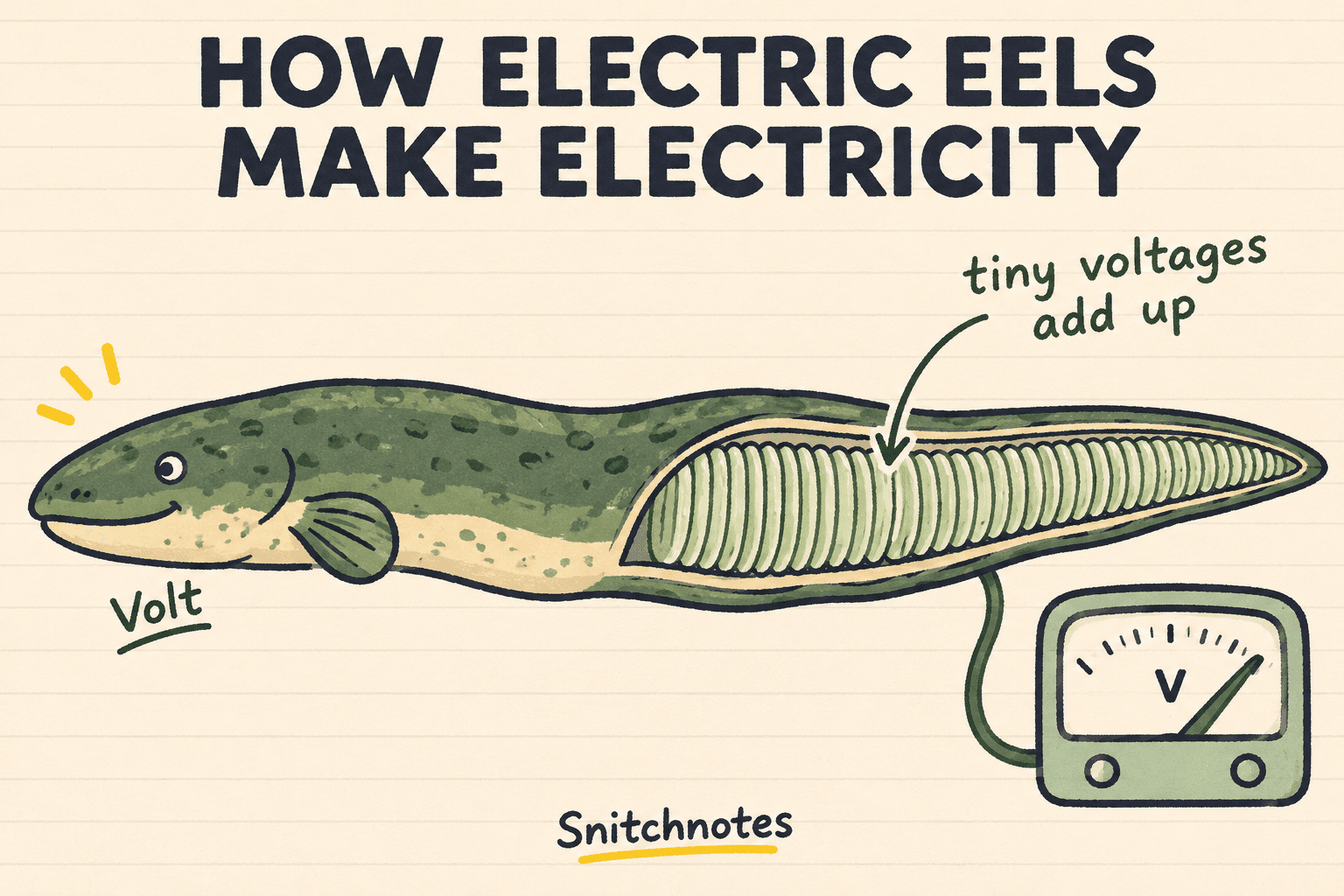
Electric eels produce electricity with thousands of flattened, muscle-derived cells called electrocytes. Each cell creates a small voltage by controlling charged ions across its membrane. When the eel's nervous system activates many electrocytes almost simultaneously, their voltages add because the cells are stacked in series. The result is an electric organ discharge: a weak pulse for sensing and communication or a much stronger pulse for hunting and defense.
The eel is not storing household electricity in its tail. It is converting chemical energy into ion gradients, then briefly releasing the electrical potential those gradients create. The clever part is scale: one cell contributes little, but thousands firing together behave like a long biological series circuit.
The mechanism in four steps
- Electrocytes maintain unequal concentrations of sodium and potassium ions across their membranes, creating electrical potential.
- A command from the eel's brain travels through motor neurons to the innervated face of the electrocytes.
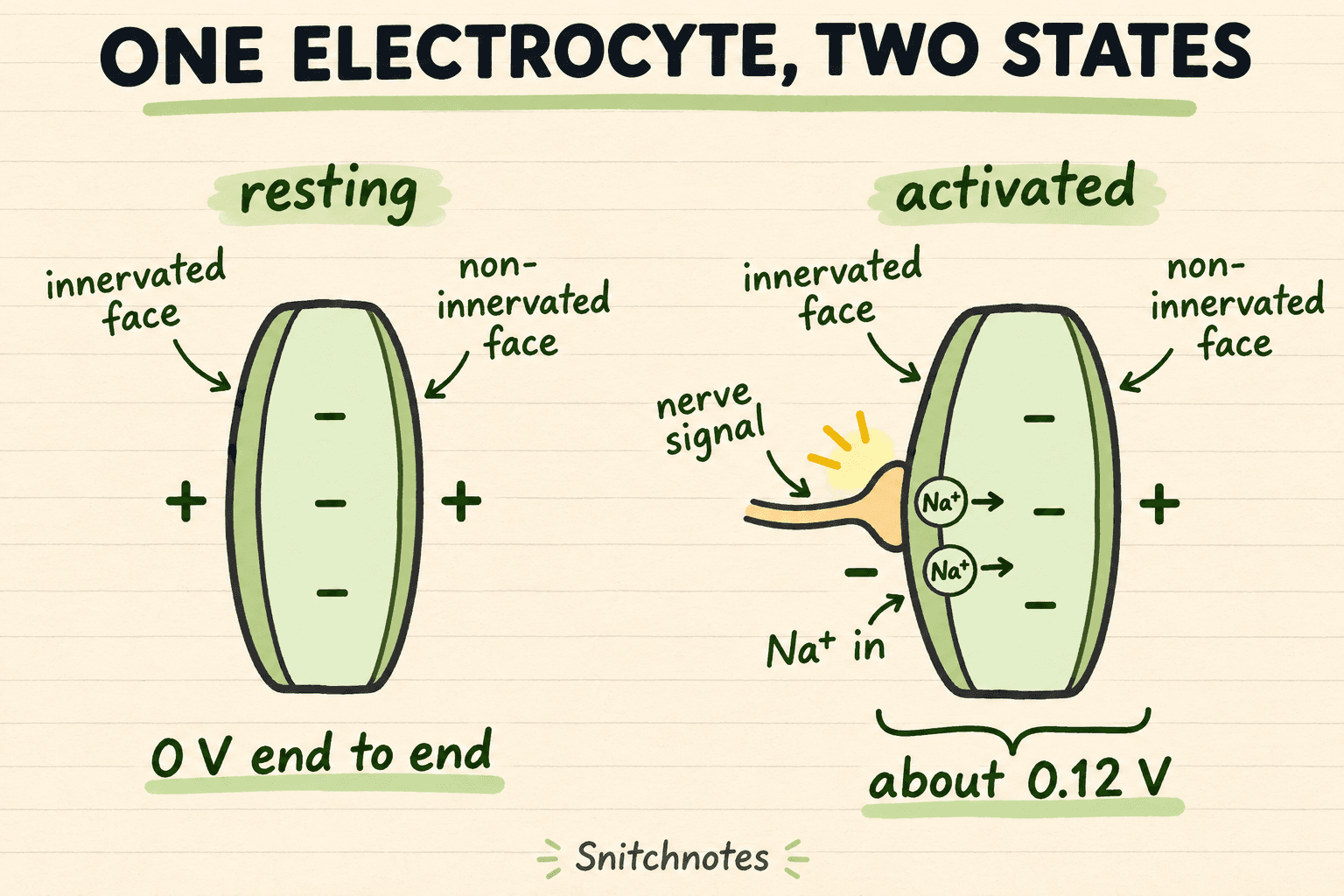
- The nerve signal opens ion channels on that face. Sodium ions rush in, changing its polarity and producing a voltage across each cell.
- Because thousands of electrocytes are aligned and activated together, their small voltages add into one much larger discharge.
This sequence connects ordinary cell physiology to an extraordinary animal behavior. Nerve cells and muscle cells also use ion gradients and action potentials; an electric eel has reorganized muscle-derived cells so their electrical change becomes the useful output instead of contraction.
From one electrocyte to one pulse
An electrocyte is a large, flattened cell with two main membrane faces. At rest, both faces are polarized in similar ways, so there is little net voltage from one end of the whole cell to the other. Sodium-potassium pumps and other membrane proteins maintain the ion gradients that make this resting state possible.
Motor neurons contact only the innervated face. When they release the neurotransmitter acetylcholine, receptors and voltage-gated sodium channels help trigger a rapid sodium influx on that side. The innervated face depolarizes while the opposite face remains polarized. That asymmetry creates a small end-to-end voltage across the electrocyte.
After the pulse, channels close and ion pumps gradually restore the gradients. Strong discharges are therefore not free: rebuilding the ionic separation costs metabolic energy. That helps explain why electric eels can use weak signals routinely but reserve intense volleys for moments when a stronger output is useful.
Volt's 5,000-cell stack
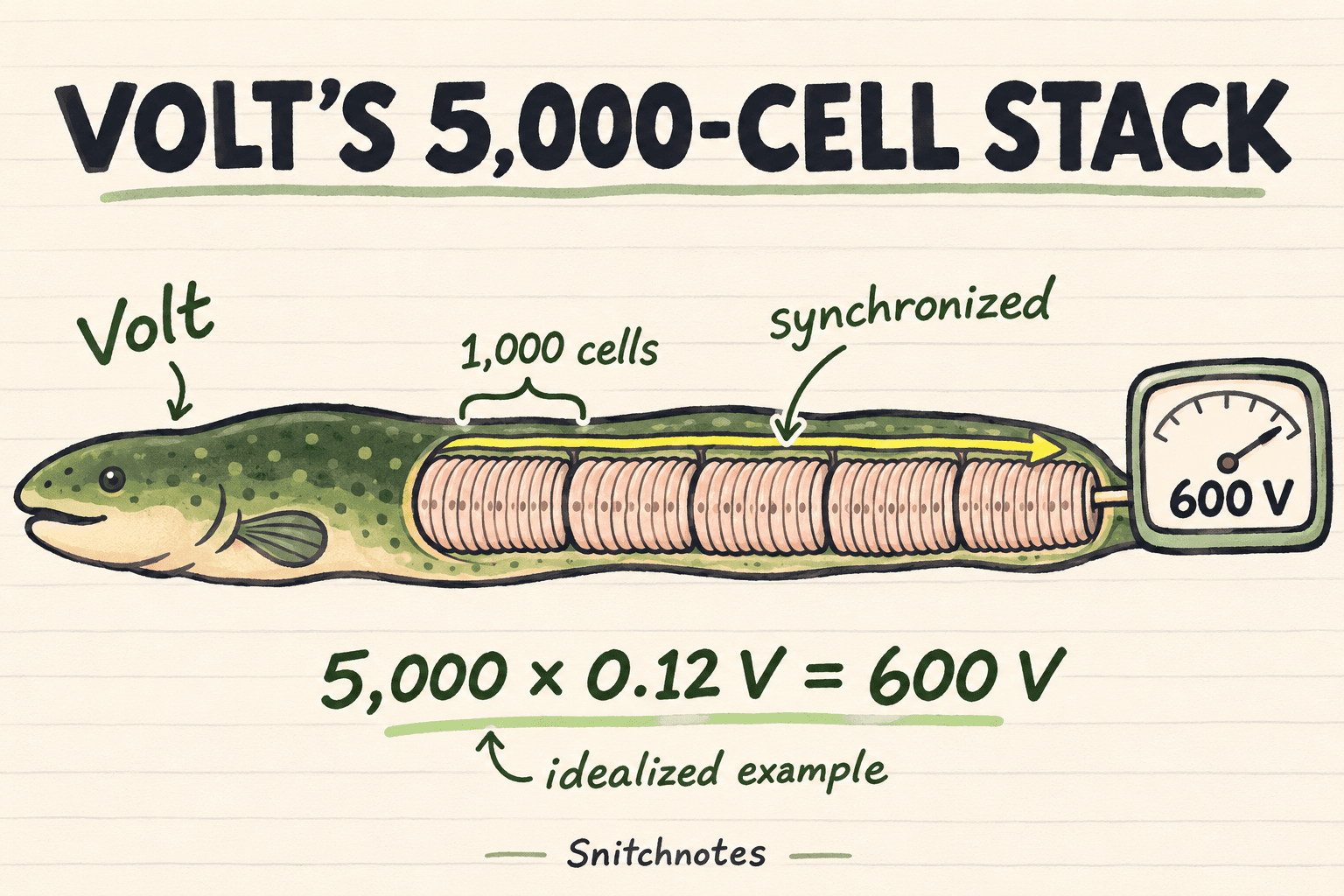
Imagine an eel named Volt with a simplified line of 5,000 electrocytes. If each activated cell contributes about 0.12 volt, the idealized series calculation is 5,000 × 0.12 V = 600 V. It is the same addition principle used when ordinary battery cells are connected in series, although electrocytes are living cells rather than metal-and-chemical batteries.
Synchronization is essential. If Volt's cells fired at scattered times, their peaks would not line up and the combined pulse would be weaker. The nervous system sends coordinated signals through many motor neurons, bringing large groups of electrocytes close to their active state together. The stack turns timing into voltage.
The 600-volt result is a teaching model, not a fixed specification for every eel. Cell contribution, number and arrangement of active electrocytes, body size, species, condition, and measurement geometry all affect the recorded output. A 2019 study described three electric-eel species and measured 860 volts from one Electrophorus voltai specimen, while other specimens and species produced lower values.
Why weak and strong pulses do different jobs
Electric eels have three paired electric organs: the main organ, Hunter's organ, and Sachs' organ. Together they occupy much of the animal's body. Different regions contribute to different outputs, allowing the eel to switch between weak and strong electric organ discharges rather than operating at maximum power all the time.
- Weak pulses: used for electrolocation, navigation, and communication in dark or murky water.
- Strong pulses: used in defense and during attacks on prey; rapid volleys can stimulate prey muscles.
A hunting eel can emit a high-voltage doublet that makes concealed prey twitch, revealing its location. During a strike, rapid high-voltage pulses can both interfere with the prey's movement and help the eel track a conductive target. Research has recorded strike volleys near 400 pulses per second, making the discharge both a weapon and a fast sensory tool.
The battery analogy has limits
Calling electrocytes tiny batteries is useful because voltages add in series. But the cells do not contain little metal terminals, and the eel does not fill up with electrons from the water. Its electrical potential comes from separated ions across living membranes. Water completes paths for current outside the animal; it conducts the discharge but does not generate it.
Voltage is also not the whole story. The biological effect depends on current, pulse duration, repetition rate, the path through the target, and the conductivity of the surrounding water. A headline voltage tells you the size of the electrical potential difference, not by itself the exact effect of every encounter.
Check your understanding
Why do the voltages add?
Electrocytes are aligned in series. When their active faces point consistently and they discharge together, the potential difference across one cell adds to the next, producing a much larger total voltage across the organ.
What synchronizes the electrocytes?
Coordinated motor-neuron signals activate the innervated faces of many electrocytes at nearly the same time. Sodium entry changes those faces' polarity and aligns the cells' voltage peaks.
Why not use maximum voltage continuously?
Strong discharges consume more energy because ion gradients must be restored. Weak pulses are sufficient for routine sensing and communication, while intense volleys are reserved for hunting or defense.
If action potentials and membrane pumps feel abstract in your lecture notes, Snitchnotes can turn your own slides, PDFs, and readings into organized notes, flashcards, and quizzes for review.
Related concepts
- The sodium-potassium pump step by step: see how cells spend ATP to maintain the ion gradients behind electrical signaling.
- Study metabolic pathways with input-output maps: use the same cause-and-effect approach for energy-consuming cellular systems.
- Action potentials: rapid changes in membrane voltage that let excitable cells transmit signals.
Sources
Nature Communications: Electric eels use high-voltage to track fast-moving prey
Frontiers in Integrative Neuroscience: The Astonishing Behavior of Electric Eels
Smithsonian's National Zoo and Conservation Biology Institute: Electric eel
Convierte tus clases en material listo para el examen.
Apuntes, quizzes, podcasts, flashcards y chat — con solo subir un archivo.
Prueba tu primer apunte gratis