
Snitchnotes Team
How to Memorize Muscle Origins and Insertions
How to Memorize Muscle Origins and Insertions
To memorize muscle origins and insertions, stop treating each muscle as four unrelated facts. Put the muscle on a body map, mark both attachments, trace which joint it crosses, predict its line of pull, and retrieve the origin, insertion, action, and innervation together. Then remove labels in stages and redraw the same map from memory. This turns a list into one connected explanation.
This method is for anatomy students who can recognize a labelled muscle but go blank when a practical pin lands on an attachment. You will use biceps brachii as a worked example, then build a three-pass drill you can repeat for any region.
Why isolated muscle tables are hard to remember
A table makes origin, insertion, action, and innervation look like separate columns. In the body, they form a system. Attachments place a muscle on bones, its route crosses one or more joints, and contraction creates a pull whose effect depends on that route. OpenStax describes skeletal muscles as pulling across joints to produce movement; learning that relationship gives every name somewhere to live.
Recognition is also a trap. A fully labelled plate can feel familiar even when you cannot produce a single attachment without it. In experiments on prose learning, Henry Roediger and Jeffrey Karpicke found that retrieval practice improved delayed retention more than repeated study. The practical implication is simple: look briefly, hide the answer, retrieve, check, and try again later.
Use the attachment-to-action chain
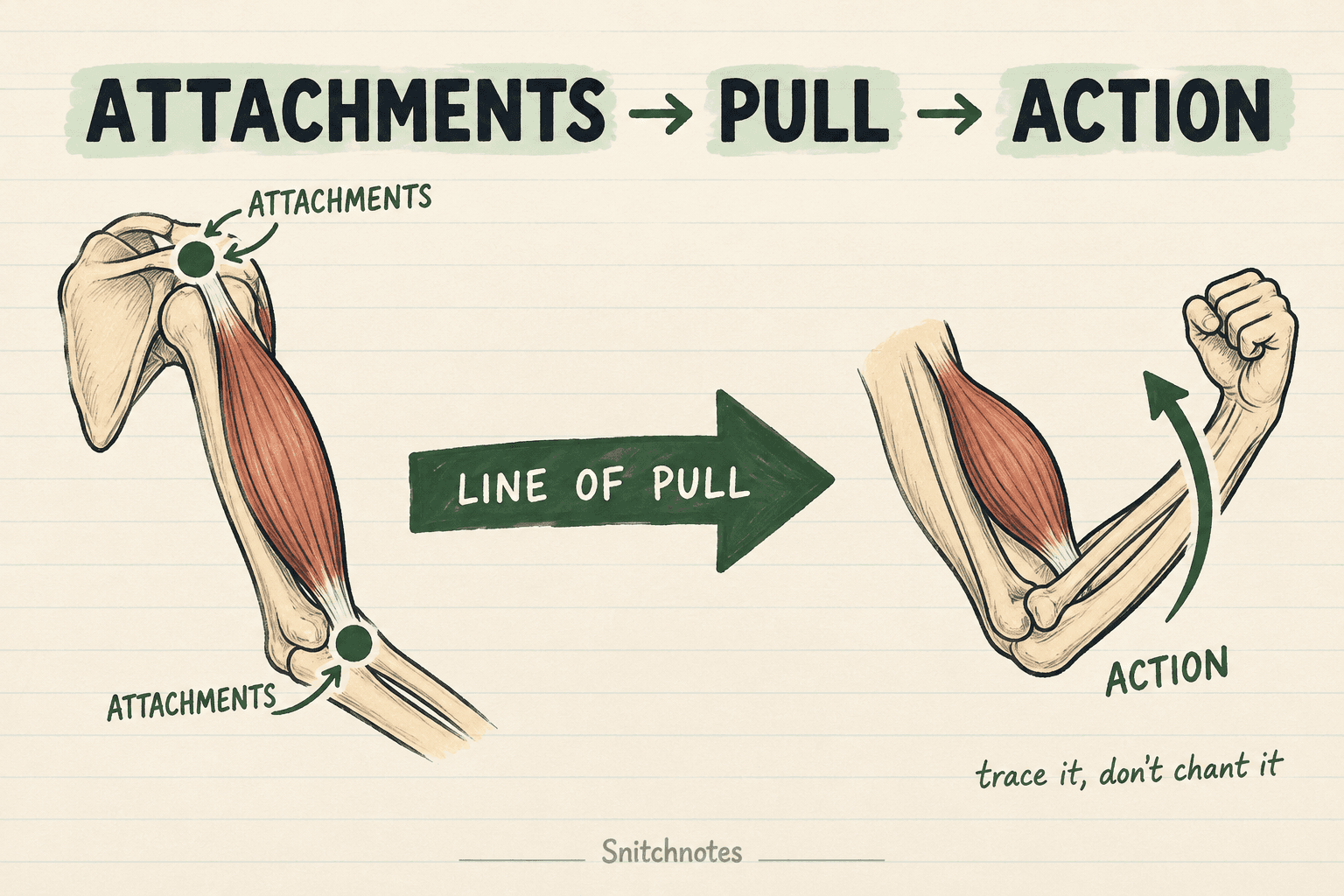
For each muscle, ask four questions in order. Where does it attach on the more stable side? Where does it attach on the side that usually moves? Which joint or joints does it cross? If the muscle shortens along that path, what movement should follow? Only after you can trace that chain should you add the nerve.
- Point to the origin and insertion on a blank regional diagram.
- Draw a single arrow from one attachment toward the other.
- Name every joint crossed and predict the movement around each one.
- Add innervation as the final retrieval cue, preferably grouped with nearby muscles supplied by the same nerve.
Say the chain as a sentence, not a chant: “This muscle attaches here and here, crosses this joint on this side, so shortening tends to produce this action.” If the predicted action conflicts with your atlas or course notes, inspect the route again instead of memorizing both facts blindly.
Worked example: biceps brachii
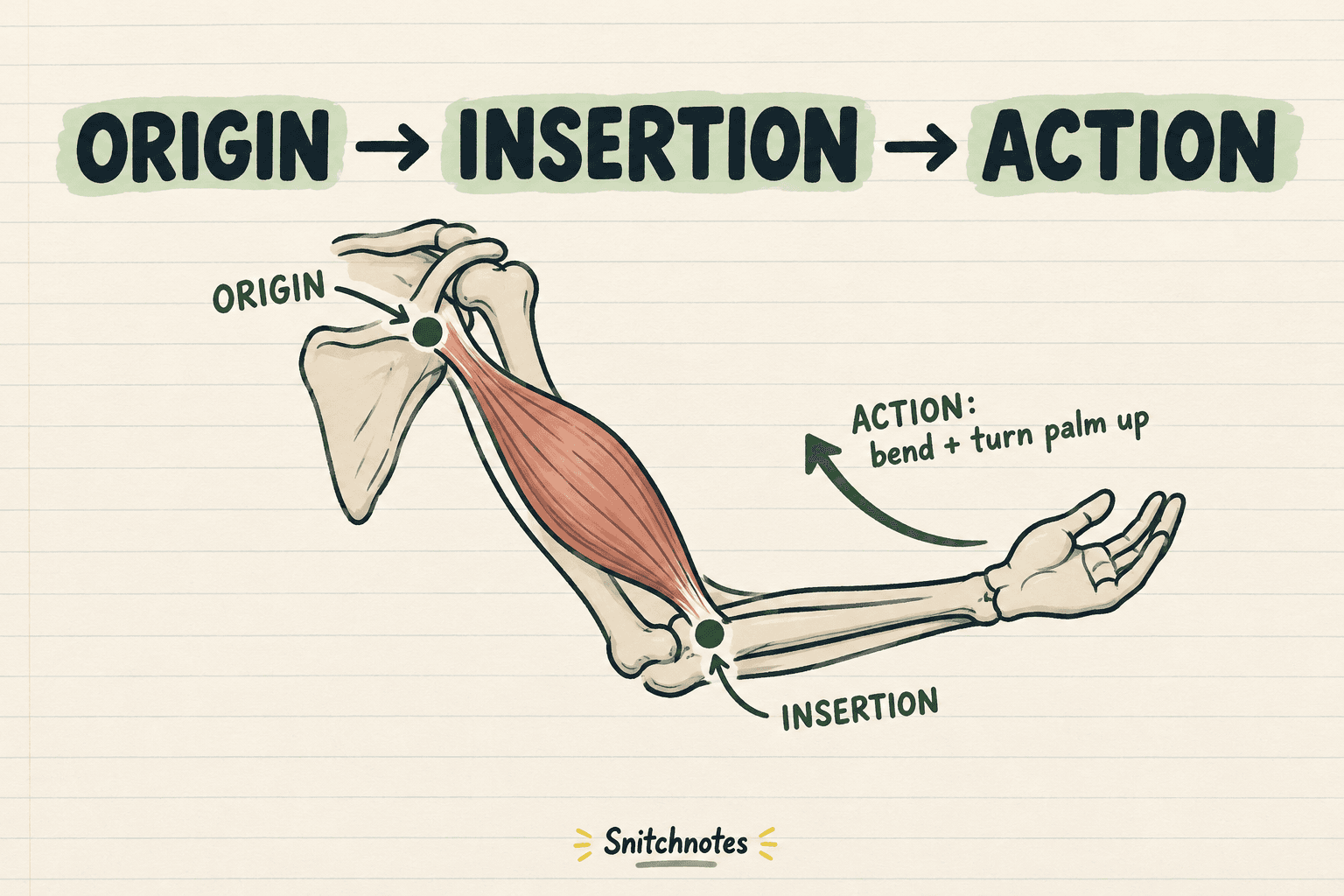
Biceps brachii has two proximal heads. The long head originates at the supraglenoid tubercle of the scapula, while the short head originates at the coracoid process. The muscle inserts at the radial tuberosity and into forearm fascia through the bicipital aponeurosis. It is innervated by the musculocutaneous nerve. These details are summarized in the National Library of Medicine's StatPearls anatomy review.
Now make the facts explain one another. The muscle crosses the elbow anteriorly, so shortening contributes to elbow flexion. Its distal attachment is on the radius, which rotates during forearm supination, so biceps also helps turn the palm upward. The two heads begin on the scapula, so the muscle also crosses the shoulder, although its role there is less useful as the first memory anchor.
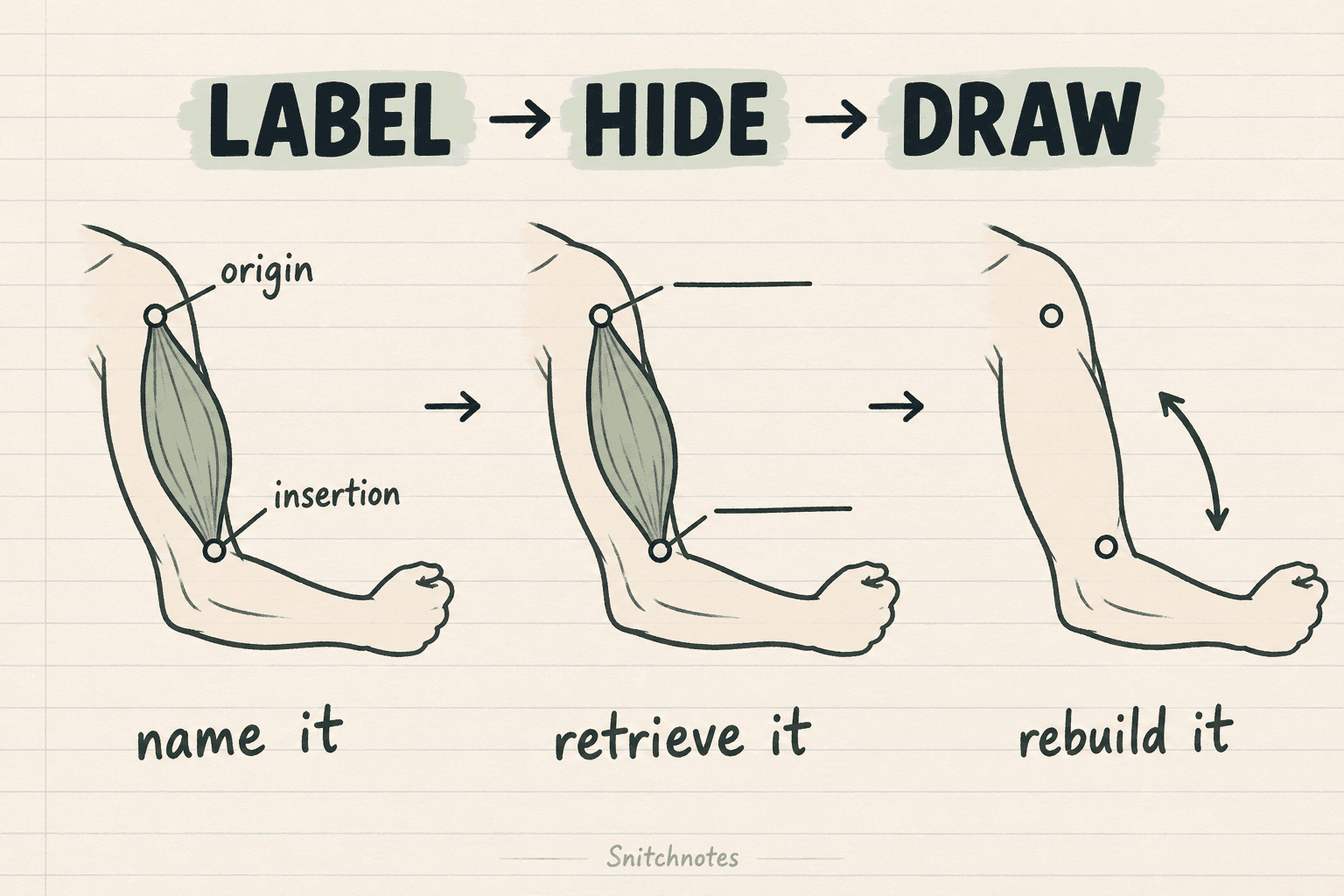
On your first card, colour the scapular origins green, the radial insertion dark green, and draw arrows for flexion and supination. On the next card, erase the words but keep the dots. On the third, keep only a faint arm outline. Each time, retrieve both origins, the insertion, the two clearest actions, and musculocutaneous nerve before checking.
Build a progressively blank body map
Use one sheet per region rather than one card per fact. Begin with the major bones and landmarks, then add only the muscles currently in your course. Give each muscle one colour or line style and keep the same orientation every time. A stable map helps you compare neighbours and spot which structures cross the same joint.
Create three versions: labelled, partly blank, and blank. Practise in both directions. Given the muscle, retrieve attachments and action; given an attachment or action, retrieve the muscle. Jeffrey Karpicke and Janell Blunt found that retrieval practice supported comprehension and inference as well as factual recall, which is exactly what you need when an exam changes the cue.
Run a three-pass practical drill
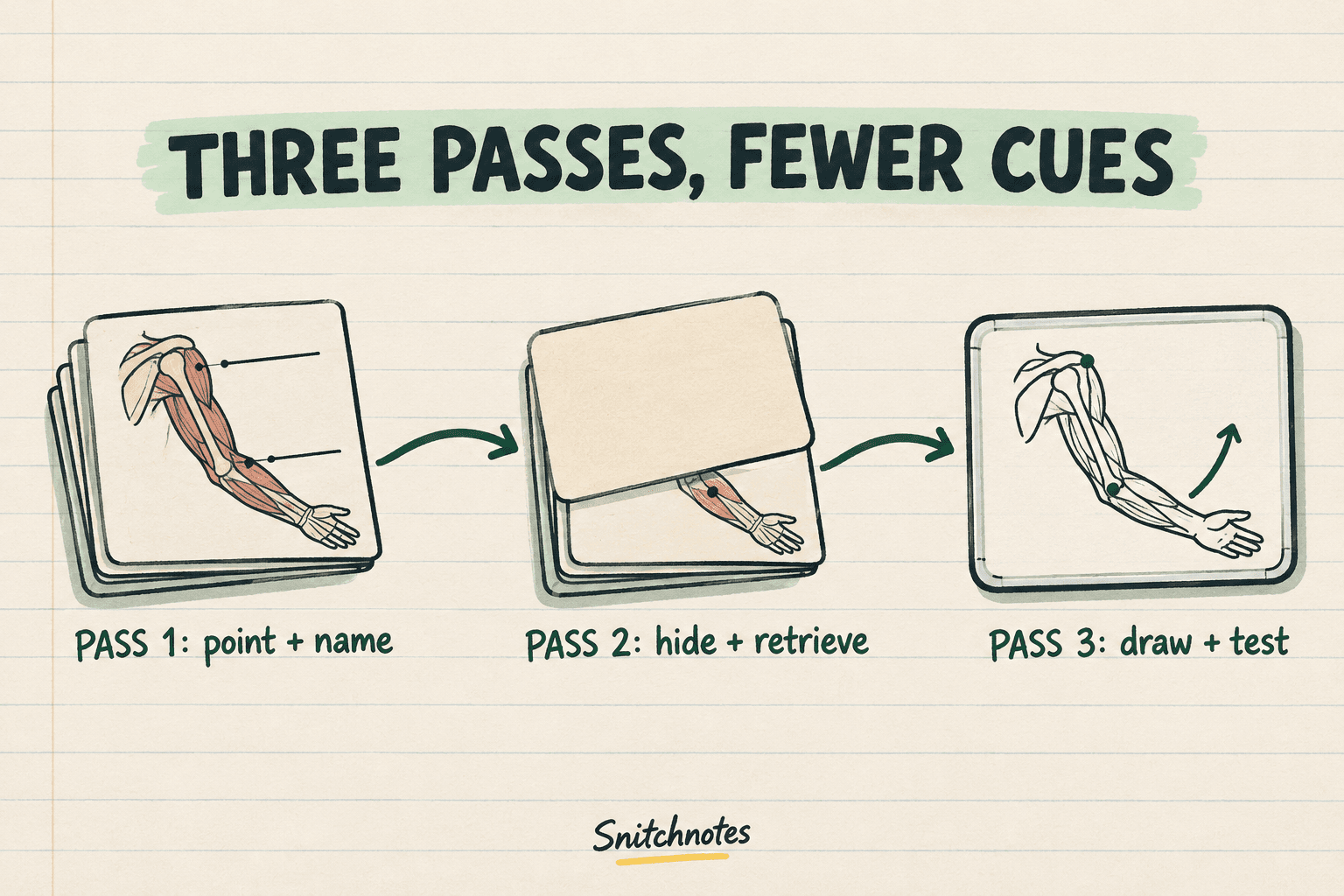
Pass one is point and name: use a labelled image and touch each landmark while saying the full chain. Pass two is hide and retrieve: cover the labels, answer aloud or in writing, and mark the exact missing detail. Pass three is draw and test: reconstruct the muscle on a blank outline, add the action arrow and nerve, then compare with a trusted atlas or course source.
Keep misses specific. “Biceps wrong” is not useful; “forgot short head origin: coracoid process” is. Retest that missing link after a short gap, then mix it with two nearby muscles so you must discriminate among similar attachments. Stop the session when you can retrieve accurately without the labelled plate, not when the plate merely looks familiar.
The boundary: anatomy does not obey one perfect shortcut
Origin is often described as the more fixed attachment and insertion as the more movable one, but that is a useful convention, not a law of motion. A fixed distal segment can reverse the usual action. Muscles may cross several joints, share actions, or change leverage with joint position. Use the attachment-to-action chain to organize and test facts, then verify the exact terminology and actions required by your course.
Do not infer innervation from movement alone. Nerve supply reflects developmental and regional patterns, and synergists can have different nerves. Learn the nerve with a compartment or regional group when possible, but check exceptions individually.
Check your understanding
Why does a line of pull help you remember action?
It connects the two attachments to the joint they cross. When the muscle shortens, the route suggests the direction of movement, so the action becomes a consequence rather than an isolated label.
What should disappear between the labelled and blank maps?
Remove cues gradually: first the names, then the muscle shape, then some landmarks. Keep enough structure to test the target without turning the task into a drawing contest.
What should you retrieve for biceps brachii?
Retrieve its two scapular origins, radial insertion, elbow flexion and forearm supination, and musculocutaneous innervation, then confirm the exact wording used by your course.
If turning lecture slides into progressively harder retrieval prompts takes longer than the studying, Snitchnotes can help transform your own anatomy materials into notes, quizzes, and flashcards for the same hide-retrieve-check loop.
Related concepts
- How to Study Histology for Medical School and Lab Practical Exams: use image-based retrieval for tissues and microscopic structures.
- How to Study for Lab Practicals: practise identification when the cue is a specimen, model, image, or pin.
- Retrieval practice: producing an answer from memory before checking it.
- Cue fading: gradually removing labels, landmarks, or prompts as recall improves.
Sources
OpenStax, Anatomy and Physiology 2e: Muscles of the Pectoral Girdle and Upper Limbs
National Library of Medicine, StatPearls: Anatomy, Shoulder and Upper Limb, Biceps Muscle
Convierte tus clases en material listo para el examen.
Apuntes, quizzes, podcasts, flashcards y chat — con solo subir un archivo.
Prueba tu primer apunte gratis