
Snitchnotes Team
Original vs Appellate Jurisdiction: Key Differences
Original vs Appellate Jurisdiction: Key Differences
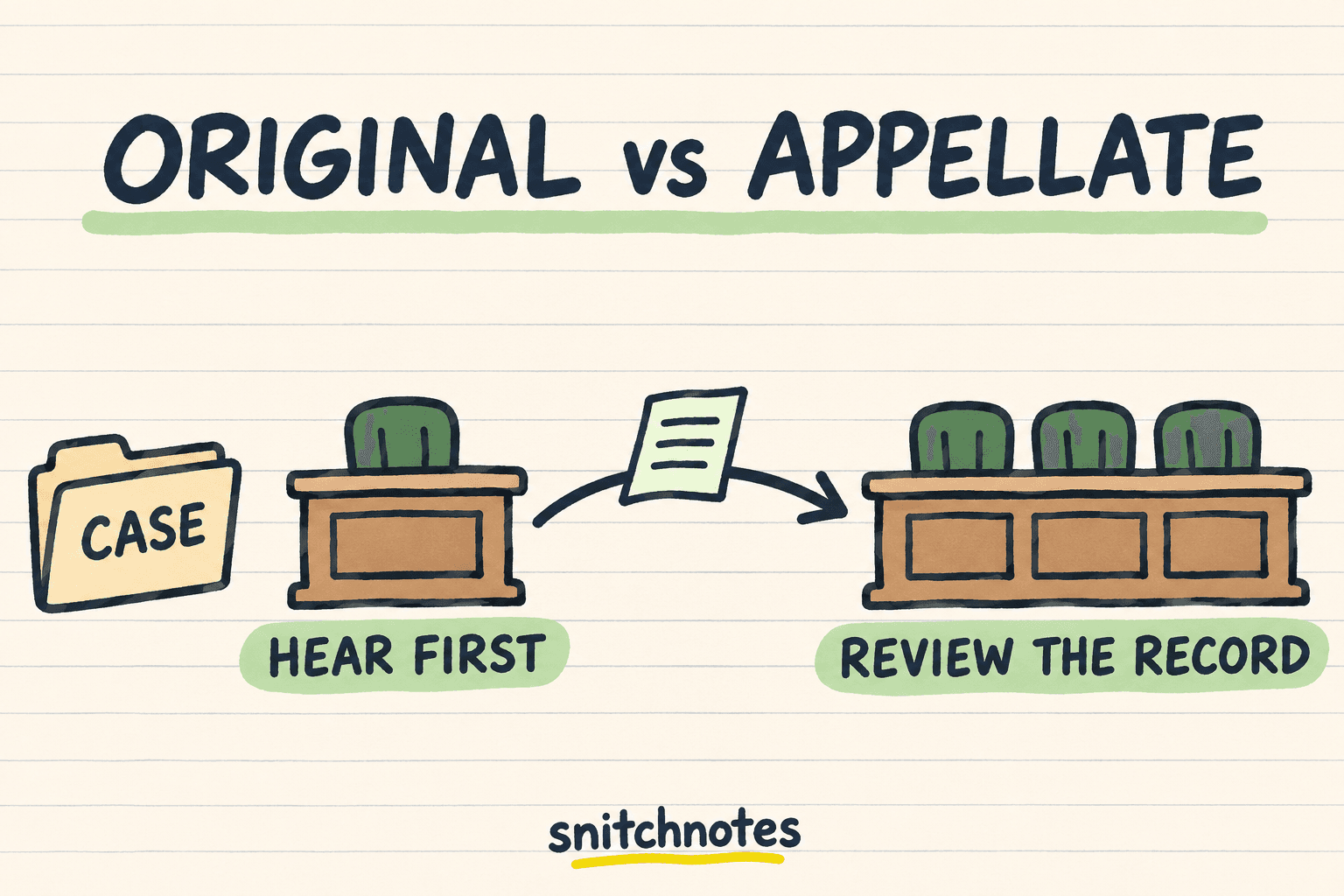
Original jurisdiction is a court's authority to hear and decide a case first. Appellate jurisdiction is a court's authority to review a decision already made by a lower court or tribunal. The simplest distinction is: original jurisdiction builds the trial record, while appellate jurisdiction examines that record for legal error.
That difference changes what the judges do, what material they consider, and what result they can produce. A trial court may hear witnesses and determine facts. An appellate court usually studies written briefs, the existing record, and the rulings below rather than holding a second trial.
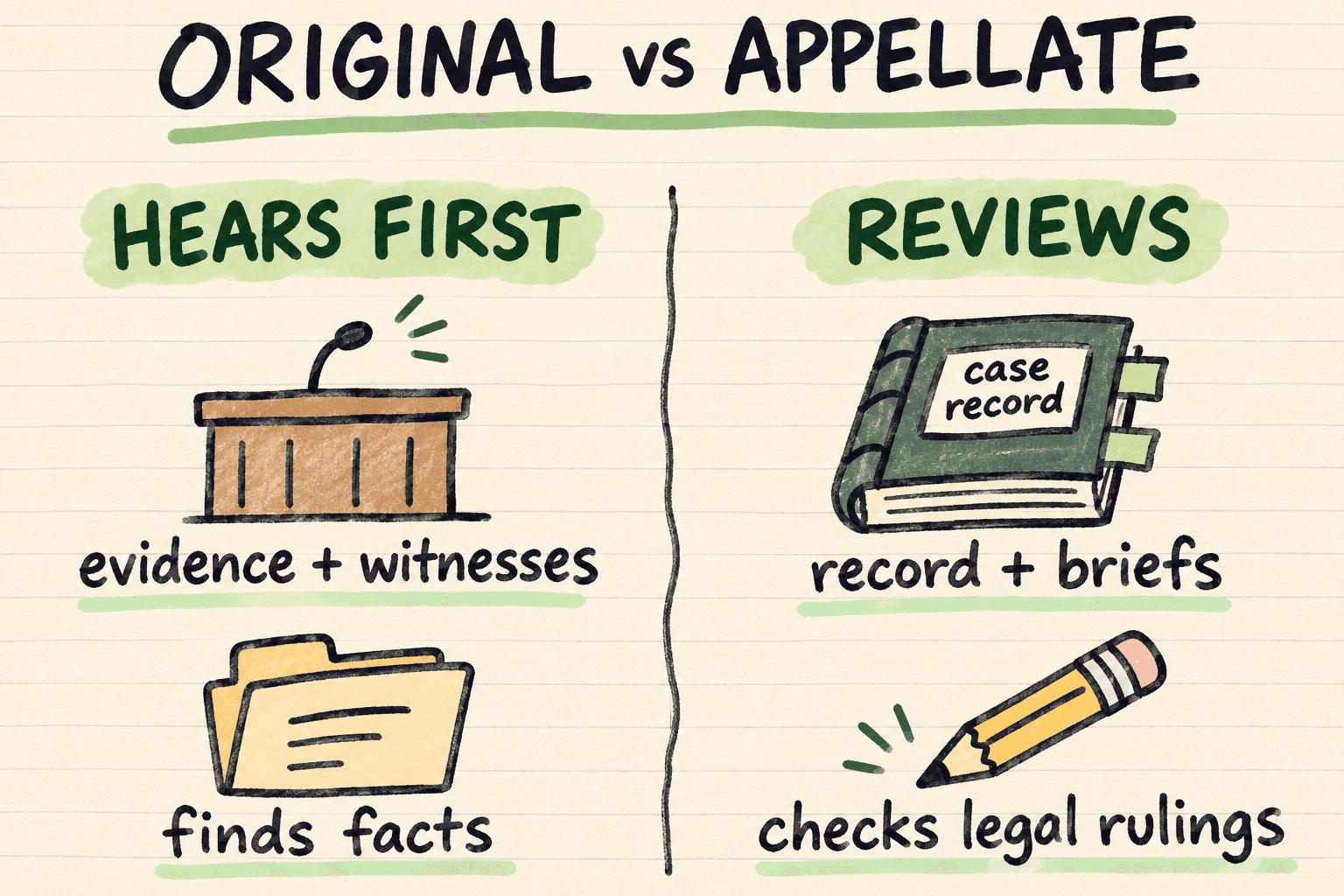
Original vs appellate jurisdiction at a glance
- Position in the case: original jurisdiction is where the case begins; appellate jurisdiction operates after an appeal or petition for review.
- Main material: the original court receives pleadings, testimony, exhibits, and arguments; the appellate court usually works from the record, briefs, and sometimes oral argument.
- Main task: the original court finds facts and applies law; the appellate court asks whether the lower court made a reviewable error.
- Typical result: the original court enters a judgment; the appellate court may affirm, reverse, modify, vacate, or remand, depending on the governing rules.
In the U.S. federal system, district courts resolve disputes by determining facts and applying law. The courts of appeals review whether proceedings were fair and the law was applied correctly. Exact procedures and appeal rights vary across countries, states, court systems, and types of case.
How original jurisdiction works
A court with original jurisdiction receives the dispute before any appellate review. In a civil case, the parties may file claims and defenses, exchange evidence, present witnesses, and ask a judge or jury to decide contested facts. The court then applies the relevant law and enters a judgment or order.
Original jurisdiction describes authority, not simply a building called a trial court. Trial courts usually exercise it, but higher courts can have limited original jurisdiction too. Article III of the U.S. Constitution, for example, gives the Supreme Court original jurisdiction in specified categories involving ambassadors, public ministers and consuls, and cases in which a state is a party.
How appellate jurisdiction works
A court exercising appellate jurisdiction reviews a decision made below. In federal appeals, the appellant argues that the trial court made an error; the appellee argues that the decision was correct or that any error did not matter enough to change the outcome. Many appeals are decided from written briefs, while some include a short oral argument before a panel of judges.
The record matters because an appeal is normally not a fresh evidentiary hearing. Federal Rule of Appellate Procedure 10 identifies the record on appeal, including the original papers and exhibits, the transcript if any, and the district court's docket entries. U.S. courts of appeals state plainly that they do not retry cases, hear new evidence, or hear witnesses testify.
Worked example: one contract dispute, two stages
Imagine a simplified dispute between Aster Design and Pine Workshop. Aster paid Pine $18,000 to deliver custom display cases by 1 May. The cases arrived six weeks late, and Aster sued for breach of contract. In the court with original jurisdiction, both sides submit the contract and emails. Witnesses explain the delay and the lost sales Aster claims. The judge decides what happened, applies contract law, and enters judgment for Aster.
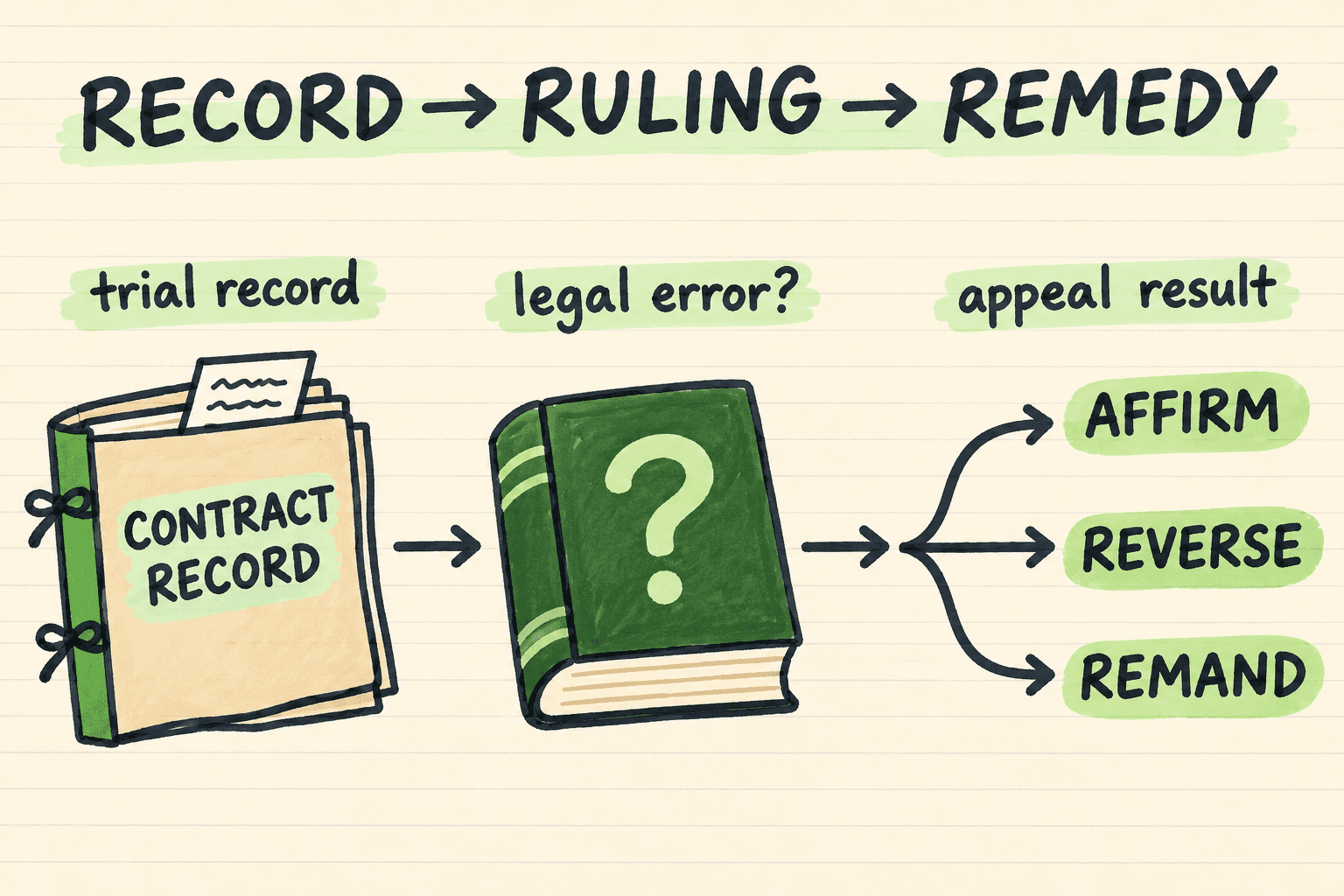
Pine appeals, arguing that the judge used the wrong legal test for deciding whether the late delivery was a material breach. The appellate judges do not recall the witnesses merely because Pine dislikes the factual findings. They examine the trial record, the parties' briefs, and the challenged legal ruling. If the trial court used the correct rule, they can affirm. If it used the wrong rule and the error affected the judgment, they might reverse or send the case back for the trial court to apply the correct rule. A new trial is one possible consequence of a remand, not the definition of an appeal.
From record to ruling to remedy
- Record: identify what the trial court actually received and decided.
- Ruling: identify the claimed legal or procedural error and the applicable standard of review.
- Remedy: decide whether to leave the judgment in place, change it, set it aside, or return the case for further proceedings.
This sequence explains why winning an appeal requires more than showing that a different judge might have reached a different conclusion. The appellant generally must identify a reviewable error and, under the applicable rules, show why that error justifies relief. Standards of review also differ: legal questions can receive closer review than many factual findings or discretionary trial-management decisions.
Common misconceptions and boundaries
First, appellate does not mean automatically better or more powerful in every respect. It describes a reviewing function. Second, an appeal is not always available immediately or as of right; deadlines, finality rules, preservation requirements, and discretionary review can matter. Third, appellate courts are not absolutely barred from every original proceeding. The federal courts' own description notes that courts of appeals hear some matters filed directly with them.
Finally, this comparison is a learning model, not legal advice. Court names and jurisdictional boundaries differ. When analyzing a real case, ask which law grants the court authority, what decision is reviewable, what record is available, and what remedies that particular court may order.
Check your understanding
Which court usually hears witnesses and receives new evidence?
The court exercising original jurisdiction, usually a trial court, because it must build the factual record and decide the case first.
Does an appellate court normally hold the whole trial again?
No. It normally reviews the existing record and the claimed errors. A remand may lead to more proceedings below, but appellate review itself is not a retrial.
Why can the Supreme Court have both kinds of jurisdiction?
Because jurisdiction depends on the legal grant of authority, not only on a court's rank. The Constitution gives the Supreme Court original jurisdiction in narrow categories and appellate jurisdiction in many other federal cases.
If court structures blur together in long civics notes, Snitchnotes can turn your own lectures, slides, and readings into organized notes, flashcards, and quizzes for review.
Related concepts
- Standard of review: the level of deference an appellate court gives to a lower court's decision.
- Remand: an order returning a case to a lower court for specified further proceedings.
- Judicial review: how courts assess whether government action is lawful or constitutional.
- Civil law vs criminal law: compare the parties, purposes, proof, and outcomes of two major case types.
Sources
Administrative Office of the U.S. Courts: Court Role and Structure
Administrative Office of the U.S. Courts: About the U.S. Courts of Appeals
Administrative Office of the U.S. Courts: Appeals
Congress.gov Constitution Annotated: U.S. Constitution, Article III
Convierte tus clases en material listo para el examen.
Apuntes, quizzes, podcasts, flashcards y chat — con solo subir un archivo.
Prueba tu primer apunte gratis