
Snitchnotes Team
How to Solve Pedigree Problems When the Inheritance Pattern Is Unclear
How to Solve Pedigree Problems When the Inheritance Pattern Is Unclear
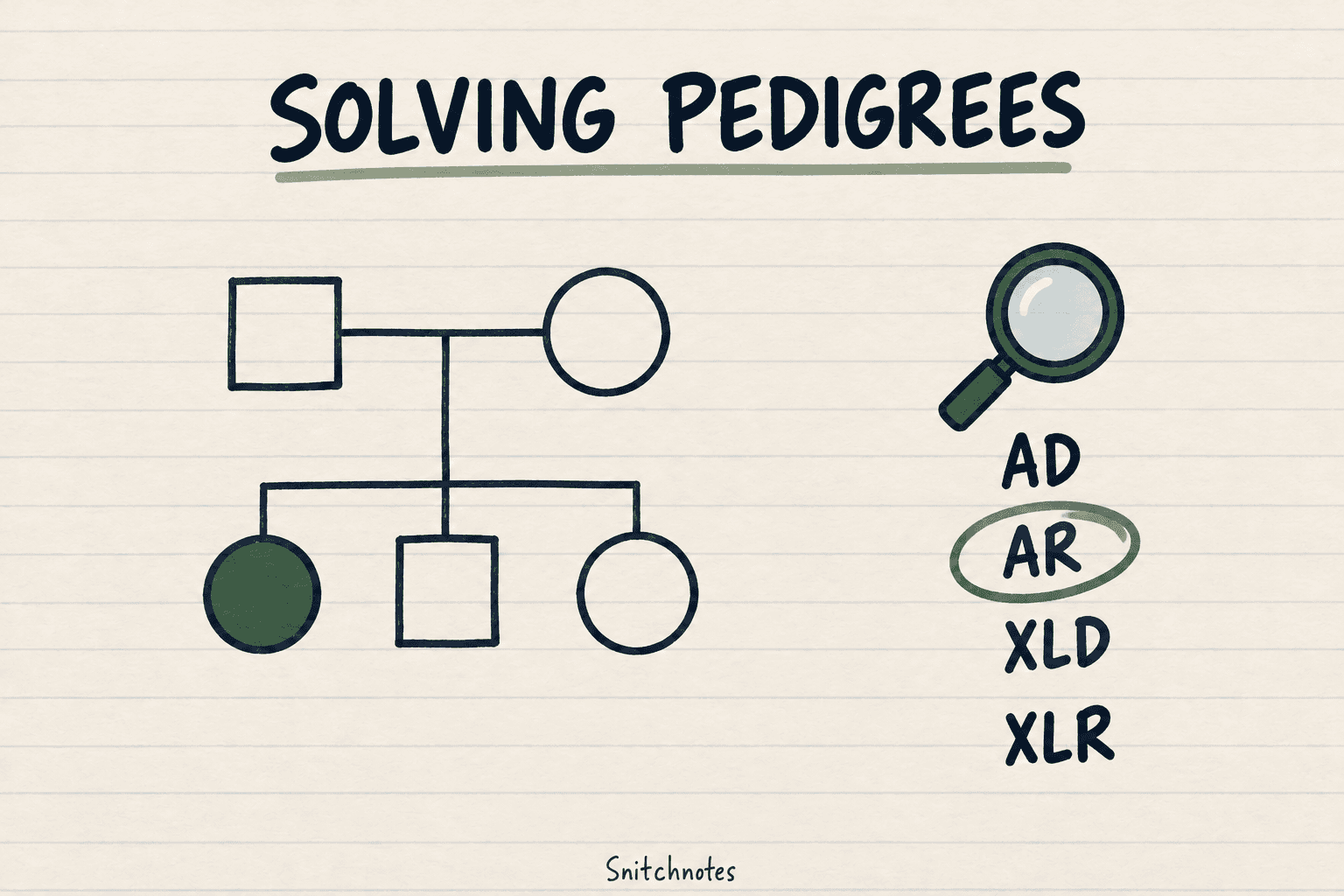
To solve an unclear pedigree problem, treat each inheritance pattern as a hypothesis and try to disprove it with the strongest family evidence. Check whether the trait skips generations, whether unaffected parents have an affected child, whether one sex is affected more often, and whether father-to-son transmission occurs. Then assign only the genotypes the pedigree actually forces.
This contradiction-first method is more reliable than guessing from the overall shape. A pedigree is a family chart showing relationships and the appearance of a trait across generations; filled symbols usually mark affected people, squares usually represent males, and circles usually represent females. The chart provides constraints, not a magic visual pattern.
Start with contradictions, not visual impressions
Write four candidates beside the pedigree: autosomal dominant, autosomal recessive, X-linked dominant, and X-linked recessive. Do not ask which one the diagram resembles. Ask what each model would make impossible under the simplified assumptions of the question. One hard contradiction is worth more than several vague similarities.
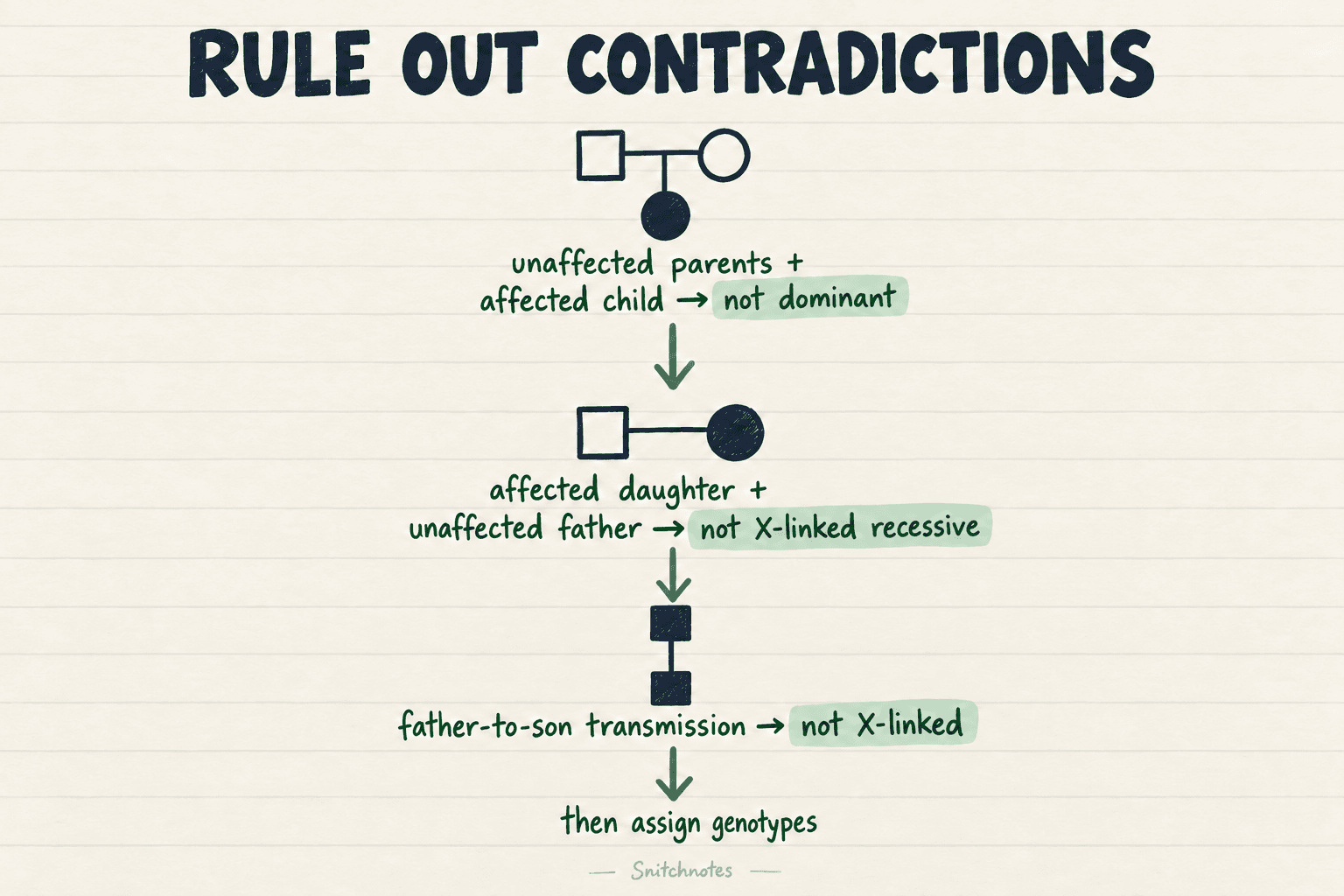
For example, two unaffected parents producing an affected child contradicts a simple fully penetrant dominant model because an affected child would normally need an affected parent. An affected daughter with an unaffected father contradicts X-linked recessive inheritance because she would need a disease-causing X chromosome from her father. Direct father-to-son transmission rules out X-linkage because a father gives his Y chromosome, not his X chromosome, to a son.
Use a dependable order of evidence
Scan the pedigree in an order that favors decisive clues. This stops you from overvaluing a small difference in the number of affected males and females.
- Check parent-child contradictions. Can two unaffected parents produce the shown affected child under this model? Can two affected parents produce an unaffected child?
- Check sex-linked impossibilities. Look for father-to-son transmission, affected daughters with unaffected fathers, and the pattern of daughters born to affected fathers.
- Check whether the trait appears in every generation. A vertical pattern supports dominance, while skipped generations support recessiveness, but neither clue proves the model alone.
- Assign forced genotypes and test every person. If one individual cannot receive the required alleles from their parents, reject the model.
Worked example: two unaffected parents and an affected daughter
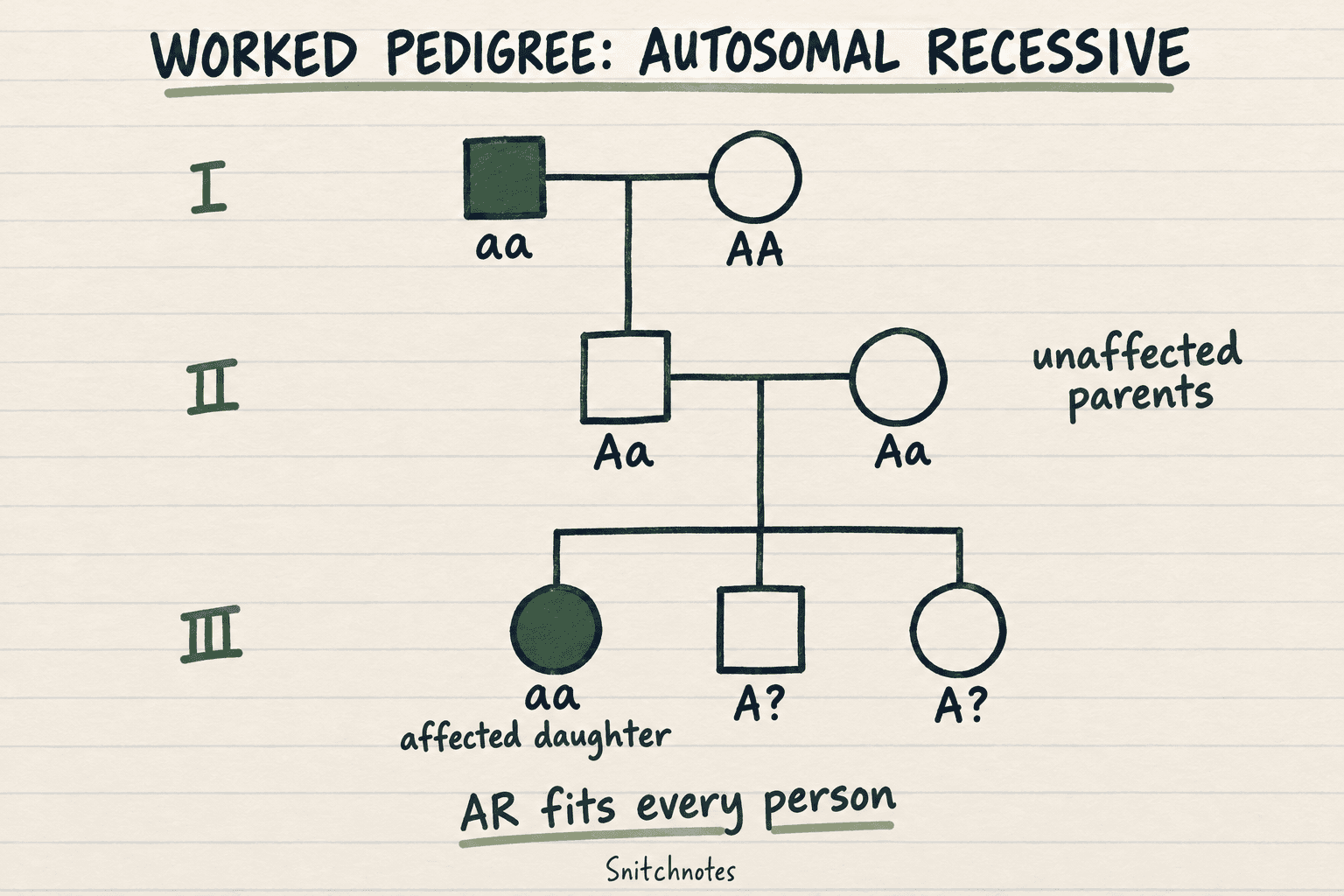
Consider a three-generation family. In generation I, an affected grandfather with genotype aa and an unaffected grandmother with genotype AA have an unaffected son. That son must be Aa: he receives a from his father and A from his mother. In generation II, he and an unaffected partner have three children, including an affected daughter.
1. Rule out simple dominant inheritance
Both parents in generation II are unaffected, yet their daughter is affected. Under the usual exam assumption of full penetrance and no new mutation, neither autosomal dominant nor X-linked dominant inheritance can explain that child. Cross out both dominant models.
2. Rule out X-linked recessive inheritance
An affected daughter would need a disease-causing X chromosome from both parents. Her father is unaffected, so his single X chromosome cannot carry the recessive allele under this model. The daughter's sex therefore gives a direct contradiction: cross out X-linked recessive inheritance.
3. Test autosomal recessive genotypes
Autosomal recessive inheritance fits. The affected daughter is aa, so each parent must contribute a. Because both parents are unaffected, each must also carry A, making them Aa. Their other children can be AA or Aa, so write A? unless the pedigree gives more evidence. The pattern works for every person shown without inventing an exception.
If both parents are carriers, each pregnancy has a 1 in 4 probability of aa, a 1 in 2 probability of Aa, and a 1 in 4 probability of AA. Those probabilities restart for each child. Three siblings are not required to display a neat 1:2:1 ratio; that ratio describes expected outcomes across many independent pregnancies.
Assign genotypes without overclaiming
Start with genotypes that are certain. In an autosomal recessive pedigree, affected people are aa. Unaffected parents of an affected child must be Aa. An unaffected child of two carriers could be AA or Aa, so A? is the honest answer unless another relationship settles it. In a dominant pedigree, unaffected people are aa, while an affected person may be Aa or AA.
Use the same restraint for X-linked models. A male has one X chromosome, so write a single allele on X rather than treating him as homozygous or heterozygous. Follow the X chromosome through actual parent-child links: fathers pass it to every daughter and no sons, while mothers pass one of their X chromosomes to children of either sex.
Know where textbook rules stop
Real pedigrees can be messier than exam diagrams. Small families may hide an expected pattern by chance. Reduced penetrance can make someone with a disease-associated genotype appear unaffected, while variable expression changes severity. New mutations, incomplete family information, adoption, mitochondrial inheritance, and traits influenced by several genes can also break the four-model checklist.
So phrase conclusions at the right strength. In a classroom problem designed around one Mendelian gene, choose the model that explains everyone without contradiction. In clinical genetics, a pedigree can suggest an inheritance pattern, but family history and molecular testing may be needed to establish what is actually happening.
Check your understanding
Which clue immediately rules out X-linked inheritance?
Direct father-to-son transmission. A son receives his Y chromosome from his father, so a trait transmitted through the father's X chromosome cannot pass directly to that son.
Why does an affected daughter with an unaffected father rule out X-linked recessive inheritance?
An affected daughter needs a recessive allele on both X chromosomes. One X comes from her father; if he is unaffected, his single X does not carry the disease-causing recessive allele under the simplified model.
What genotype should you assign to an unaffected child of two autosomal recessive carriers?
Write A? unless other evidence distinguishes AA from Aa. Being unaffected proves the child has at least one dominant A allele, but it does not reveal the second allele.
If genetics diagrams are scattered across lectures and PDFs, Snitchnotes can turn your own material into clearer notes, flashcards, and quizzes so you can practise ruling out inheritance models instead of memorizing silhouettes.
Related concepts
- Genotype and phenotype: the allele combination a person carries versus the observable trait recorded in the pedigree.
- Penetrance: the proportion of people with a genotype who show its associated phenotype.
- How to study histology for medical school and lab practical exams
- How to study the complement system without rote memorization
Sources
National Human Genome Research Institute: Pedigree
Genetic Science Learning Center, University of Utah: Inheritance Patterns for Single Gene Disorders
OpenStax Biology 2e: Characteristics and Traits
National Center for Biotechnology Information: Inheritance Patterns
Convierte tus clases en material listo para el examen.
Apuntes, quizzes, podcasts, flashcards y chat — con solo subir un archivo.
Prueba tu primer apunte gratis