
Snitchnotes Team
Why Does Metal Feel Colder Than Wood at the Same Temperature?
Why Does Metal Feel Colder Than Wood at the Same Temperature?
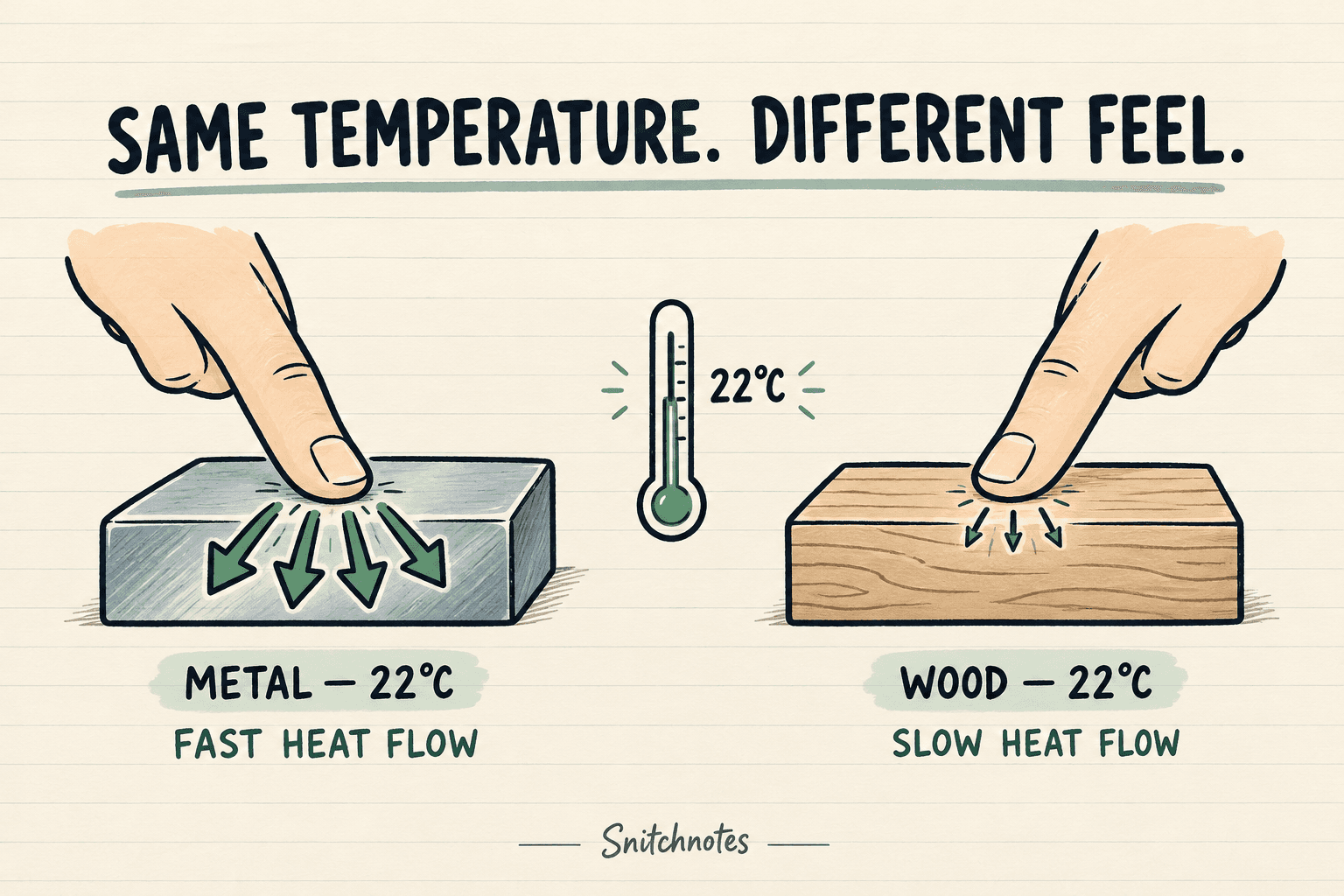
Metal feels colder than wood at the same temperature because it transfers heat away from your skin much faster. Your touch receptors respond to the cooling of your skin, not to an object’s temperature as precisely as a thermometer does. The metal is not secretly colder; it simply changes your skin temperature faster during contact.
This matters because the everyday words hot and cold mix up two different ideas: temperature and heat flow. Temperature describes a thermal state. What you feel in the first moments of touching something depends strongly on how quickly energy crosses the contact between your skin and the material.
What your hand is actually sensing
If your hand is warmer than a room-temperature object, energy flows from your skin into that object. As the skin near the contact cools, cold-sensitive nerve endings change their activity and your brain interprets the signal as coolness. The faster and larger that local temperature change is, the colder the surface tends to feel.
A thermometer works differently. Given proper contact and enough time, it measures temperature rather than asking how quickly the object can cool a fingertip. That is why touch is useful for noticing change but unreliable for comparing the true temperatures of different materials.
Sophie’s first five seconds at 22°C
Sophie walks into a classroom that has been at 22°C all morning. She touches a steel chair leg with one finger and the wooden desktop with another. A thermometer gives the same 22°C reading for both, yet the steel feels sharply colder. Nothing mysterious happens to the numbers when her fingers arrive.
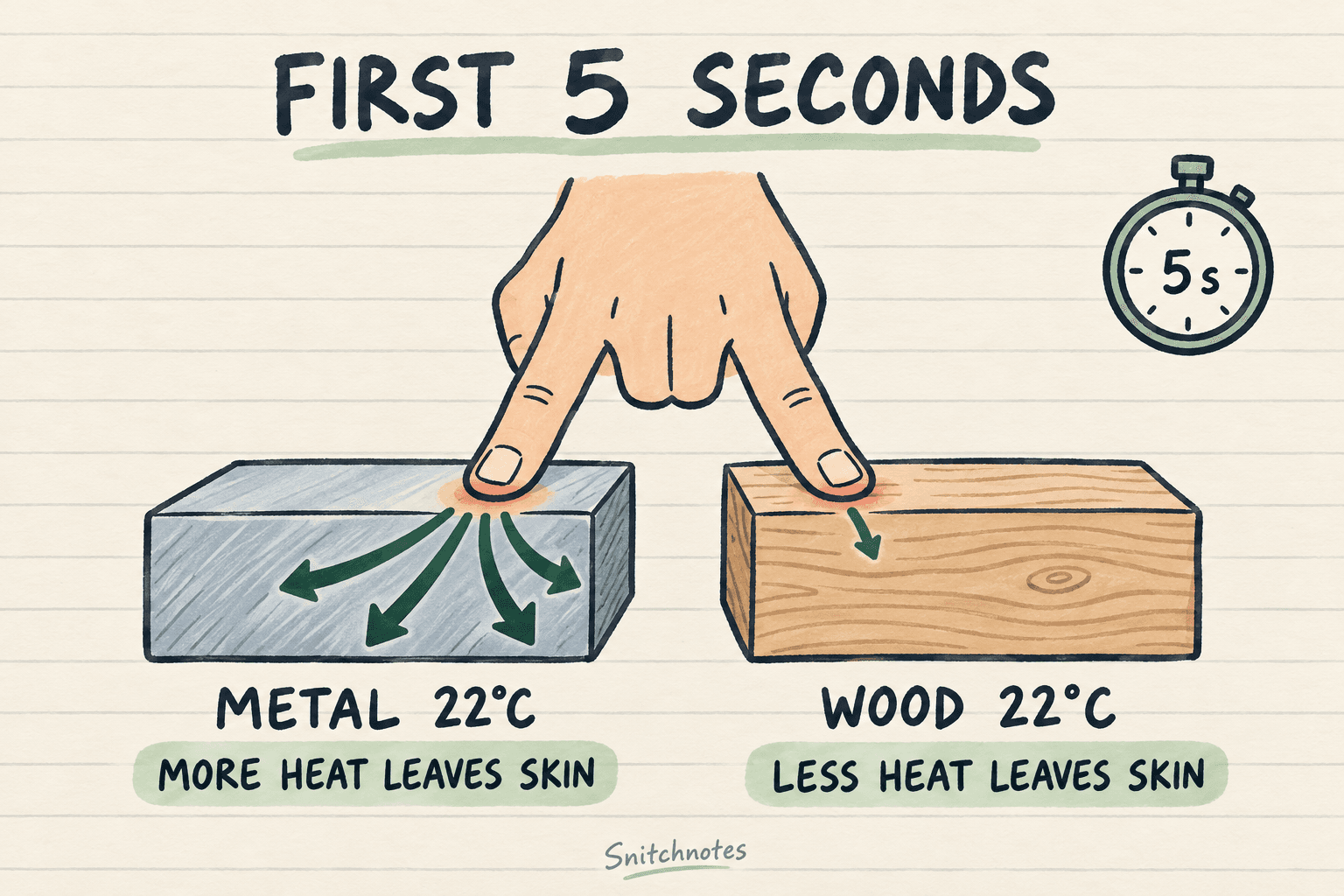
Follow only the first five seconds. The steel accepts energy at the contact and conducts it into fresh, cooler parts of the chair leg, so the surface near Sophie’s finger does not warm as quickly. Wood transfers energy inward much more slowly. Its thin surface layer warms toward skin temperature, reducing the temperature difference and slowing further heat flow.
That is the screenshot-sized lesson: same thermometer reading, different heat-flow arrows. Sophie is feeling the rate at which her skin is losing energy, not discovering two different room temperatures.
Why metal moves heat away faster
Metals contain mobile electrons that help transport thermal energy through the material. Wood, by contrast, has a cellular structure that contains many tiny pockets of air, and air is a poor conductor. The exact values depend on the metal alloy, wood species, grain direction, moisture, and temperature, but the broad contrast is large enough to notice with a fingertip.
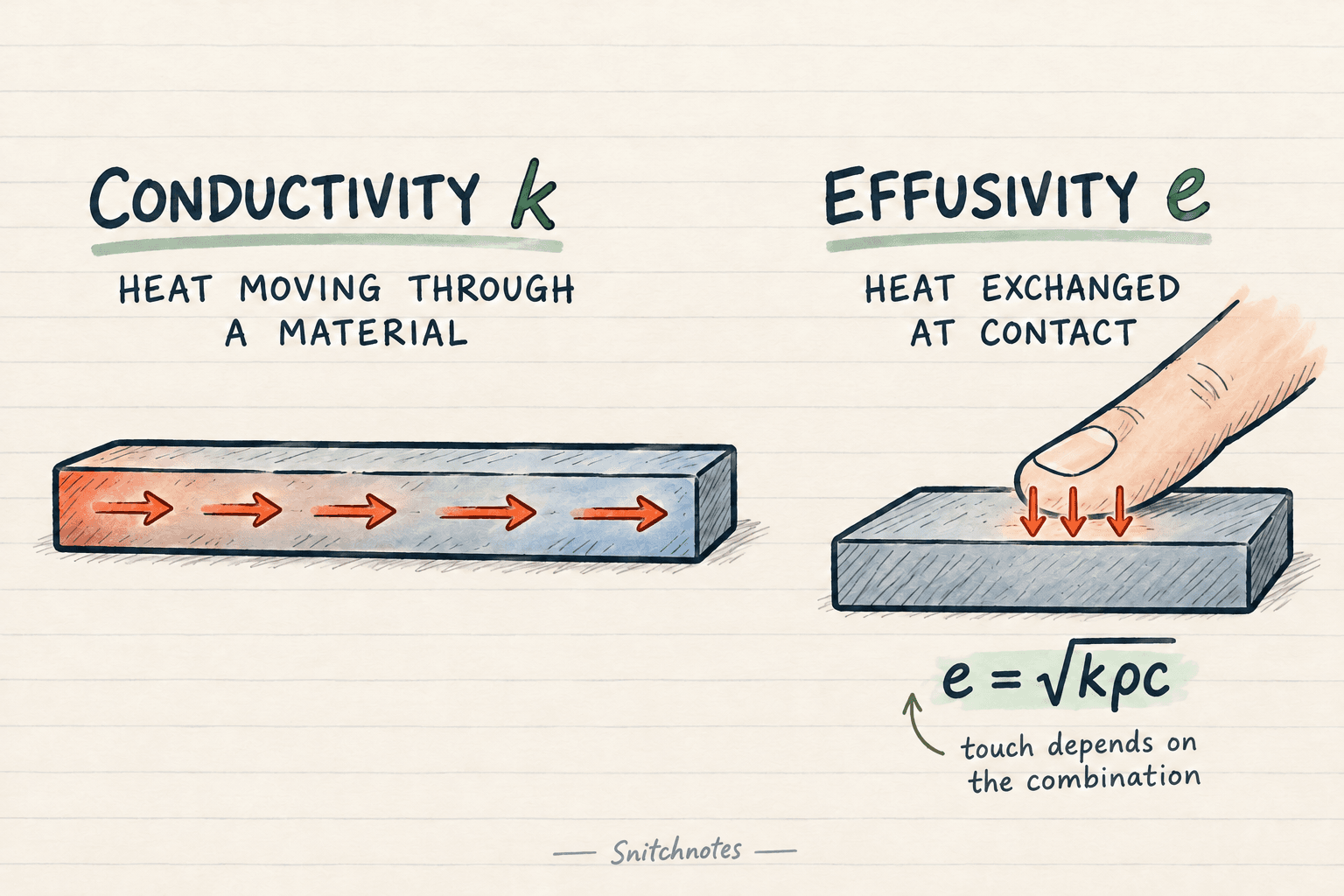
Thermal conductivity, written as k, describes how readily heat moves through a material under a temperature gradient. Higher conductivity lets the energy arriving from your finger spread away from the contact region. The nearby metal therefore remains able to accept more energy, while the wood surface warms locally and begins to feel less cool.
Conductivity helps, but effusivity tells the fuller story
Conductivity is important, but the initial touch sensation also depends on how much thermal energy a material can absorb without its temperature changing very much. Thermal effusivity captures that contact behavior. It is defined as e = √(kρc), combining thermal conductivity k, density ρ, and specific heat capacity c.
A material with high effusivity can exchange energy rapidly at its surface and has substantial thermal capacity behind that exchange. Typical metals have much higher effusivity than typical dry woods, so contact with metal pulls the skin’s surface temperature closer to the metal’s temperature. This is why saying only “metal conducts better” is useful but incomplete: the cool-touch effect comes from transient contact between two materials, your skin and the object.
The important boundary: metal can also feel hotter
Heat flow reverses when the object is warmer than your skin. Put equal-temperature metal and wood in a warm environment and the metal may feel hotter because it delivers energy to your skin faster. The same property that makes a cool metal railing feel icy makes a hot metal surface especially hazardous.
Surface coatings, thickness, contact pressure, moisture, and contact time also matter. A thin metal foil over an insulating backing may quickly warm because there is little metal available to absorb energy. Damp wood can behave differently from dry wood. Your hand is therefore sensing a whole contact event, not reading a permanent label attached to the material.
A safe classroom comparison
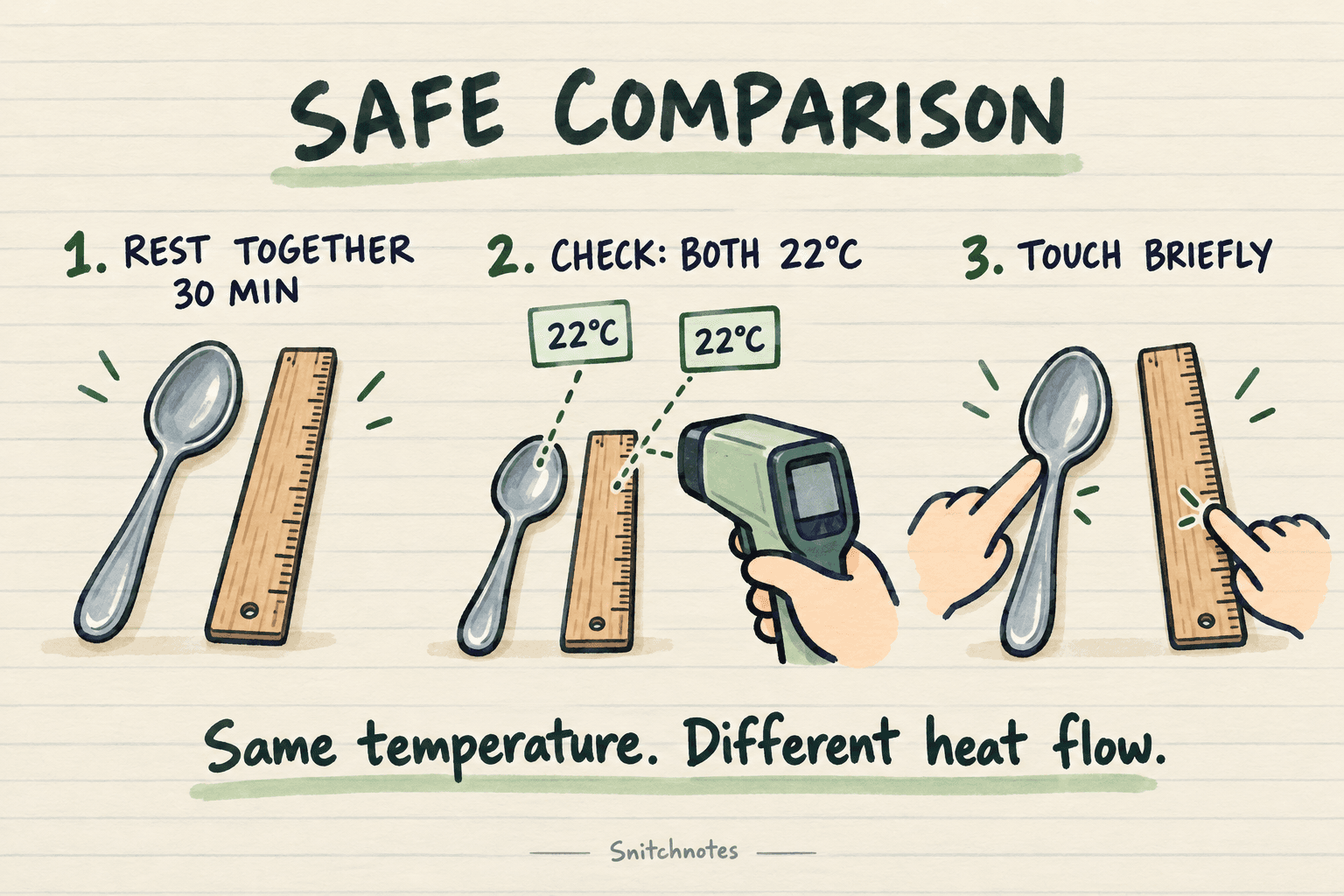
Place a metal spoon and a wooden ruler side by side in the same room for at least 30 minutes. Use a suitable thermometer to check that their surfaces are close to the same temperature. Then touch each briefly with the same part of your hand, using similar pressure. The metal should feel cooler even though the measured temperatures match.
Keep the comparison at ordinary room temperature. Do not use a stove, flame, boiling water, freezer-chilled metal, or any unknown surface. The point is to isolate material behavior safely, not to test pain or burn thresholds.
A common misconception: cold is stored inside the metal
Cold is not a substance that metal contains. In this situation, thermal energy leaves the warmer skin and enters the cooler object. Metal feels colder because that transfer proceeds faster. After long enough contact, the local temperatures move toward equilibrium and the dramatic difference in sensation shrinks.
Check your understanding
If metal and wood both read 22°C, why does the metal feel colder?
The metal draws heat from warmer skin faster, producing a quicker drop in skin temperature and a stronger cold sensation.
Would metal still feel colder if both objects were hotter than your hand?
No. The direction of heat flow would reverse, and the metal would usually feel hotter because it transfers energy into your skin faster.
Why is thermal effusivity more complete than conductivity alone?
Effusivity includes conductivity, density, and specific heat capacity, so it better describes how a material exchanges energy during brief contact.
If your physics notes blur temperature, heat, and conductivity together, Snitchnotes can turn your lectures, slides, and PDFs into clearer study notes, flashcards, quizzes, and audio.
Related concepts
- Thermal equilibrium: the state reached when objects in contact no longer exchange net heat.
- Thermal diffusivity: how quickly a temperature disturbance spreads through a material.
- Why stars twinkle but planets do not: another familiar observation explained by physics.
- Dimensional analysis in chemistry: a step-by-step method for keeping units and quantities straight.
Sources
University of Illinois Physics Van: Cold Metal
Exploratorium Teacher Institute: Cold Metal
PubMed: Thermal effusivity of different tabletop materials in relation to users’ perception
National Center for Biotechnology Information Bookshelf: TRPM8—The Cold and Menthol Receptor
Convierte tus clases en material listo para el examen.
Apuntes, quizzes, podcasts, flashcards y chat — con solo subir un archivo.
Prueba tu primer apunte gratis