
Snitchnotes Team
Why Does Roman Concrete Last So Long?
Why Does Roman Concrete Last So Long?
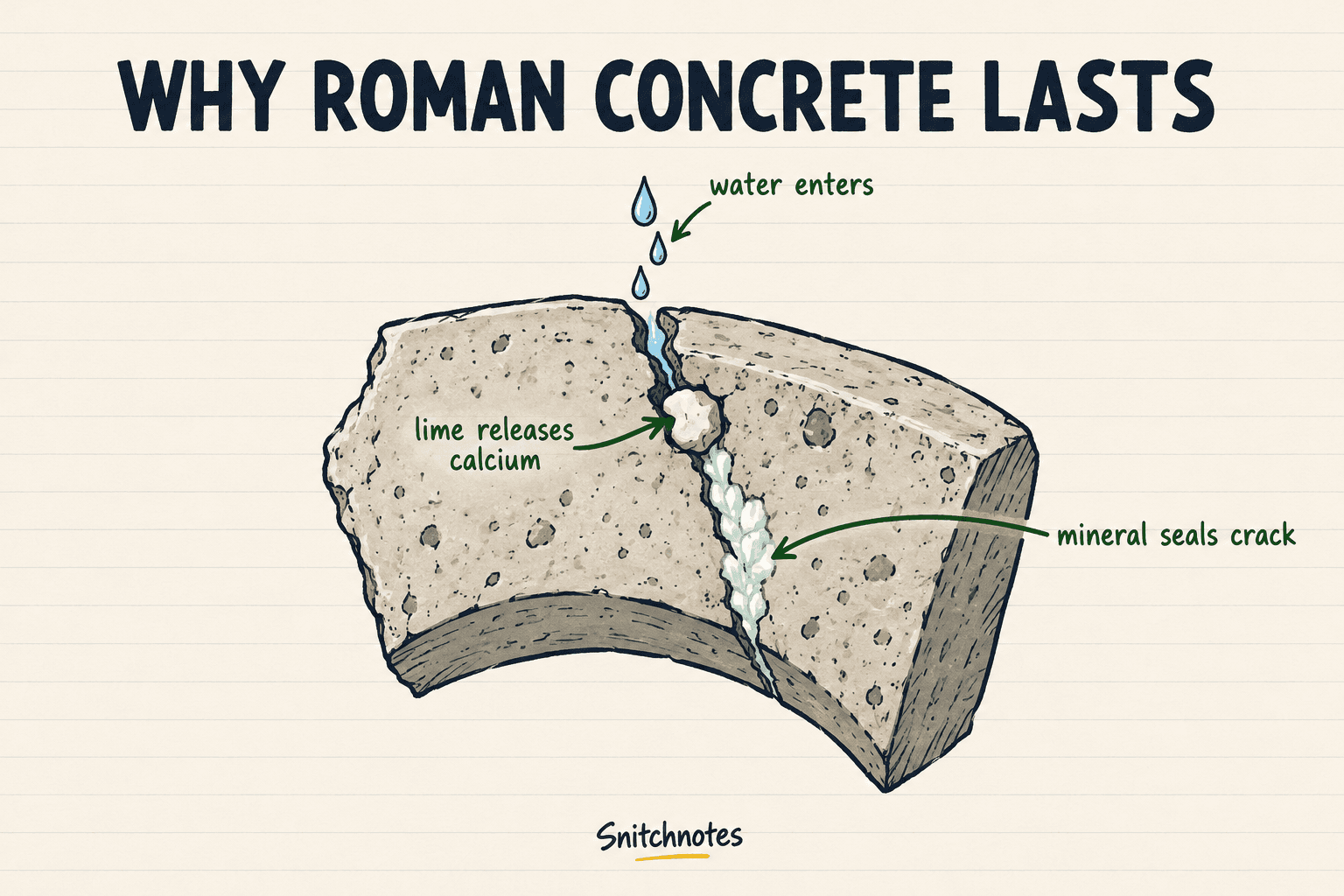
Roman concrete can last for centuries because some mixes combined reactive volcanic material with lime, were made by processes that left useful lime clasts, and continued to form strengthening minerals when water moved through them. In some cases, those reactions could even seal small cracks before they became larger paths for damage.
There is no single lost miracle recipe, though. Roman builders used different materials for domes, walls, foundations, and harbors. The famous survivors also give us a biased sample: failed structures are much harder to inspect two thousand years later.
Why Roman concrete durability matters
The puzzle is not simply that old stone buildings remain. The Pantheon, harbor works, aqueducts, and other Roman structures contain cast mortar or concrete that has stayed coherent through water, weather, and time. Understanding why matters because a material that resists crack growth and keeps useful chemistry active for longer may need fewer repairs and replacements.
The history is also a useful warning against judging a material by one ingredient. Durability came from a system: raw materials, mixing temperature, pore structure, exposure, geometry, and maintenance all interacted. Change the job or environment and the winning recipe can change too.
What Roman concrete was made from
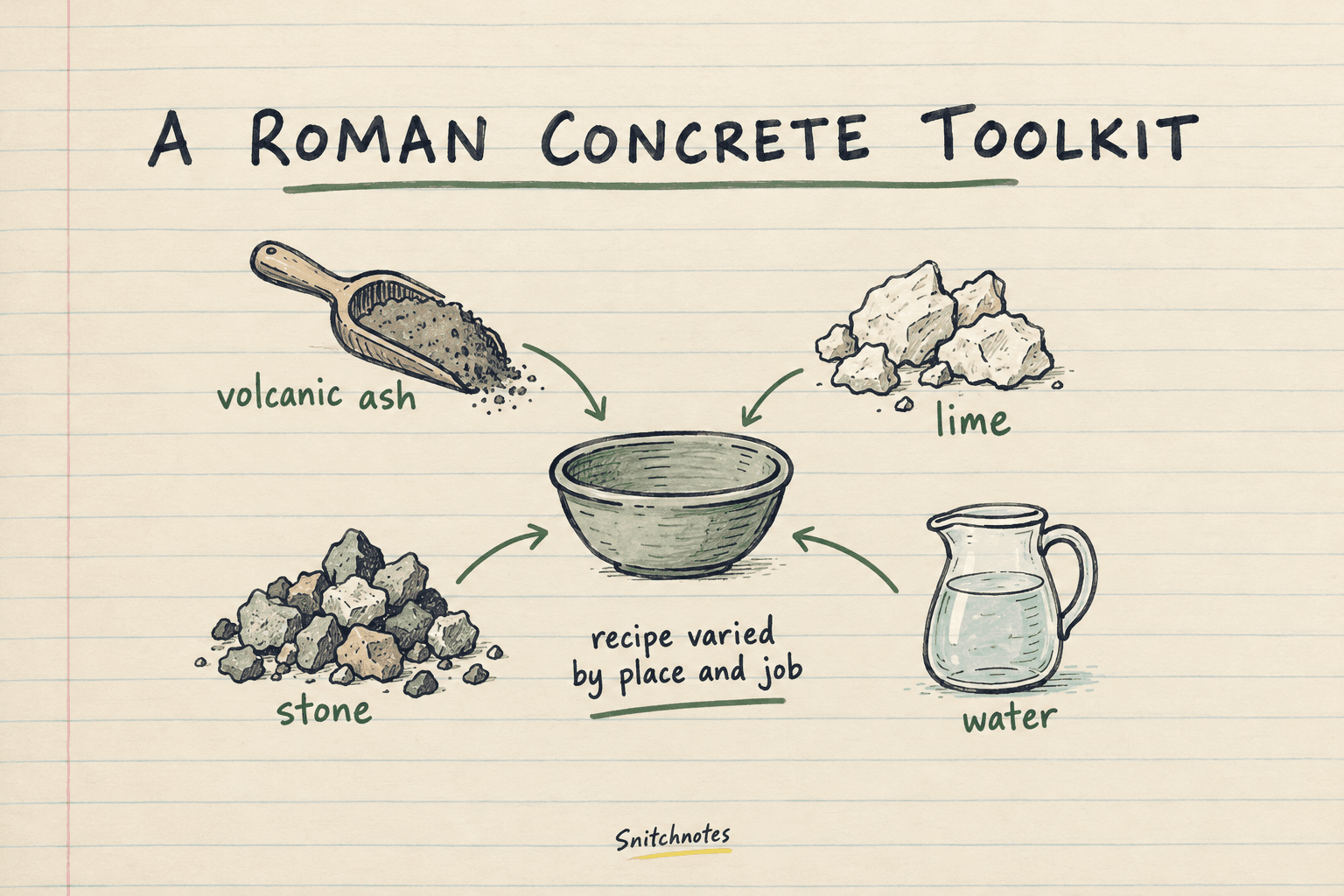
Concrete is a composite: a binder holds larger pieces of aggregate together. Roman builders commonly made the binder from lime and a reactive silicate-rich material, often volcanic ash or tuff, then packed it around stone or brick rubble. Vitruvius described powder from the region around Baiae and Mount Vesuvius that could make structures set under water when mixed with lime and rubble.
That volcanic material is called pozzolana after Pozzuoli. Its reactive silica and alumina can combine with calcium from lime to form durable binding phases. But local geology mattered, and a wall in Rome did not necessarily use the same mix as a breakwater in the Bay of Naples. Think of Roman concrete as a toolkit, not a packet with one printed recipe.
A manufacturing clue hidden in white specks
Ancient samples often contain small white features called lime clasts. They were once easy to dismiss as evidence of careless mixing. A 2023 Science Advances study of wall concrete from Privernum argued that their chemistry and structure instead point to hot mixing: builders added quicklime directly, either alongside or instead of fully slaked lime.
Quicklime reacts strongly with water and releases heat. That hot environment can create distinctive calcium-rich clasts while accelerating some reactions. The clasts are brittle and porous, which sounds like a flaw until a crack reaches one. Then the clast can become a local reservoir of reactive calcium.
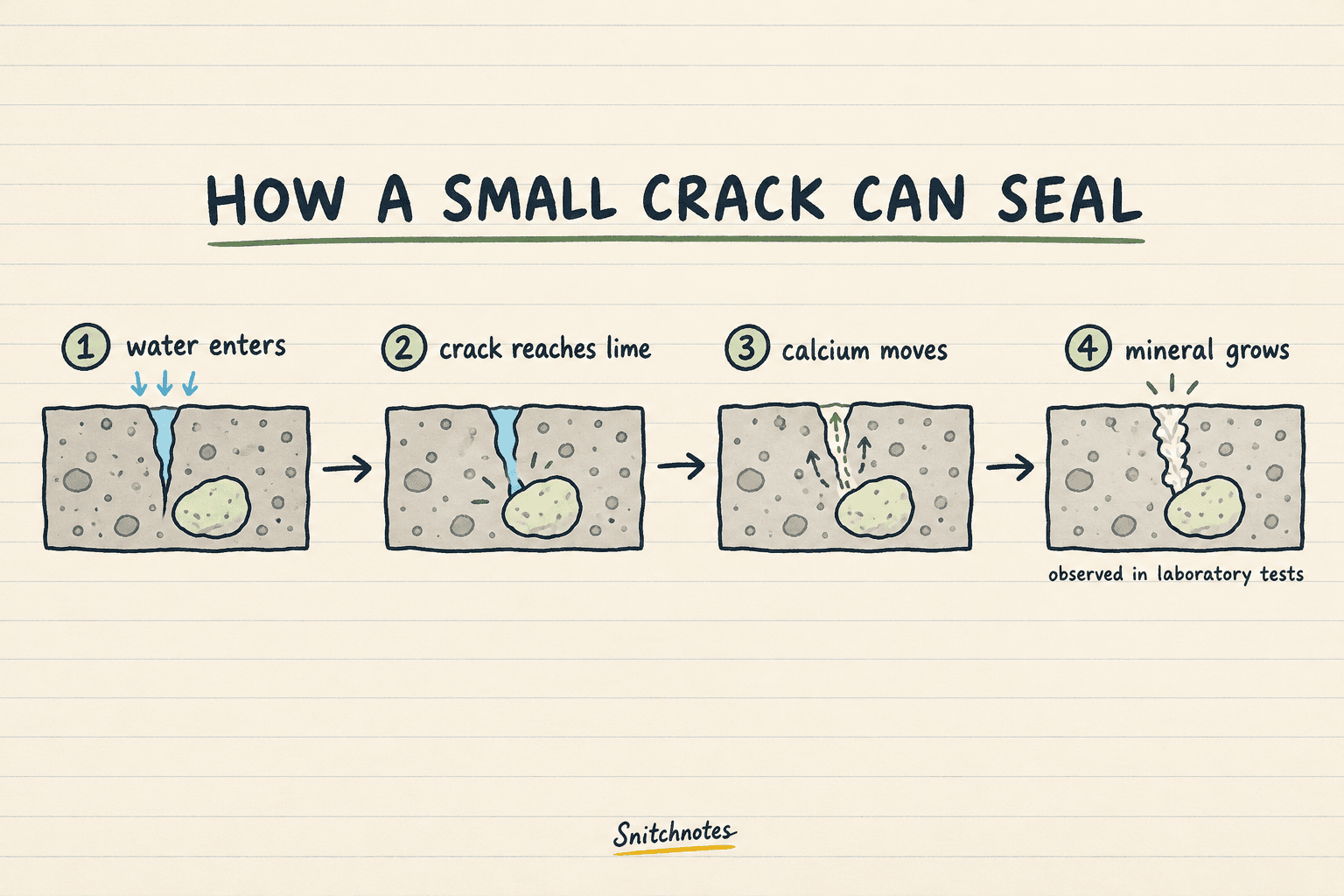
How lime clasts can seal a small crack
- A narrow crack forms and water enters it.
- The crack intersects a calcium-rich lime clast, which fractures easily and exposes reactive surfaces.
- Water carries dissolved calcium into the crack.
- Calcium carbonate or other cementing products precipitate, reducing or closing the water path.
Researchers tested this idea by cracking modern replicas. Water continued through a control mixture without quicklime, while cracks in hot-mixed samples containing lime clasts sealed within two weeks. That experiment supports a mechanism for small-crack repair; it does not mean a collapsed arch can rebuild itself or that every Roman mix behaved this way.
A harbor-block example
Picture one block in a Roman breakwater near Pozzuoli. A hairline crack opens as waves and temperature changes stress the mass. Seawater slips inside. Near a lime clast, calcium-rich material can move into the crack and recrystallize, narrowing the route that the next wave would use. Farther inside the block, seawater also reacts slowly with volcanic material.
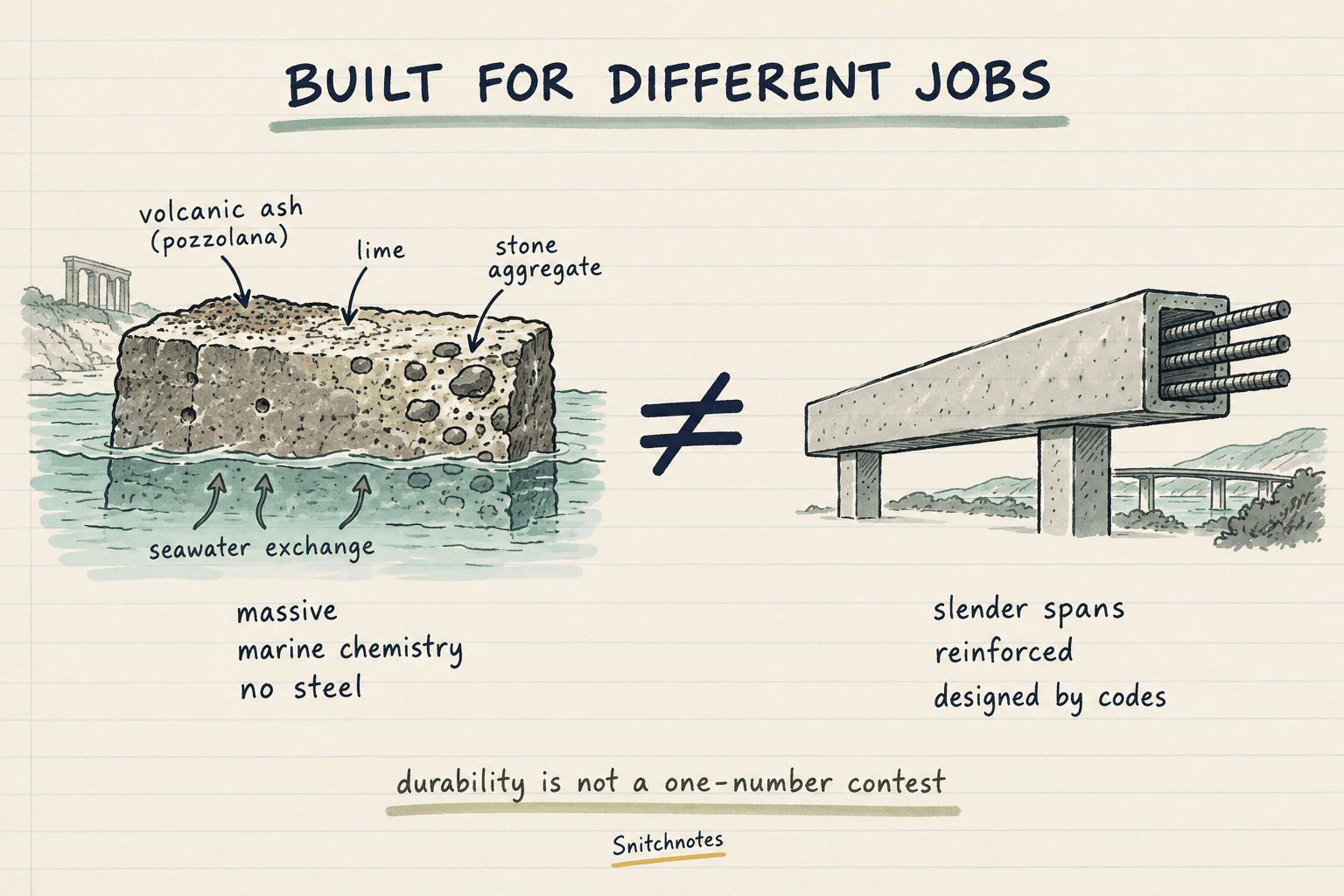
Studies of ancient marine concrete have found phillipsite and aluminum-rich tobermorite growing through long-running water-rock reactions. Instead of seawater acting only as an attacker, this particular material system could use chemical exchange to create additional mineral cement. The key phrase is this particular system: seawater is highly damaging to many modern reinforced-concrete structures because it can help chloride reach and corrode steel.
Roman concrete versus modern concrete
Saying Roman concrete was simply better than modern concrete compares different tools as if they took the same exam. Many ancient harbor works were massive, unreinforced blocks. Modern reinforced concrete can form slender bridges, tall frames, and long spans because steel carries tension that plain concrete handles poorly. Engineers also need consistent materials that meet codes and predictable construction schedules.
Roman-inspired chemistry may still help modern design, especially where longer service life matters. But engineers must test strength, setting time, reinforcement compatibility, freeze-thaw behavior, local raw materials, and environmental impact. Copying volcanic ash and lime into a modern project is not a shortcut around those requirements.
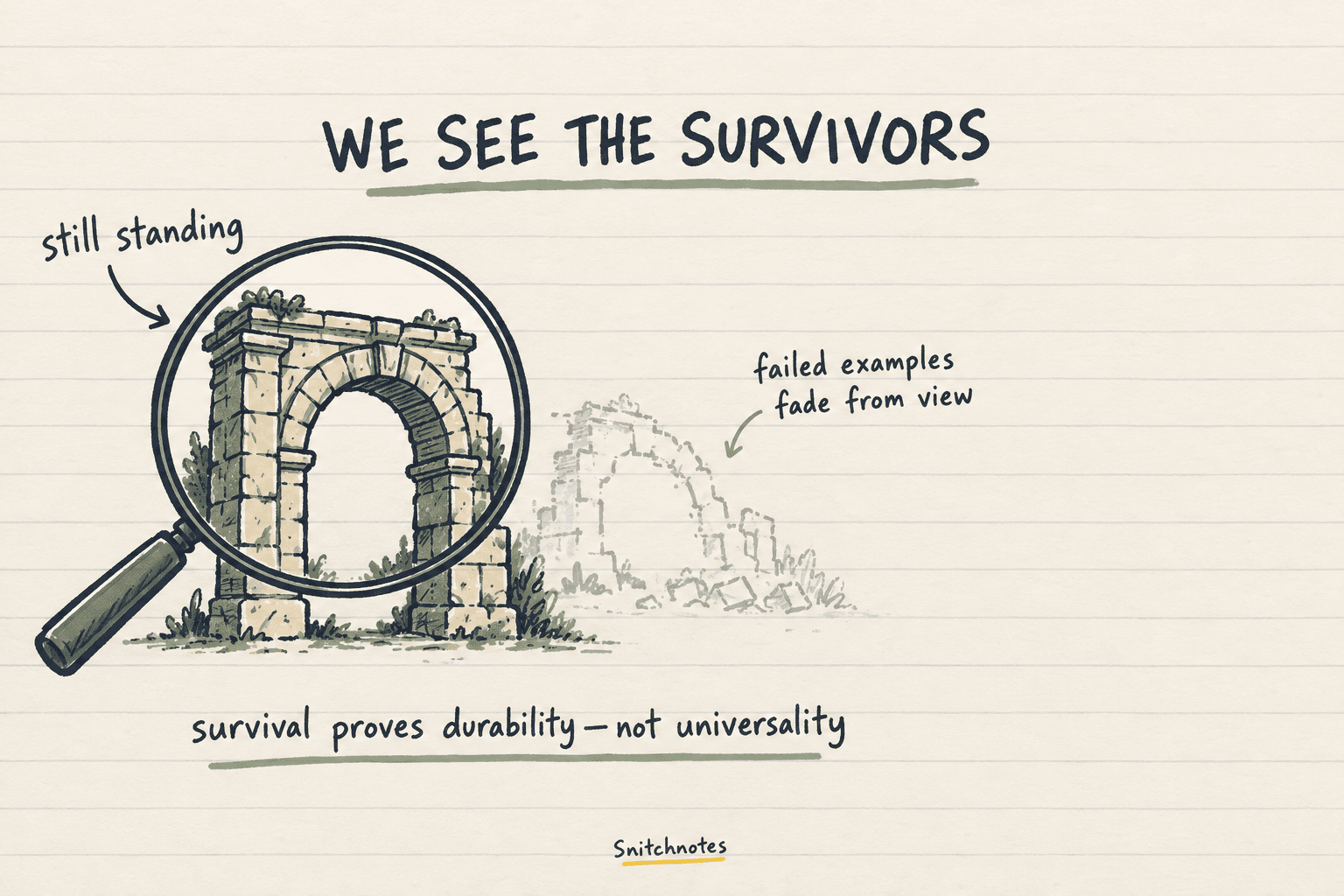
The boundary: we mostly see the survivors
Survivorship bias happens when the examples that remain visible are not representative of everything that once existed. The Pantheon is powerful evidence that its materials and design worked. It is not evidence that every Roman wall, pier, or batch of mortar lasted equally well. Poor structures could collapse, be quarried for stone, be buried, or disappear without leaving convenient samples.
The fair conclusion is impressive but narrower: some Roman concretes paired good structural choices with chemical systems that remained durable for extraordinarily long periods. Their survival gives researchers valuable mechanisms to study, not a license to turn ancient engineering into a myth.
Check your understanding
Was volcanic ash the only secret?
No. Reactive volcanic material mattered, but manufacturing choices such as hot mixing, the resulting lime clasts, water exposure, aggregate, structural form, and local conditions also affected durability.
Can Roman concrete heal any damage?
No. The evidence concerns mineral growth that seals limited cracks and pores. Large fractures, movement, missing material, and structural failure still require engineering intervention.
Does seawater strengthen all concrete?
No. Helpful seawater reactions were found in specific Roman marine mixtures. In modern reinforced concrete, seawater can contribute to steel corrosion and deterioration when the protection system fails.
If a lecture mixes history, chemistry, and engineering into one hard block, Snitchnotes can turn your material into clearer notes, flashcards, quizzes, and audio for review.
Related concepts
- Pozzolanic reaction: reactive silica and alumina combine with calcium in the presence of water to form cementing phases.
- Self-healing materials: systems that can close limited damage through chemical, biological, or physical processes.
- Survivorship bias: drawing broad conclusions from the cases that remain observable while missing those that failed or vanished.
- How to study structural engineering: connect materials, loads, and failure modes instead of memorizing them separately.
Sources
Science Advances: Hot mixing—Mechanistic insights into the durability of ancient Roman concrete
Massachusetts Institute of Technology: Riddle solved—Why was Roman concrete so durable?
Lawrence Berkeley National Laboratory: The Ancient Roman Secret to Concrete Resilience in Seawater
University of Chicago LacusCurtius: Vitruvius, de Architectura, Book II
Convierte tus clases en material listo para el examen.
Apuntes, quizzes, podcasts, flashcards y chat — con solo subir un archivo.
Prueba tu primer apunte gratis