
Snitchnotes Team
How to Review a Marked Essay Before Your Next Assignment
How to Review a Marked Essay Before Your Next Assignment
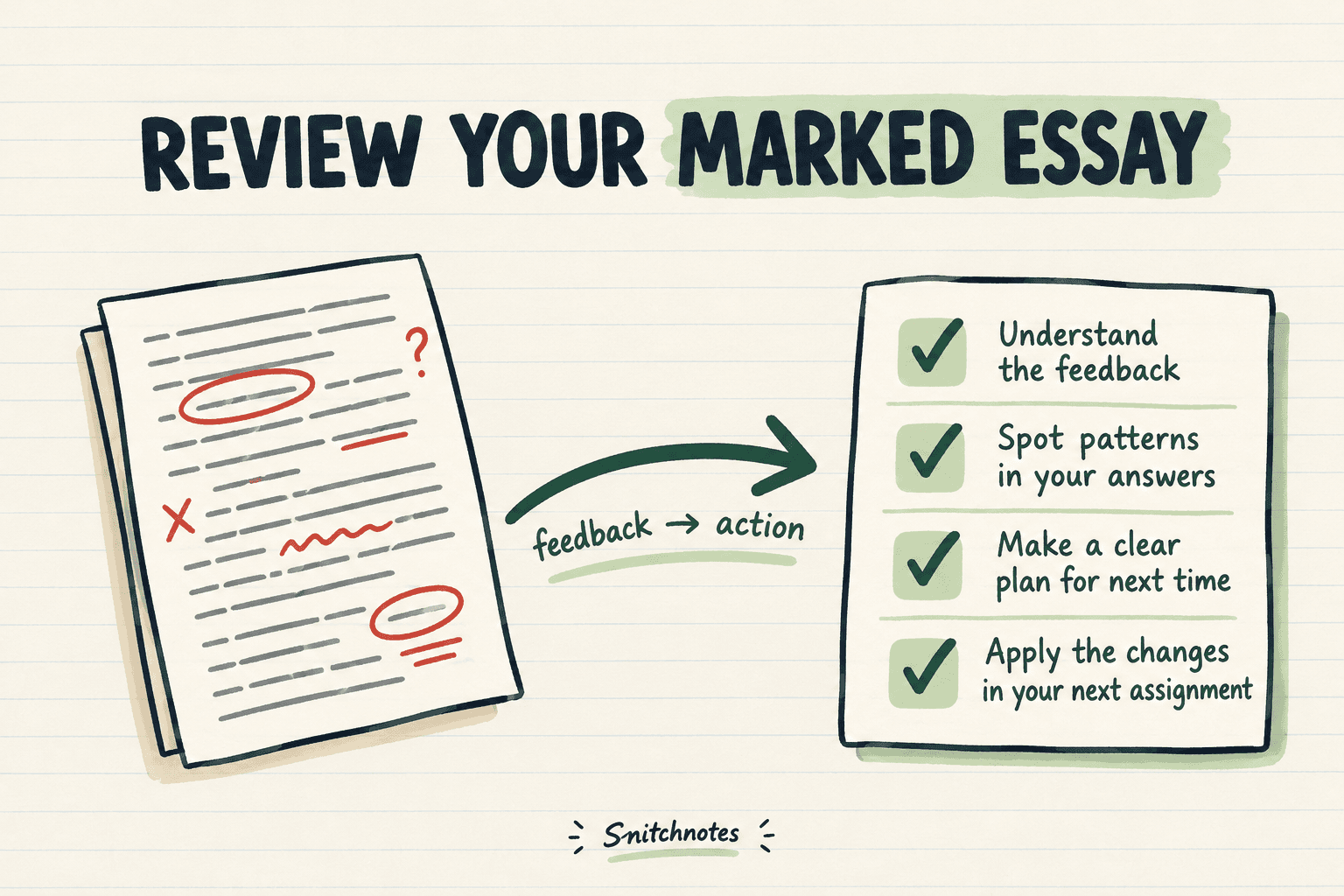
To use essay feedback for your next assignment, reread the marked work and rubric, sort comments into argument, evidence, structure, and style, then rewrite each useful comment as a concrete action. Keep those actions beside you while planning and drafting the next essay, and check them before submission.
The goal is not to relive the grade or obey every annotation mechanically. It is to extract a short, testable plan: what should you repeat, what should you change, and where in the next writing process will you make that change?
Why reviewing a marked essay matters
A grade describes one completed performance. Feedback can influence a future one, but only if you convert it into decisions. The University of Bath recommends reading all available feedback, logging it, and using it as a checklist for later assignments. The University of Sheffield similarly treats feedback as a dialogue that needs a response rather than a verdict that ends the conversation.
This distinction matters because comments often arrive in compressed academic language. “Too descriptive” names a problem, but it does not yet tell you what to do at 8 p.m. with a half-finished paragraph. A review process closes that gap between the marker’s diagnosis and your next writing move.
Step 1: Review the whole feedback package
Open the submitted essay, marginal comments, overall comment, rubric, and assignment brief together. Read once without editing anything. On the second pass, mark three kinds of information: strengths to preserve, problems to solve, and comments you do not understand. Positive feedback belongs in the plan too; if your signposting or source selection worked, repeat the method deliberately.
If the grade or wording still feels raw, wait until you can examine the work without turning every sentence into a judgment about yourself. Sheffield’s guidance explicitly suggests returning later if you are upset and asking the tutor to clarify anything unclear. The essay was assessed; you as a person were not reduced to its mark.
Step 2: Sort the feedback into four categories
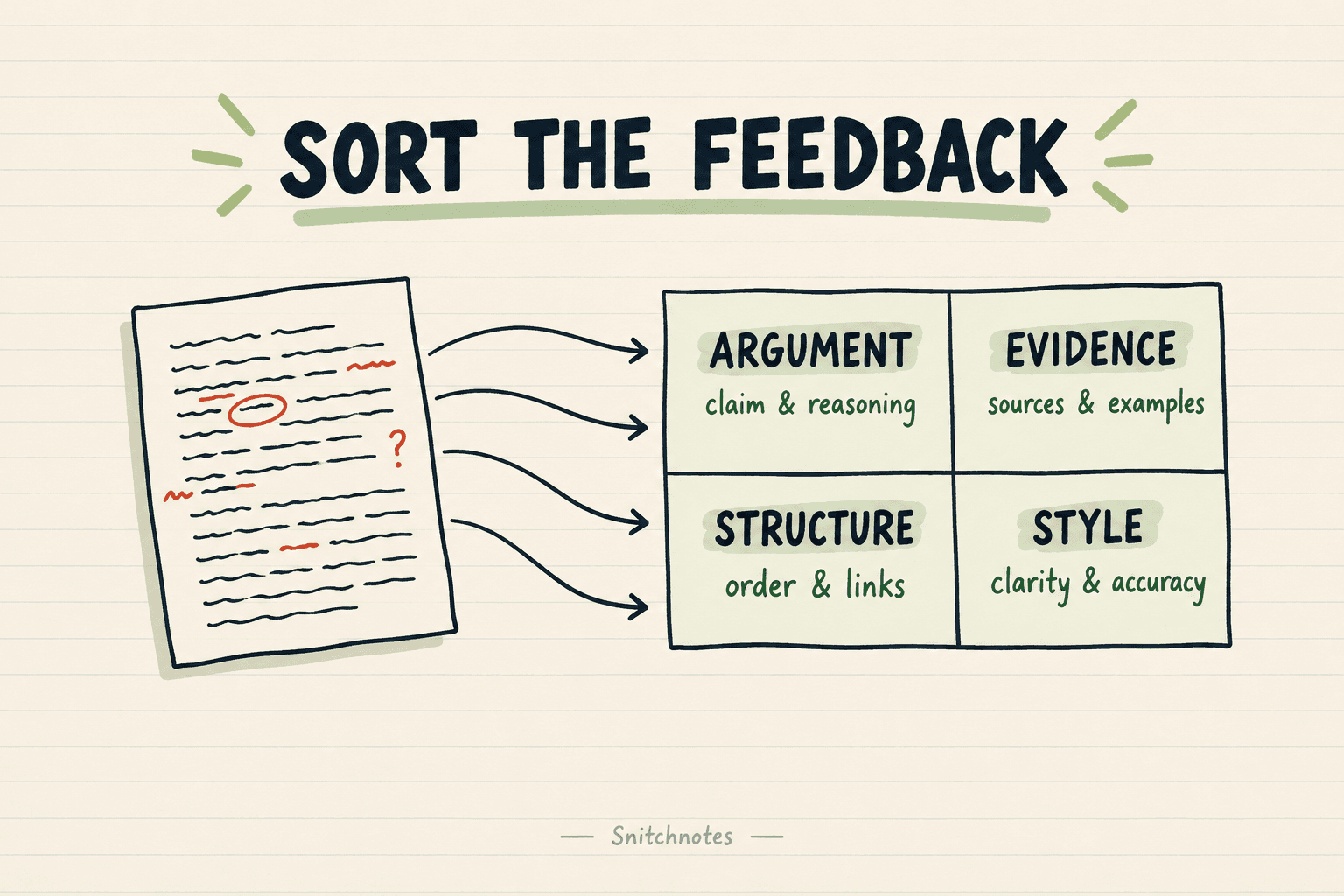
Group each comment by the part of writing it affects. Argument covers the claim, reasoning, analysis, and evaluation. Evidence covers sources, examples, quotation, and how evidence supports a point. Structure covers the order of sections, paragraph jobs, signposting, and links between ideas. Style covers clarity, academic tone, grammar, referencing, and presentation.
The categories are practical, not sacred. A note such as “this paragraph does not support the thesis” touches both argument and structure; place it where it will be easiest to act on. Sorting helps reveal patterns. Five scattered annotations about unsupported claims may represent one recurring evidence problem, not five unrelated mistakes.
Step 3: Turn each useful comment into an action
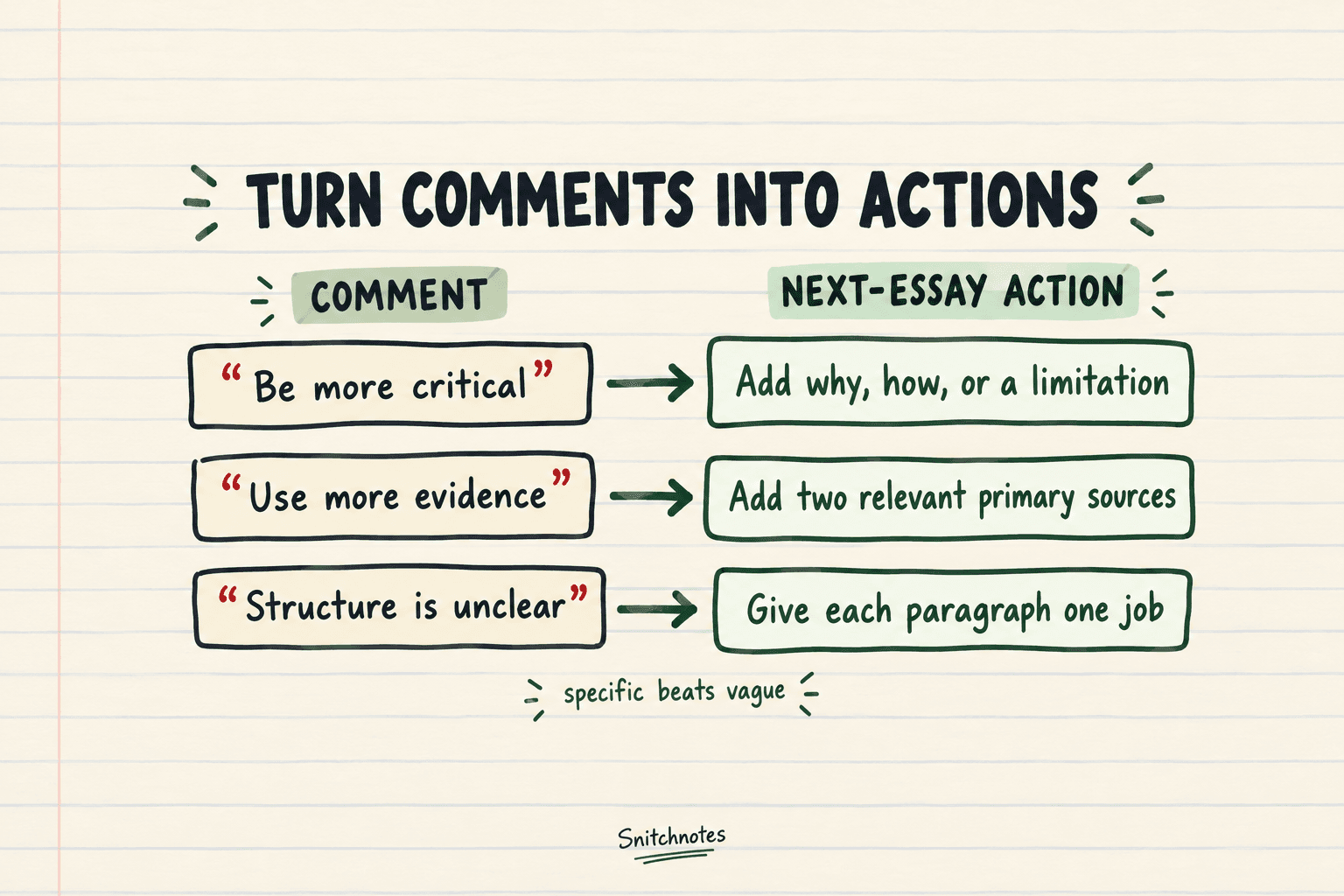
Rewrite comments as instructions you can observe in the next essay. “Be more critical” can become “after presenting a source, explain why its evidence is persuasive, limited, or relevant.” “Use more evidence” can become “find two relevant primary sources before drafting the second section.” “Structure is unclear” can become “write one sentence stating the job of every planned paragraph.”
Attach each action to a stage: planning, research, drafting, or editing. This prevents proofreading from becoming the place where you try to repair a weak argument. Cambridge’s Wolfson College frames useful feedback around the goal, the current level, and the specific next steps. The Open University also advises carrying one or two main points into the next assignment, which is often more realistic than attempting ten changes at once.
Step 4: Test the method on a real essay
Suppose a 1,600-word history essay received 64%. The marker praised its relevant reading but wrote “too descriptive,” “argument becomes unclear in the middle,” and “proofread references.” The next assignment is 1,800 words and due in ten days. Copying those comments into a new document would preserve them, but it would not yet improve the work.
- Planning action: write the thesis at the top of the outline and give each paragraph one claim that advances it.
- Drafting action: after every source, add a sentence that evaluates its significance or limitation instead of stopping at summary.
- Editing action: reserve the final 30 minutes for an item-by-item reference check against the required style guide.
The student should also preserve the successful reading strategy. That creates a three-item repair plan without throwing away what already worked. Ten minutes of review has now produced decisions for three different stages of the next assignment.
Step 5: Keep a reusable feedback log
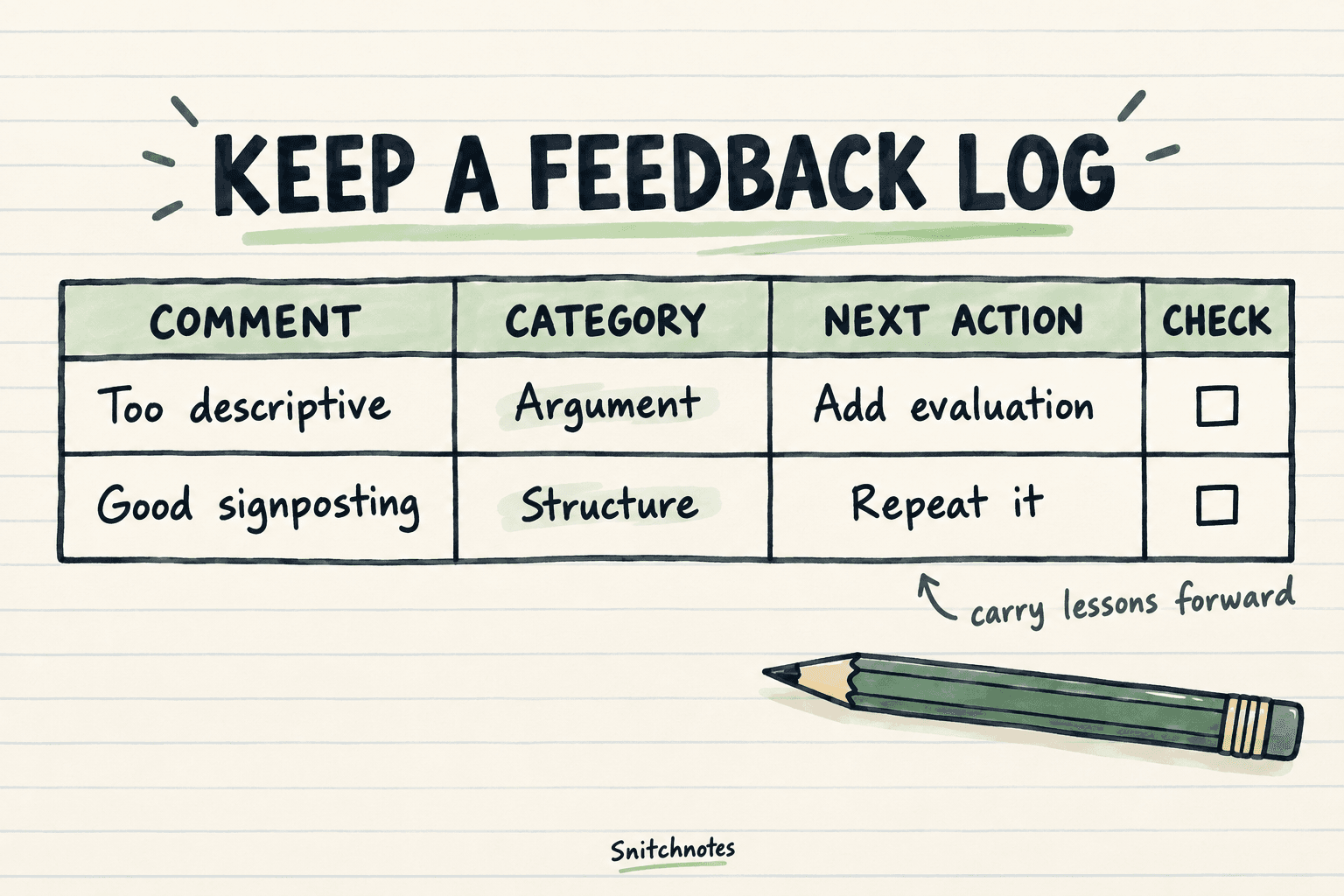
Use a small table with four fields: the original comment, its category, your next action, and a check box. Add the module and date if you want to compare assignments over time. Bath recommends storing feedback somewhere accessible and notes that a table or mind map can work; the best system is the one you will actually reopen.
Before a new brief, scan the log for repeated themes. During outlining, select no more than three priority actions. Before submission, check them against the draft and record evidence: a revised thesis, a paragraph map, two added primary sources, or a cleaned reference list. The log is useful because it links a comment to visible work, not because it becomes an archive of every sentence a marker has written.
When feedback is unclear, conflicting, or too specific
Ask for clarification with a focused question. Instead of “How do I improve?”, try “When you wrote ‘more analysis’ beside paragraph four, did you want evaluation of the source, a clearer link to my thesis, or both?” Bring the paragraph and your proposed revision. That gives the tutor something concrete to confirm or correct.
Not every comment transfers unchanged. A literature essay, laboratory report, and policy memo may use different structures and conventions. If advice conflicts, prioritize the current brief and rubric, then ask the current instructor which expectation governs. Separate transferable skills, such as supporting claims, from task-specific choices, such as whether headings are allowed.
Check your understanding
Why is copying feedback into a document not enough?
Because a stored comment is still only a diagnosis. It becomes useful when you translate it into a specific action, attach that action to a writing stage, and check whether the new draft contains evidence of the change.
Should you work on every criticism at once?
Usually no. Choose two or three recurring, high-impact actions that fit the new assignment. Keep the other comments in your log for later rather than turning the next essay into an impossible repair project.
What should you do with positive feedback?
Record the successful method, not just the praise. If the introduction was focused, identify how you planned it. If the evidence was relevant, keep the search or selection process that produced it.
Related concepts
- Feedback literacy: understanding, judging, and using feedback rather than only receiving it.
- Feedforward: using information from one performance to guide a future task.
- How to synthesize sources in a literature review
- How to build a synthesis matrix for a literature review
Sources
University of Bath: Feedback on your assignments—what it is and how to use it
University of Sheffield: How to make the most of your feedback
The Open University: Using feedback from your tutor
University of Cambridge, Wolfson College Academic Skills: Responding to and using feedback
Convierte tus clases en material listo para el examen.
Apuntes, quizzes, podcasts, flashcards y chat — con una sola subida.
Prueba tu primer apunte gratis