
Snitchnotes Team
Why Did the Gregorian Calendar Skip 10 Days?
Why Did the Gregorian Calendar Skip 10 Days?
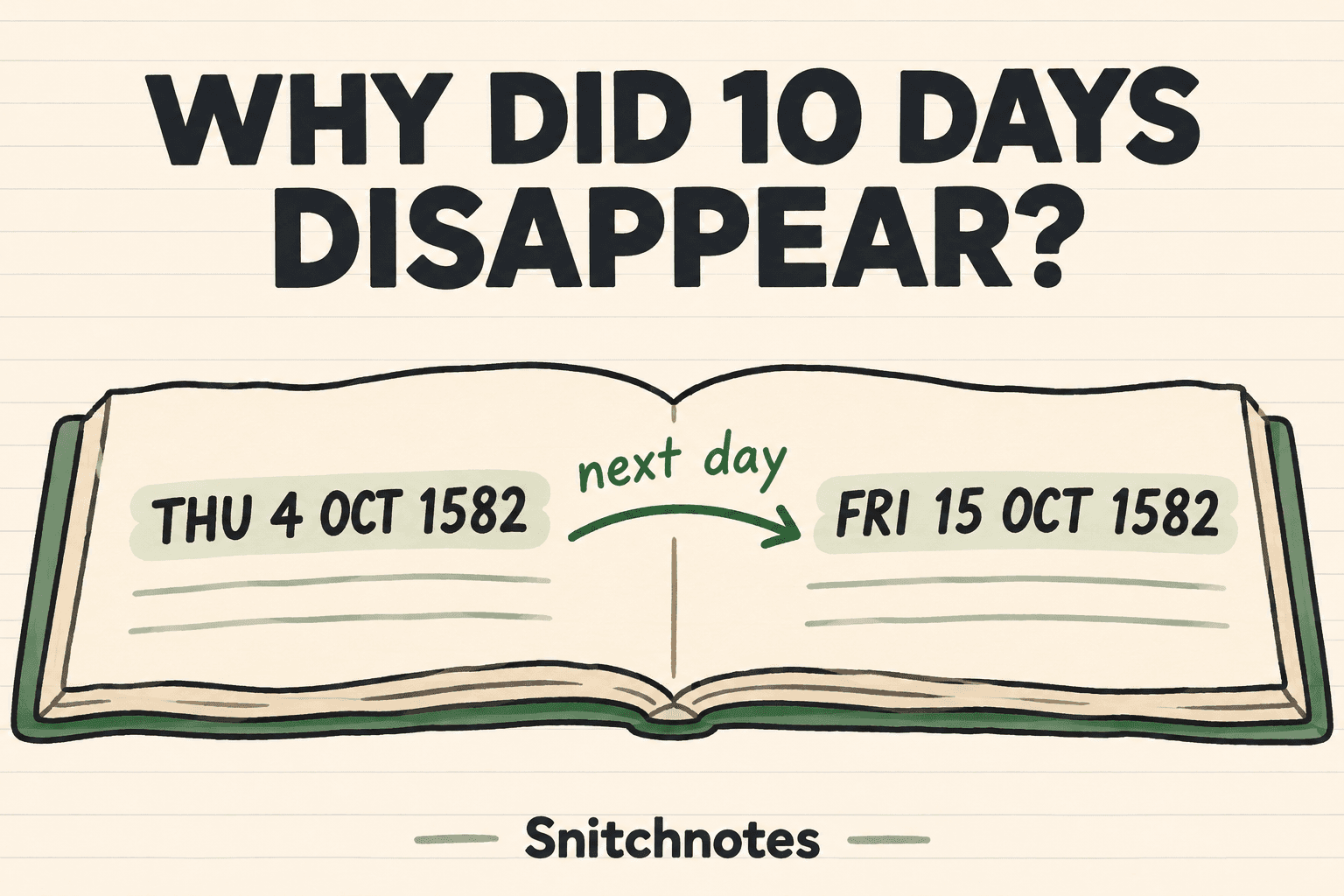
The Gregorian calendar skipped 10 dates in October 1582 because the older Julian calendar had drifted about 10 days out of step with the seasonal year. Pope Gregory XIII's reform reset the calendar so the spring equinox returned to about March 21, then changed the leap-year rule to slow future drift. In the first adopting countries, Thursday 4 October 1582 was followed by Friday 15 October.
No one experienced a mysterious 240-hour hole. The Sun rose after October 4 as usual; only the next date written on the calendar changed. And the switch was not worldwide: different states adopted the reform across more than three centuries.
Lucia's two consecutive ledger entries
Imagine Lucia, a fictional shopkeeper in Rome. On Thursday 4 October 1582, she closes her ledger after counting the day's sales. She sleeps, wakes the next morning, opens the same shop, and writes Friday 15 October at the top of a fresh page. Her two entries describe consecutive days even though their date numbers are 11 apart.
Thursday 4 October: close the ledger. Friday 15 October: open it again. Ten date labels disappeared; ten lived days did not.
That distinction matters. A calendar is a labeling system laid over a continuous sequence of days. The reform deleted the labels October 5 through October 14 in places that switched then, but it did not pause clocks, erase memories, or make people suddenly ten days older. The weekday sequence also stayed intact: Thursday was followed by Friday.
How the Julian calendar drifted
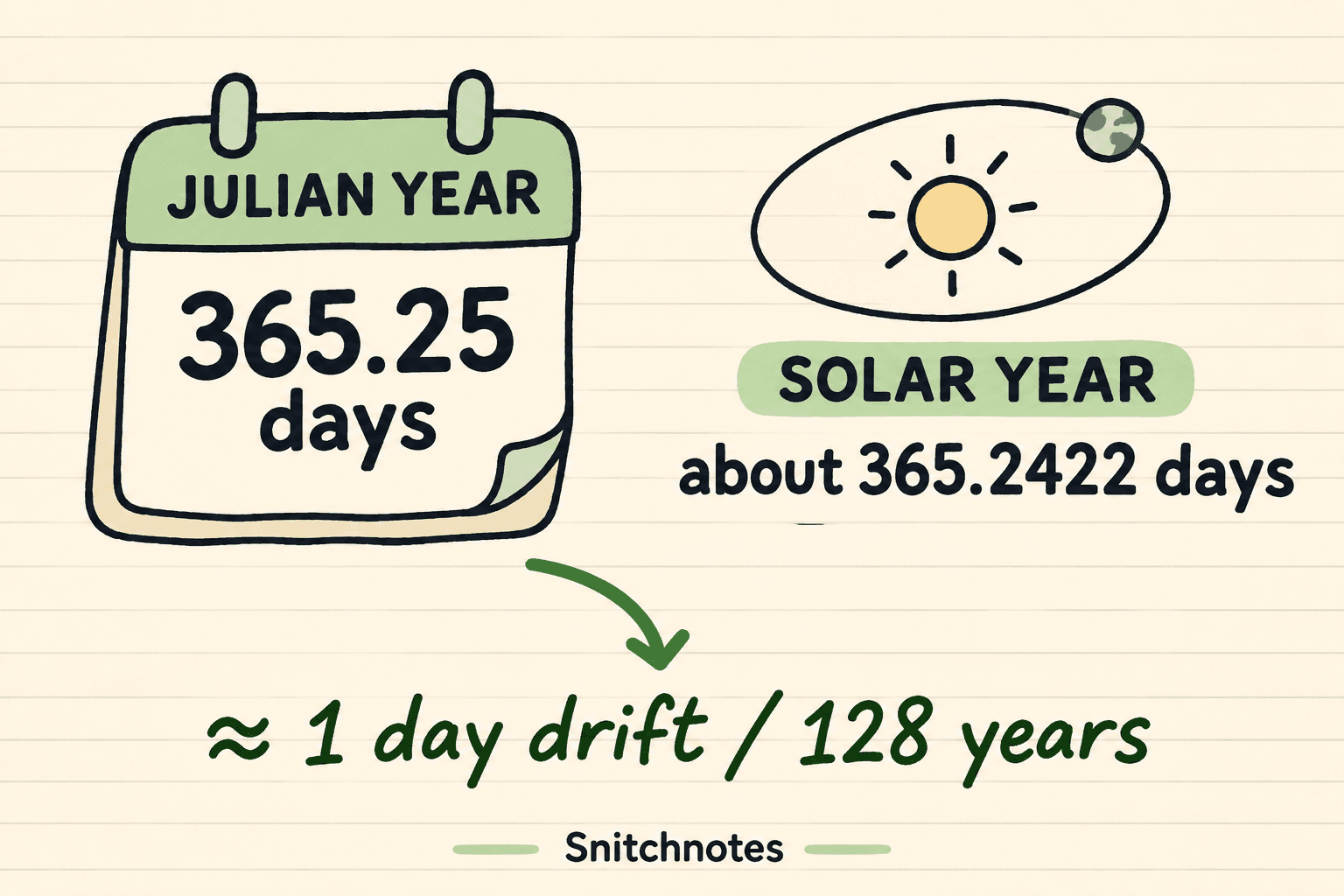
The Julian calendar, introduced under Julius Caesar, treated the average year as exactly 365.25 days. It used three ordinary 365-day years followed by a 366-day leap year. That is an elegant approximation, but the tropical year that keeps the seasons aligned is about 365.2422 days. The difference is only around 11 minutes and 14 seconds per year.
Small yearly errors accumulate. At that rate, the calendar drifts by roughly one day every 128 years. By the 1500s, the spring equinox was arriving around March 11 in the Julian calendar rather than near March 21, the reference date used in medieval church calculations for determining Easter. A date meant to track the season was sliding away from it.
Why the correction was 10 days
The reform aimed to restore the relationship between the calendar and the equinox as it had been understood around the time of the Council of Nicaea in AD 325. The drift accumulated since then was about 10 days, so 10 calendar dates were removed. In the countries making the October 1582 change, October 4 was immediately followed by October 15.
The reform also prevented the same error from rebuilding so quickly. Under the Gregorian rule, a year divisible by 4 is normally a leap year, but a century year is not unless it is divisible by 400. So 1600 and 2000 were leap years, while 1700, 1800, and 1900 were not. This produces 97 leap years in every 400-year cycle, for an average calendar year of 365.2425 days.
This is why the Gregorian calendar did two jobs at once: the skipped dates corrected the accumulated error, while the revised leap-year rule reduced future error. Removing days without changing the rule would have been only a temporary reset.
Why countries changed calendars at different times
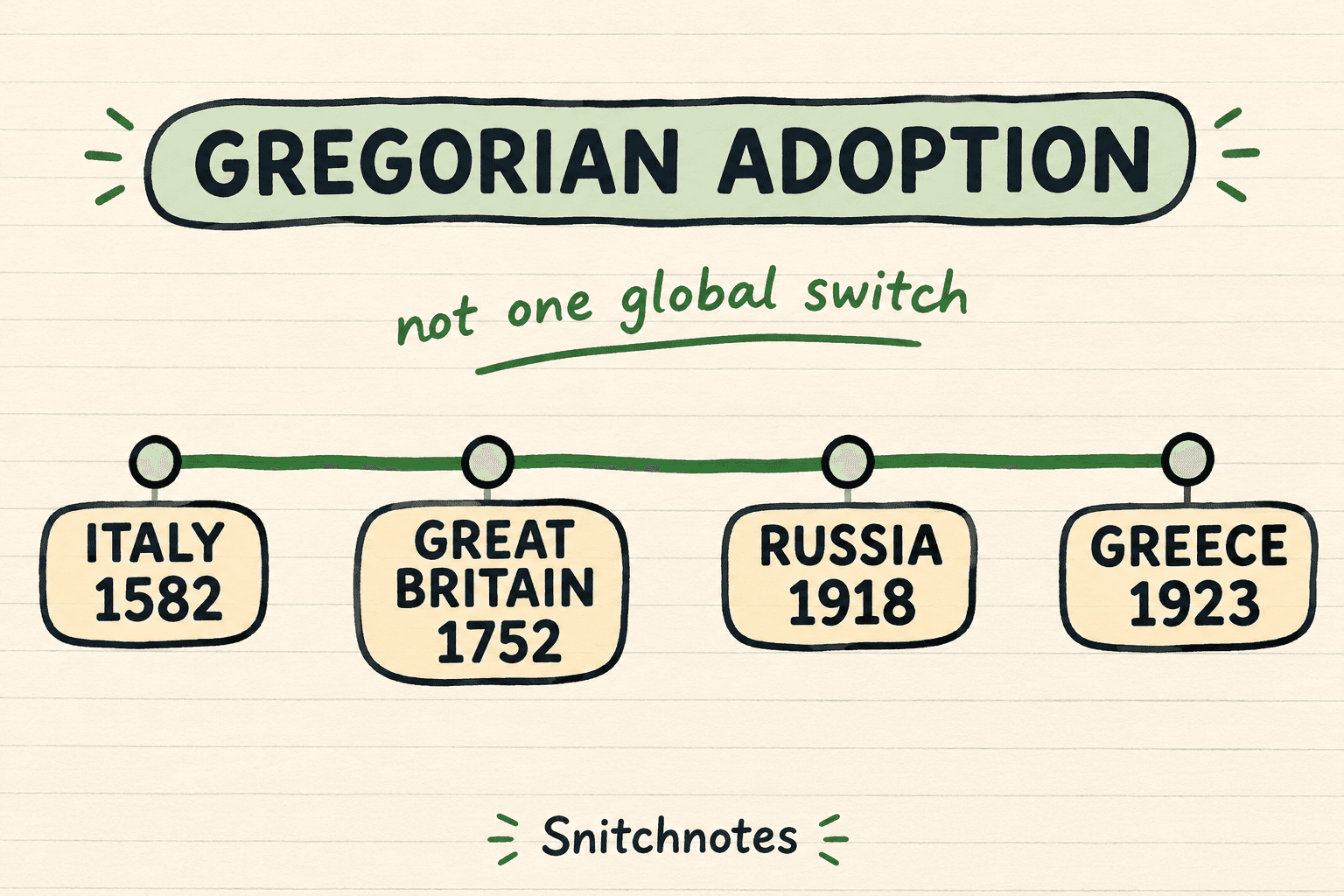
Pope Gregory XIII issued the reform in 1582, so Catholic states such as the Italian states, Spain, and Portugal were among the earliest adopters. Protestant and Orthodox countries often resisted a calendar proclaimed by the pope, even when the astronomical logic was useful. Calendar reform therefore became entangled with religion, political authority, trade, and administrative convenience.
Great Britain and its colonies changed in 1752. By then the Julian-Gregorian gap had grown to 11 days, so Wednesday 2 September was followed by Thursday 14 September. Russia made its civil switch in 1918, when the gap was 13 days: January 31 was followed by February 14. Greece adopted the Gregorian calendar for civil use in 1923. Some Orthodox churches still use the Julian calendar for parts of their religious calendar, so civil and liturgical practice need not match.
The changing gap explains why later countries skipped more than 10 dates. The Julian calendar counted 1700, 1800, and 1900 as leap years; the Gregorian calendar did not. Each disagreement added another day between the systems.
A common misconception: people lost 10 days of life
People did not lose sleep, wages, meals, or biological time simply because the date label jumped. Legal and financial consequences still had to be managed, of course: governments needed rules for contracts, rents, birthdays, taxes, and anniversaries. But the physical sequence of days remained uninterrupted.
Historical dates also require context. An event recorded under the Julian calendar may appear under a different date when converted to the Gregorian system. That is why historians sometimes label dates Old Style and New Style. Russia's October Revolution, for example, began on October 25, 1917 in the calendar then used in Russia, but that date corresponds to November 7 in the Gregorian calendar.
Check your understanding
Why were 10 dates skipped in 1582?
Because the Julian calendar's slightly overlong average year had moved the calendar about 10 days away from the seasonal reference used for the spring equinox. The skip reset that accumulated drift.
Did October 4 and October 15 have days between them?
Not in the new date sequence used by the first adopters. October 15 was the day immediately after October 4, so there were no uncounted physical days between them; the labels October 5 through 14 were omitted.
Why did Russia skip 13 dates instead of 10?
Russia changed in 1918. By then three additional century years—1700, 1800, and 1900—had been leap years in the Julian calendar but not in the Gregorian calendar, widening the gap from 10 to 13 days.
If timelines and calendar conversions keep tangling your history notes, Snitchnotes can turn your lectures, slides, and PDFs into clearer notes, flashcards, quizzes, and audio for review.
Related concepts
- How Eratosthenes measured Earth's circumference: another historical example of using observation and geometry to measure the natural world.
- How to study historical causation with cause-and-consequence chains: a practical method for separating long-term causes, triggers, and effects.
- Tropical year: the cycle of the seasons, measured from one equinox to the corresponding equinox.
Sources
U.S. Naval Observatory Astronomical Applications Department: Leap Years
The Ohio State University Department of Astronomy: Lecture 11, The Calendar
Encyclopaedia Britannica: Gregorian calendar
Boris Yeltsin Presidential Library: The decree on adoption of the Gregorian calendar approved
Convierte tus clases en material listo para el examen.
Apuntes, quizzes, podcasts, flashcards y chat — con una sola subida.
Prueba tu primer apunte gratis