
Snitchnotes Team
Why Do Memories Change Each Time We Recall Them?
Why Do Memories Change Each Time We Recall Them?
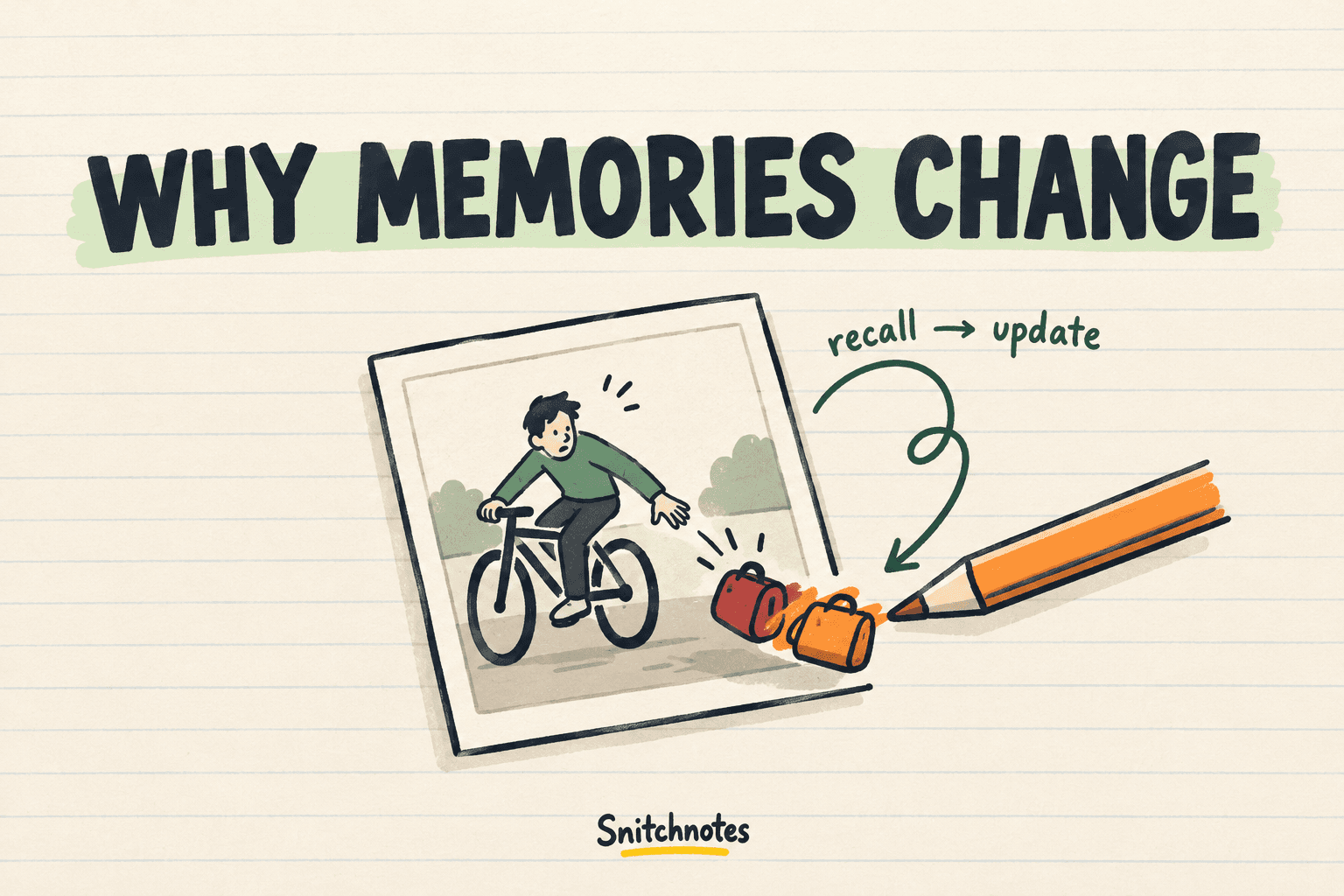
Memories can change when recalled because remembering is reconstruction, not playback. Retrieval rebuilds an event from stored details, current context, and later knowledge. Under some conditions, the reactivated memory becomes temporarily open to strengthening or updating before it stabilizes again, a process called memory reconsolidation. That flexibility is useful, but it also creates opportunities for suggestion and source confusion.
This does not mean every memory changes every time you think about it, or that recollection is worthless. It means a confident memory can contain both durable information and details added later. Understanding the mechanism helps explain why two honest witnesses may disagree, why stories become smoother through retelling, and why studying by retrieval can strengthen what you know.
Why remembering is not replaying
An experience is not stored as one complete video file. Features of it—people, places, actions, feelings, and meaning—depend on distributed patterns of activity. When you remember, the brain uses cues to assemble enough of those features into a coherent event. Missing pieces may be supplied by expectations or knowledge that fits the situation.
That reconstruction is efficient. You do not need to preserve every pixel of yesterday's bus ride to remember where you got off. But the same efficiency can blur the boundary between what was present in the original event and what was inferred, imagined, or learned later. Psychologists call judgments about where information came from source monitoring.
How memory reconsolidation works
New memories go through consolidation, a set of processes that make them more stable over time. Research later showed that an established memory can become labile again after it is reactivated. In a foundational animal study, Karim Nader and colleagues found that a retrieved fear memory again depended on protein synthesis in the amygdala; blocking that process shortly after retrieval disrupted later expression of the memory. The effect did not appear when the drug was given without reactivation or six hours later.
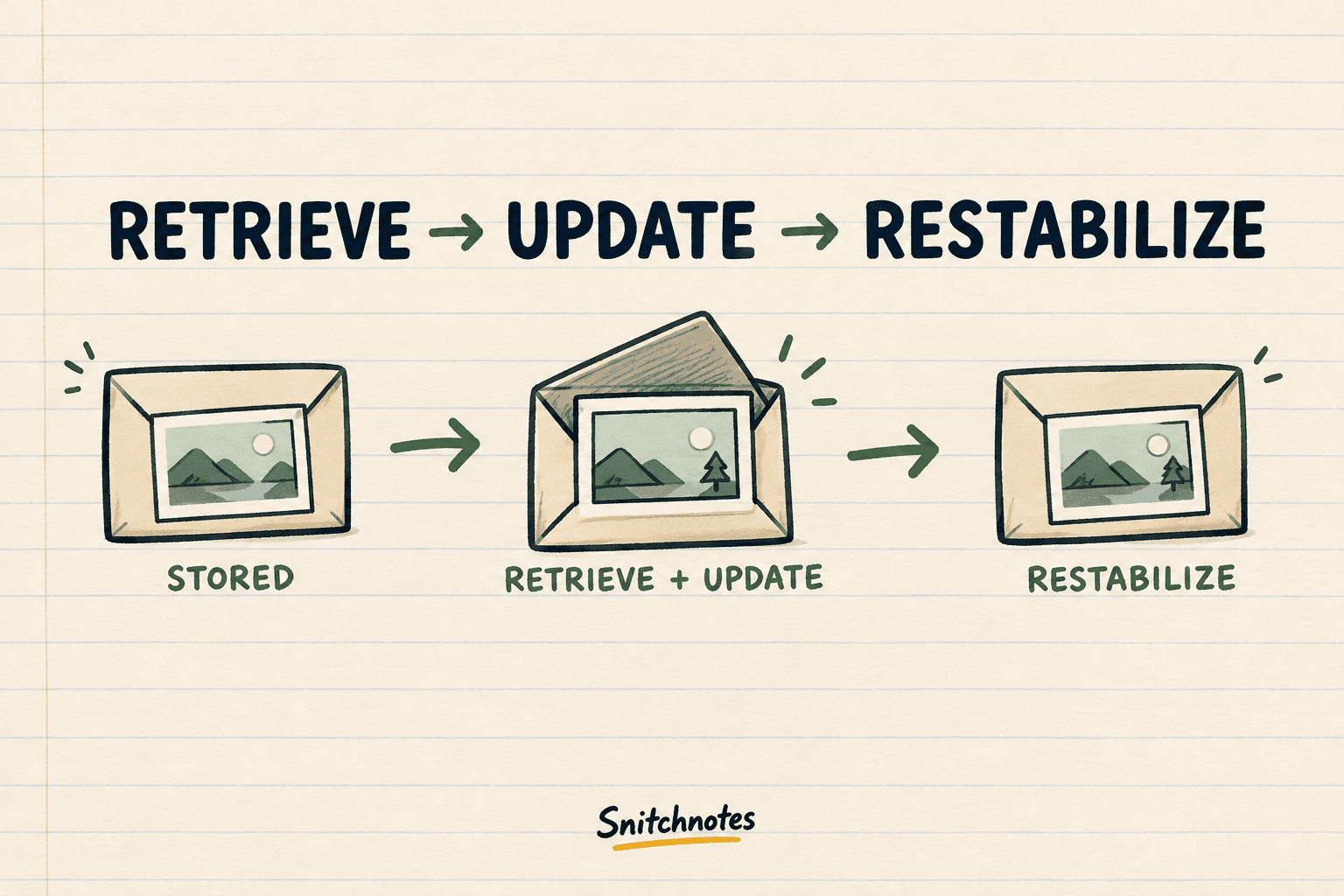
Reconsolidation is the restabilization that follows this period of retrieval-induced plasticity. A useful three-part model is: retrieve the memory, allow strengthening or updating, then restabilize it. Human work by Almut Hupbach and colleagues found that a subtle reminder before learning a second list of objects could lead items from the new list to intrude into recall of the first list two days later. That result shows how new information can become integrated with an older episodic memory.
The word can is crucial. Reviews of reconsolidation research emphasize boundary conditions: memory age and strength, the kind of reminder, timing, and whether something unexpected occurs can all matter. Retrieval may leave a trace stable, strengthen it, update it, or support new learning instead. There is no automatic erase-and-rewrite command.
Mira and the red bag that became orange
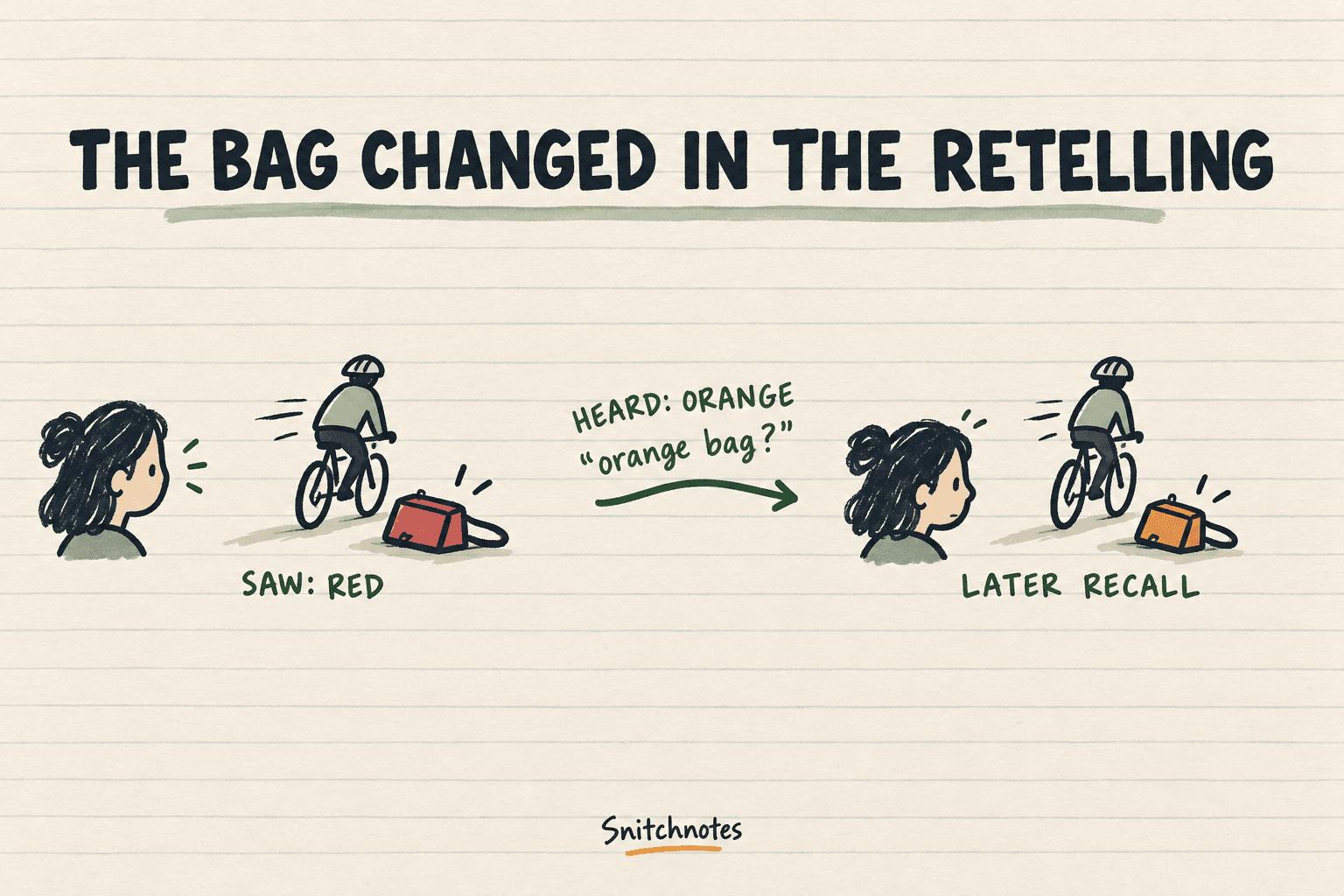
Mira sees a cyclist drop a red bag at a crossing. That evening, her friend asks, “Did the cyclist pick up the orange bag?” Mira first answers that it was red. Two days later, the friend casually says “the orange bag” again while they retell the story. A week later, Mira pictures an orange bag and reports that color sincerely.
The example combines two related routes to change. Each retelling reconstructs the episode, giving the suggested color a chance to join the active representation. Later, source monitoring may fail: Mira remembers orange but no longer recognizes that orange came from her friend's wording rather than the street scene. Classic work by Elizabeth Loftus and John Palmer similarly showed that wording used after filmed car crashes affected later reports, including memory for broken glass that was not present.
Mira's memory is not therefore entirely false. The cyclist, crossing, dropped object, and sequence may remain accurate while one feature changes. Real recollections often contain this mixture. The lesson is not “trust nothing”; it is “separate confidence from independent evidence, especially for a detail introduced after the event.”
Why a changeable memory system is useful
A memory system that never updated would preserve outdated information. If a café moves, a friend changes their phone number, or a concept is corrected in class, useful memory must connect the old knowledge with what is new. Retrieval also supports strengthening: successfully bringing an answer to mind can make later access easier, which is one reason retrieval practice helps learning.
The trade-off is that adaptability and accuracy are not identical. Updating can improve a memory when the new information is true, or distort a detail when the new information is misleading. Repetition may make a story feel fluent and familiar without proving that each feature came from the original experience.
Misconceptions and boundaries
- Recall does not guarantee change. Reconsolidation effects depend on the memory, reminder, timing, and learning conditions.
- Change is not always distortion. Retrieval can strengthen a memory or update it with correct information.
- A vivid or confident recollection can still contain a source error. Confidence and accuracy are related imperfectly, not interchangeably.
- Reconsolidation is not a proven do-it-yourself method for deleting painful memories. Translating laboratory effects into reliable treatment is difficult and remains an active research area.
Check your understanding
Why can a friend's wording alter a remembered detail?
The wording supplies new information while the event is being reconstructed. If that information becomes integrated, and its source is later confused, the person may remember the suggestion as part of the original event.
Does reconsolidation mean every recall makes memory less accurate?
No. A retrieved memory may remain stable, become stronger, be updated accurately, or be distorted. What happens depends on the conditions and the information available during retrieval.
What is the safest practical takeaway?
For important events, record details early, avoid leading questions, and compare recollection with independent evidence. For studying, retrieve information and then check it against a reliable source so errors are corrected rather than rehearsed.
Related concepts
- Cognitive dissonance explained with a real-life example
- Retrieval practice describes how actively recalling information can strengthen later access to it.
- The misinformation effect describes how post-event information can alter later reports of an event.
- Source monitoring is the process of judging whether a detail came from perception, conversation, imagination, or another source.
Sources
Johnson, Hashtroudi, and Lindsay, Source Monitoring, Psychological Bulletin (1993)
Convierte tus clases en material listo para el examen.
Apuntes, quizzes, podcasts, flashcards y chat — con una sola subida.
Prueba tu primer apunte gratis