
Snitchnotes Team
How to Find a Nash Equilibrium in a Payoff Matrix
How to Find a Nash Equilibrium in a Payoff Matrix
To find a Nash equilibrium in a payoff matrix, mark each player's best response to every strategy the other player could choose. Any cell marked as a best response for both players is a pure-strategy Nash equilibrium. At that cell, neither player can improve their own payoff by changing strategy alone.
The reliable routine is simple: read the payoff order, compare the row player's payoffs within each column, compare the column player's payoffs within each row, and look for overlapping marks. Then test the candidate by checking both one-sided deviations.
What a Nash equilibrium means
A payoff matrix lists the result of every strategy combination. In a pair such as (4, 6), the first number usually belongs to the row player and the second to the column player, unless the question states otherwise. A best response is the strategy that gives a player the highest available payoff after the other player's choice is treated as fixed.
A Nash equilibrium is a combination of mutual best responses. The important word is unilateral: one player changes while the other holds still. The equilibrium does not promise the highest total payoff, fairness, or the outcome both players like most. It says only that no single player has a profitable one-person switch.
How to mark best responses step by step
- Confirm the payoff order. Write (row player, column player) beside the matrix so you do not accidentally compare the wrong numbers.
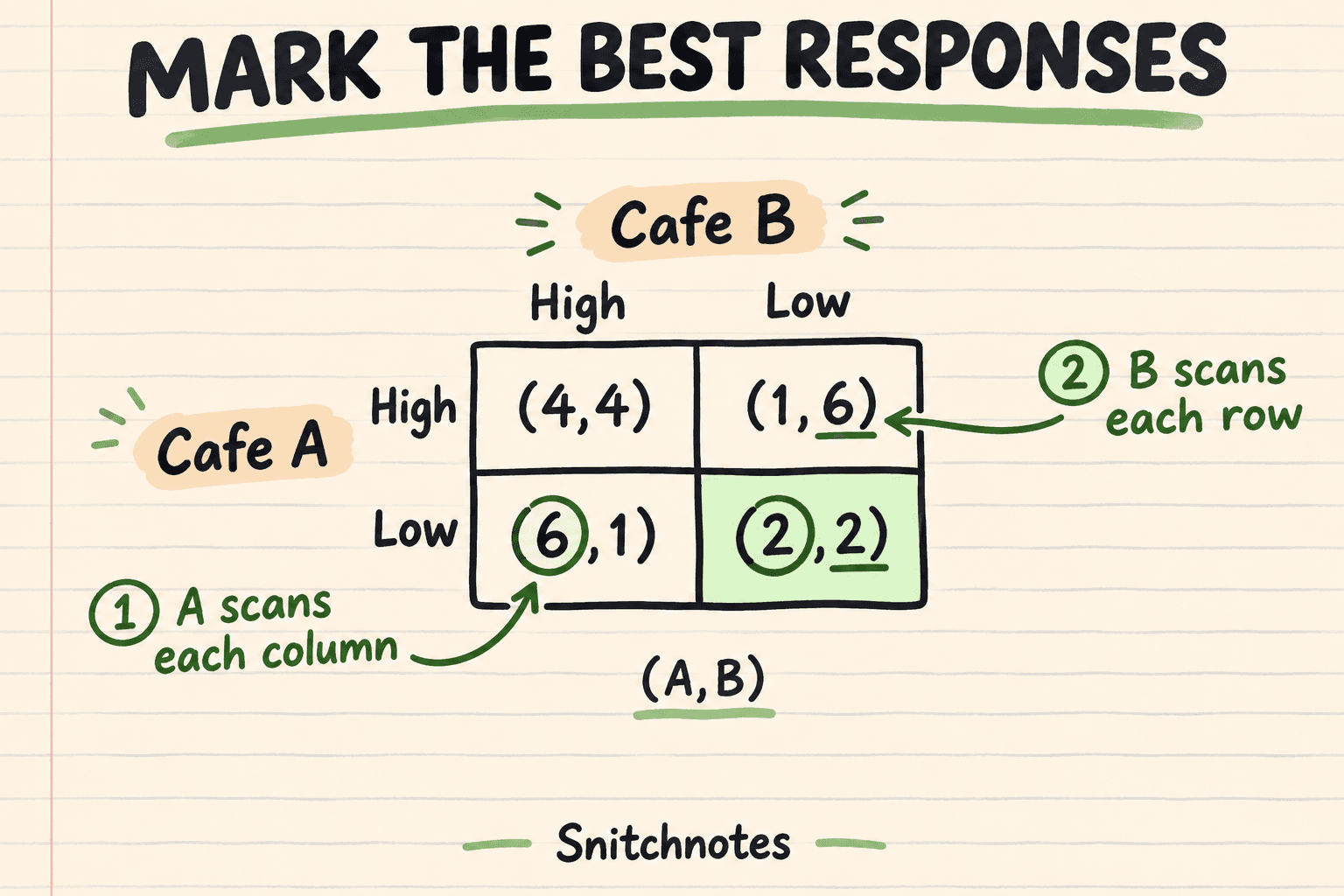
- Mark the row player's best responses. Hold one column fixed, compare the first numbers down that column, and circle the largest. Repeat for every column.
- Mark the column player's best responses. Hold one row fixed, compare the second numbers across that row, and underline the largest. Repeat for every row.
- Find overlapping marks. A cell with both a circle and an underline is a pure-strategy Nash equilibrium. Keep all ties: equal highest payoffs are all best responses.
- Verify each candidate. From that cell, let only the row player switch, then reset and let only the column player switch. Neither move should raise the mover's payoff.
Why scan columns for the row player? A column represents the column player's fixed choice, so the row player can only move up or down. The same logic turns sideways for the column player: with the row fixed, that player can only move left or right.
Worked example: two cafes choose prices
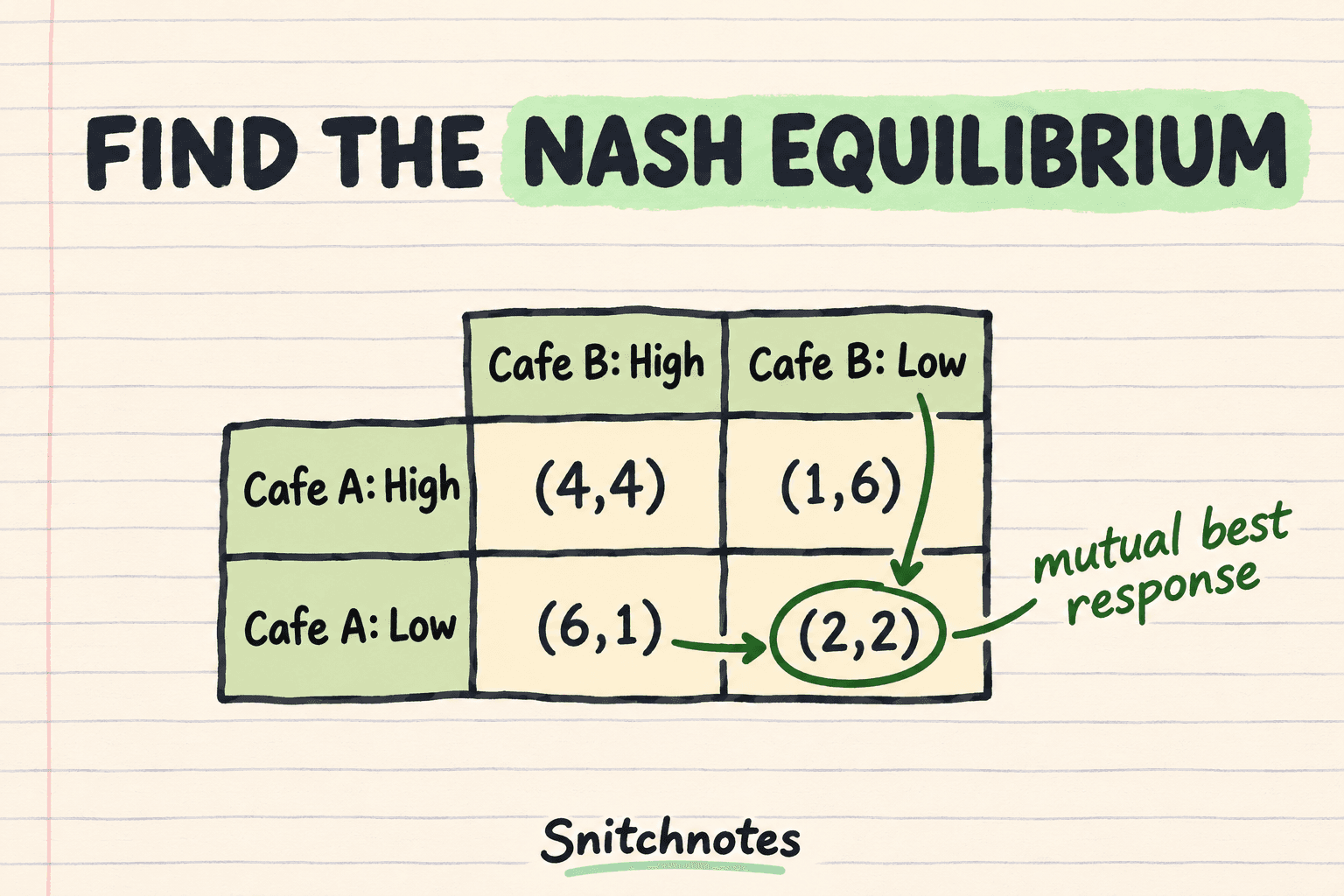
Cafe A chooses the row and Cafe B chooses the column. Each chooses a High or Low price. The payoffs are weekly profit in thousands of euros, written (A, B): High–High gives (4, 4), High–Low gives (1, 6), Low–High gives (6, 1), and Low–Low gives (2, 2).
Start with Cafe A. If B chooses High, A compares 4 from High with 6 from Low, so Low is A's best response. If B chooses Low, A compares 1 with 2, so Low is again A's best response. Circle A's 6 in the High column and A's 2 in the Low column.
Now mark Cafe B's choices. If A chooses High, B compares 4 from High with 6 from Low, so Low is B's best response. If A chooses Low, B compares 1 with 2, so Low is again B's best response. Underline B's 6 in the High row and B's 2 in the Low row.
The marks overlap only at Low–Low, with payoff (2, 2). Test it numerically. If A alone switches to High while B stays Low, A's profit falls from 2 to 1. If B alone switches to High while A stays Low, B's profit also falls from 2 to 1. Neither cafe benefits from a unilateral deviation, so Low–Low is the unique pure-strategy Nash equilibrium.
Why the equilibrium is not always the best outcome
Both cafes would earn 4 at High–High, which is better for each than the 2 earned at Low–Low. Yet High–High is not stable: if B stays High, A can switch to Low and raise its payoff from 4 to 6. B faces the same temptation. The matrix separates collective desirability from individual stability.
That distinction is why Nash equilibrium matters in economics and business. It provides a disciplined prediction for strategic settings where each person's best move depends on what others do. It also reveals when incentives can trap players in an outcome they would jointly prefer to avoid.
A matrix can have two pure equilibria or none
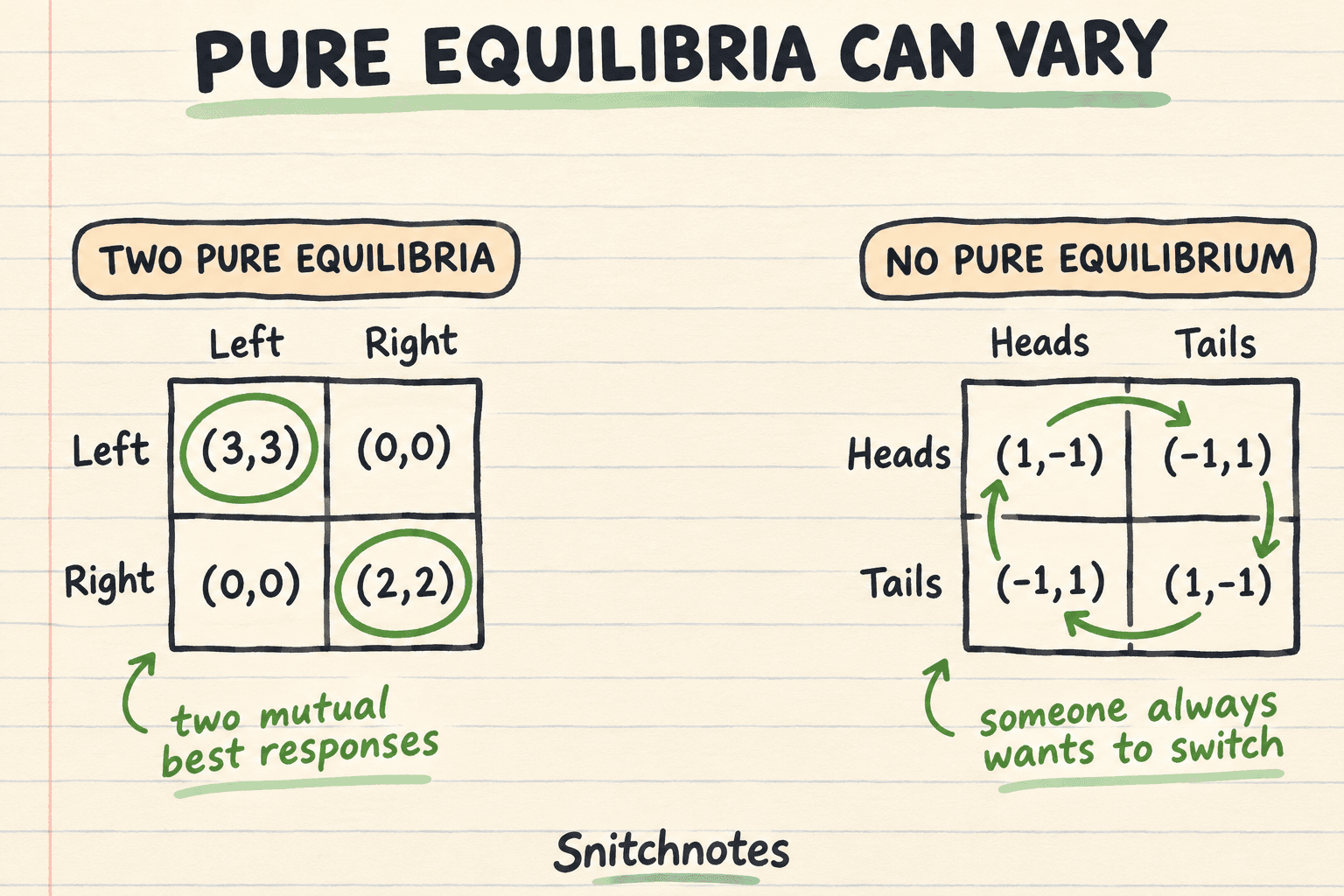
Do not stop after finding the first overlap. In a coordination game, both players may prefer matching choices, so two diagonal cells can be mutual best responses. Both are pure-strategy Nash equilibria, even if one gives higher payoffs than the other.
The marks can also fail to overlap. In matching pennies, one player wants the choices to match and the other wants them to differ, so someone wants to switch at every pure-strategy cell. That means there is no pure equilibrium. For a finite game, Nash's existence result guarantees at least one equilibrium when mixed strategies—probability distributions over pure choices—are allowed, but calculating that is a different method.
Common mistakes and boundaries
- Comparing numbers within a cell: a player compares their own payoffs across choices, not one player's payoff with the other's.
- Scanning in the wrong direction: row-player best responses are found down columns; column-player best responses are found across rows.
- Ignoring ties: if two choices produce the same highest payoff, both are best responses and both must be marked.
- Assuming equilibrium requires dominant strategies: dominance can make a game easy, but mutual best responses can exist without either player having one strategy that is best in every case.
Check your understanding
Why is High–High not an equilibrium in the cafe game?
If one cafe keeps High, the other can switch to Low and raise its own payoff from 4 to 6. A profitable unilateral deviation exists, so the cell fails the Nash test.
What proves that Low–Low is an equilibrium?
Holding B at Low, A would fall from 2 to 1 by switching. Holding A at Low, B would also fall from 2 to 1 by switching. Both strategies are best responses to each other.
What should you conclude when no cell has both marks?
There is no pure-strategy Nash equilibrium. Do not conclude that the game has no equilibrium at all; a mixed-strategy equilibrium may still exist.
Related concepts
- Deadweight loss explained with a supply and demand example: see how individual incentives can produce an inefficient market outcome.
- How banks create money when lending: connect strategic behavior with a broader economics mechanism.
- Dominant strategy: a choice that gives at least as high a payoff as every alternative, whatever the other player does.
- Mixed strategy: a probability distribution over pure strategies, used when predictable pure choices are not stable.
Sources
Holt and Roth, The Nash Equilibrium: A Perspective, Proceedings of the National Academy of Sciences
University of Chicago: Basic Game Theory—Pure Nash Equilibria
Transforme tes cours en fiches prêtes pour les exams.
Notes, quiz, podcasts, flashcards et chat — en un seul upload.
Essaie ta première note gratuitement