
Snitchnotes Team
How to Fix a Literature Essay That Summarizes Instead of Analyzes
How to Fix a Literature Essay That Summarizes Instead of Analyzes
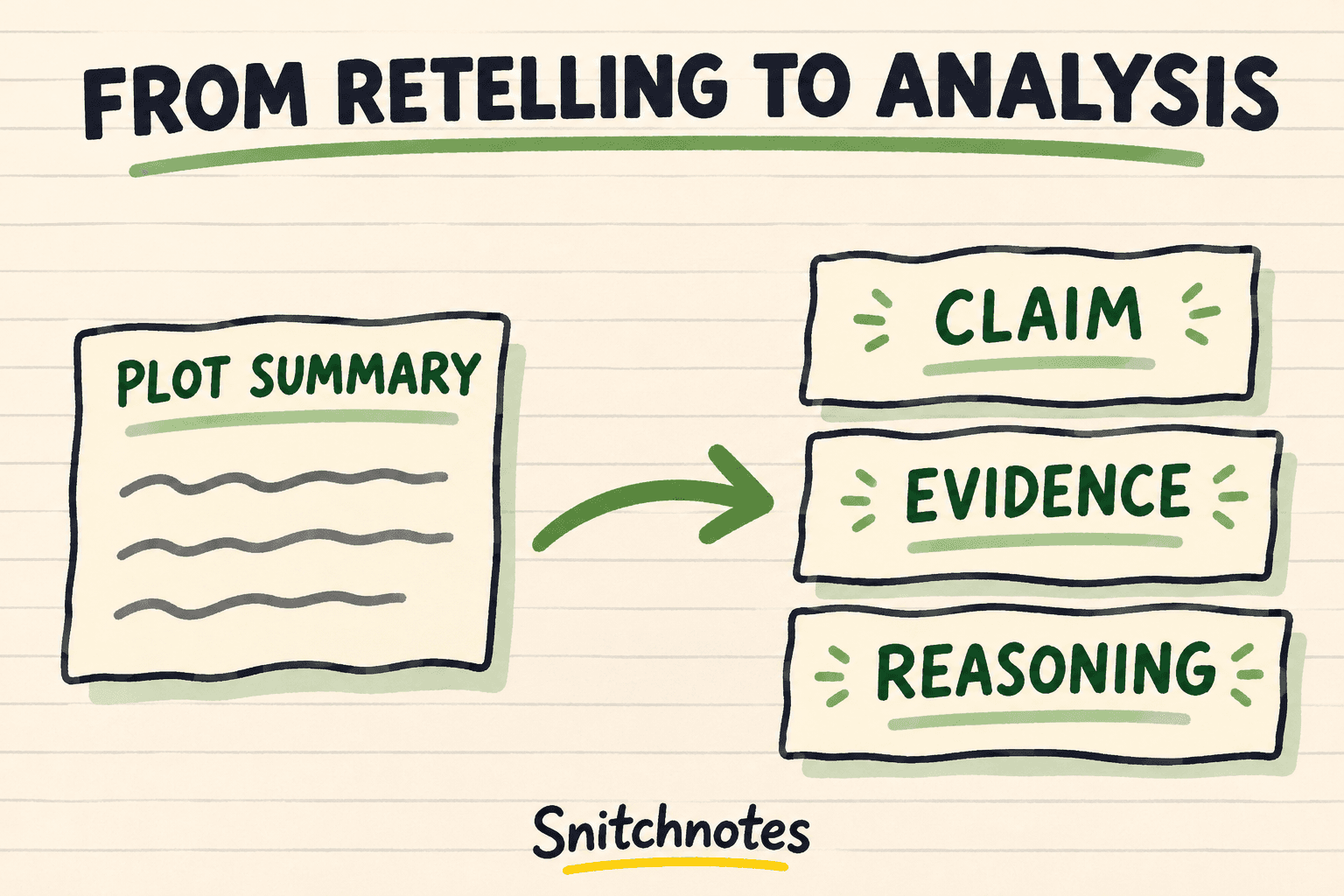
To fix a literature essay that summarizes instead of analyzes, keep only the plot context the reader needs, replace event-reporting topic sentences with arguable claims, choose one precise textual detail, and explain how that detail creates meaning. A useful paragraph moves through claim, evidence, and reasoning: what you think the text suggests, what word or image supports that reading, and why the choice changes the reader’s understanding.
This article is for students whose feedback says “too much summary,” “analyze the quotation,” or simply “so what?” Summary tells us what happens. Analysis makes a defensible interpretation of how language, form, structure, or contrast produces an effect. The University of North Carolina Writing Center notes that summary can orient a reader, but it must remain subordinate to your own argument.
Diagnose a paragraph that is mostly summary
Read one body paragraph and underline every sentence that only reports an event. Then circle every sentence that explains a textual choice and connects it to the paragraph’s claim. If underlining dominates, the problem is visible. You do not need to guess whether the paragraph “feels analytical.”
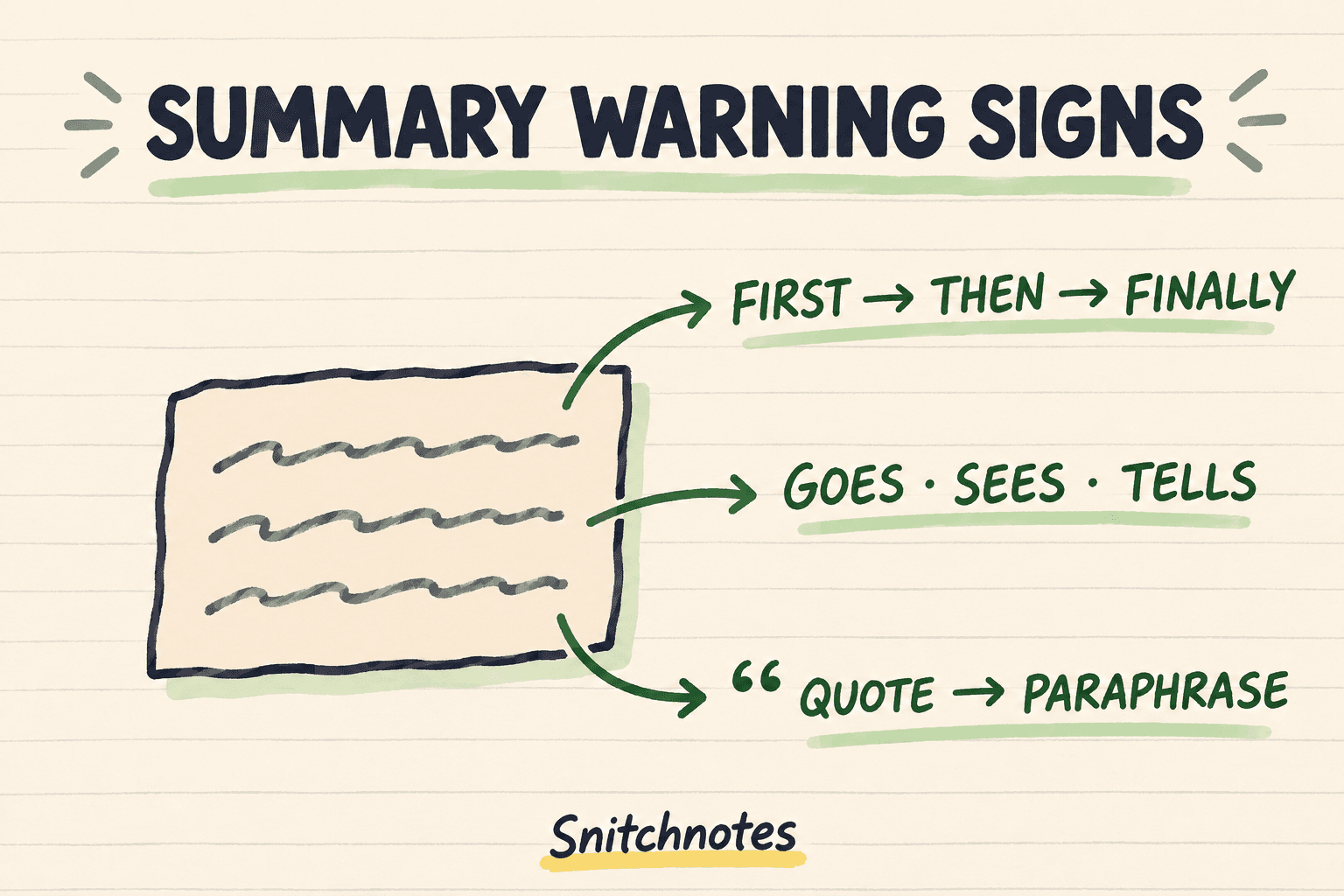
- The paragraph follows the plot in order: first, then, after that, finally.
- The topic sentence names a topic or event but makes no arguable claim about it.
- Most verbs report action: goes, sees, tells, kills, discovers, or leaves.
- A quotation is followed by a paraphrase of the same quotation rather than an explanation of its language.
- The paragraph could appear in a plot guide without changing its purpose.
One quick test is to ask, “Could a careful reader disagree with this sentence?” “Banquo is murdered” is a fact from the plot. “Macbeth’s new power makes him more fearful rather than secure” is an interpretation that needs proof. Analysis begins when your sentence creates that need.
Use the claim-evidence-reasoning repair
Do not decorate the summary with academic-sounding words. Rebuild its job. Start with a claim that answers how or why. Add the minimum context needed to locate the moment. Select a short quotation or formal feature. Then spend your attention on reasoning: name what is unusual, describe its effect, and connect that effect back to the claim.
- Claim: state the interpretation that this paragraph will prove.
- Evidence: quote or describe the smallest useful word, image, contrast, rhythm, narrative choice, or structural pattern.
- Reasoning: explain what the detail suggests, how it shapes the reader’s response, and why that supports the claim.
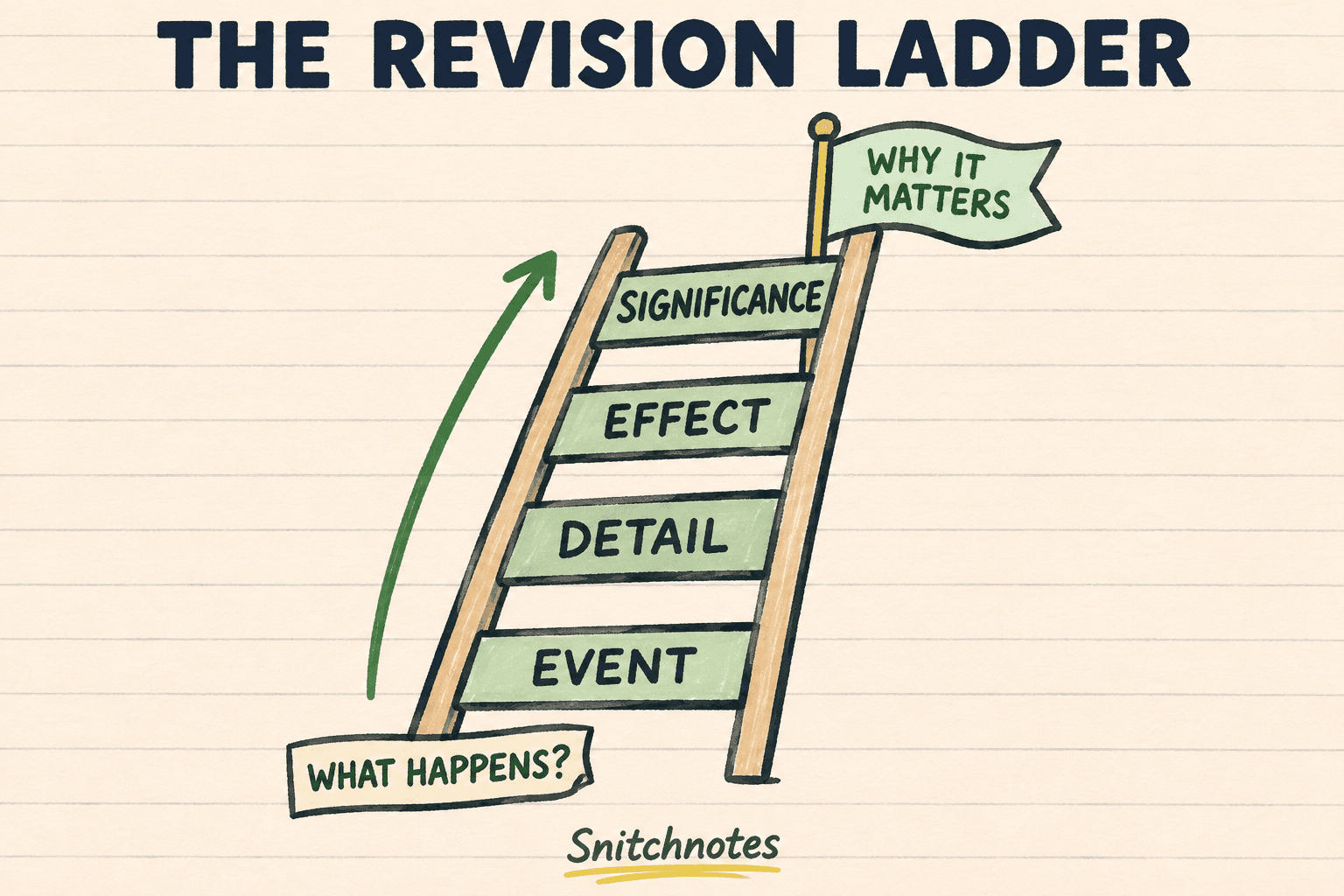
Harvard College Writing Center’s close-reading guidance recommends moving from observation about a detail toward interpretation rather than jumping straight to a broad conclusion. Try a four-rung revision ladder before drafting: What happens? What textual choice stands out? What effect does it create? Why does that effect matter to my claim? The first rung supplies context; the next three produce analysis.
Worked example: Macbeth, fear, and power
Suppose a draft retells Banquo’s murder:
Macbeth sends murderers to kill Banquo and Fleance. Banquo is killed, but Fleance escapes. The murderer tells Macbeth what happened, and Macbeth becomes worried because Fleance is still alive.
The facts are accurate, but the paragraph has not yet made a literary claim. Keep one sentence of context and choose an image worth examining. In Act 3, Scene 4, Macbeth calls the dead Banquo the “grown serpent” and the escaped Fleance a “worm” that will eventually “venom breed,” although it has “no teeth” for now. The animal imagery gives the paragraph something specific to interpret.
Macbeth’s rise to the throne intensifies his fear instead of making him secure. When he learns that Banquo is dead but Fleance has escaped, he imagines Banquo as a “grown serpent” and Fleance as a “worm” that will one day “venom breed.” By turning both men into poisonous creatures, Macbeth recasts his own victims as threats. The contrast between Fleance’s future venom and his present lack of “teeth” shows that Macbeth experiences control as temporary: every act of violence creates another danger to anticipate. The audience therefore sees a king whose power depends on imagining and attacking future enemies, not a ruler made confident by authority.
Notice the proportions. The revision uses one short context sentence, then several sentences on the imagery, contrast, and audience effect. It does not merely replace “Macbeth is worried” with “Macbeth is extremely paranoid.” It demonstrates how the language produces that interpretation. Purdue University’s Online Writing Lab similarly advises writers about fiction to move beyond plot information and build an arguable interpretation supported by selected textual evidence.
Revise sentence by sentence
- Box the topic sentence. If it only announces an event, rewrite it as a claim about meaning or effect.
- Keep one or two context sentences only when the evidence would otherwise be confusing.
- Trim long quotations to the detail you can actually discuss, without changing the author’s meaning.
- After each quotation, add two questions in the margin: “how?” and “so what?” Answer both in the draft.
- Read the last sentence beside the topic sentence. Make sure the reasoning proves the exact claim you began with.
If the same feedback appears across assignments, make a three-column revision table for each body paragraph: current sentence, job of the sentence, revised sentence. Snitchnotes can help organize feedback, notes, and source material into study aids, but your interpretation still needs to come from careful reading of the text and your assignment’s requirements.
The boundary: summary is useful in small doses
A literature essay is not improved by deleting every reference to the plot. Readers need enough context to understand who speaks, when the moment occurs, and what has changed. Summary becomes a problem when it replaces the argument rather than serving it. A practical balance is to summarize briefly, quote selectively, and analyze at greater length.
Analysis is also not a hunt for hidden symbols at any cost. Begin with observable details and make claims proportionate to the evidence. Your instructor may prioritize historical context, narrative technique, genre, or theory, so use the required method and citation style. A strong interpretation is arguable, not arbitrary.
Check your understanding
What is the clearest sign that a paragraph is summary?
Most sentences report what characters do in chronological order, while few explain how a textual detail supports an arguable claim.
Why is paraphrasing a quotation not analysis?
Paraphrase restates what the quotation says. Analysis explains how its wording or form creates an effect and why that effect matters to your interpretation.
When should you keep plot summary?
Keep the minimum context a reader needs to understand the evidence. If a sentence does not orient the reader or advance the claim, cut or replace it.
Related concepts
- How to find evidence for a literature essay without rereading everything
- How to review a marked essay before your next assignment
- Close reading: examine diction, imagery, syntax, sound, form, and structure before drawing a larger interpretation.
Sources
University of North Carolina Writing Center: Summary — Using It Wisely
Harvard College Writing Center: How to Do a Close Reading
Transforme tes cours en fiches prêtes pour les exams.
Notes, quiz, podcasts, flashcards et chat — en un seul upload.
Essaie ta première note gratuitement