
Snitchnotes Team
Permutation vs Combination: Differences and Examples
Permutation vs Combination: Differences and Examples
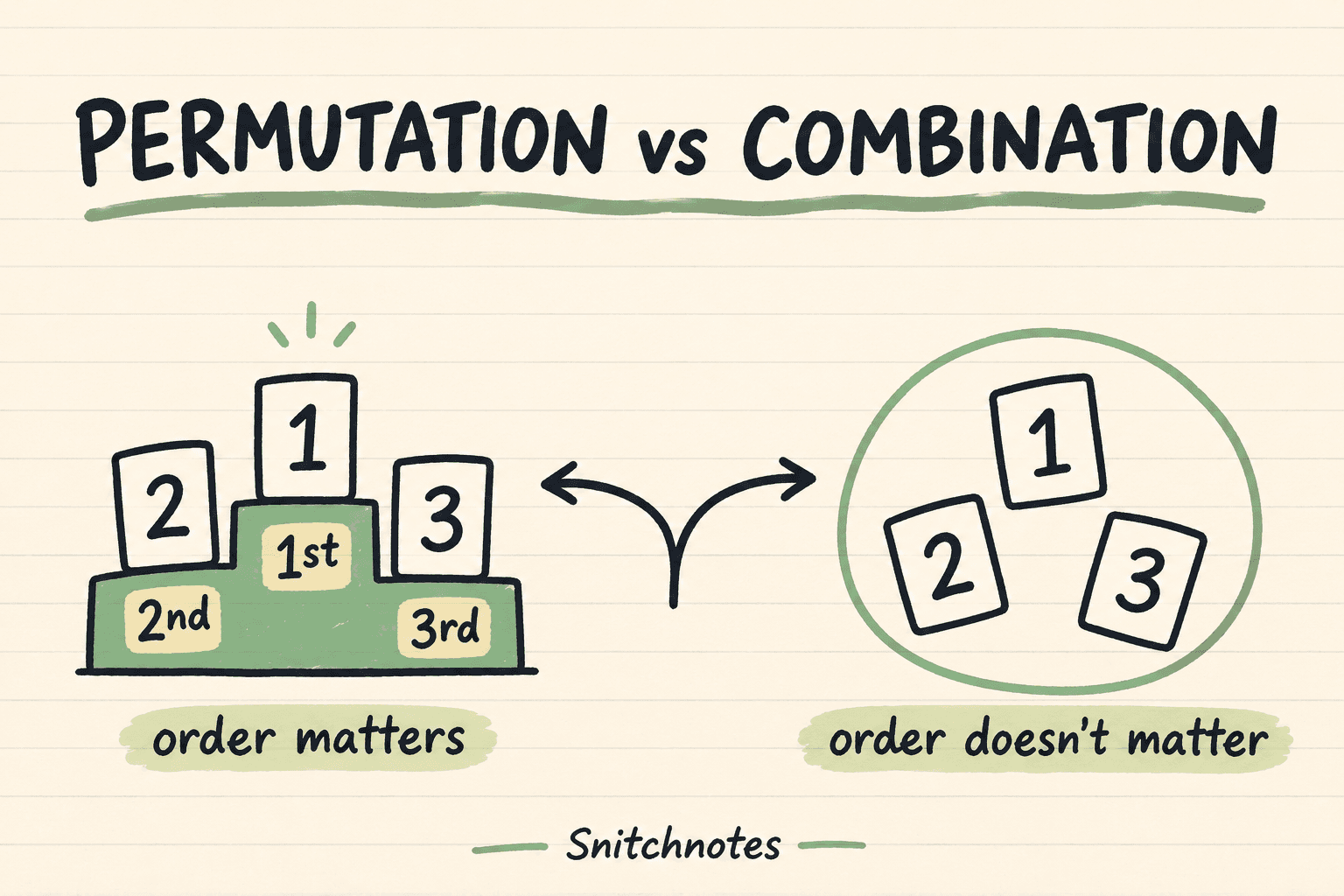
The difference between a permutation and a combination is order. Use a permutation when changing the order creates a different outcome, such as assigning president, vice president, and treasurer. Use a combination when only the selected group matters, such as choosing three committee members with equal roles.
Both methods choose r items from n distinct items without repetition, but permutations count every relevant arrangement while combinations merge rearrangements of the same chosen items. That one distinction determines the formula, the answer, and whether you accidentally overcount.
Permutation vs combination at a glance
- Permutation: order matters. The outcomes A-B-C and C-B-A are different.
- Combination: order does not matter. The groups {A, B, C} and {C, B, A} are the same selection.
- Permutation formula: nPr = n! / (n − r)!
- Combination formula: nCr = n! / [r!(n − r)!]
- Connection: nPr = nCr × r!, because each unordered group of r distinct items has r! possible orders.
Here, n is the number of available items and r is the number selected. The exclamation mark means factorial: for example, 5! = 5 × 4 × 3 × 2 × 1 = 120. The National Institute of Standards and Technology also defines 0! as 1, which keeps the counting formulas consistent when r equals n.
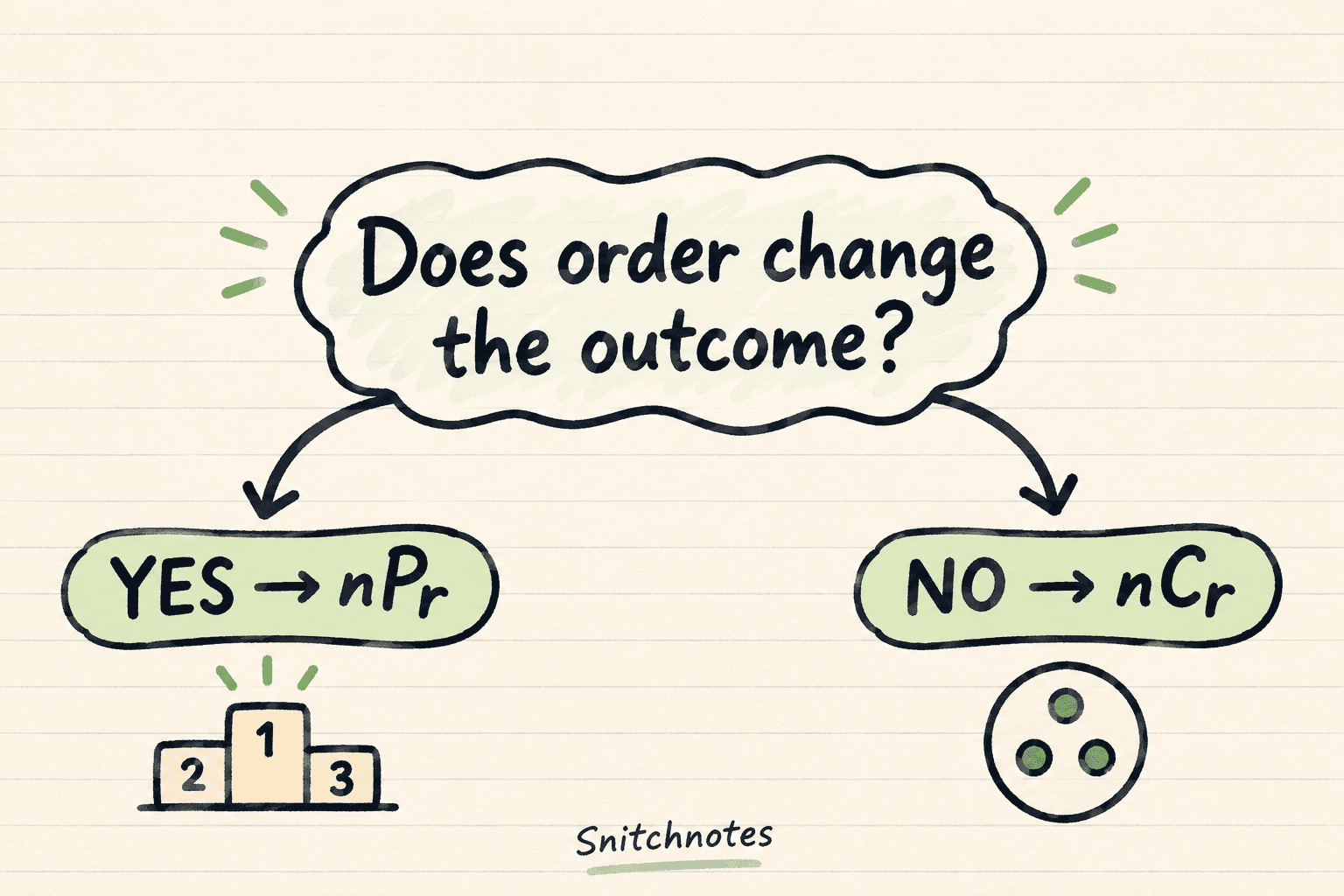
The quickest decision rule: does order change the outcome?
Do not decide from verbs like choose, select, or arrange alone. Instead, imagine swapping two of the chosen items. If the swap changes the meaning of the result, order matters and the problem is a permutation. If the swap describes the same result, order does not matter and the problem is a combination.
- Gold, silver, and bronze medalists: permutation. Maya-Sam-Leo is a different podium from Leo-Sam-Maya because the positions differ.
- Three students on an equal-status committee: combination. Listing Maya first instead of Leo does not create a new committee.
- A four-digit code with no repeated digits: permutation. 1234 and 4321 open different codes.
- A five-card poker hand: combination. The order in which the cards arrive does not change the hand.
Why the two formulas are different
A permutation fills ordered positions. If eight students can fill three offices, there are 8 choices for the first office, then 7 for the second, then 6 for the third. The multiplication principle gives 8 × 7 × 6. The factorial formula n! / (n − r)! is a compact way to write that descending product.
A combination begins with that ordered count, then removes duplicate arrangements. Any particular set of three students can be ordered in 3! = 6 ways. Dividing the permutation count by 3! leaves one count for the group itself. This is why the combination formula adds r! to the denominator.
Worked example: three officers or a three-person committee
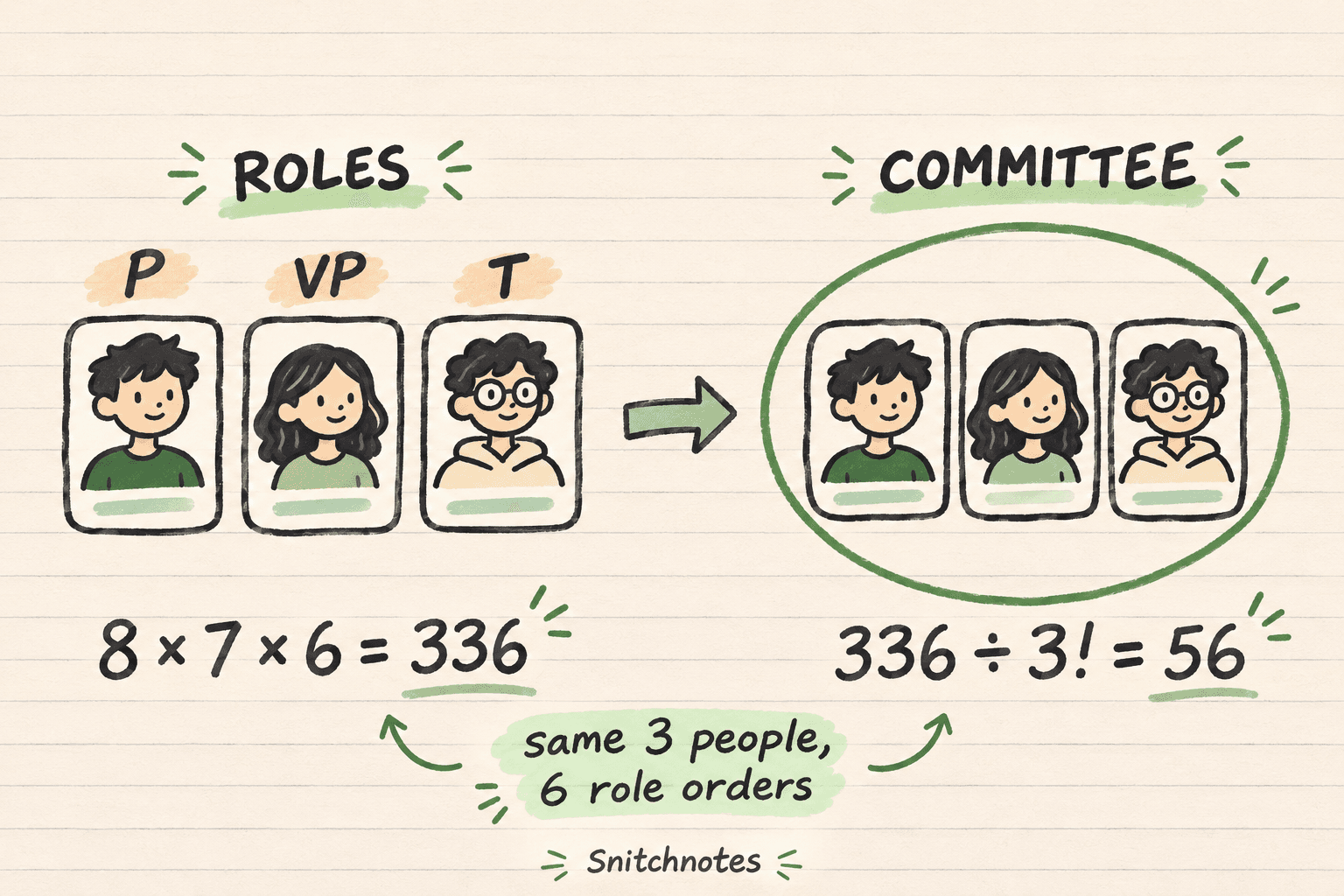
Eight students volunteer for student council. First, the class needs a president, vice president, and treasurer. These offices are distinct, so assigning Ana as president, Bo as vice president, and Cy as treasurer is different from assigning Cy as president, Bo as vice president, and Ana as treasurer. Order matters.
Use a permutation: 8P3 = 8! / 5! = 8 × 7 × 6 = 336. There are 336 possible officer assignments.
Now suppose the same class chooses three people for an events committee, and all members have equal responsibility. Ana, Bo, and Cy form the same committee no matter which name is written first. Order does not matter.
Use a combination: 8C3 = 8! / (3!5!) = (8 × 7 × 6) / (3 × 2 × 1) = 336 / 6 = 56. There are 56 possible committees.
Why 336 becomes 56
The permutation answer is exactly 3! = 6 times the combination answer. Take one committee: Ana, Bo, and Cy. The ordered count includes ABC, ACB, BAC, BCA, CAB, and CBA as six separate assignments. The committee count treats all six strings as one group. Dividing 336 by 6 removes that overcount and gives 56.
This relationship is a useful check. For the same n and r, with distinct items and no repetition, nPr should equal nCr × r!. If your two answers do not have that relationship, revisit the arithmetic or the model.
Common mistakes and important boundaries
- Mistake: assuming every problem that says choose is a combination. You can choose people for distinct offices, and the distinct roles make order matter.
- Mistake: using the visual order in a written list. Names may be listed in some order even when the mathematical outcome is an unordered group. Ask whether swapping them changes the result.
- Boundary: these basic formulas assume distinct items selected without replacement. Repeated objects, allowed repetition, circular arrangements, or role restrictions need different counting methods.
- Boundary: everyday language is looser than mathematical language. People may casually say combination for a keypad code, even though codes are ordered sequences. Model the outcome, not the label.
Check your understanding
A coach names a captain and co-captain from 12 players. Permutation or combination?
Permutation. The roles differ, so swapping the two selected players creates a different assignment. The count is 12P2 = 12 × 11 = 132.
A reader chooses 4 books from a shelf of 10 to take on holiday. Permutation or combination?
Combination, assuming only the set of books matters. The count is 10C4 = 10! / (4!6!) = 210. If the problem instead asked for the order in which the books would be read, it would become a permutation.
Why is a permutation count usually larger?
Because it counts every order of each selected group separately. For r distinct selected items, that creates r! ordered outcomes for every one unordered combination. The two counts are equal only in special edge cases such as r = 0 or r = 1, where r! = 1.
If counting formulas blur together in your own class notes, Snitchnotes can turn your lectures, slides, and PDFs into organized notes, flashcards, and quizzes so you can practice choosing the right method.
Related concepts
- Fundamental counting principle: multiply the number of available choices at each successive step.
- Factorial: the product n × (n − 1) × ... × 1, used to count arrangements of distinct items.
- Confidence intervals: a worked statistics example using a different kind of formula and interpretation.
- Standard deviation vs standard error: another statistics comparison where choosing the right measure matters.
Sources
OpenStax, Contemporary Mathematics: 7.2 Permutations
OpenStax, Contemporary Mathematics: 7.3 Combinations
OpenStax, College Algebra 2e: 9.5 Counting Principles
Pennsylvania State University, STAT 414: Counting Techniques
Zamień wykłady w materiały gotowe na egzamin.
Notatki, quizy, podcasty, fiszki i czat — z jednego uploadu.
Stwórz pierwszą notatkę za darmo