
Snitchnotes Team
How to Read Old Handwriting for a Paleography Exam
How to Read Old Handwriting for a Paleography Exam
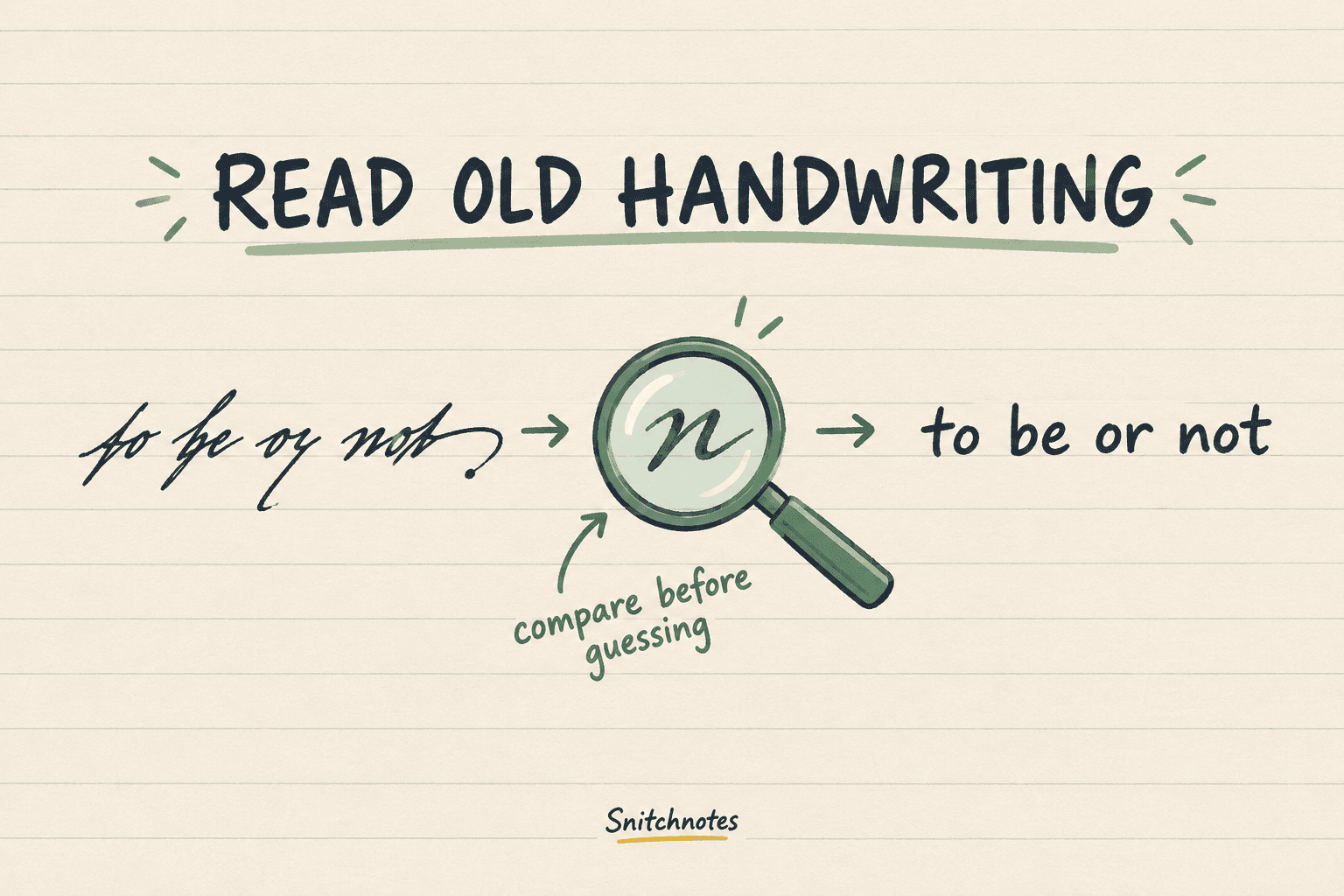
To read old handwriting in a paleography exam, work from evidence rather than whole-word guesses. Scan the document, build a small alphabet from repeated letterforms, identify abbreviation marks, test uncertain readings against grammar and context, and record any remaining doubt using the exam's transcription rules. Preserve original spelling unless the instructions explicitly tell you to modernize it.
This method matters because an unfamiliar hand is a system, not random scribbling. The United Kingdom National Archives teaches reading handwriting from 1500 to 1800 through graded practical examples, while the United States National Archives recommends comparing a writer's recurring shapes and using context. In an exam, those habits turn a page-sized mystery into a sequence of small decisions.
Start with the document, not the hardest word
Spend the first minute surveying the whole page. Note the language, probable date, document type, line count, repeated names, formulaic greetings, and obvious numbers. A letter that begins with a place and date behaves differently from an account book or court deposition. These are constraints, not answers: they narrow what a reading could plausibly be without licensing you to invent it.
Next, transcribe the easiest words first. Short function words, repeated names, month names, and familiar openings can reveal how this particular writer forms common letters. The United States National Archives demonstrates this with recurring features such as the long s, an open-topped a, and a p with a tall ascender. Do not memorize one universal alphabet and force every document into it; hands vary by writer, place, period, and purpose.
Step 1: Build a letter bank from the document
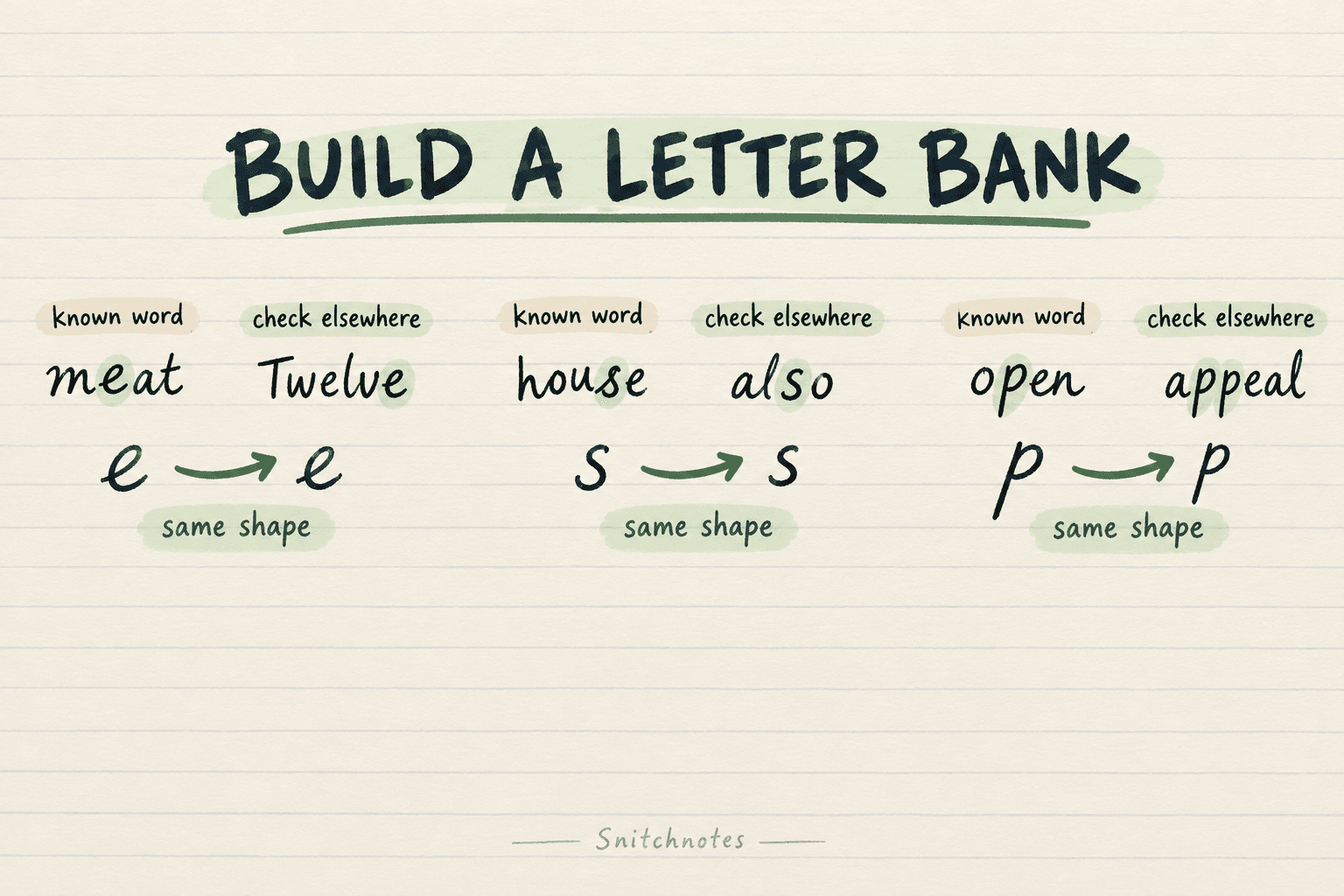
Create a quick letter bank in the margin. When a word is secure, copy one distinctive form beneath its modern letter: the writer's e, s, p, r, or capital S. Then compare uncertain characters with examples from the same page. Look at the whole stroke pattern—entry stroke, height, loops, joins, and exit stroke—not just a vague resemblance.
Repeated evidence is stronger than a single attractive guess. If a shape appears five times and four readings point to e, the fifth is probably e too. But position can change a letter: initial, medial, and final forms may differ. Keep separate samples when needed, and add a question mark to your letter bank until the identification is secure.
Step 2: Separate abbreviations from strange letters
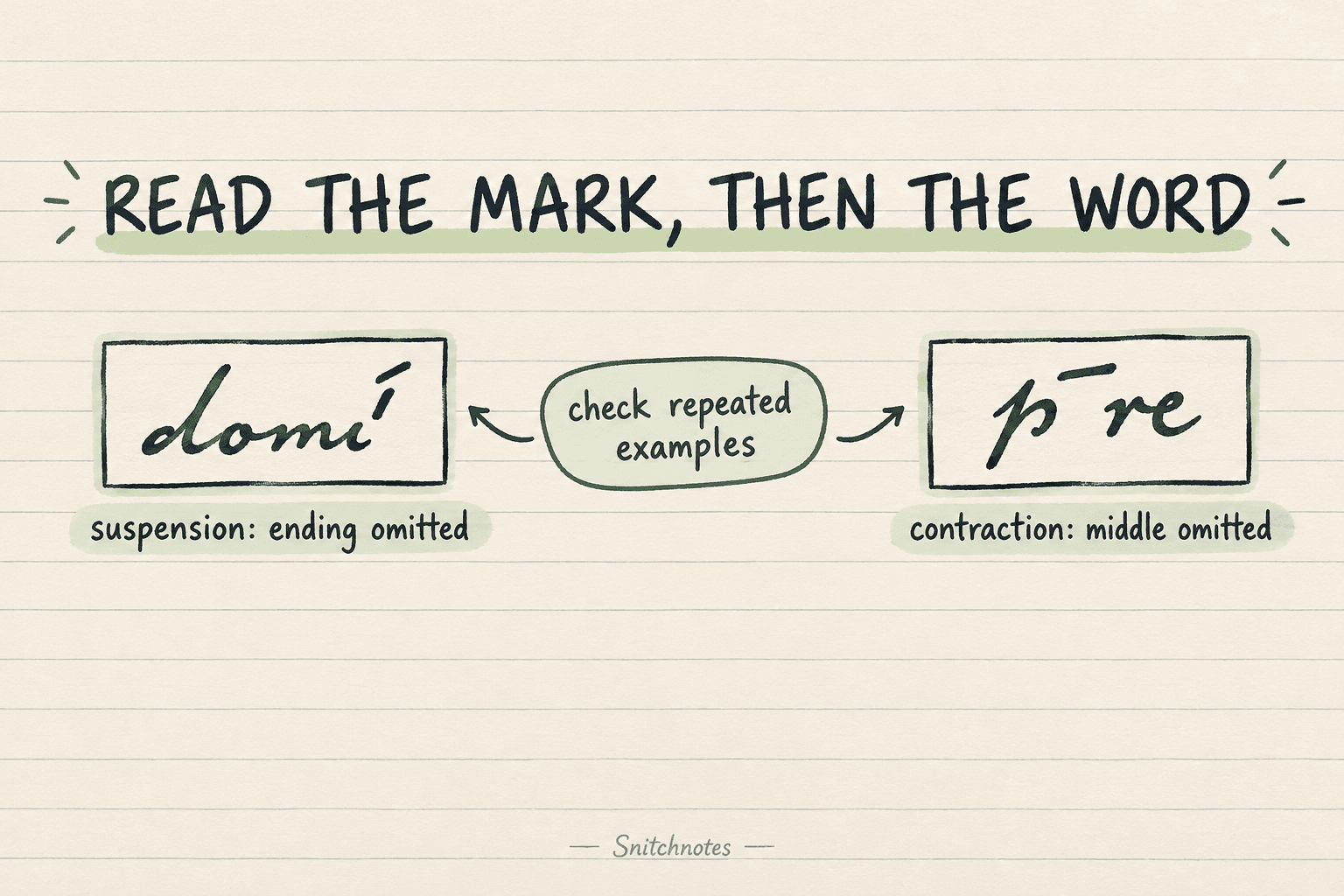
A puzzling mark may not be a letter at all. Historical writers shortened frequent words by suspension, which omits an ending, or contraction, which omits letters inside a word. Superscript letters, strokes, apostrophe-like marks, and special symbols can signal the omission, but their meanings are not universal. Compare the same mark elsewhere and consult the abbreviation list supplied by your course.
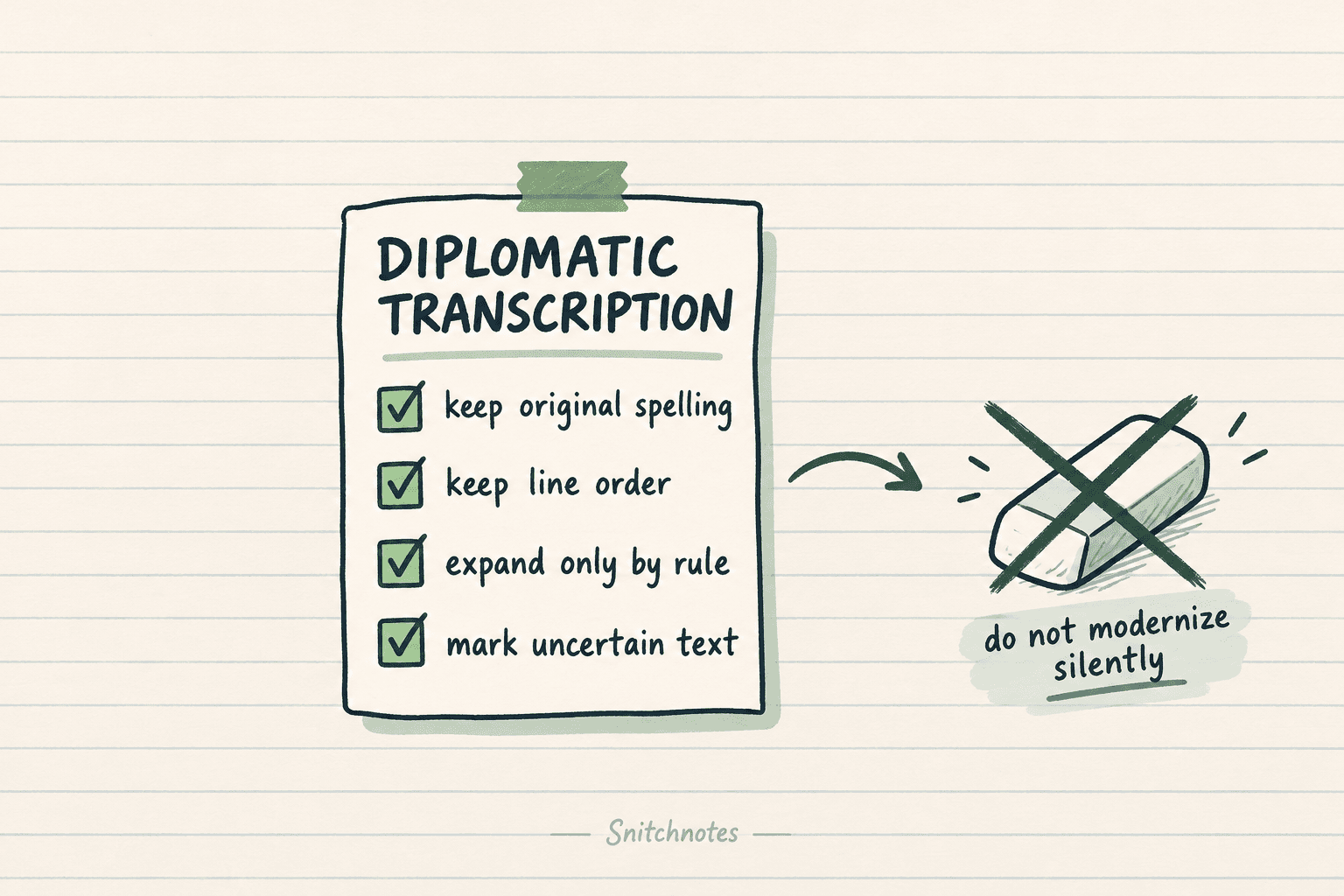
Keep two layers in your notes: what is visibly on the page and your proposed expansion. For example, you might first record yr, then annotate the likely expansion your. Whether the final transcription keeps yr, expands it, or marks supplied letters depends on the exam's editorial convention. A good paleographer makes that decision visible instead of quietly replacing historical usage with modern prose.
Step 3: Resolve uncertain words with three kinds of evidence
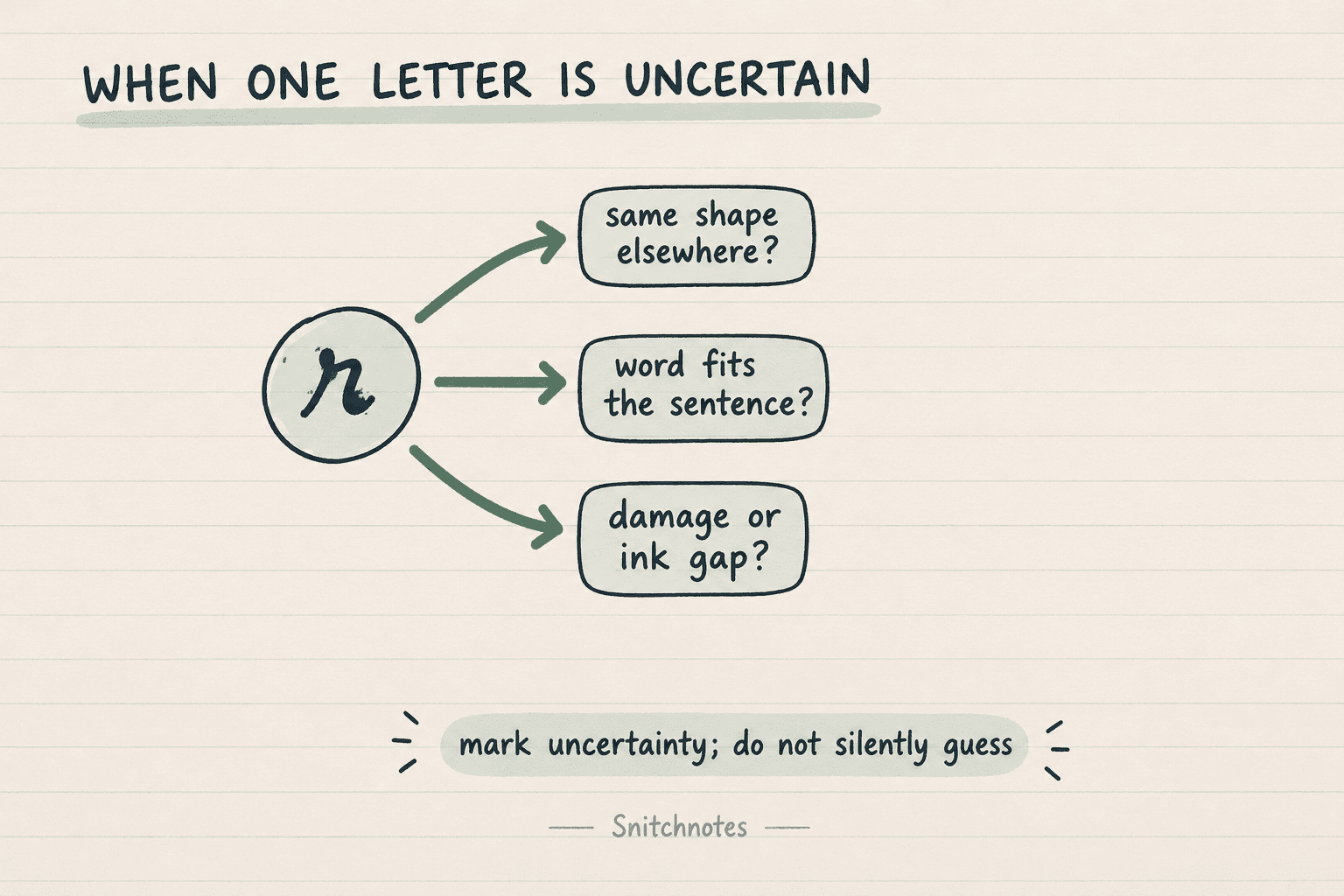
Test an uncertain reading against three things. Graphic evidence asks whether each stroke matches the writer's known forms. Linguistic evidence asks whether the spelling, grammar, and word order fit the period and sentence. Material evidence asks whether a stain, fold, fading, bleed-through, or cropped edge explains missing strokes. Context should choose between readings supported by the page; it should never manufacture letters that are not there.
If doubt remains, mark it. The Library of Congress uses bracketed question marks for illegible letters or words in its crowdsourced transcription rules, while the Smithsonian and other projects use their own bracket conventions. Your exam may differ, so follow its key exactly. Honest uncertainty earns more trust than a fluent but unsupported sentence.
A six-line eighteenth-century practice letter
Consider this fictional practice specimen: Bath, 14 Oct. 1772 / Dear Sister, / I receiv'd yr parcel this morn: / The brown cl?th is arriv'd, / but one corner is much stain'd. / Your affecte brother, Samuel. Imagine the fourth-line vowel is partly hidden by a stain.
- Secure the repeated shapes first. The clear words one and brother provide o forms; this and The help with t and h; receiv'd and arriv'd reveal the writer's repeated apostrophe abbreviation.
- Keep yr visible in the working transcript and note your as the likely expansion. Do not silently replace receiv'd with received, because the apostrophe and spelling are evidence.
- Resolve cl?th by combining the visible c-l-th sequence, the writer's known o, and the parcel and brown context. Cloth fits all three; clath or cleth do not. Record any required uncertainty mark if the stroke remains genuinely unreadable.
The point is not that context magically reveals cloth. The point is that context confirms a reading already compatible with visible strokes and repeated letterforms. On a timed paper, show that chain briefly in your working: shape, comparison, context, decision.
Step 4: Produce the transcription your exam asks for
Read the rubric before polishing. A diplomatic transcription usually preserves spelling, capitalization, punctuation, and lineation as closely as the chosen rules require. A normalized transcription may expand abbreviations or modernize selected features. Neither is automatically better; they answer different questions. State or apply one system consistently.
Leave time for a final pass from image to transcript, not transcript to image. Check every line ending, abbreviation, deletion, insertion, and uncertain reading. Reading backward from your polished prose encourages your brain to see what it expects. Comparing again with the manuscript catches the elegant mistakes.
Common mistakes and useful boundaries
The biggest mistakes are guessing whole words too early, treating every unusual form as a new letter, modernizing spelling without permission, and forcing damaged text into a sensible sentence. Also remember that paleography is not only decipherment: some exams ask you to identify a hand, date a script, explain letter development, or justify an editorial convention. Use this reading method inside the task actually set.
Check your understanding
What should you do before guessing an unclear word?
Build evidence from clear words and repeated letterforms in the same document, then test the candidate against grammar, meaning, and physical damage.
Should you correct old spelling in your transcription?
Not unless the exam requests normalization. Preserve what the document shows and make expansions or editorial additions according to the stated convention.
What if two readings remain possible?
Record uncertainty using the exam's notation and, if space permits, state the competing reading. Unsupported certainty is not better paleography.
Related concepts
- Primary versus secondary sources: examples for students
- How to analyze primary sources like a historian
- Diplomatic transcription: representing the source closely under an explicit editorial system.
Sources
The National Archives (UK): Palaeography tutorial
U.S. National Archives: Transcription Tips
Library of Congress, By the People: Transcription Basic Rules
Smithsonian Transcription Center: How to Transcribe
Harvard Library: Background Resources on Handwriting and Transcription
Zamień wykłady w materiały gotowe na egzamin.
Notatki, quizy, podcasty, fiszki i czat — z jednego uploadu.
Stwórz pierwszą notatkę za darmo