
Snitchnotes Team
How to Study Comparative Advantage With Opportunity-Cost Tables
How to Study Comparative Advantage With Opportunity-Cost Tables
To study comparative advantage, turn every production table into an opportunity-cost table. For each producer, divide the maximum output of the good given up by the maximum output of the good gained. Then compare the same opportunity cost across producers: whoever gives up less has the comparative advantage in that good.
This routine matters because comparative advantage is about relative sacrifice, not raw productivity. A person can produce more of both goods and still lack comparative advantage in one of them. Once you separate “who makes more?” from “who gives up less?”, most table questions become careful arithmetic rather than guesswork.
Why opportunity cost decides comparative advantage
Opportunity cost is what must be forgone to choose one option instead of the next-best alternative. In a two-good production problem, making more bread means giving up some bicycles, and making more bicycles means giving up some bread. Comparative advantage belongs to the producer with the lower opportunity cost for the good being compared.
OpenStax frames the key question as: what do we give up to produce this good? That wording is a useful exam habit. Before calculating anything, write the cost in units: “bicycles per loaf” or “loaves per bicycle.” The unit tells you which number belongs on top of the fraction and keeps reciprocal answers from being swapped.
The four-step opportunity-cost table method
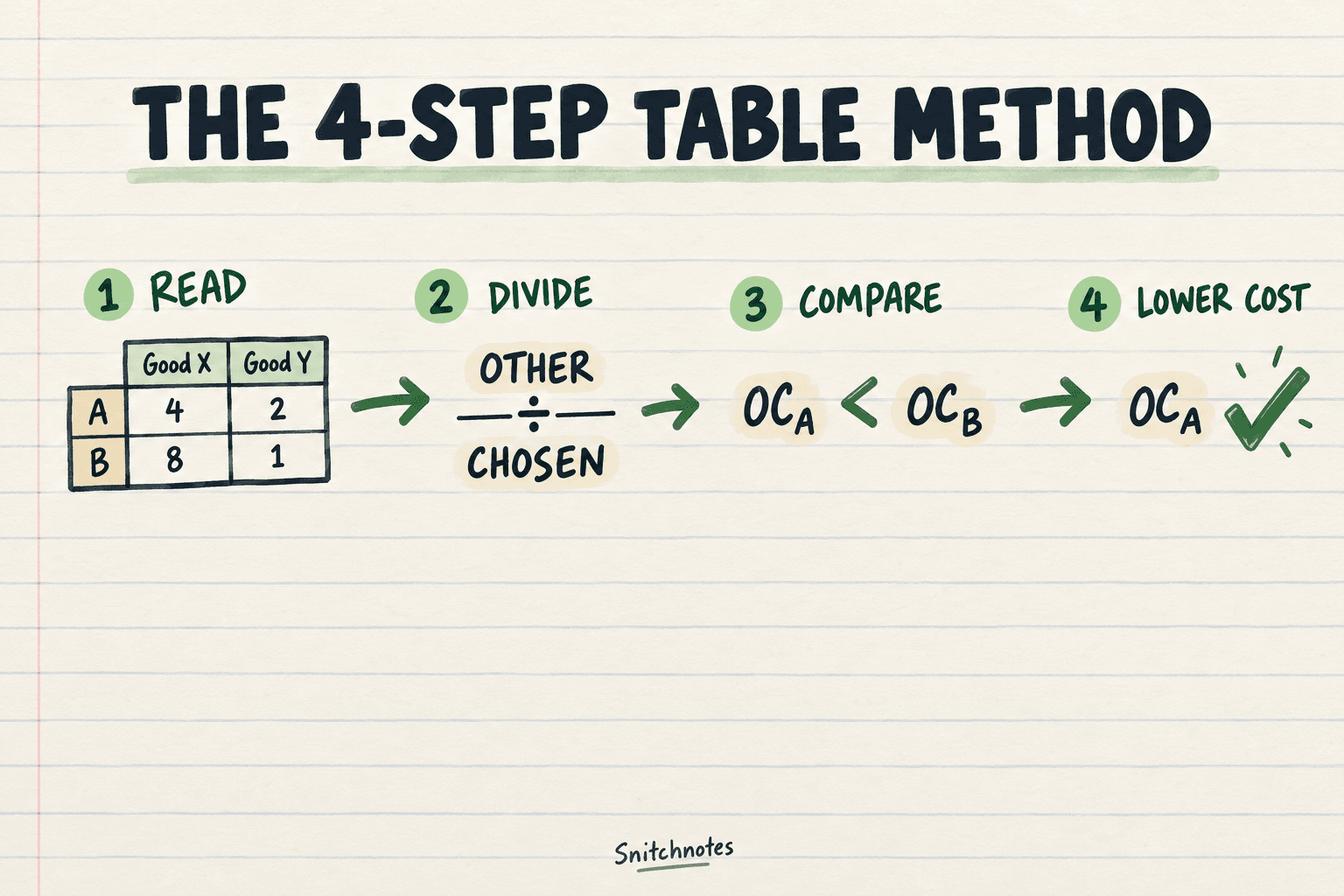
- Read the endpoints. For each producer, identify the maximum amount of good A or good B that can be made with the same resources. Do not compare producers yet.
- Calculate both costs within each producer’s row. Cost of 1 unit of A = maximum B ÷ maximum A. Cost of 1 unit of B = maximum A ÷ maximum B.
- Compare like with like. Put both producers’ costs of one loaf side by side, then both costs of one bicycle side by side. The lower number wins comparative advantage.
- Run two checks. The two costs within one row should be reciprocals, and in the usual two-producer, two-good problem each producer should have the lower cost in one good unless the costs are equal.
A compact memory cue is “other over chosen.” If you want the cost of one bicycle, put the bread forgone on top and bicycles gained on the bottom. If you want the cost of one loaf, reverse the fraction. Always attach the unit to the answer.
Worked example: Ana and Ben have eight hours
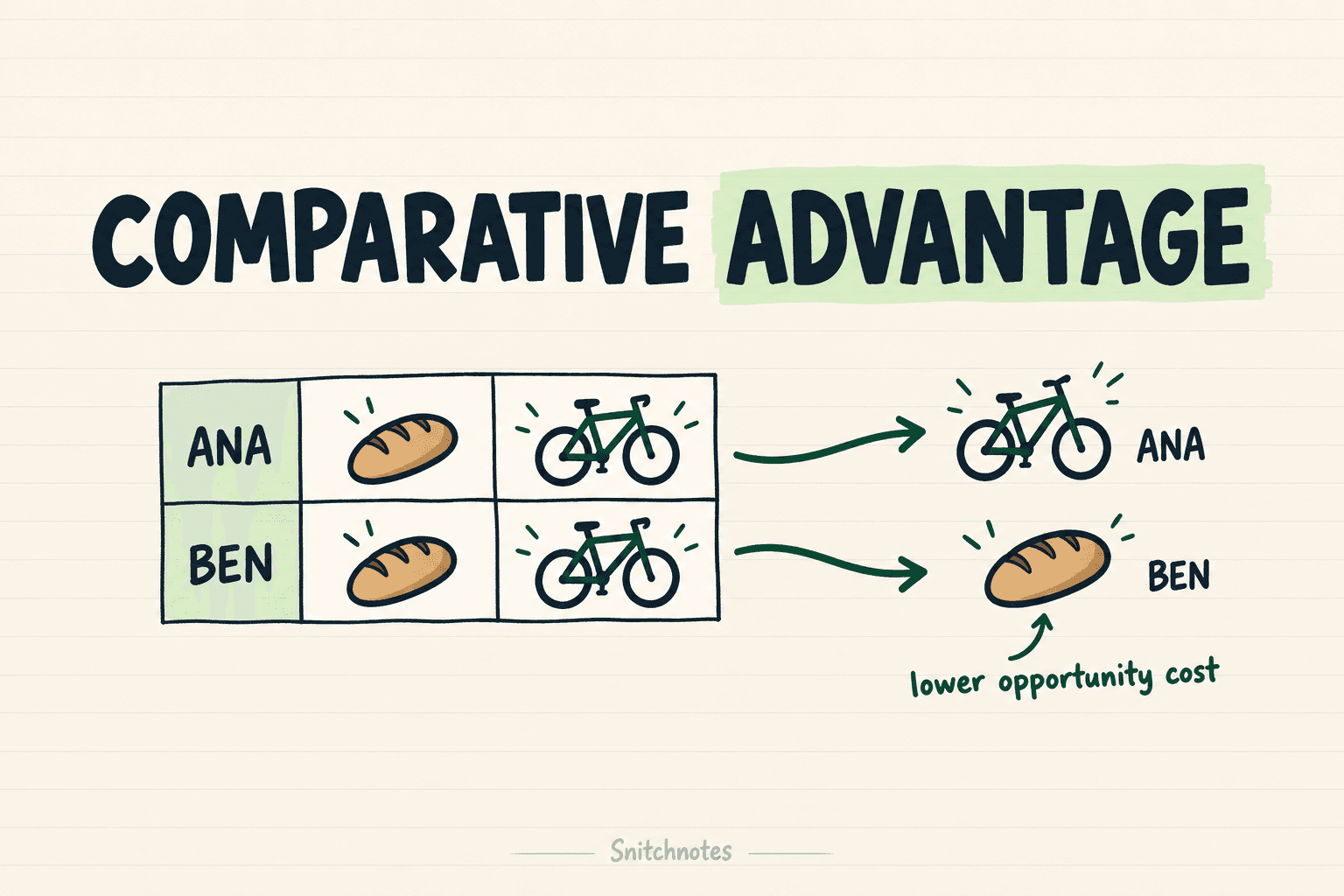
Ana and Ben each have eight hours. If Ana spends all eight hours baking, she can make 8 loaves of bread; if she spends them building, she can make 4 bicycles. Ben can make 6 loaves or 1 bicycle in the same eight hours. The production table is therefore Ana: 8 loaves or 4 bicycles; Ben: 6 loaves or 1 bicycle.
Start with Ana. The opportunity cost of 1 loaf is 4 bicycles ÷ 8 loaves = 0.5 bicycle. The opportunity cost of 1 bicycle is 8 loaves ÷ 4 bicycles = 2 loaves. Her two answers, 0.5 and 2, are reciprocals, so the row passes the first check.
Now calculate Ben’s costs. The opportunity cost of 1 loaf is 1 bicycle ÷ 6 loaves = 1/6 of a bicycle. The opportunity cost of 1 bicycle is 6 loaves ÷ 1 bicycle = 6 loaves. Again, 1/6 and 6 are reciprocals.
Compare the same goods. One loaf costs Ana 0.5 bicycle but costs Ben only 1/6 of a bicycle, so Ben has the comparative advantage in bread. One bicycle costs Ana 2 loaves but costs Ben 6 loaves, so Ana has the comparative advantage in bicycles. The lower opportunity cost, not the larger production number, decides each answer.
Do not confuse absolute and comparative advantage
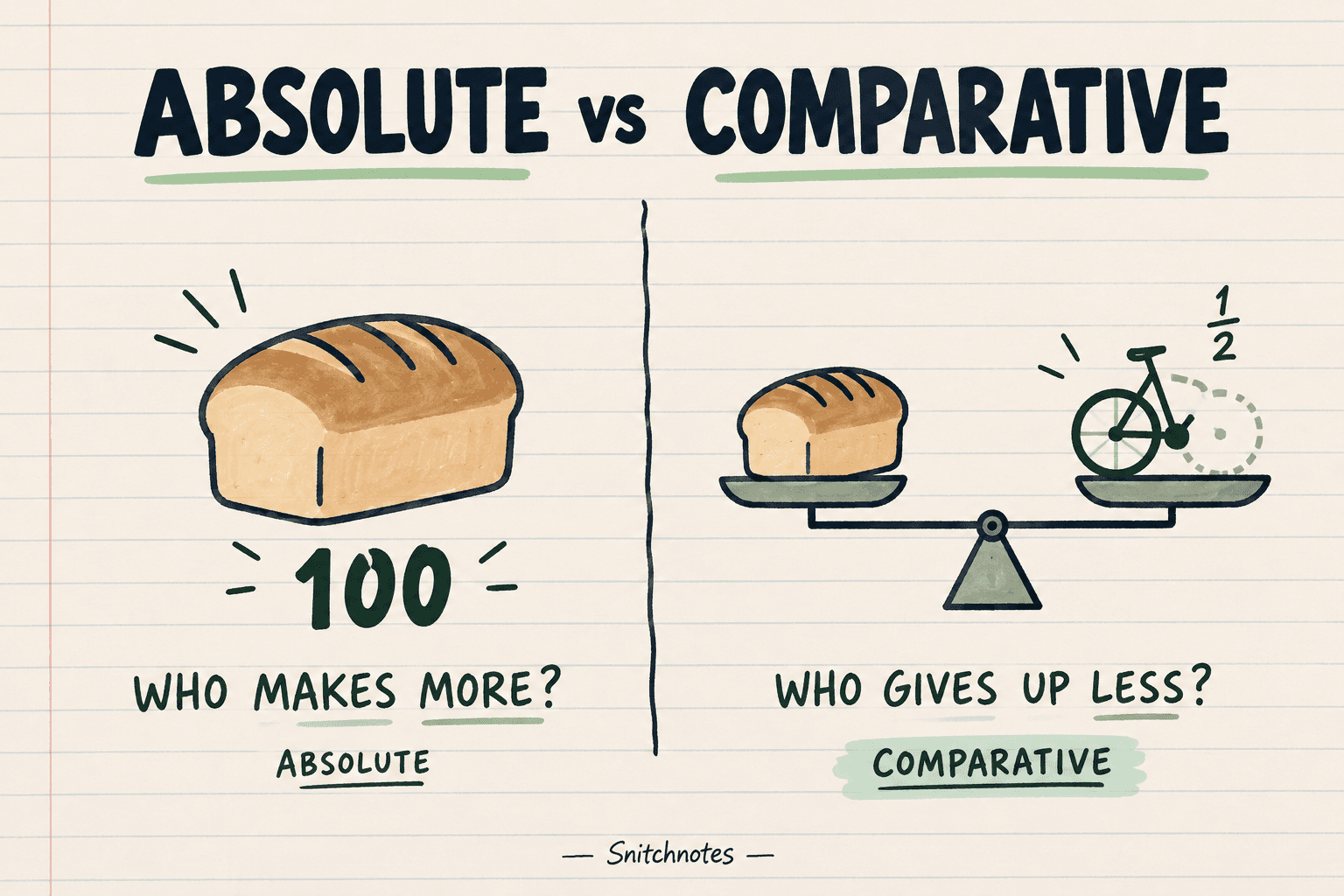
Absolute advantage asks who can produce more with the same resources. Ana can make 8 loaves versus Ben’s 6 and 4 bicycles versus Ben’s 1, so Ana has the absolute advantage in both goods. Comparative advantage asks who gives up less of the other good. By that measure, Ana specializes relatively in bicycles while Ben specializes relatively in bread.
This is the central misconception to catch: “best at producing” and “lowest cost of producing” are different claims. The International Monetary Fund explains that trade can still follow comparative costs even when one party is more productive in every good. Comparative advantage is about where the productivity gap is relatively smaller or larger.
How to study the method instead of memorizing answers
- Cover the answer column and rebuild both opportunity costs from the original production row. Retrieval is more useful than rereading a finished table.
- Say every fraction aloud with units: “one bicycle costs two loaves.” A bare 2 is easy to place in the wrong column.
- Change the numbers and solve again. For example, give Ben 2 bicycles instead of 1 and see whether either comparative advantage changes.
- Practice one trap question where the same producer has absolute advantage in both goods. That forces you to use opportunity cost rather than visual size.
The simple table model assumes the same fixed resources and a constant trade-off between two goods. Real economies have changing costs, many inputs, transport expenses, institutions, and distributional effects. The classroom calculation is a model for isolating one mechanism; it is not a complete verdict on every real trade policy.
Check your understanding
Ana can produce more bread than Ben. Why does Ben still have comparative advantage in bread?
Because Ben sacrifices only 1/6 of a bicycle for one loaf, while Ana sacrifices 0.5 bicycle. Ana’s higher bread output gives her absolute advantage, but Ben’s lower sacrifice gives him comparative advantage.
If one bicycle costs Ana 2 loaves, what should one loaf cost Ana?
It should cost 1/2, or 0.5, bicycle. The two opportunity costs in a row are reciprocals when the table describes straight-line, constant trade-offs.
Related concepts
- Deadweight loss with a supply-and-demand example
- Why stagflation is hard to fix
- Production possibilities frontiers: graphs that show maximum output combinations and the opportunity cost of moving between them.
Sources
OpenStax Principles of Economics 3e: Absolute and Comparative Advantage
Federal Reserve Education: Comparative Advantage lesson plan
Federal Reserve Education: Opportunity Cost interactive module
Open Educational Resources Texas: Opportunity Cost and Comparative Advantage Using an Output Table
International Monetary Fund Finance & Development: International Trade — Commerce among Nations
Zamień wykłady w materiały gotowe na egzamin.
Notatki, quizy, podcasty, fiszki i czat — z jednego uploadu.
Stwórz pierwszą notatkę za darmo