
Snitchnotes Team
How to Study Continuity and Change in History
How to Study Continuity and Change in History
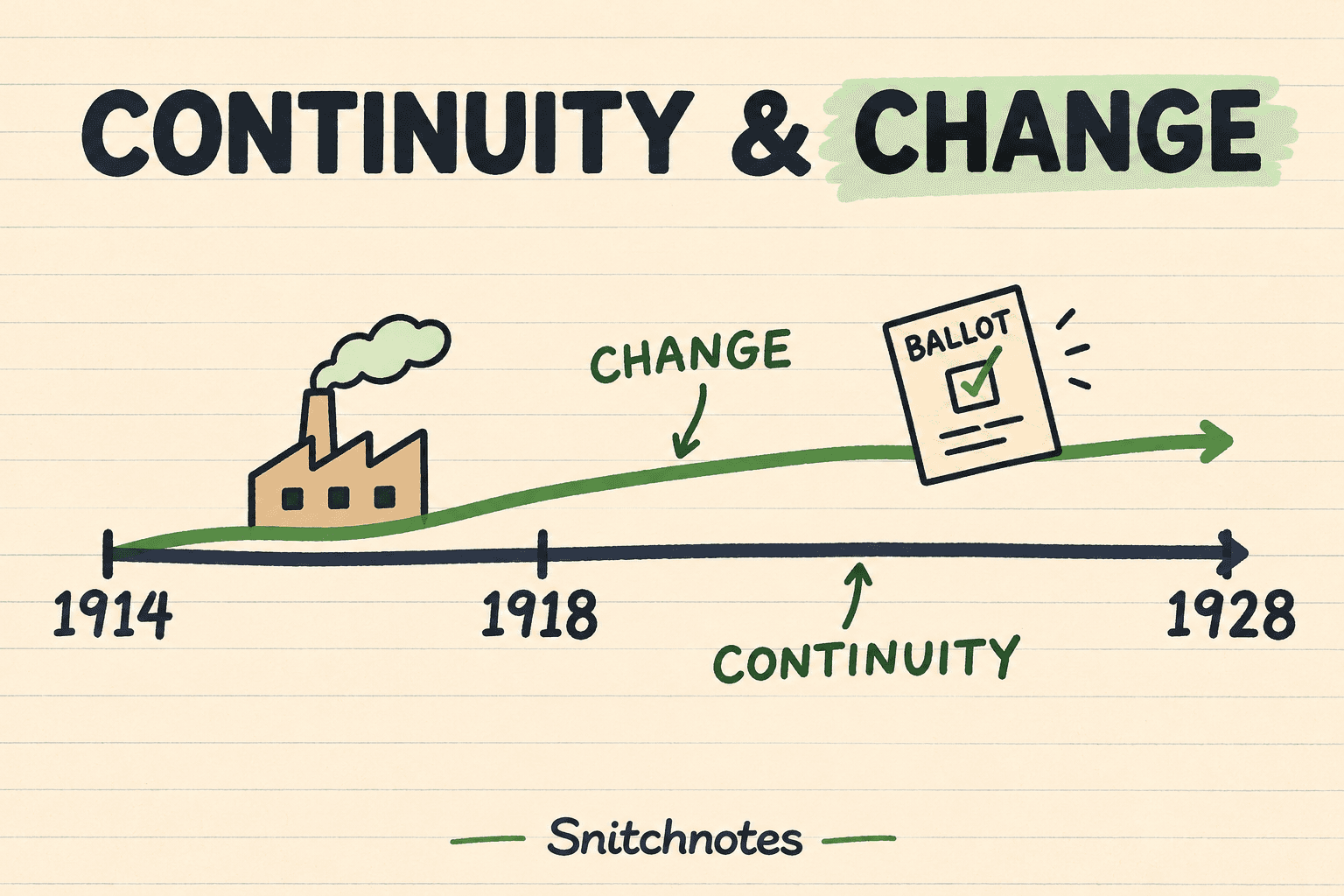
To study continuity and change in history, choose one feature of society, compare it at the beginning, middle, and end of a period, and attach dated evidence to every claim. Then judge the scale, pace, and duration of the change. Do not treat continuity as “nothing happened”: it means an important pattern persisted even while other things changed.
This method turns a pile of dates into an argument. It also stops a common essay mistake: describing one dramatic event as a total transformation without checking what survived it or whether the change lasted.
What continuity and change mean in history
Change is a meaningful difference across time. Continuity is a meaningful similarity or persistence across time. Historians often examine both together because a society can change politically while retaining older economic habits, social hierarchies, or cultural expectations. The University of California, Berkeley History-Social Science Project recommends starting with chronology, then evaluating the pace and scale of change.
Keep the feature of comparison stable. “Britain changed” is too broad to test. “Women entered a wider range of paid occupations during the First World War” is testable because occupation is the feature, 1914–1918 is the period, and records can show what women did before and during it.
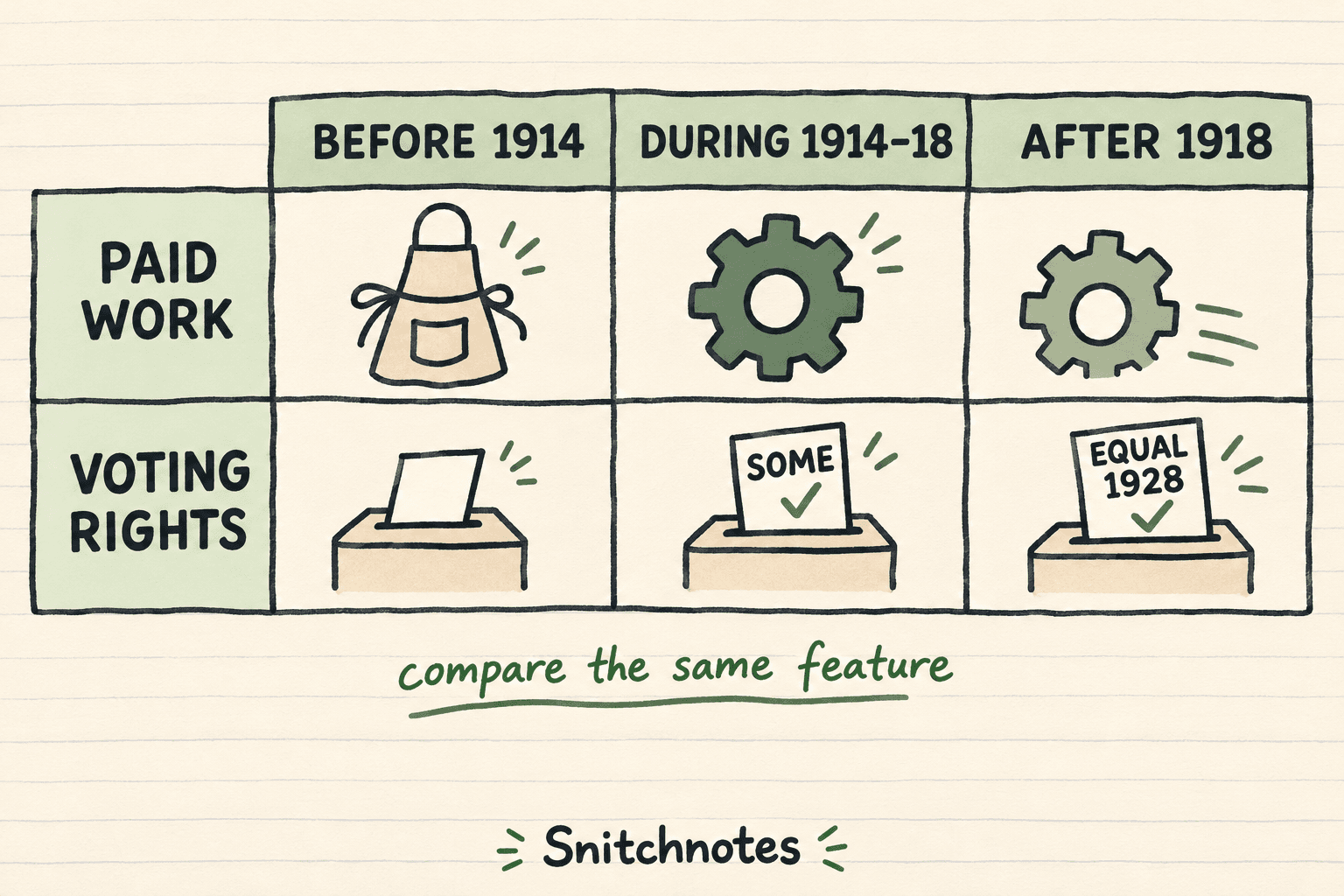
Build a before-during-after table
- Define the period and question. Write exact boundary dates instead of “around this time.”
- Choose two to four features, such as paid work, voting rights, wages, or access to professions.
- Make columns for before, during, and after. Compare the same feature in every column.
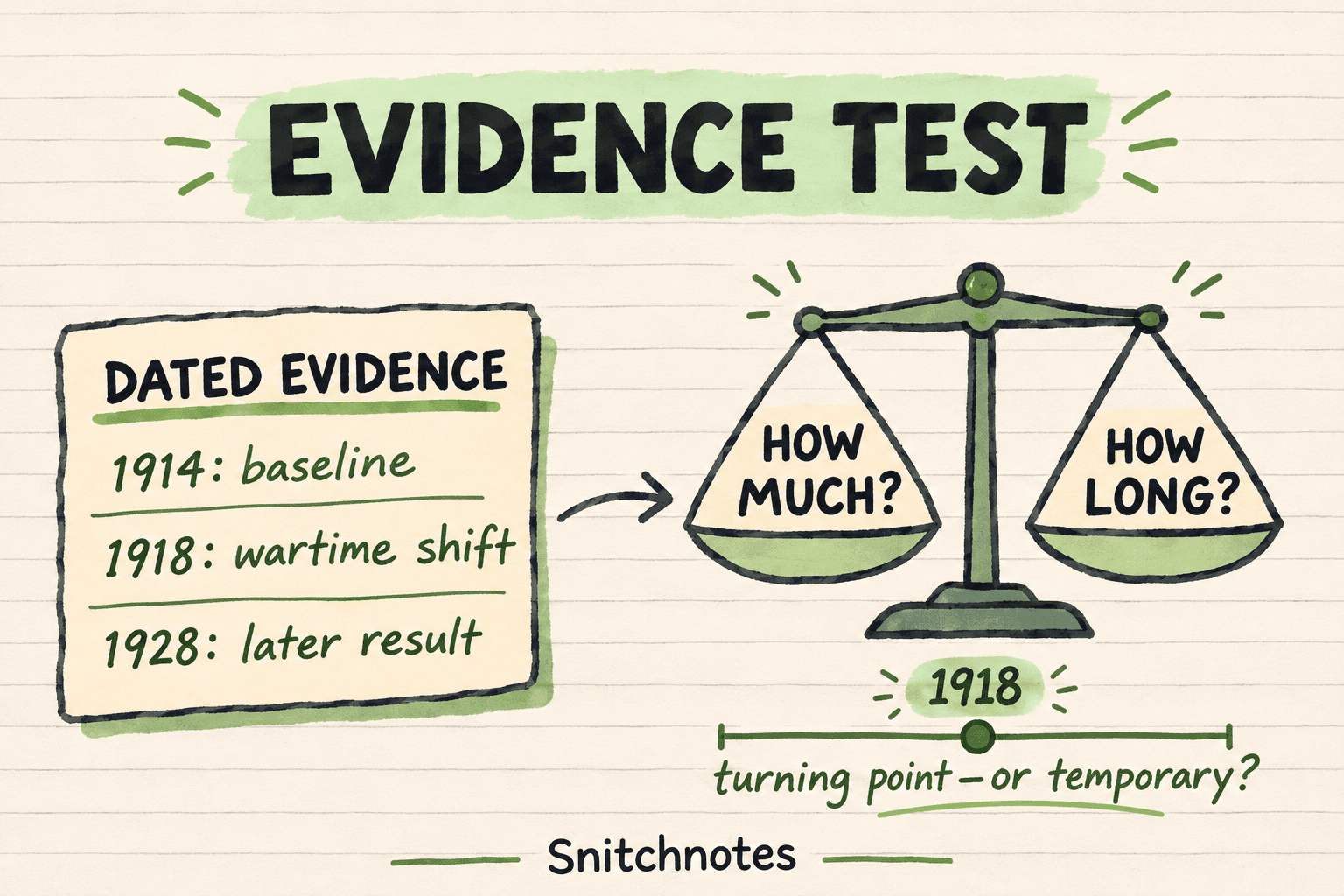
- Add one dated piece of evidence to each relevant cell and note its source.
- Label the pattern: continuity, gradual change, rapid change, reversal, or mixed outcome.
The table is a thinking tool, not the final essay. Its job is to expose missing comparisons. If the “before” cell is blank, you cannot prove change. If the “after” cell is blank, you cannot tell whether a wartime shift became a lasting turning point.
Worked example: women in Britain, 1914 to 1928
Start with paid work. Before 1914, women already worked for pay, especially in established female occupations. The war did not invent women’s employment. The National Archives notes that early government contracts often employed women in industries where they had traditionally worked. As military demand grew, women also moved into engineering, munitions, agriculture, transport, and military support roles. The Women’s Land Army, formed in 1917, had more than 80,000 women working on the land at its peak.
Now add the after column. Oxford’s Bodleian Libraries guide points researchers to records about schemes to substitute returning men for women and the demobilisation of women employed during the war. That evidence supports a mixed judgment: wartime employment changed quickly and visibly, but some gains were reversed after 1918. Continuity also remained because occupational segregation and unequal treatment did not disappear.
Next track voting rights separately. The Representation of the People Act 1918 gave the parliamentary vote to women over 30 who met a property qualification; it did not establish equal voting terms. The Equal Franchise Act 1928 then gave women and men equal voting rights from age 21. A precise change claim therefore needs two steps, not the vague sentence “women got the vote after the war.”
A defensible change claim is: Between 1914 and 1928, British women gained substantially greater political citizenship, first through limited enfranchisement in 1918 and then equal voting terms in 1928. A defensible continuity claim is: Despite wartime expansion into new jobs, women continued to face occupational limits and postwar displacement, so paid work changed less completely than voting rights.
Test the scale, pace, and duration of change
Scale asks how much changed and for whom. Pace asks whether the shift was sudden, gradual, or uneven. Duration asks whether it lasted. A turning point should alter the direction or rate of a development beyond the immediate event. The war was a sharp employment disruption, but the postwar reversal makes its long-term effect harder to describe as complete transformation.
Use verbs that match the evidence. Expanded, narrowed, accelerated, persisted, and partially reversed are usually stronger than transformed. Also check groups and geography: evidence about women in munitions factories cannot automatically describe every woman in Britain. A claim becomes more accurate when it names its limits.
Misconceptions and boundaries
Continuity is not the absence of history, and change is not always progress. A law may change quickly while everyday behavior changes slowly. An event may produce short-term disruption without a durable result. Different features can also move in opposite directions, so avoid forcing an entire period into one label.
Do not confuse continuity and change with causation. A continuity-and-change answer establishes what shifted or persisted across time. A causal answer explains why. You may eventually connect the two, but first make the pattern visible and support it with comparable evidence.
Check your understanding
Why is one dramatic wartime example not enough to prove lasting change?
It shows that something happened, but not how common it was, what came before, or whether it survived after the war. You need a baseline, a later comparison, and evidence of scale and duration.
Can the same period contain both continuity and change?
Yes. In this example, voting rights changed in clear legal stages while employment patterns produced a more mixed combination of wartime expansion, postwar reversal, and continuing inequality.
What should every table cell contain?
A statement about the same feature, a date or time marker, and evidence. Empty baseline or aftermath cells signal that more research is needed.
Related concepts
- Study historical causation with cause-and-consequence chains: move from identifying a pattern to explaining why it happened.
- Primary vs secondary sources: choose evidence appropriate to the claim you are testing.
- Periodisation: deciding where one historical period ends and another begins.
Sources
University of California, Berkeley History-Social Science Project: Continuity and Change
The National Archives: Women and the First World War
Bodleian Libraries, University of Oxford: Changes in Work and Employment
Zamień wykłady w materiały gotowe na egzamin.
Notatki, quizy, podcasty, fiszki i czat — z jednego uploadu.
Stwórz pierwszą notatkę za darmo