
Snitchnotes Team
How to Study Kirchhoff's Laws With Circuit Loop Maps
How to Study Kirchhoff's Laws With Circuit Loop Maps
The best way to study Kirchhoff's laws is to map the circuit before doing algebra: mark every junction, assign a current arrow to each branch, trace independent closed loops, choose one sign convention, and check the final currents against conservation. This turns a crowded diagram into a repeatable route rather than a guessing game.
This method is for students who know Ohm's law but lose signs or equations in multi-loop circuits. Kirchhoff's junction rule expresses conservation of charge: current entering a junction equals current leaving. The loop rule expresses conservation of energy: the algebraic sum of potential changes around a closed path is zero.
Why a circuit loop map helps
A circuit diagram shows electrical connections, but it does not automatically show your reasoning. Adding current arrows and highlighted loop routes makes three hidden decisions visible: which branches share a current, where current splits, and which direction you will travel when counting voltage rises and drops.
Think of the circuit as a transit map. A junction is a station where flow divides or rejoins. A loop is a route that returns to its starting point. You can assume any current direction at first; if a solved current is negative, the real current simply runs opposite to your arrow. The arrow is a bookkeeping choice, not a prediction you must get right in advance.
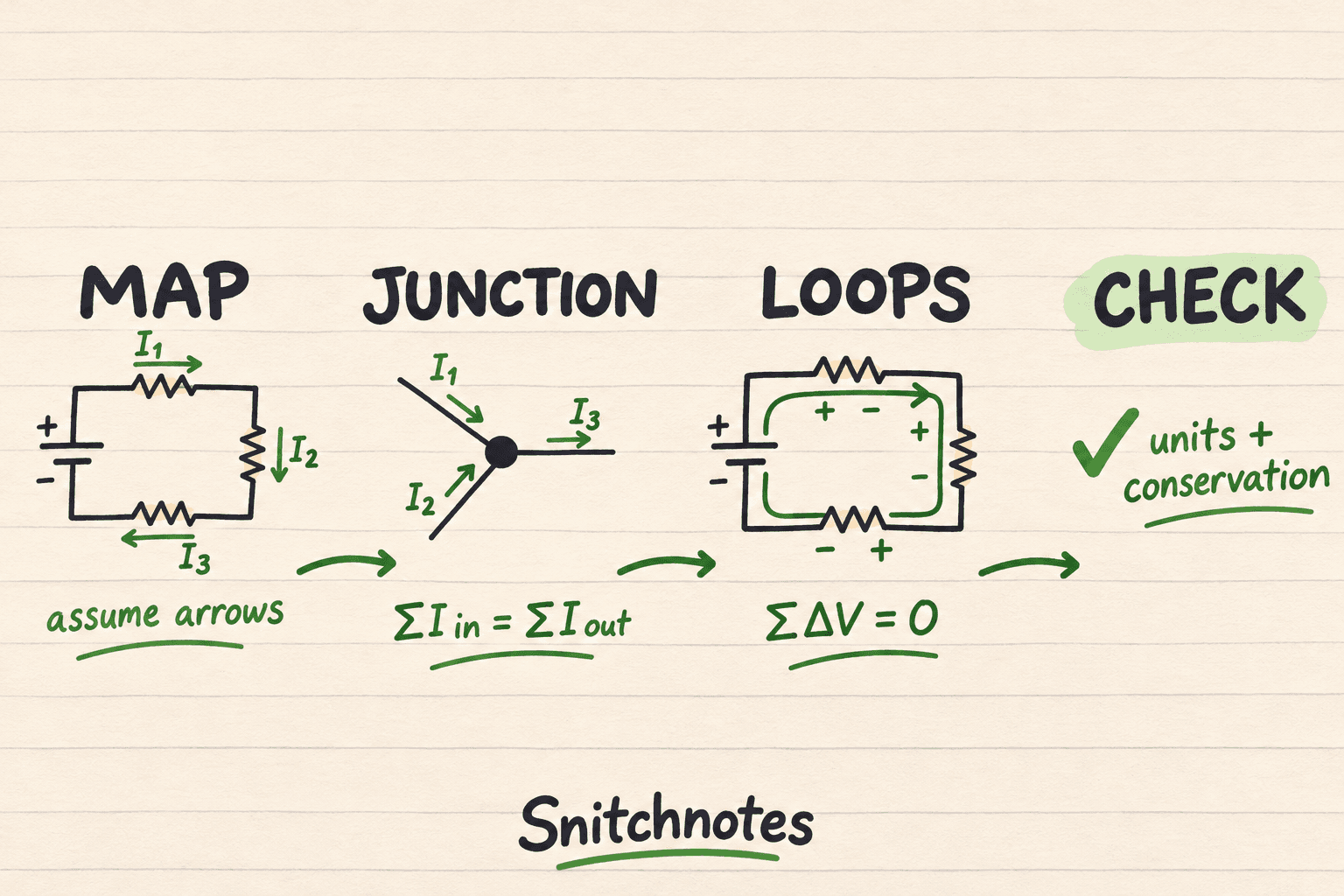
The map-first Kirchhoff routine
- Redraw the topology. Replace decorative bends with clean branches and junction dots. Label every battery voltage and resistance with units.
- Assign branch currents. Draw one arrow per branch and keep its label, such as I1, I2, or I3, beside every component in that branch.
- Write a junction equation. Choose a useful junction and set total current entering equal to total current leaving. Do this before writing loop equations.
- Trace independent loops. Pick a direction for each loop and record every potential change in that travel direction. You need enough independent equations to match the unknown currents.
- Solve, then audit. Check amperes for currents, volts for potential changes, the junction balance, and at least one loop sum.
A sign convention you can reuse
When you cross a battery from its negative terminal to its positive terminal, count a voltage rise; crossing from positive to negative is a drop. Across a resistor, traveling with the assumed current gives a drop of IR, while traveling against it gives a rise of IR. You may choose clockwise or counterclockwise for a loop. Consistency, not the direction itself, makes the equation correct.
Worked example: a 12-volt, two-loop circuit
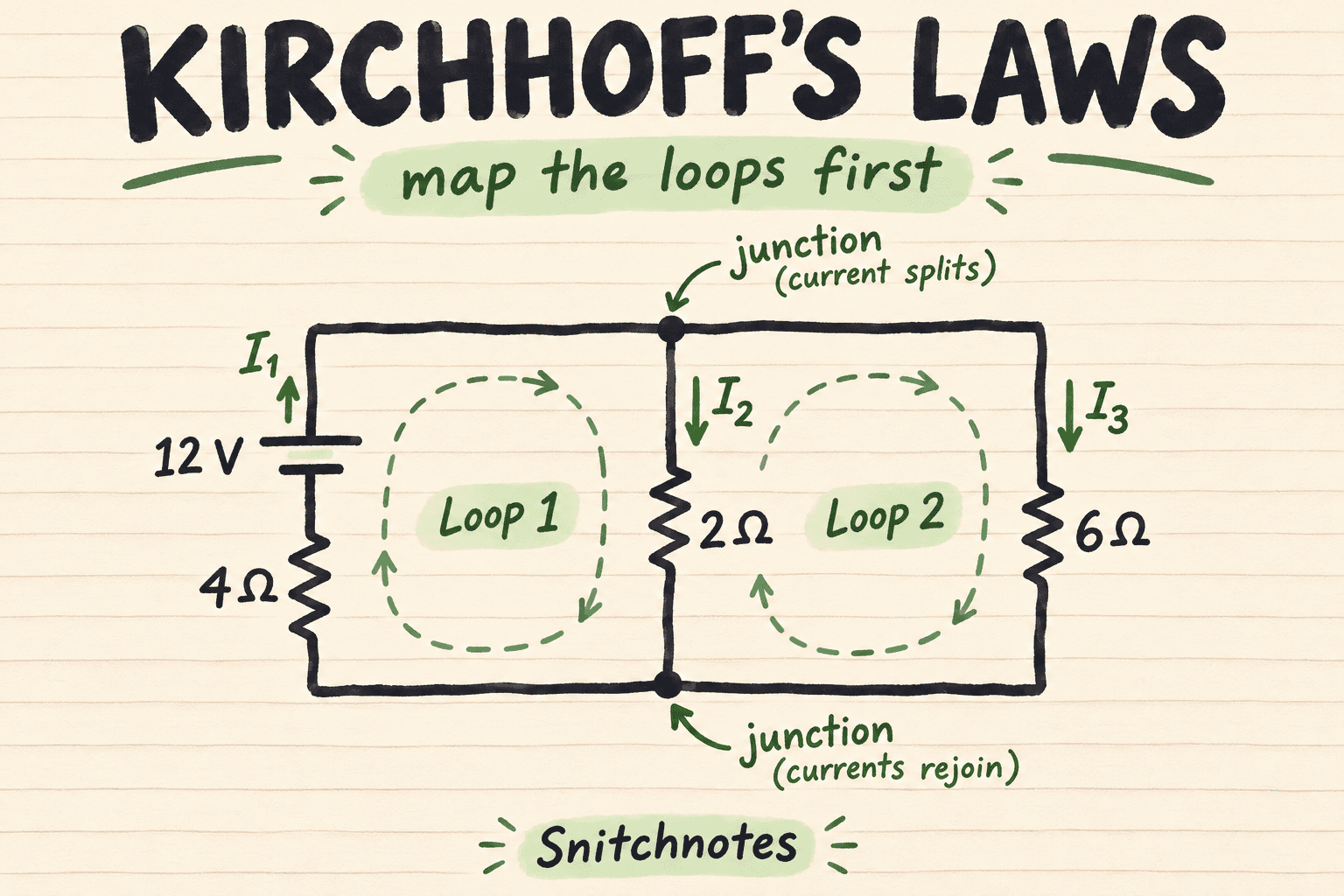
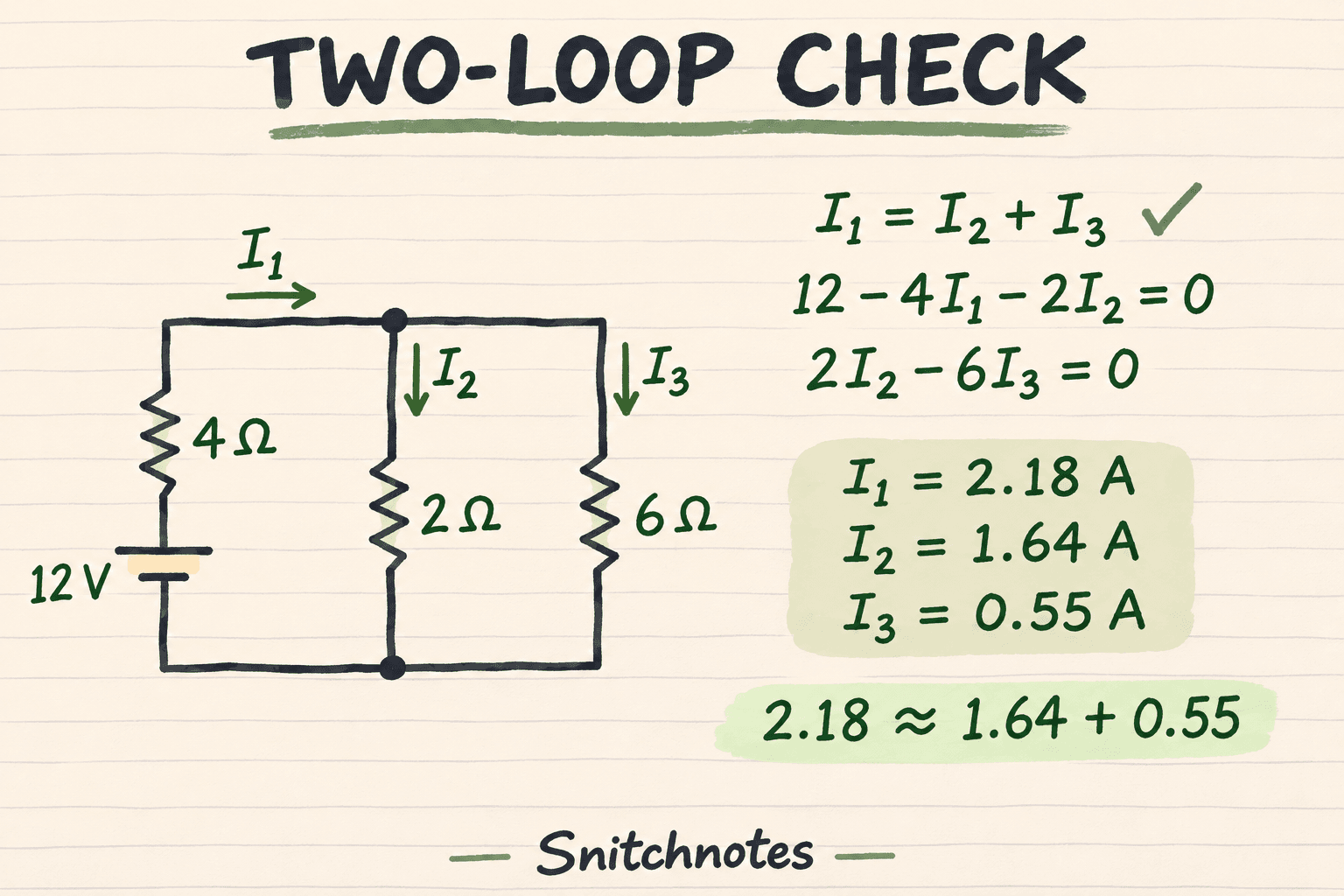
Consider two junctions connected by three parallel branches. The left branch contains a 12-volt battery and a 4-ohm resistor. The shared center branch has a 2-ohm resistor, and the right branch has a 6-ohm resistor. Let I1 travel upward in the left branch, while I2 and I3 travel downward through the center and right branches.
At the top junction, I1 enters while I2 and I3 leave, so I1 = I2 + I3. For the left loop, travel through the battery from negative to positive and then with the assumed currents through both resistors: 12 − 4I1 − 2I2 = 0. For the right loop, the equal potential drop across the two parallel paths gives 2I2 − 6I3 = 0.
The right-loop equation says I2 = 3I3. Substituting that and I1 = 4I3 into the left-loop equation gives 12 − 16I3 − 6I3 = 0, so I3 = 6/11 amperes, or about 0.55 amperes. Therefore I2 = 18/11 amperes, about 1.64 amperes, and I1 = 24/11 amperes, about 2.18 amperes.
Now perform the fastest error check: 2.18 amperes entering the junction should equal 1.64 + 0.55 amperes leaving. The rounded values differ by 0.01 ampere, while the exact fractions balance perfectly. That tiny rounding gap is expected; a large mismatch means an equation or substitution is wrong.
How to practise without memorizing one diagram
Use the same circuit for three short passes. First, cover the equations and reconstruct only the current arrows and junction rule. Second, trace each loop with a finger and say “rise” or “drop” at every element. Third, solve from a blank page and run the junction check. Changing one resistor value on the next attempt forces you to reuse the method instead of remembering the previous numbers.
A useful flashcard does not ask only for the definition of the loop rule. Put a tiny circuit on the front and ask for the signed equation. On the back, show the traced direction and explain each sign. Retrieval practice should reproduce the decisions that a real problem requires.
Common mistakes and boundaries
The most common mistake is changing a current direction halfway through the solution. Keep the original arrow and let a negative answer communicate reversal. Another mistake is writing a loop equation that omits a shared resistor or uses the wrong branch current. Trace the physical path and touch each component once. A third is treating every visible loop as independent; redundant loop equations add work without adding information.
Kirchhoff's ideal circuit rules assume charge does not accumulate at a junction and that the lumped circuit model is appropriate. They work extremely well for ordinary direct-current resistor networks. At very high frequencies or when changing magnetic flux through a loop matters, simple lumped-element assumptions may need refinement. For an introductory problem, use the model the course specifies.
Check your understanding
What does a negative solved current mean?
It means the actual current flows opposite to the arrow you assumed. The equation is not automatically wrong, and you should not restart merely because the sign is negative.
Can you choose either direction around a loop?
Yes. Clockwise and counterclockwise are both valid. The battery and resistor signs must match the direction you chose throughout that equation.
Why check the junction after solving?
Because conservation of charge gives a quick independent test. If current entering does not equal current leaving after allowing for rounding, revisit the current labels, equations, or algebra.
Related concepts
- Ohm's law: connect voltage, current, and resistance with V = IR before combining branch equations.
- Node-voltage and mesh-current methods: systematic extensions of the same junction and loop principles.
- Learn centripetal force with free-body diagrams: practise turning a physics picture into a controlled map of forces.
- Dimensional analysis in chemistry: use units as an error-checking system for multistep equations.
Sources
University of Central Florida Pressbooks, University Physics Volume 2: Kirchhoff's Rules
Mesa Community College Physical Science: Kirchhoff's Loop Law Hint
Zamień wykłady w materiały gotowe na egzamin.
Notatki, quizy, podcasty, fiszki i czat — z jednego uploadu.
Stwórz pierwszą notatkę za darmo