
Snitchnotes Team
Why Do Some Languages Lose Grammatical Gender?
Why Do Some Languages Lose Grammatical Gender?
Some languages lose grammatical gender when the forms that reveal noun classes become less distinct or less predictable. Sound change can wear down endings, analogy can level irregular patterns, and language contact can encourage speakers to rely on forms shared across groups. Once articles, adjectives, or pronouns no longer reliably signal a noun's class, children learning the language may acquire a smaller system or none at all.
That is the short answer, but it is not a law of language. Gender can survive major sound changes and intense contact, and contact can sometimes strengthen rather than erase a category. English provides a vivid historical example because Old English had three grammatical genders, while Modern English does not have a productive noun-gender agreement system.
What grammatical gender actually is
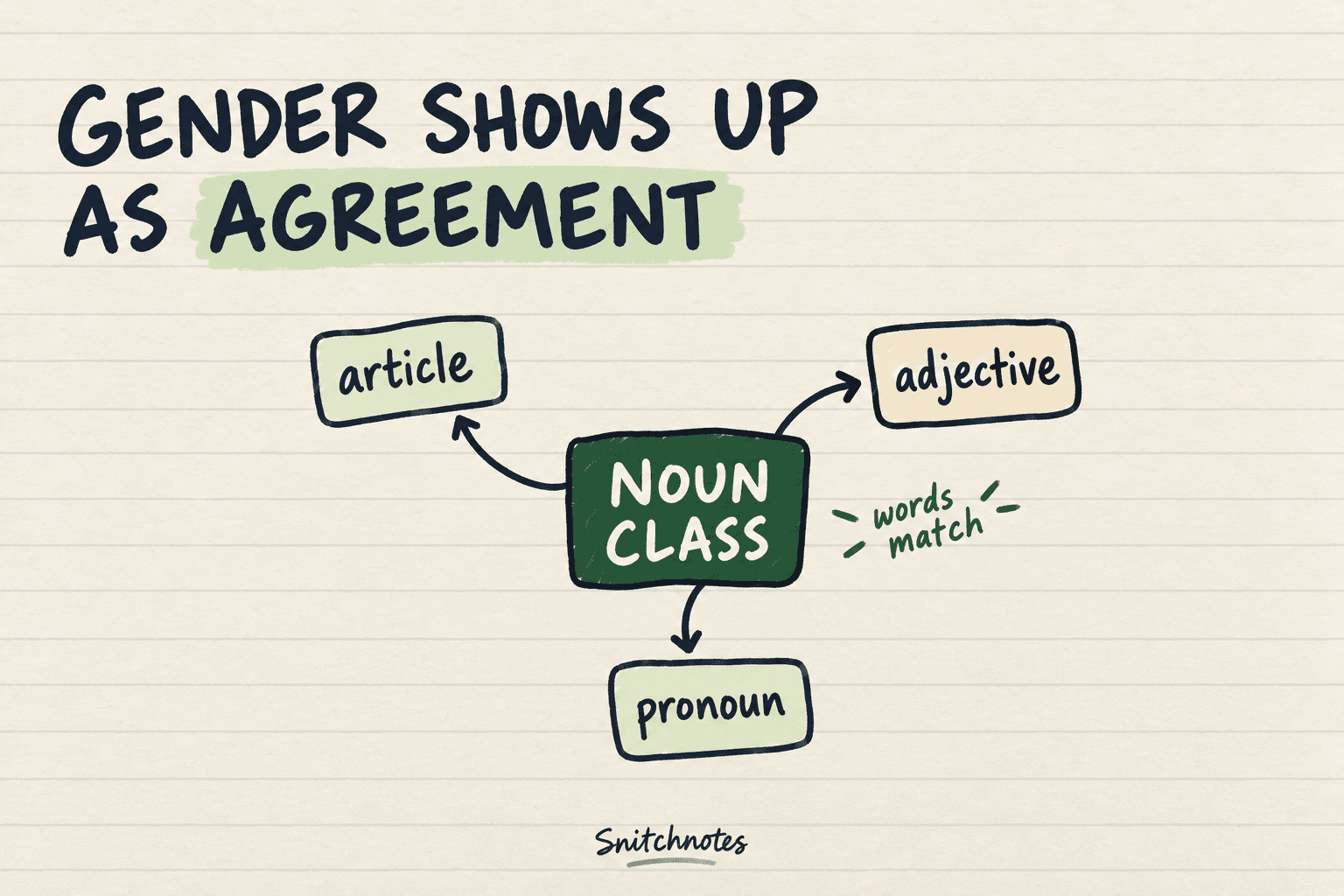
Grammatical gender is best understood as a noun-class system. Nouns belong to classes, and related words may change form to agree with those classes. A language might mark the class on articles, adjectives, demonstratives, pronouns, verbs, or some combination of them. The labels masculine, feminine, and neuter describe grammatical patterns; they do not mean every noun has a biological sex.
Old English makes that difference obvious. Its nouns could be masculine, feminine, or neuter, and adjectives and pronouns inherited gender from the nouns they accompanied. The assignment was often arbitrary from a modern semantic point of view: the word wīf, meaning woman or wife, was grammatically neuter. Gender therefore lived not inside an object's meaning but in a network of agreement forms speakers learned together.
A three-card example
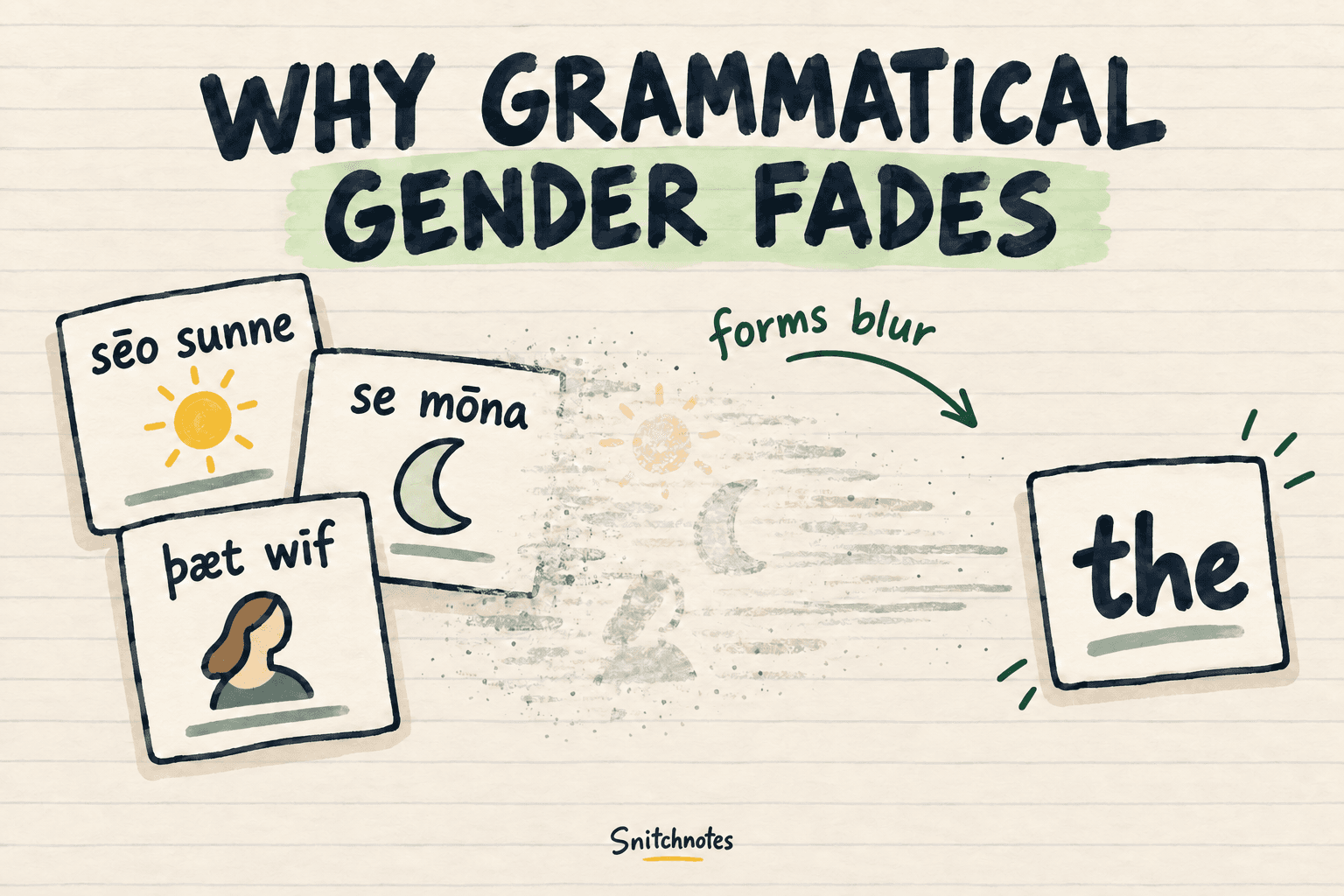
Imagine three cards on a medieval student's desk: sēo sunne, the sun; se mōna, the moon; and þæt wīf, the woman. The nouns belong to feminine, masculine, and neuter classes respectively. The different forms sēo, se, and þæt help announce the class before the listener even reaches the noun. Modern English uses the for all three, so that particular agreement clue has disappeared.
Now smudge the endings and let frequently used forms influence one another across generations. If formerly different markers begin to sound alike, their informational value shrinks. Learners can still memorize each noun's class for a while, but there is less evidence supporting the old pattern. A simpler analysis—one general article, with pronouns chosen mainly by the referent—can eventually win out.
The English system fades
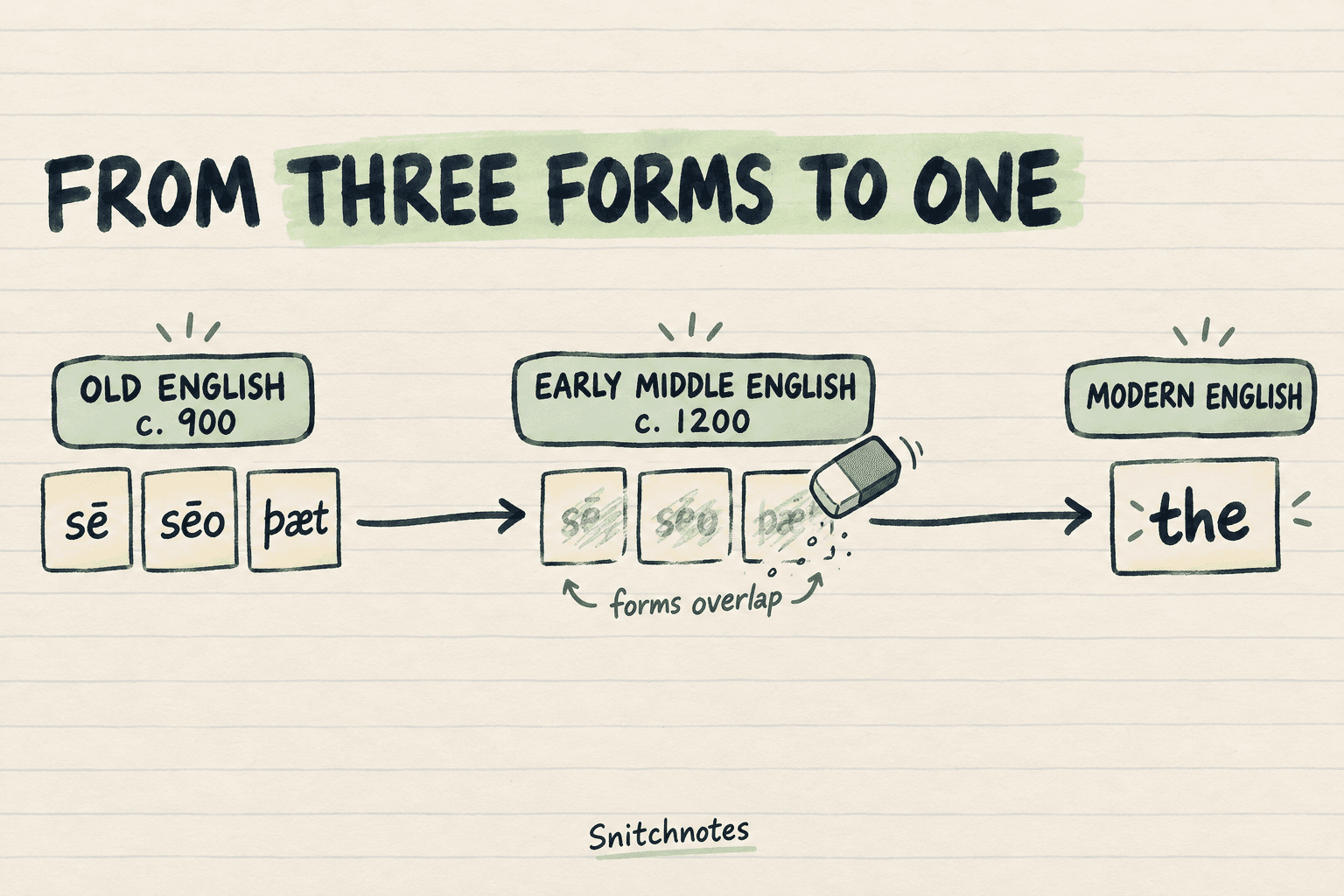
Old English, used roughly from the fifth through the eleventh century, was much more richly inflected than Modern English. Nouns, adjectives, and pronouns carried distinctions of case, number, and gender. Over time, final syllables weakened or vanished, and many inflectional forms became alike. This syncretism—different grammatical forms collapsing into the same visible or audible form—made gender contrasts less dependable.
The shift was gradual and uneven. Early Middle English texts show mixtures: older grammatical agreement can persist in one construction while pronouns elsewhere follow the natural sex or animacy of the referent. Historical evidence therefore looks less like a switch being flipped and more like several fading pencil lines. By later stages, English articles and adjectives no longer maintained the old three-way noun classes.
Why gender systems disappear
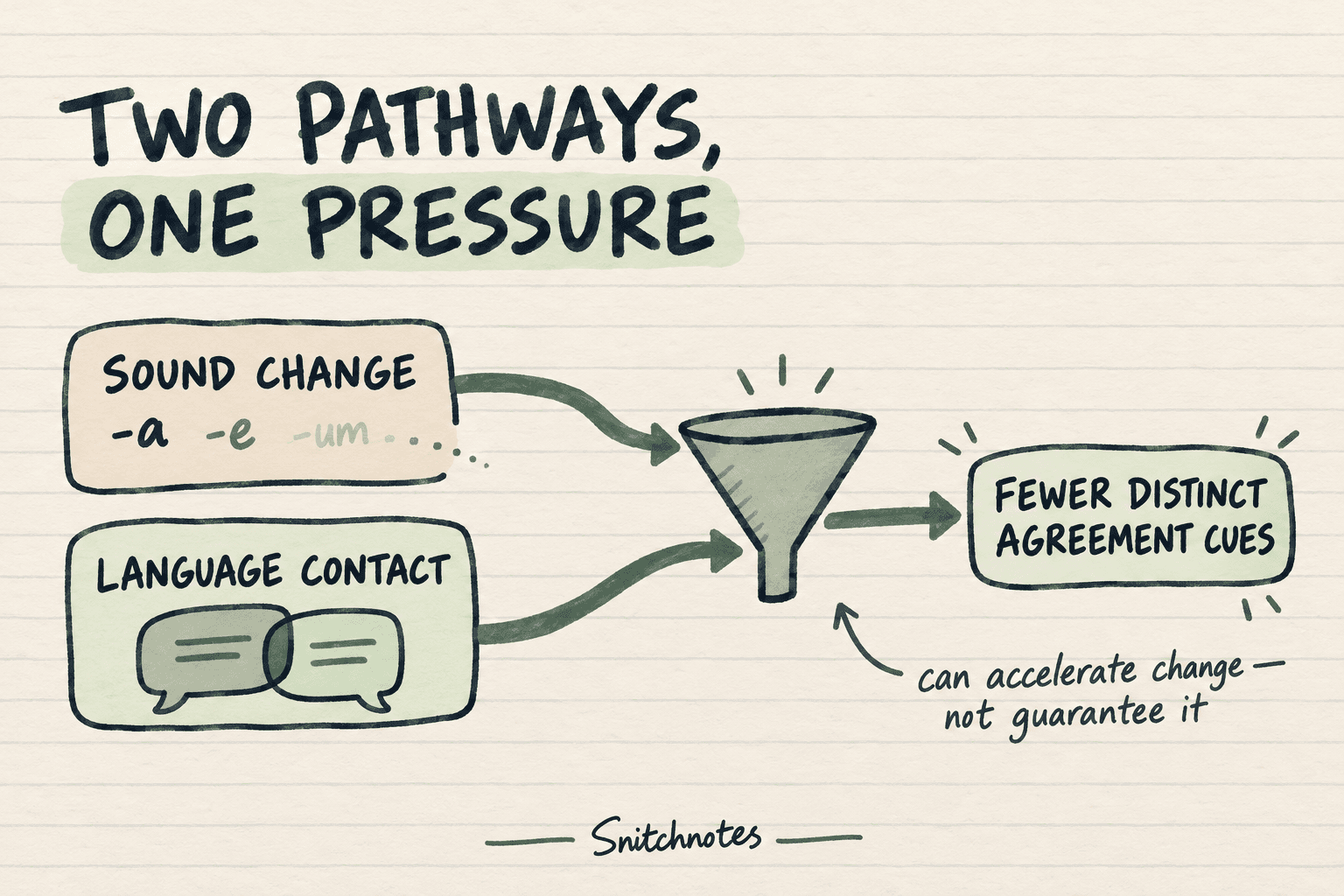
The central mechanism is a loss of reliable cues, but several processes can produce it. Phonological erosion can reduce unstressed endings. Analogy can spread one common form into places where several forms once competed. If agreement is already inconsistent, speakers may increasingly choose pronouns according to a referent's sex or animacy rather than a noun's inherited class. Each step makes the old classification less useful to the next learner.
Language contact can add pressure. Adults communicating across closely related or different languages may favor transparent, widely shared patterns, especially when one language lacks gender or assigns nouns differently. Research on Afrikaans, Ossetic, and Cappadocian Greek links complete gender loss with contact, but the authors treat contact as a key factor rather than an automatic eraser. Social conditions, prestige, bilingualism, and the structure already present all matter.
Was Old Norse contact the cause in English?
Contact between English and Old Norse is one important proposal because the languages were related yet often used different endings and gender assignments. Such contact may have rewarded common, easier-to-identify forms. But scholars debate how much weight it deserves, and internal sound change was already reducing English inflections. The safest conclusion is interaction: erosion weakened the cues, while contact may have accelerated leveling in some communities.
Does losing gender make a language simpler?
It makes that part of the grammar less elaborate, but it does not make the whole language primitive, vague, or universally easier. English lost noun-gender agreement while relying more heavily on fixed word order, prepositions, and context. Languages routinely lose distinctions in one area and develop new ones elsewhere. Change is not a march toward perfection; it is a reorganization of the evidence speakers use.
Modern English also retains gender distinctions in some third-person singular pronouns, but that is not the old system surviving intact. He, she, and it are normally selected from properties of the referent, not from a grammatical class assigned to every noun. A table is not neuter because the noun table belongs to a neuter agreement class; speakers use it because the object is ordinarily treated as inanimate.
Check your understanding
Suppose a language has two noun classes, but its article and adjective endings merge in everyday speech. What makes class loss plausible? New learners now hear fewer consistent forms that identify each noun's class. If other agreement targets also stop distinguishing the classes, learners may analyze the language as having one class instead of memorizing a contrast with little visible support.
Now test the boundary: does heavy contact guarantee gender loss? No. Contact creates opportunities for restructuring, but outcomes depend on who speaks which language, the prestige and population of each group, how much the systems overlap, and whether clear agreement cues remain. Sound erosion is not a guarantee either; a language can rebuild or preserve distinctions through other forms.
Related concepts
- Agreement: grammatical features on one word determine the form of another word.
- Syncretism: forms that once expressed different grammatical categories become identical.
- Analogy: speakers reshape a less regular pattern to match a more familiar one.
- How to study English literature offers a practical method for connecting historical language, context, and close reading.
Sources
University of Texas at Austin Linguistics Research Center: Introduction to Old English
Harvard University: Grammatical Gender in Old English
Anne Curzan, Cambridge University Press: Gender Shifts in the History of English
Samuel Moore, PMLA: Grammatical and Natural Gender in Middle English
Zamień wykłady w materiały gotowe na egzamin.
Notatki, quizy, podcasty, fiszki i czat — z jednego uploadu.
Stwórz pierwszą notatkę za darmo