
Snitchnotes Team
The Haber Process Explained: Conditions and Equilibrium
The Haber Process Explained: Conditions and Equilibrium
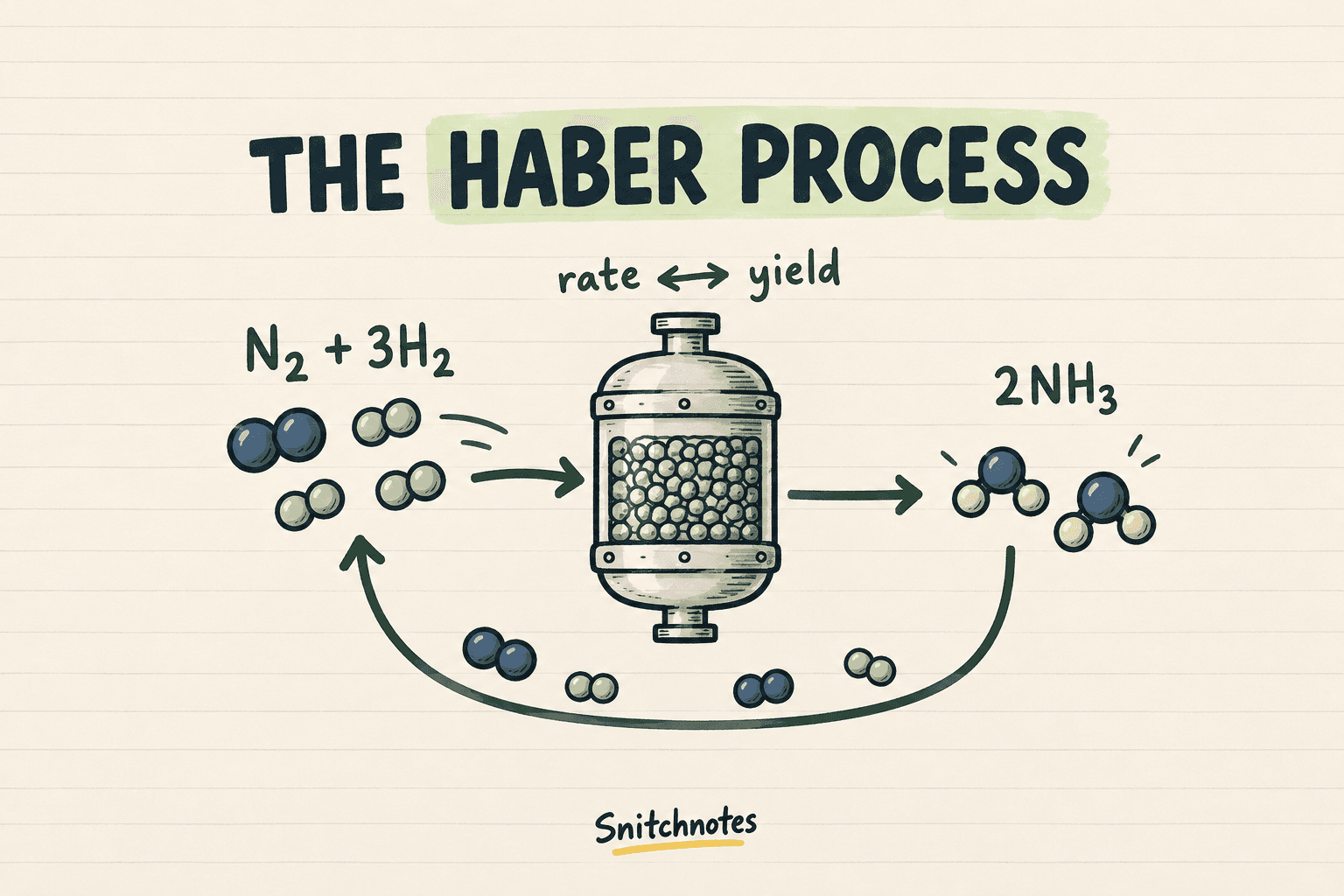
The Haber process makes ammonia by reacting nitrogen gas with hydrogen gas in a reversible, exothermic reaction. Industry typically uses a temperature around 450°C, high pressure around 200 atmospheres, and an iron catalyst. Those conditions are compromises: lower temperature and higher pressure would improve the equilibrium yield of ammonia, but temperature also affects speed and very high pressure makes the plant more expensive and demanding to operate.
The process matters because ammonia is a starting material for fertilizers and many other nitrogen compounds. It is also a useful chemistry case study: equilibrium, reaction rate, catalysis, and engineering economics all pull on the same production decision.
The reaction at the center of the Haber process
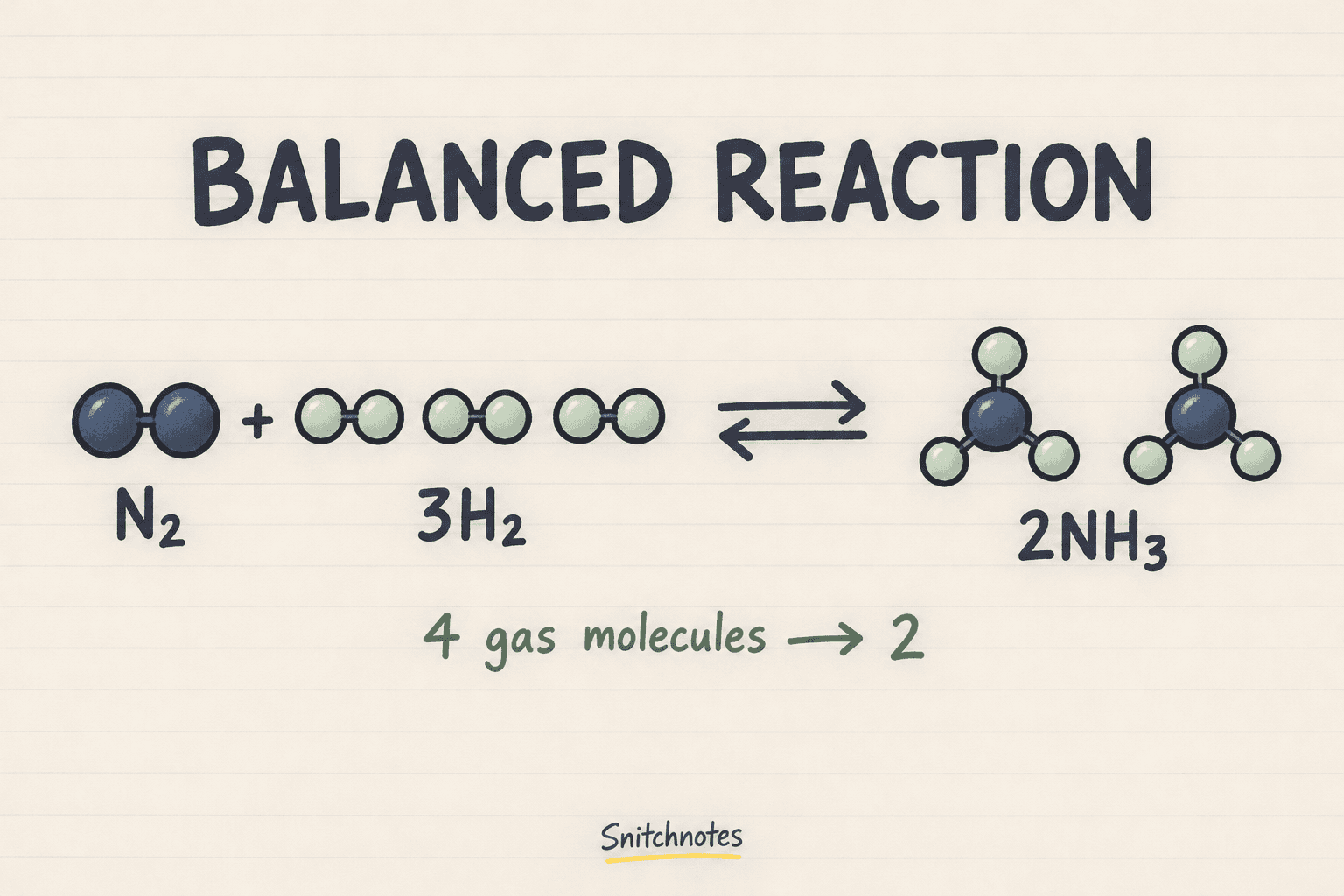
The balanced equation is N₂(g) + 3H₂(g) ⇌ 2NH₃(g). One mole of nitrogen reacts with three moles of hydrogen to form two moles of ammonia. The double arrow matters: ammonia forms in the forward reaction, while ammonia molecules can decompose in the reverse reaction. At dynamic equilibrium, both reactions continue at equal rates, so the overall concentrations stop changing even though molecules are still reacting.
The forward reaction releases heat, with an enthalpy change of about −92.2 kJ for the equation as written. It also changes four moles of gas on the left into two moles of gas on the right. Those two facts explain the effects of temperature and pressure.
Step 1: Feed gases in the right ratio
Nitrogen and hydrogen enter the reactor in the stoichiometric ratio shown by the equation: one part nitrogen to three parts hydrogen by amount of substance. Nitrogen is separated from air; conventional hydrogen is commonly obtained from natural gas. The gases are purified because contaminants can interfere with the catalyst, then compressed and heated before reaching the reaction chamber.
Step 2: Choose a compromise temperature
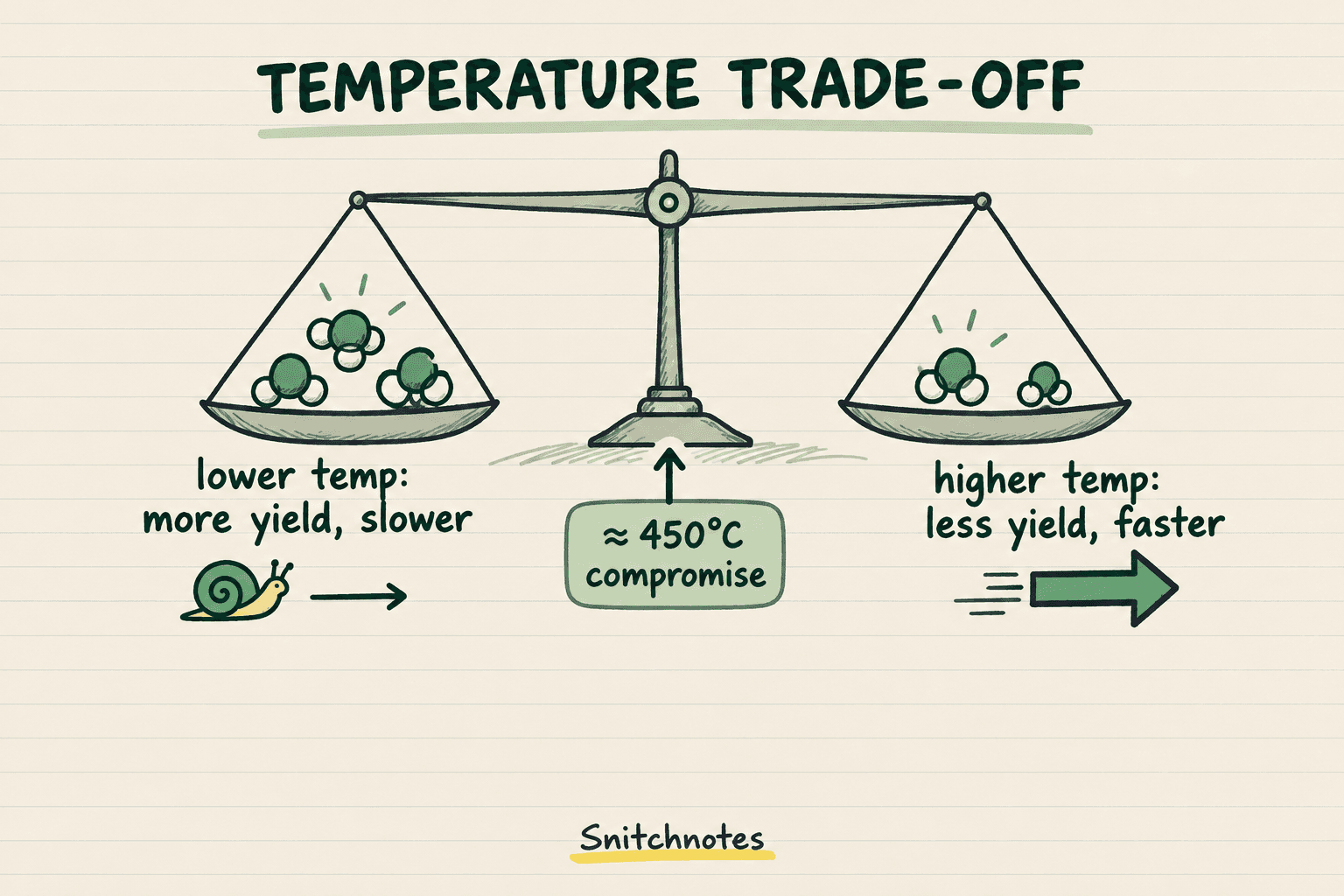
Because ammonia formation is exothermic, lowering the temperature shifts the equilibrium toward ammonia. If equilibrium yield were the only goal, a cold reactor would look attractive. But nitrogen molecules contain a very strong triple bond, and at low temperature the reaction is far too slow for useful production. A factory cares about tonnes made per day, not merely the final percentage after an impractical wait.
Raising the temperature speeds collisions and helps molecules cross the activation-energy barrier, but it shifts the equilibrium toward nitrogen and hydrogen. Around 450°C is therefore a familiar teaching value for a workable compromise: fast enough for continuous production while retaining a useful equilibrium yield. Exact industrial conditions vary with plant design and catalyst.
Step 3: Use high pressure
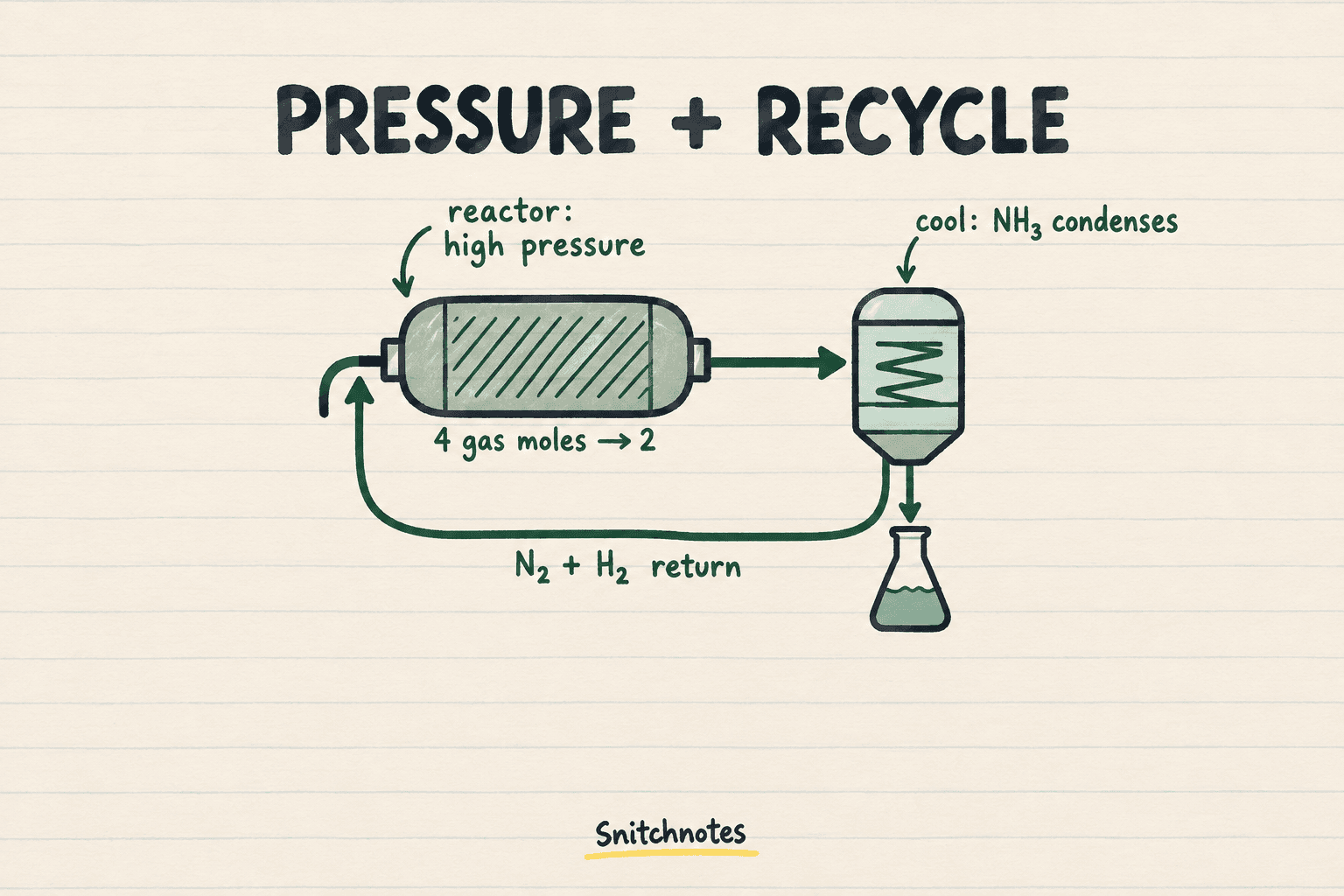
Increasing pressure favors the side with fewer gas molecules. Here, four gas molecules in the reactants become two in the products, so compression shifts equilibrium toward ammonia. Higher pressure also brings molecules closer together and can increase reaction rate. This is Le Chatelier's principle made physical: the system responds to compression by favoring the lower-gas-mole side.
Why not keep increasing pressure? Stronger compressors and thicker reaction vessels cost more, use more energy, and must safely contain the gas. Textbooks often use about 200 atmospheres, while real commercial ranges vary. The selected pressure balances extra ammonia and faster reaction against equipment and operating costs.
Step 4: Add a catalyst, cool the mixture, and recycle gases
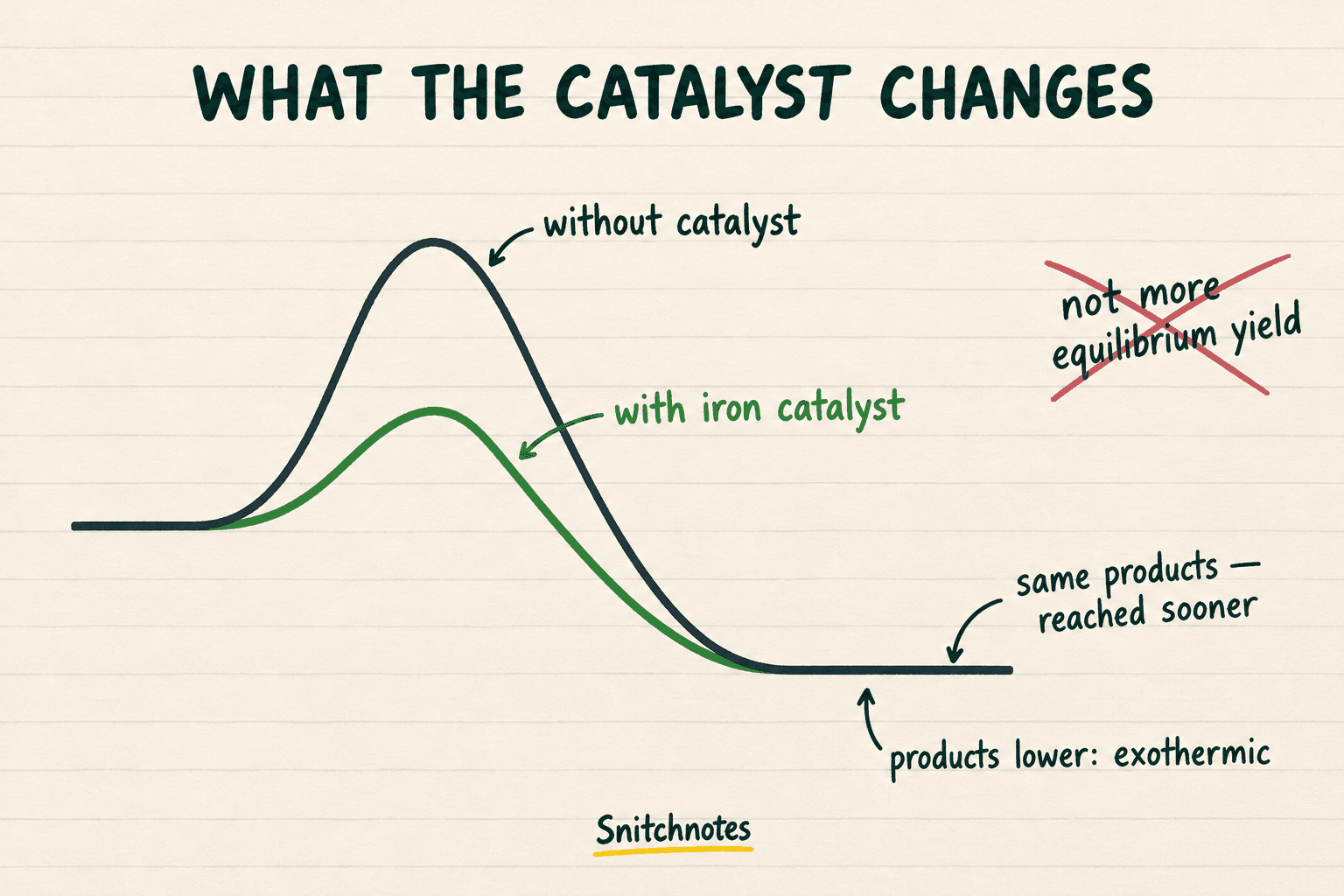
An iron-based catalyst provides a lower-activation-energy pathway, allowing forward and reverse reactions to proceed faster. The hot mixture leaving the reactor contains ammonia plus unreacted nitrogen and hydrogen. Cooling the mixture condenses ammonia, which can be separated because it liquefies more readily than the feed gases. Removing a product also encourages further ammonia formation when the gases return to equilibrium.
The unreacted nitrogen and hydrogen are recycled into the reactor. That loop is essential: a single pass does not need to convert every molecule. Repeated passes, each followed by cooling and ammonia removal, let the plant achieve high overall conversion while using conditions chosen for throughput rather than maximum single-pass yield.
A plant chooses throughput over perfect single-pass yield
Imagine a plant team choosing its reactor settings. A much lower temperature promises a larger equilibrium fraction of ammonia, but the gas approaches equilibrium painfully slowly. A much higher pressure improves yield, but the compressor and vessel become more costly. The team chooses about 450°C, high pressure near 200 atmospheres, and an iron catalyst—not because each setting maximizes yield in isolation, but because together they produce ammonia quickly and repeatedly.
Suppose some nitrogen and hydrogen leave the reactor unconverted. They are not treated as a failed batch. The stream is cooled, ammonia is condensed and removed, and the remaining gases circle back. The loop turns a moderate single-pass conversion into efficient overall production. This is the central lesson of the Haber process: an industrial optimum is a system decision, not the maximum value in one column of a table.
The catalyst misconception
A catalyst does not shift the equilibrium toward ammonia and does not change the equilibrium constant. It lowers the activation-energy barrier for both forward and reverse reactions, so the mixture reaches the same equilibrium composition sooner. Its practical value is speed: the plant can operate at a lower temperature than would otherwise be economical, improving equilibrium yield without waiting indefinitely.
Check your understanding
Why does high pressure favor ammonia?
The reaction changes four moles of reactant gas into two moles of product gas. Increasing pressure therefore shifts equilibrium toward the side with fewer gas moles: ammonia.
Why is 450°C a compromise?
Lower temperature favors ammonia at equilibrium but makes the reaction slow. Higher temperature increases rate but reduces the equilibrium yield. About 450°C balances those effects for the familiar textbook process.
What does the iron catalyst change?
It increases the rates of both directions and helps the system reach equilibrium sooner. It does not alter the equilibrium position or equilibrium yield.
Related concepts
- Dimensional analysis in chemistry: a step-by-step method
- Ionic vs covalent bonds: differences and examples
- Le Chatelier's principle: predicting how equilibrium responds to temperature, pressure, and concentration changes.
Sources
Royal Society of Chemistry Education: Ammonia
OpenStax Chemistry: Shifting Equilibria—Le Chatelier's Principle
Convierte tus clases en material listo para el examen.
Apuntes, quizzes, podcasts, flashcards y chat — con una sola subida.
Prueba tu primer apunte gratis