
Snitchnotes Team
How Do Ants Find the Shortest Path to Food?
How Do Ants Find the Shortest Path to Food?
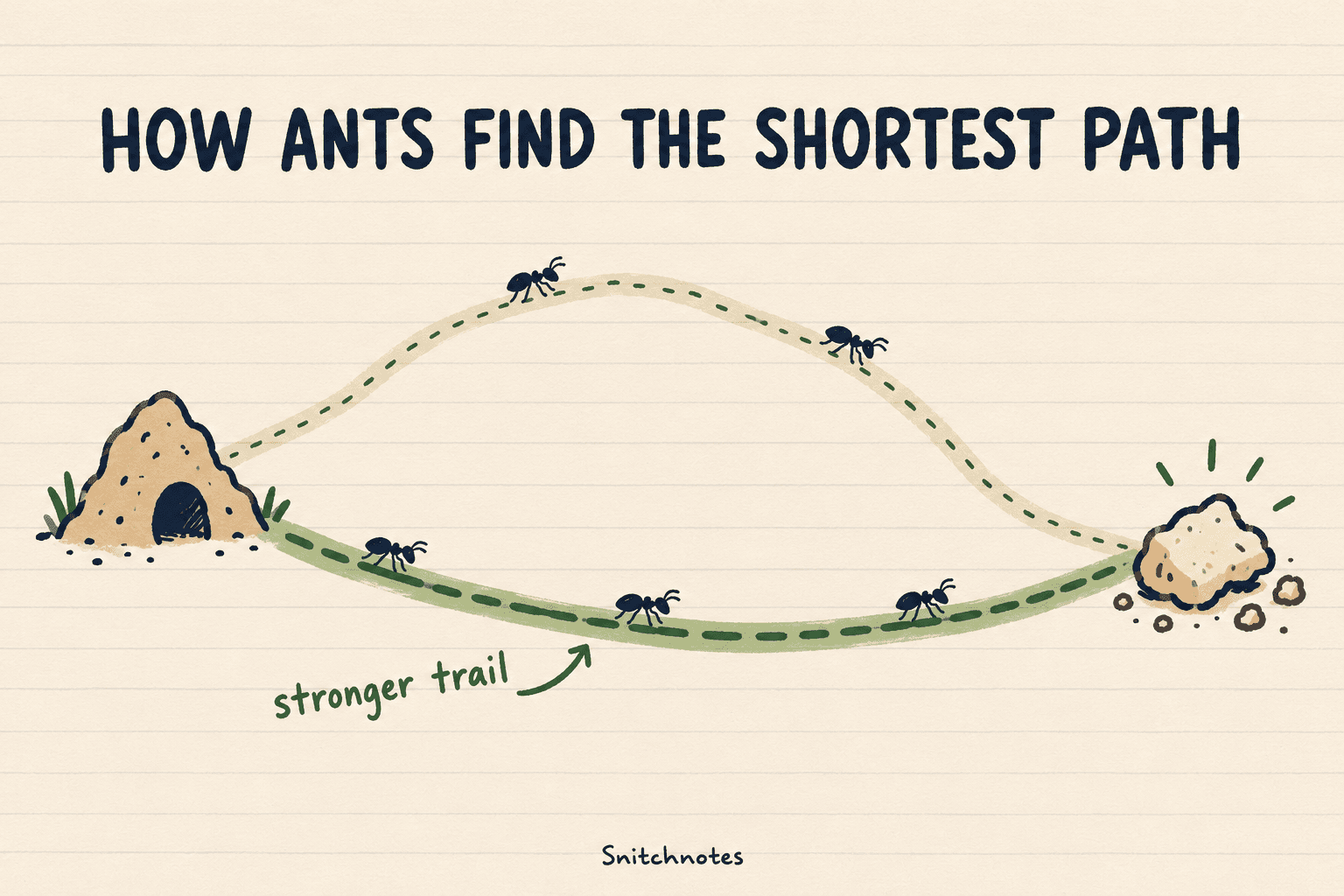
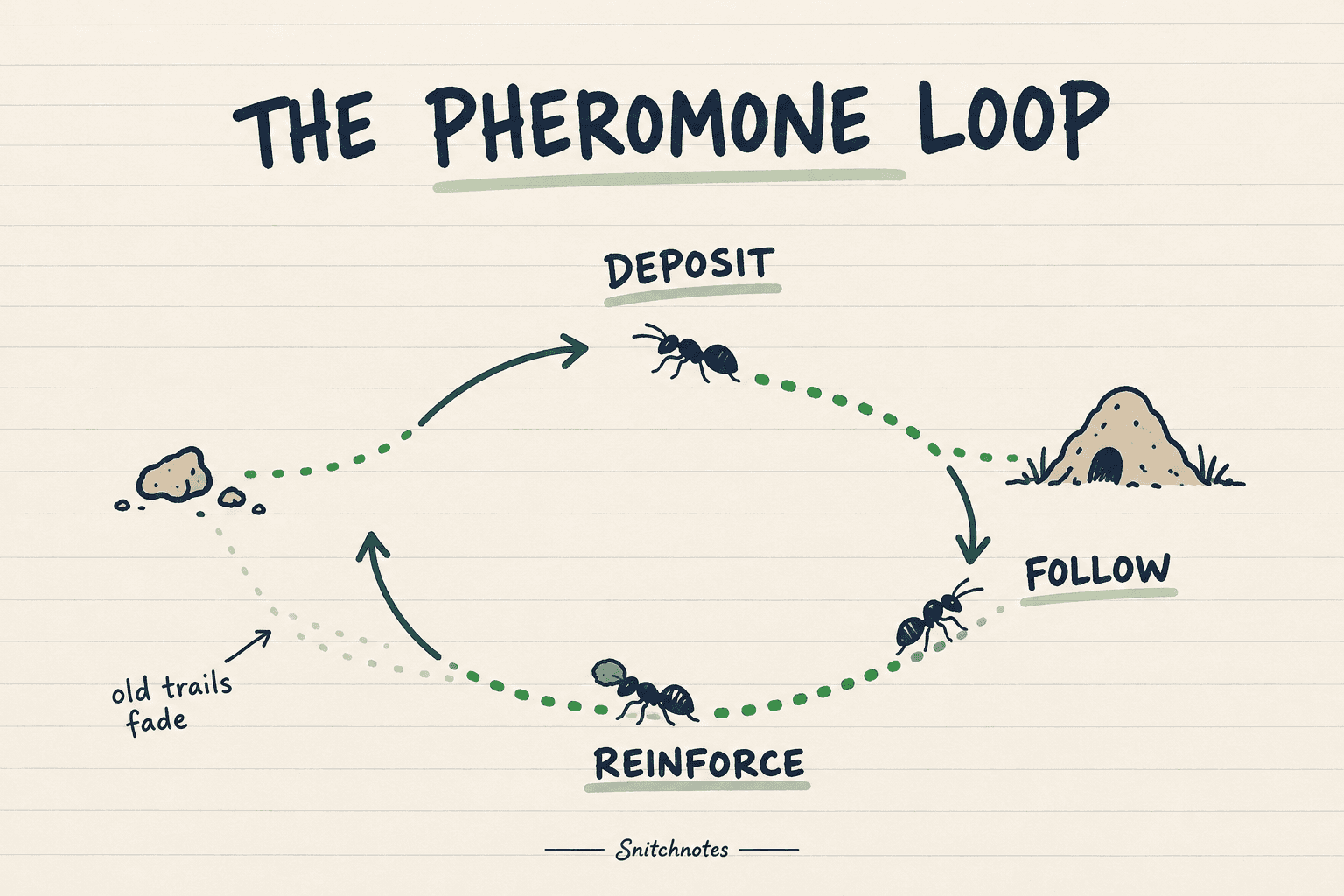
Ants can converge on a short route to food because each trip leaves information for the next traveler. Many trail-forming species deposit chemical signals called pheromones. Ants tend to follow stronger trails, and the shorter route can be completed and reinforced sooner. That creates positive feedback: more traffic adds more pheromone, which attracts still more traffic.
No ant needs a map, a distance calculation, or instructions from a leader. The route emerges from many local decisions. Pheromone also fades, so an abandoned or unproductive route can lose its pull. The result is often an efficient path, although real ants use more than pheromone and do not always choose the geometrically shortest line.
How pheromone feedback builds a trail
Imagine two branches between a nest and a crumb. At first, neither branch has much chemical information, so exploring ants may take both. An ant that reaches the food can return while laying trail pheromone. Later ants detect that signal with their antennae and become more likely—not certain—to choose the marked branch.
Every successful return can add another layer of signal. This is positive feedback: a small difference in traffic can amplify itself. Meanwhile, volatile trail chemicals weaken with time, and some species adjust how much they deposit according to food quality, experience, direction of travel, or existing trail strength. Evaporation and continued exploration stop the system from being permanently locked to every old route.
Why the shorter path gains an advantage
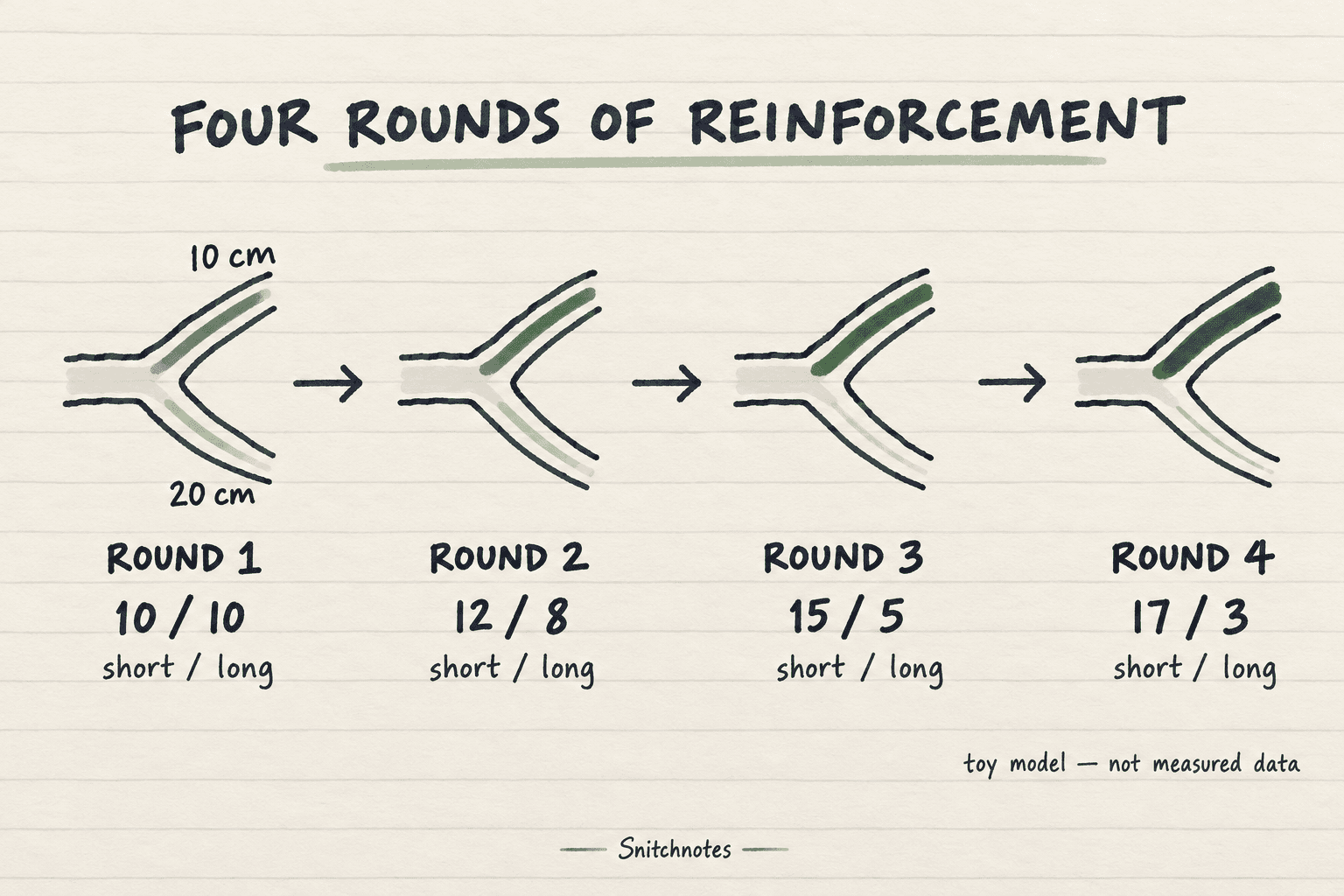
Suppose one branch is 10 centimeters long and the other is 20 centimeters. If ants travel at roughly similar speeds on both, a round trip on the short branch takes about half as long. During the time one ant completes a long round trip, an ant on the short branch may finish sooner and begin reinforcing that route again.
That timing difference is the key. The short route does not announce that it is short; it simply receives successful return traffic at a faster rate. New foragers encounter a stronger signal there, raising the chance that they choose it too. Repeated choices can turn an accidental early lead into a colony-wide traffic pattern.
Example: 20 ants and two paths
Use a toy model with 20 ants choosing between the 10-centimeter and 20-centimeter paths. In round 1, imagine an even split: 10 take each path. Because the short-path ants return sooner, their branch gets the first reinforcement. In round 2, suppose the stronger scent shifts the split to 12 short and 8 long.
Continue the illustration: round 3 sends 15 ants short and 5 long; round 4 sends 17 short and 3 long. Those numbers are not measurements or a universal formula. They make the feedback visible. Individual ants can still explore the weaker route, which matters if the food moves, the strong route becomes blocked, or a different option becomes faster.
Why this matters beyond one crumb
The colony solves a coordination problem without central control. Each ant responds to nearby cues, yet the combined behavior can reduce travel time and concentrate workers on a productive source. Biologists call this kind of large-scale order from local interactions self-organization. The useful information is stored partly outside any individual ant, in the changing trail itself.
Experiments show that route geometry also matters. Garden ants at a fork tend to favor the branch that deviates less from their current direction when pheromone levels are equal. Field and laboratory work also finds roles for memory, path integration, edge-following, and encounters with nestmates. A colony's route is therefore a product of chemistry, bodies, experience, and terrain—not pheromone alone.
Misconceptions and boundaries
First, an efficient route is not necessarily the shortest by distance. Ants may minimize travel time instead, especially when surfaces differ in walking speed or when congestion changes the cost of a path. A slightly longer smooth route can beat a shorter difficult one.
Second, positive feedback can amplify a poor early choice. If chance gives a long route a strong initial signal, ants may follow it for a while. Exploration and pheromone decay make correction possible, but not instant. Finally, trail systems differ among species. Some ants rely heavily on chemical trails; others combine several signals or navigate mainly with visual landmarks and memory.
From ant behavior to ant colony optimization
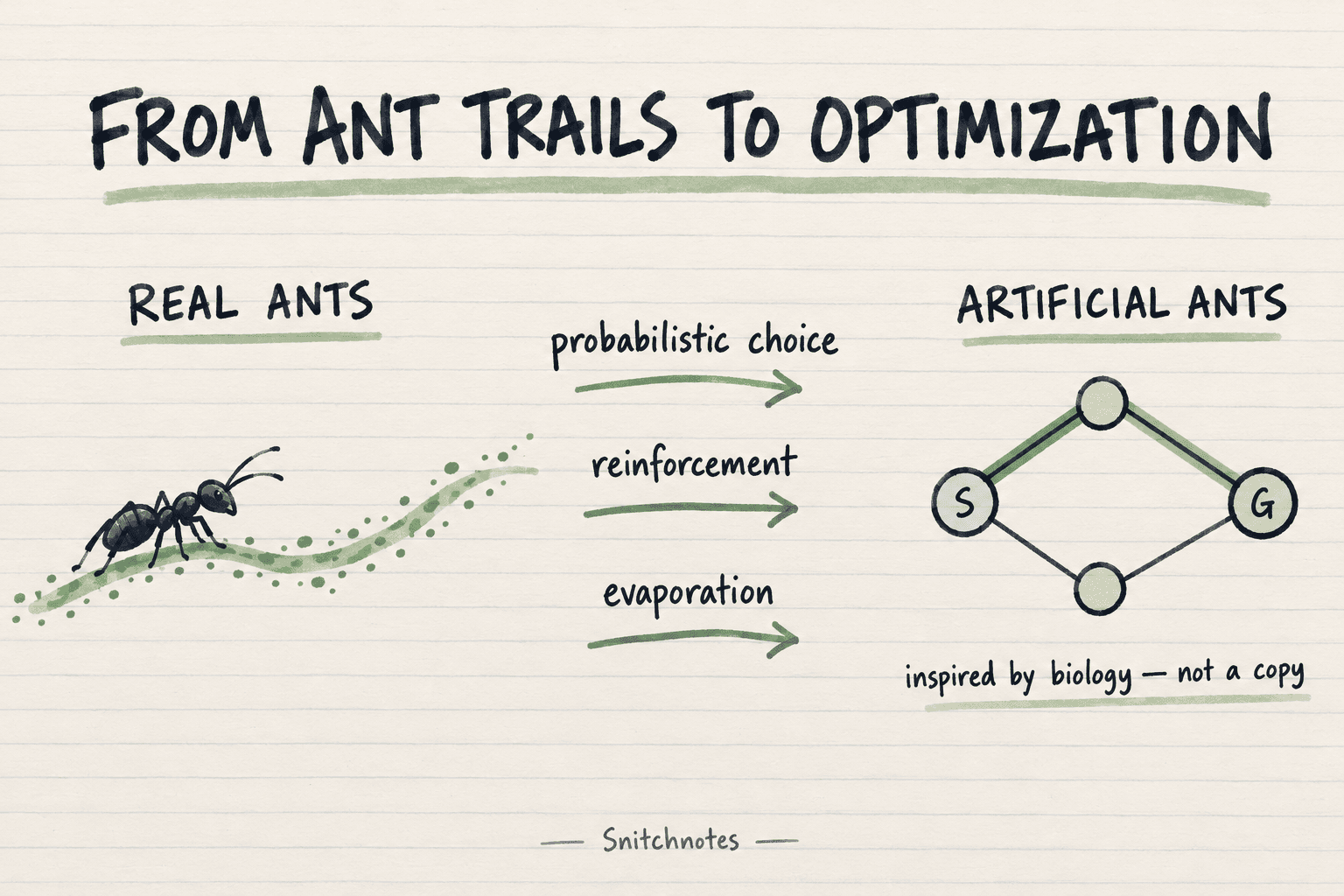
Computer scientists turned this biological idea into ant colony optimization. Artificial ants sample routes through a graph, and good solutions receive virtual pheromone. Later agents are more likely to use well-marked connections, while simulated evaporation reduces stale information. The approach can search routing and scheduling problems where checking every possible solution would be expensive.
The analogy has limits. Software designers choose equations, update rules, and stopping conditions; real ants respond to a richer world. Still, the shared lesson is powerful: repeated local trials, selective reinforcement, and forgetting can produce useful global behavior without one agent knowing the complete answer.
Check your understanding
Why can the 10-centimeter path become stronger than the 20-centimeter path?
Ants can complete the shorter round trip sooner, so successful traffic returns and reinforces that path at a faster rate. The growing pheromone difference then biases later choices.
Does every ant always follow the strongest pheromone trail?
No. Trail following is often probabilistic, and ants can use memory, geometry, landmarks, nestmate encounters, and other cues. Continued exploration helps a colony discover changes.
What two processes keep old information from dominating forever?
Pheromone evaporation weakens trails that are not renewed, while exploratory choices allow ants to test alternatives. Together they make the system adaptable rather than perfectly fixed.
If feedback loops in your biology or computer-science notes feel tangled, Snitchnotes can turn your own lectures, slides, and readings into organized notes, flashcards, and quizzes.
Related concepts
- Positive feedback: an initial change triggers effects that strengthen that change.
- Self-organization: coordinated group structure emerging from local interactions without central control.
- Binary search: a different way to narrow a search space by repeatedly halving it.
- Error correction in QR codes: how a distributed pattern preserves information when parts are damaged.
Sources
National Center for Biotechnology Information: Uncovering the complexity of ant foraging trails
Goss, Aron, Deneubourg, and Pasteels: Self-organized shortcuts in the Argentine ant
Convierte tus clases en material listo para el examen.
Apuntes, quizzes, podcasts, flashcards y chat — con una sola subida.
Prueba tu primer apunte gratis