
Snitchnotes Team
How to Balance Redox Equations Using Half-Reactions
How to Balance Redox Equations Using Half-Reactions
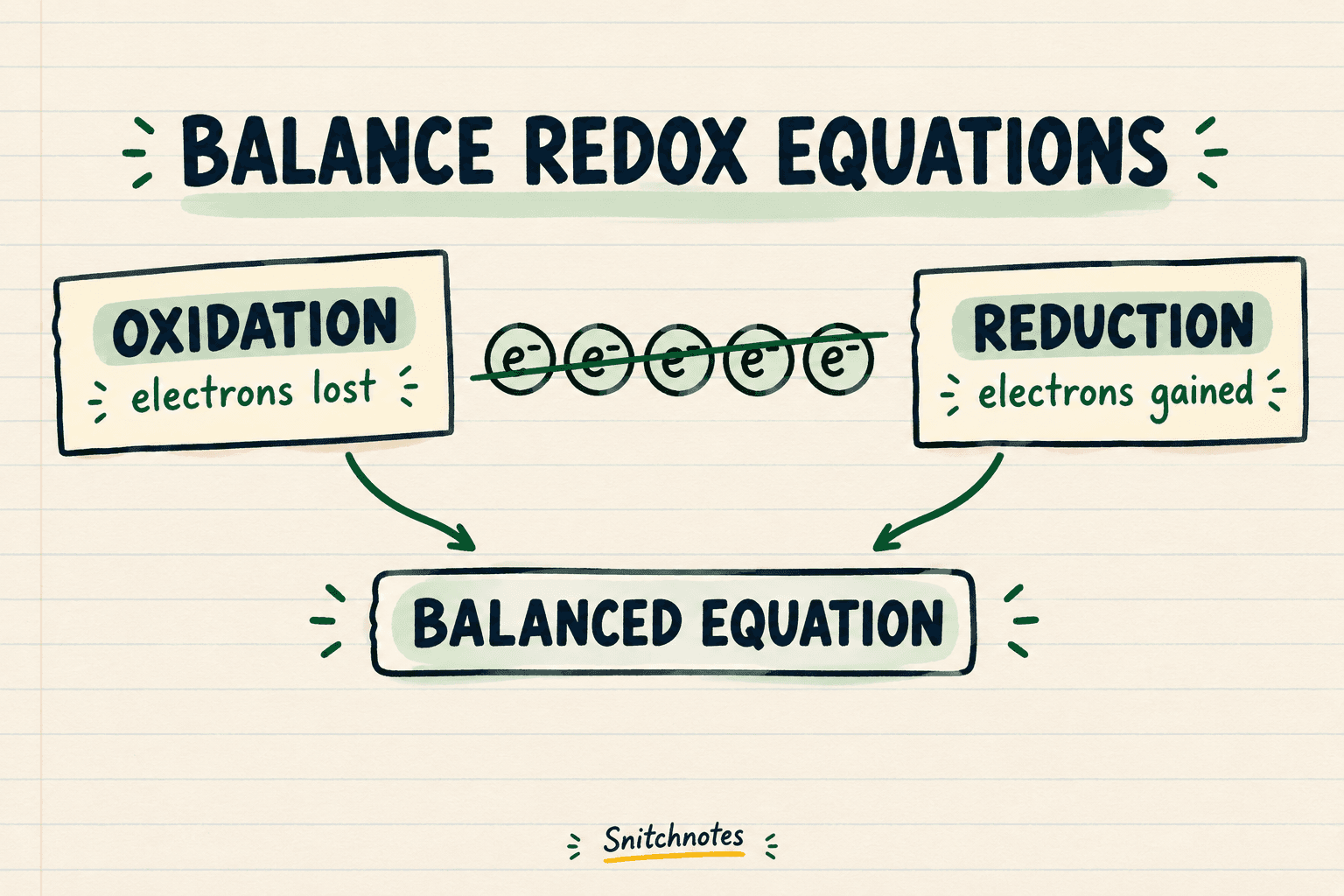
To balance a redox equation using half-reactions, split it into oxidation and reduction halves, balance atoms and charge in each half, multiply the halves so they transfer the same number of electrons, then add and cancel matching terms. In acidic solution, use H₂O for oxygen, H⁺ for hydrogen, and e⁻ for charge. In basic solution, first balance as if acidic, then add OH⁻ to remove every H⁺.
This method works because a complete redox reaction must conserve both mass and electric charge. It also exposes the step that trial-and-error balancing hides: electrons lost during oxidation must equal electrons gained during reduction. For students facing a crowded ionic equation, that turns one hard puzzle into two smaller bookkeeping jobs.
The seven-step method in acidic solution
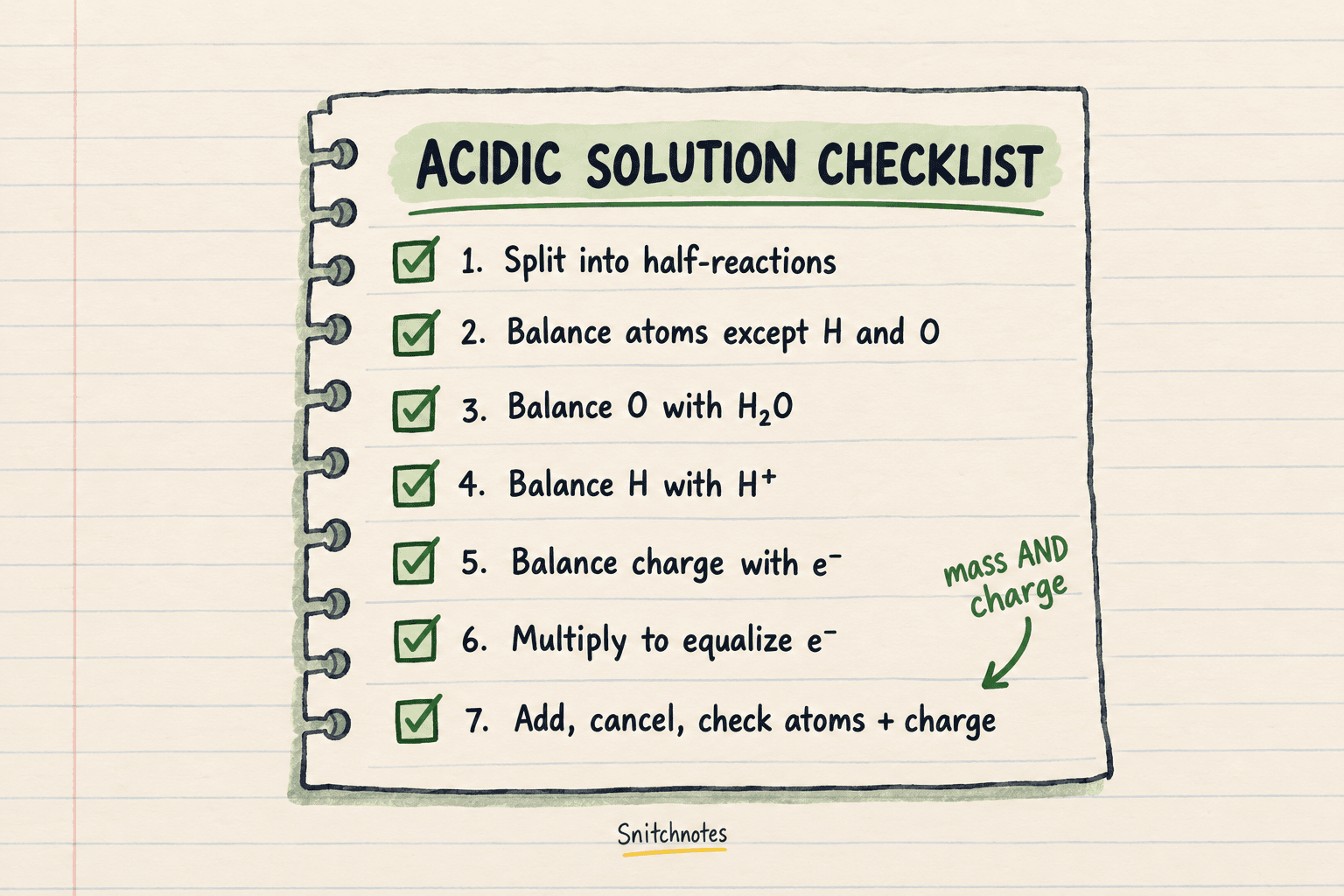
Use this order every time. Changing the order is the usual reason a nearly balanced equation becomes a tangle of extra water, hydrogen ions, and electrons.
- Split the skeleton equation into oxidation and reduction half-reactions. Each half should contain the species with the element whose oxidation state changes.
- Balance every element except hydrogen and oxygen. Use coefficients; never change a chemical formula's subscripts.
- Balance oxygen by adding H₂O to the side that needs oxygen.
- Balance hydrogen by adding H⁺ to the side that needs hydrogen.
- Balance charge by adding e⁻ to the more positive side. Count net charge, not just the number of charged particles.
- Multiply one or both complete half-reactions until the electrons lost and gained are equal.
- Add the halves, cancel identical terms on opposite sides, reduce coefficients if possible, and check every atom plus the total charge.
Worked example: permanganate and iron(II) in acid
Balance MnO₄⁻ + Fe²⁺ → Mn²⁺ + Fe³⁺ in acidic solution. Manganese changes from +7 in permanganate to +2, so it is reduced. Iron changes from +2 to +3, so it is oxidized. The two skeleton halves are MnO₄⁻ → Mn²⁺ and Fe²⁺ → Fe³⁺.
Start with the manganese half. Manganese is already balanced. Add 4H₂O to the right to balance four oxygen atoms, then add 8H⁺ to the left to balance eight hydrogen atoms: MnO₄⁻ + 8H⁺ → Mn²⁺ + 4H₂O. The left side now has net charge +7, while the right has +2, so add 5e⁻ to the left. The balanced reduction half is MnO₄⁻ + 8H⁺ + 5e⁻ → Mn²⁺ + 4H₂O.
The iron half needs no water or hydrogen ions. Its left side has charge +2 and its right side has charge +3, so put one electron on the right: Fe²⁺ → Fe³⁺ + e⁻. Electrons on the product side confirm oxidation; electrons on the reactant side confirm reduction.
Make the electrons match before combining
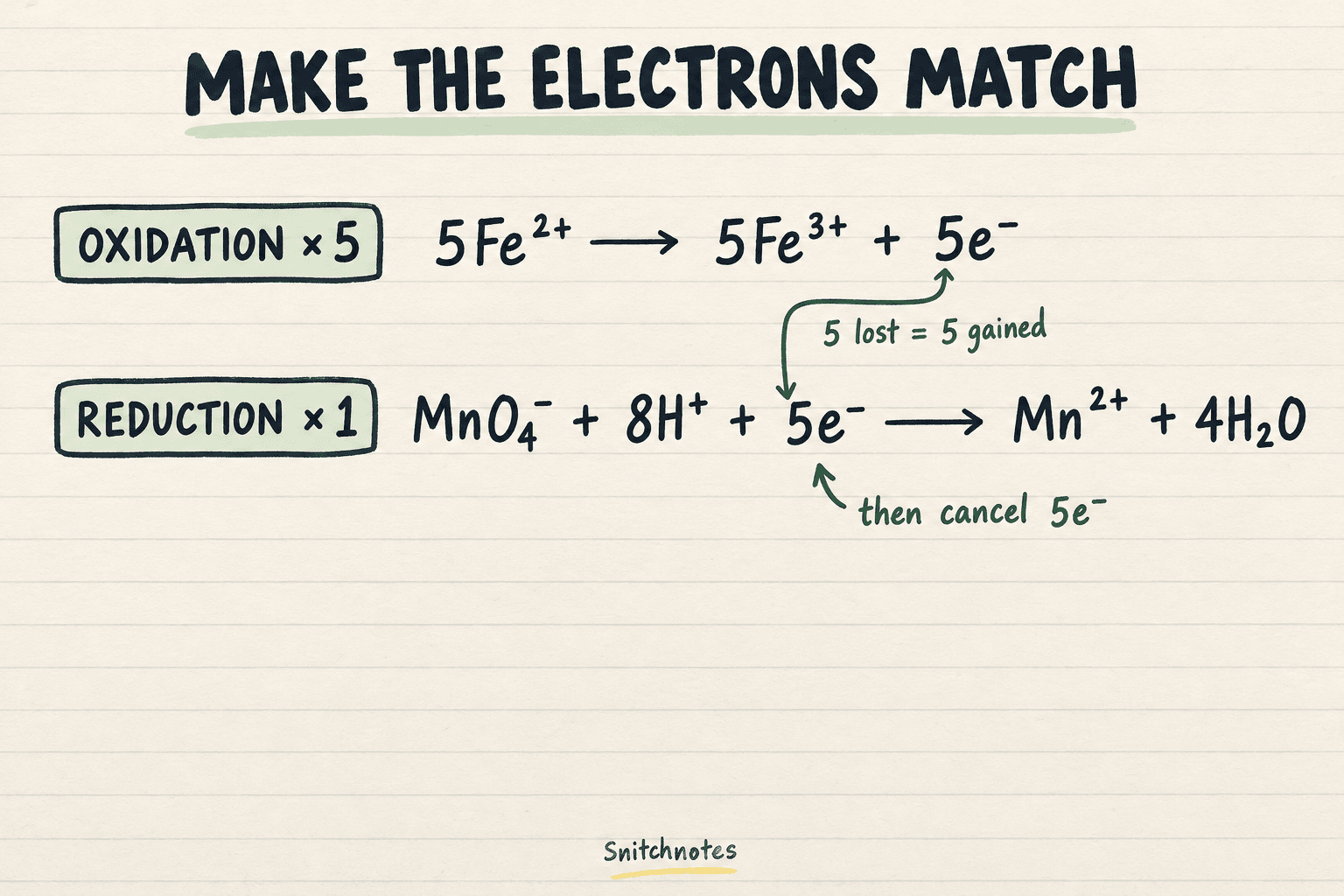
The manganese half consumes five electrons, but the iron half produces only one. Multiply every coefficient in the iron half by 5: 5Fe²⁺ → 5Fe³⁺ + 5e⁻. Do not multiply only the electron; a multiplier applies to the whole half-reaction.
Now add the halves and cancel 5e⁻ from both sides. The result is MnO₄⁻ + 8H⁺ + 5Fe²⁺ → Mn²⁺ + 4H₂O + 5Fe³⁺. Check it line by line: 1 Mn, 5 Fe, 4 O, and 8 H appear on each side. Charge is also equal: −1 + 8 + 10 = +17 on the left, and +2 + 15 = +17 on the right. That final charge check catches mistakes that atom counting cannot.
How to balance a redox equation in basic solution
Balance both halves with the acidic method first. Then add one OH⁻ to both sides for every H⁺ present. On the side containing H⁺, combine H⁺ and OH⁻ into H₂O; cancel any water molecules that appear on both sides. Finish by checking atoms and net charge again. The equal addition of OH⁻ preserves the equation while removing free H⁺ from the final basic-solution form.
There is an important boundary: pH can change which products are chemically formed. Permanganate, for example, does not always reduce to the same manganese product under acidic and basic conditions. Use the species given for the stated medium, then balance that skeleton; do not mechanically convert an acidic equation if its products are wrong for basic solution.
The most common balancing mistakes
- Changing subscripts instead of coefficients. That changes the substance, not just its amount.
- Balancing charge before atoms. Electrons fix charge only; they cannot repair missing oxygen or hydrogen.
- Forgetting to multiply every term in a half-reaction when equalizing electrons.
- Stopping after the atoms match. A redox equation is not balanced until net charge matches too.
Check your understanding
Where do electrons appear in an oxidation half-reaction?
On the product side, because oxidation is loss of electrons. In a reduction half-reaction, electrons appear on the reactant side.
Why is the iron half-reaction multiplied by five?
It initially releases one electron while the permanganate half consumes five. Multiplying the entire iron half by five makes the electron transfer equal, so the electrons cancel when the halves are added.
What two checks must the final equation pass?
It must have the same number of each type of atom on both sides and the same total electric charge on both sides. Passing only one check is not enough.
Related concepts
- Dimensional analysis in chemistry: a step-by-step method
- Ionic vs covalent bonds: differences and examples
- Oxidation numbers: identifying which species loses electrons and which species gains them.
Sources
OpenStax Chemistry: Balancing Oxidation-Reduction Reactions
University of Central Florida Chemistry Fundamentals: Review of Redox Chemistry
Purdue University: Oxidation-Reduction Equations
Texas A&M University CHEM 101: Balancing Redox Equations by the Method of Half-Reactions
Transforme tes cours en fiches prêtes pour les exams.
Notes, quiz, podcasts, flashcards et chat — en un seul upload.
Essaie ta première note gratuitement