
Snitchnotes Team
Why Do Onions Make You Cry? The Chemistry Explained
Why Do Onions Make You Cry? The Chemistry Explained
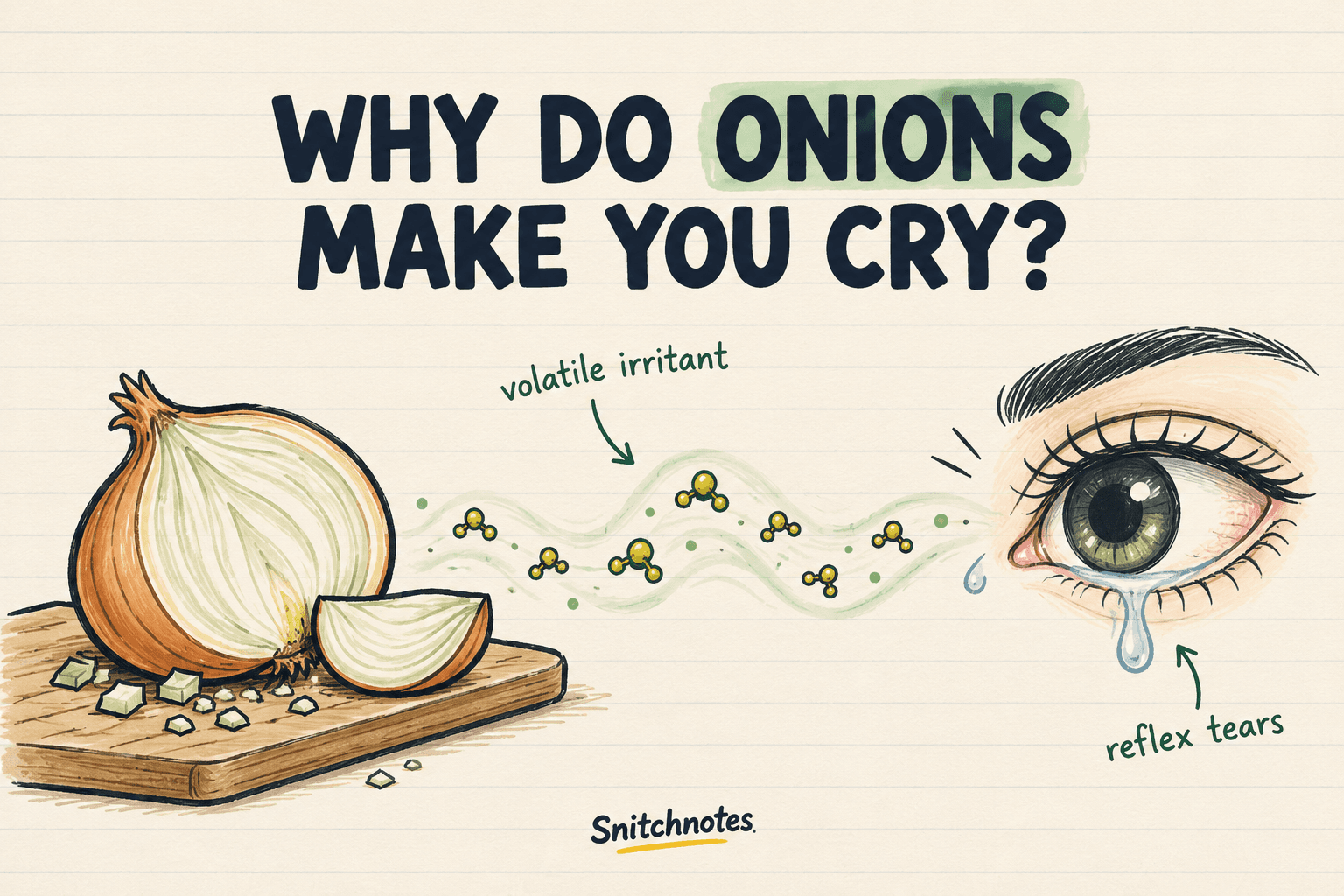
Onions make you cry because cutting them breaks open cells and starts a rapid enzyme reaction. That reaction produces a volatile sulfur compound called syn-propanethial S-oxide, also known as onion lachrymatory factor. The compound travels through the air, reaches the surface of your eyes, irritates sensory nerves, and triggers reflex tears that help wash the irritant away.
The onion is not aiming for your tear ducts, and the tears are not an emotional response. They are the visible end of a short chemical chain: damaged plant cell, active enzymes, airborne molecule, irritated eye, protective tear flow. Understanding that chain also shows why a cold onion or good airflow may help while chewing gum is mostly a distraction.
What happens when you cut an onion
An intact onion keeps its reactive ingredients in different parts of its cells. One ingredient is alliinase, an enzyme. Another is a sulfur-containing precursor often called isoalliin, or trans-S-1-propenyl-L-cysteine sulfoxide. As long as the cellular compartments stay intact, those materials do not freely mix.
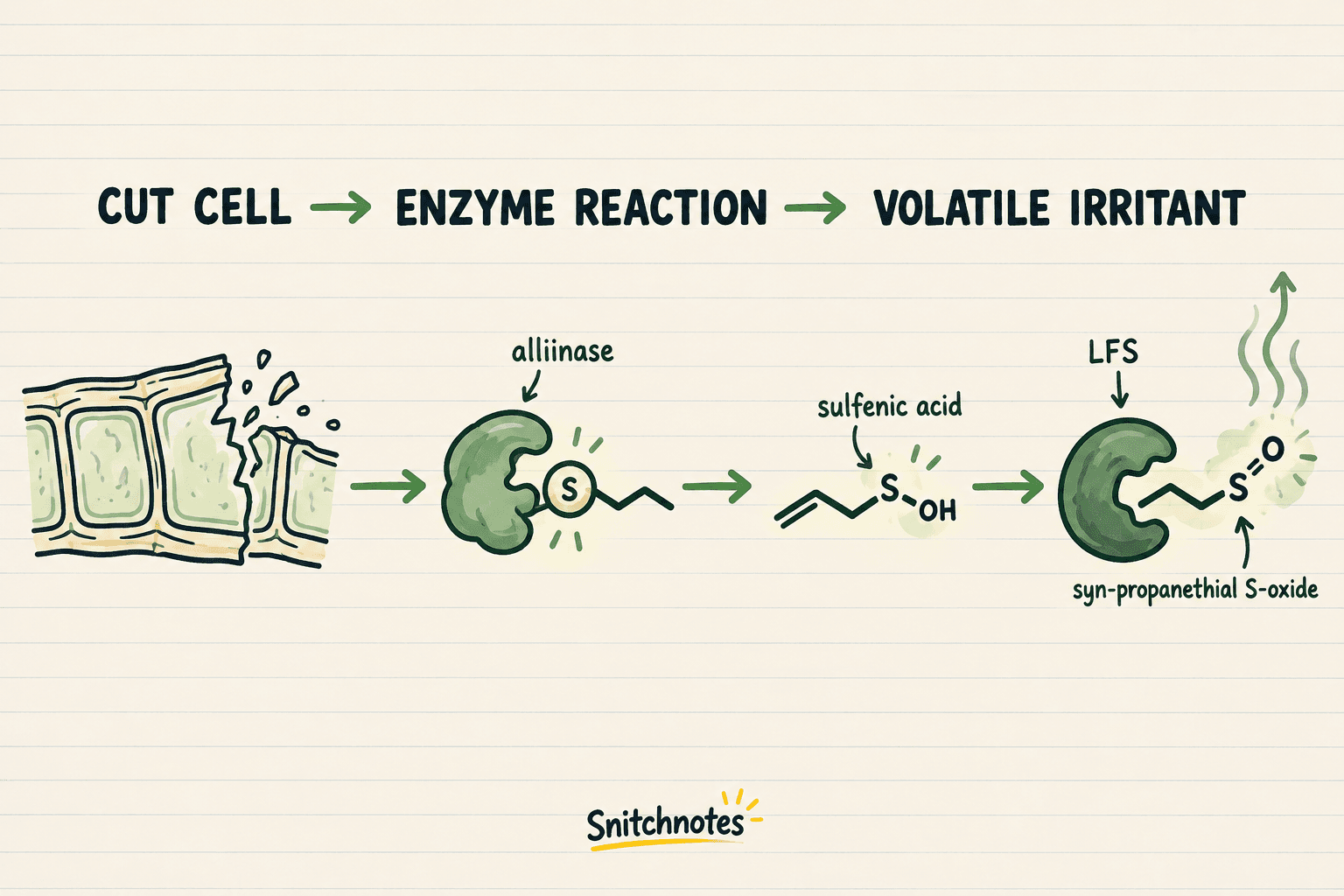
- The knife ruptures onion cells and removes the barriers between the enzyme and its sulfur precursor.
- Alliinase acts on the precursor and produces 1-propenylsulfenic acid among the reaction products.
- A second enzyme, lachrymatory factor synthase, rearranges that sulfenic acid into syn-propanethial S-oxide.
- Because the lachrymatory factor is volatile, molecules escape from the cut surface and spread through the nearby air.
Scientists once assumed that onion lachrymatory factor formed spontaneously. A 2002 Nature study identified lachrymatory factor synthase as the missing enzyme. Later experiments supported the pathway: suppressing the enzyme sharply reduced tear-inducing factor in wounded onions, while biochemical work showed that the enzyme converts the relevant sulfenic-acid intermediate.
Why the chemical makes your eyes water
Syn-propanethial S-oxide is small enough to leave the onion and reach the moist surface over your cornea and conjunctiva. There, it acts as an irritant. Sensory nerve endings detect the chemical exposure and send a warning signal into the nervous system.
Your response is reflex lacrimation: the lacrimal glands above the outer part of each eye increase tear production. Blinking spreads the fluid, and the extra tears dilute and carry away the irritating material. If production exceeds what the drainage ducts can remove, tears overflow onto your cheeks and some fluid drains into your nose. That is why onion cutting can make both your eyes and your nose run.
This is different from emotional crying. Both responses use tears, but onion tears begin with chemical irritation at the eye rather than sadness, joy, or another emotional state. The sting is unpleasant, but ordinary kitchen exposure is usually brief once you move away from the cut onion and the air clears.
Ava's two-onion kitchen test
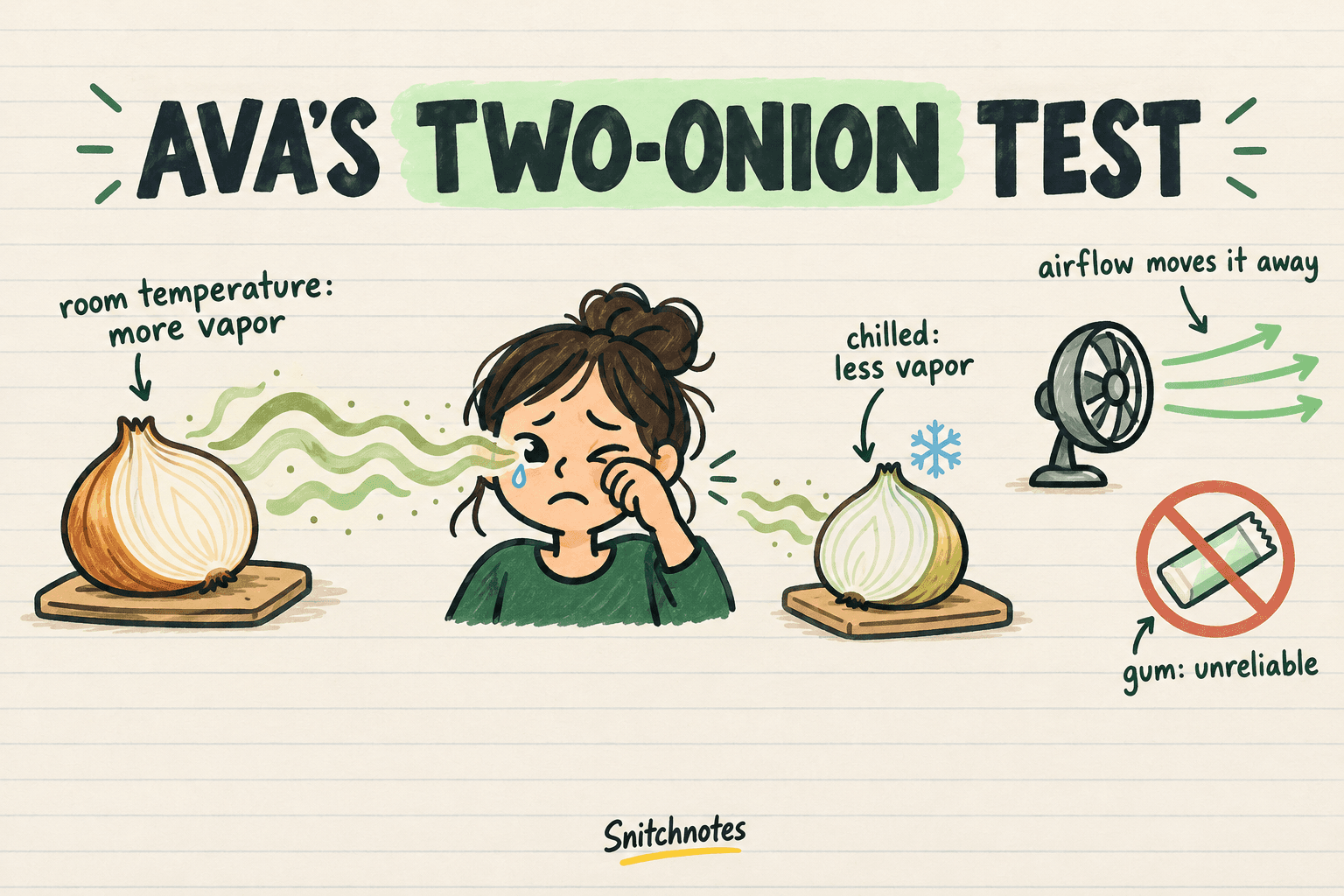
Ava has two similar yellow onions. She leaves one on the counter and chills the other in the refrigerator for 30 minutes, following Poison Control's cited preparation advice. She cuts the room-temperature onion first. Cell damage starts the chemistry, volatile molecules spread from the board, and within moments her eyes sting and water.
She then cuts the chilled onion with the same sharp knife. It can still make lachrymatory factor, so cold is not an off switch. Lower temperature can slow enzyme-driven processes and reduce how readily volatile material enters the air, which may lower her exposure while she works. The useful claim is less vapor reaching the eyes, not a guaranteed tear-free onion.
Next Ava turns on an extractor fan that pulls air away from her face. This does not change the onion's chemistry; it changes the molecule's route. Moving contaminated air away reduces the local concentration near her eyes. A fan blowing the vapor directly into her face would do the opposite, so direction matters.
Chewing gum is the weak part of the experiment. It may change how Ava breathes or give her something else to notice, but it does not shield the surface of her eyes from an airborne irritant. Sealed goggles create a physical barrier; gum does not. A sharp knife may also help by crushing fewer cells, though every clean cut still damages some tissue and begins the reaction.
What the onion is doing—and what it is not
The sulfur chemistry is part of what gives damaged Allium plants their strong aroma and flavor. Garlic has related sulfur chemistry, but it does not produce the same onion-specific lachrymatory factor in the same way. Onion pungency also varies with cultivar, growing conditions, storage, and the amount of sulfur available to the plant, so one onion may be much fiercer than the next.
A common misconception is that the onion stores a pocket of ready-made tear gas. It does not. The key irritant is assembled after tissue damage brings previously separated components together. That distinction matters: the knife is not merely releasing a reservoir; it is starting a chemical process.
Check your understanding
Why does an intact onion not make you cry from across the room?
Its cell compartments keep alliinase and the sulfur precursor largely separated. Cutting or crushing breaks those compartments, allowing the reaction sequence that forms the volatile irritant to begin.
What does lachrymatory factor synthase do?
It converts the relevant sulfenic-acid intermediate into syn-propanethial S-oxide, the volatile lachrymatory factor associated with onion tears.
Why can airflow help when chewing gum does not?
Airflow directed away from the face can carry irritant molecules away before they reach the eyes. Chewing gum does not remove the vapor or form a barrier over the eye, so it does not target the exposure path.
If a chemistry mechanism like this becomes a blur of names and arrows in your notes, Snitchnotes can turn your lectures, slides, and PDFs into clearer study notes, flashcards, quizzes, and audio for practice.
Related concepts
- Dimensional analysis in chemistry: use units to keep multi-step calculations on track.
- Ionic vs covalent bonds: compare two basic ways atoms form chemical bonds.
- Enzyme catalysis: how a biological catalyst speeds a reaction without being consumed by it.
Sources
Imai et al., Nature: An onion enzyme that makes the eyes water
Eady et al., Plant Physiology: Silencing onion lachrymatory factor synthase
Transforme tes cours en fiches prêtes pour les exams.
Notes, quiz, podcasts, flashcards et chat — en un seul upload.
Essaie ta première note gratuitement