
Snitchnotes Team
Judicial Review Explained: Definition and Example
Judicial Review Explained: Definition and Example
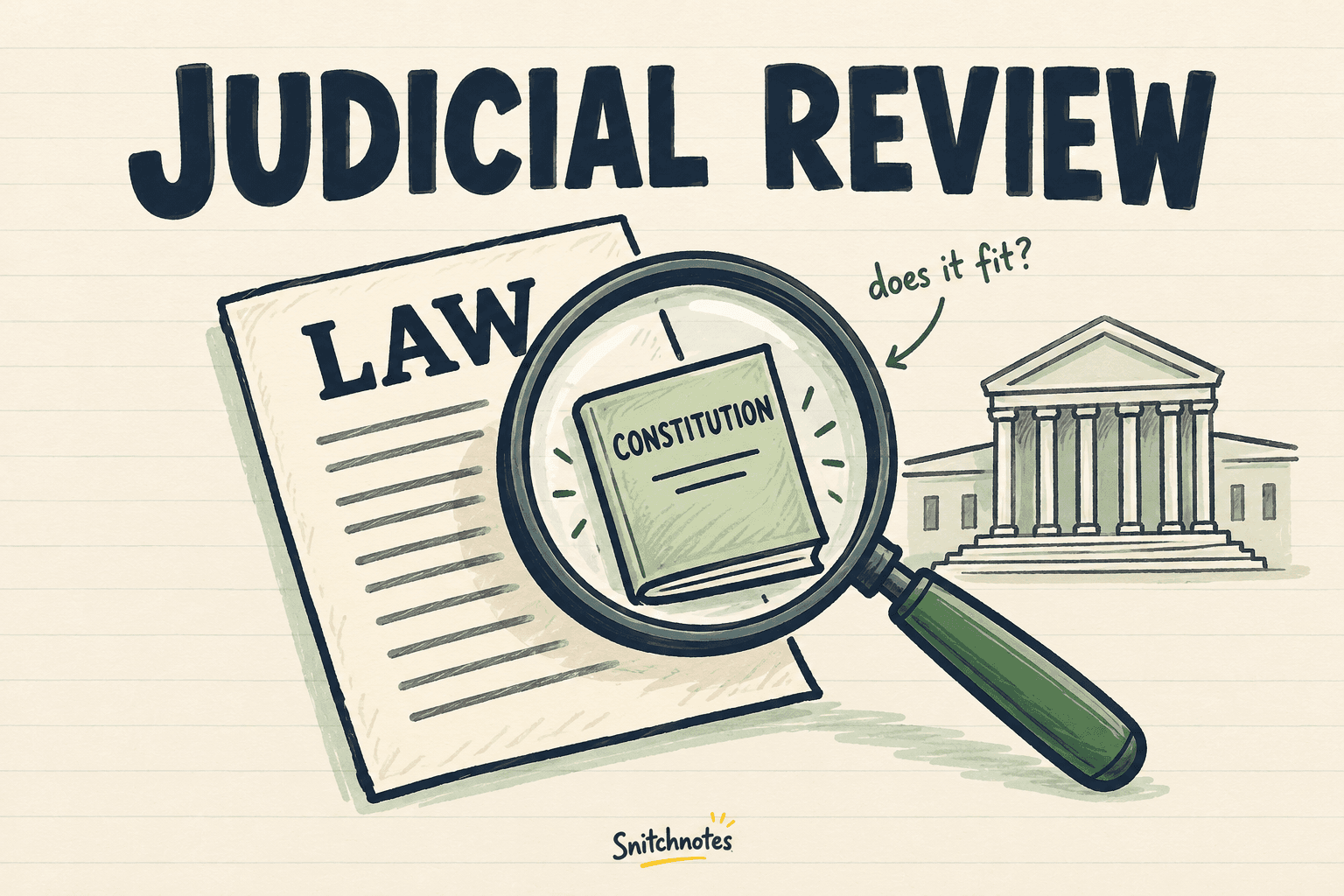
Judicial review is the power of a court to examine a law or government action and decide whether it conflicts with the Constitution or another controlling legal rule. If a conflict exists and the court has authority to decide the case, it may refuse to enforce or invalidate the challenged action. Judicial review does not mean that judges automatically cancel any policy they dislike.
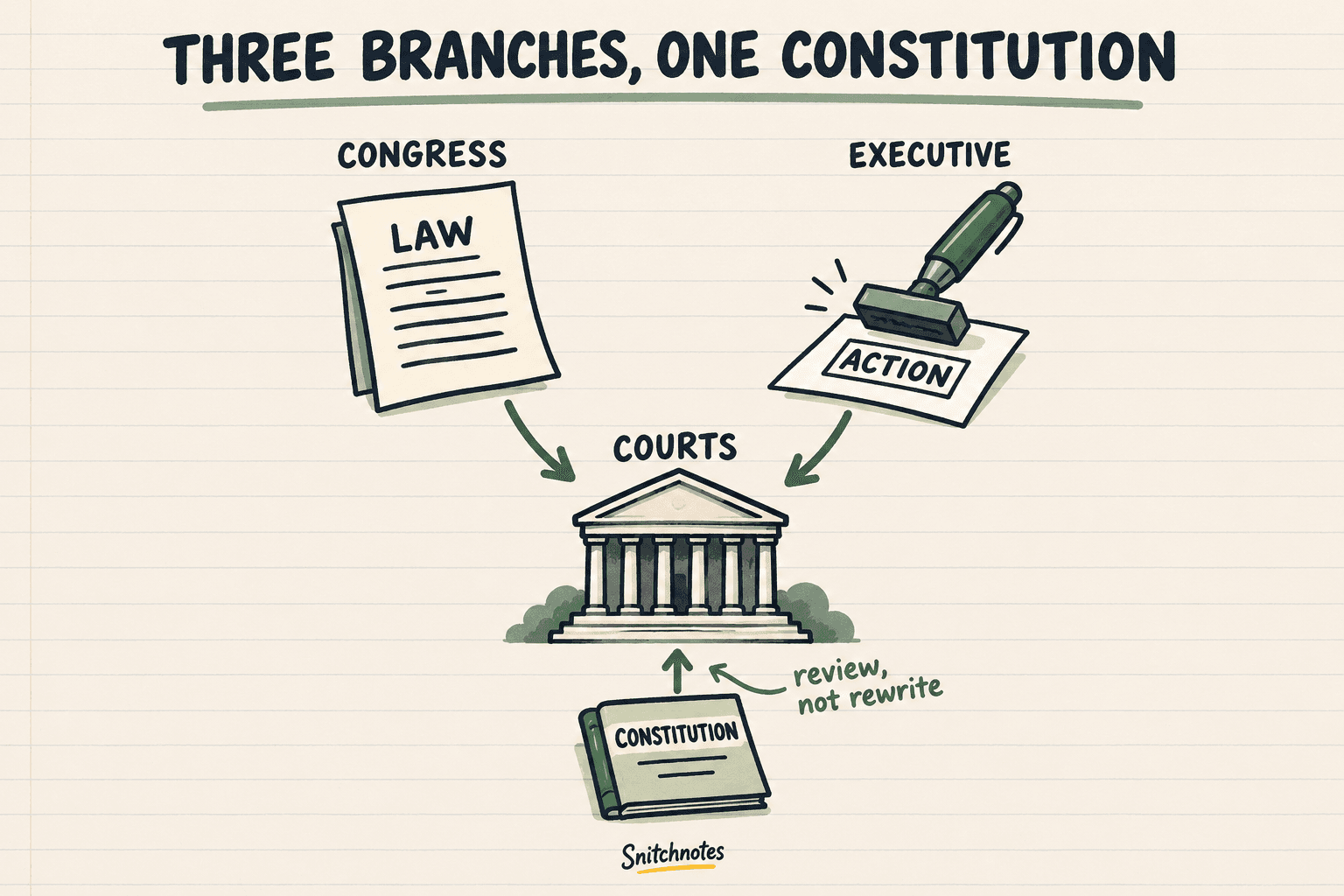
This article uses the United States as its main context, because judicial review differs across legal systems. In U.S. civics, the idea is a central part of checks and balances: legislatures make laws, executives enforce them, and courts interpret and apply the law in concrete disputes.
What judicial review means
A court conducting judicial review compares two things. On one side is the challenged government act: perhaps a statute passed by a legislature, an executive order, or an agency decision. On the other side is a higher source of law that controls it, most famously the U.S. Constitution. The court interprets both, applies them to the dispute, and explains its conclusion in a ruling.
The result is not always invalidation. A court may uphold the action because it is constitutional, rule that the claimant has not met a procedural requirement, interpret the action narrowly to avoid a conflict, or hold that all or part of it cannot be enforced. That is why judicial review describes a power and process, not a guaranteed outcome.
Why judicial review matters
A written constitution would be a weak limit if ordinary government action could override it whenever convenient. Judicial review gives courts a way to apply the Constitution in actual cases, helping protect constitutional rights and keep each branch within legal boundaries. Cornell Law School's Legal Information Institute describes the doctrine as review and possible invalidation of legislative and executive action by the judiciary.
The power also creates tension. Judges are not elected federal lawmakers, yet constitutional interpretation can affect public policy for decades. Courts therefore work within limits: federal courts decide cases and controversies rather than issuing general advice, parties ordinarily must have a proper basis to sue, and judges decide the legal questions presented rather than rewriting an entire policy from scratch.
Judicial review example: a $200 sign fine
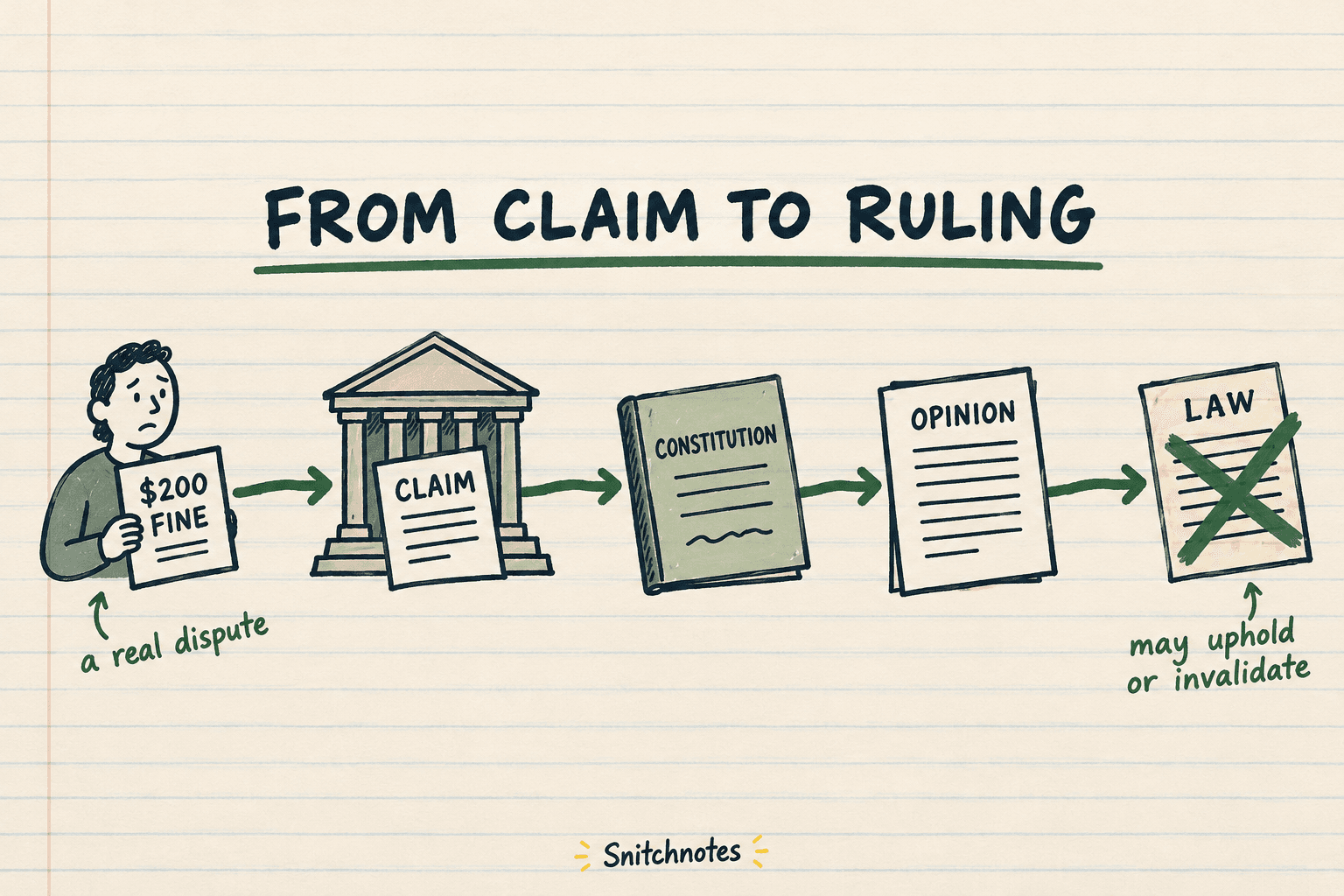
Imagine that a city adopts an ordinance banning political signs on private lawns. Elena puts up a small sign, receives a $200 fine, and challenges the ordinance in court. She argues that the ban violates constitutional protection for speech. The city answers that the rule is a lawful way to address traffic safety and visual clutter.
- A real dispute exists: Elena has been fined under a specific ordinance.
- The court identifies the government action and the controlling constitutional rule.
- Both sides present legal arguments and relevant facts, including how broadly the ban operates.
- The court issues a reasoned ruling that may uphold the ordinance, narrow its reach, or prevent its enforcement.
Suppose the ordinance prohibits every political lawn sign but permits commercial signs of the same size. If the court finds that distinction unconstitutional, it can rule for Elena and stop the city from enforcing the invalid rule. The example is hypothetical, but its structure is realistic: claimant, government action, higher law, comparison, and remedy.
Marbury v. Madison and the origin of U.S. judicial review
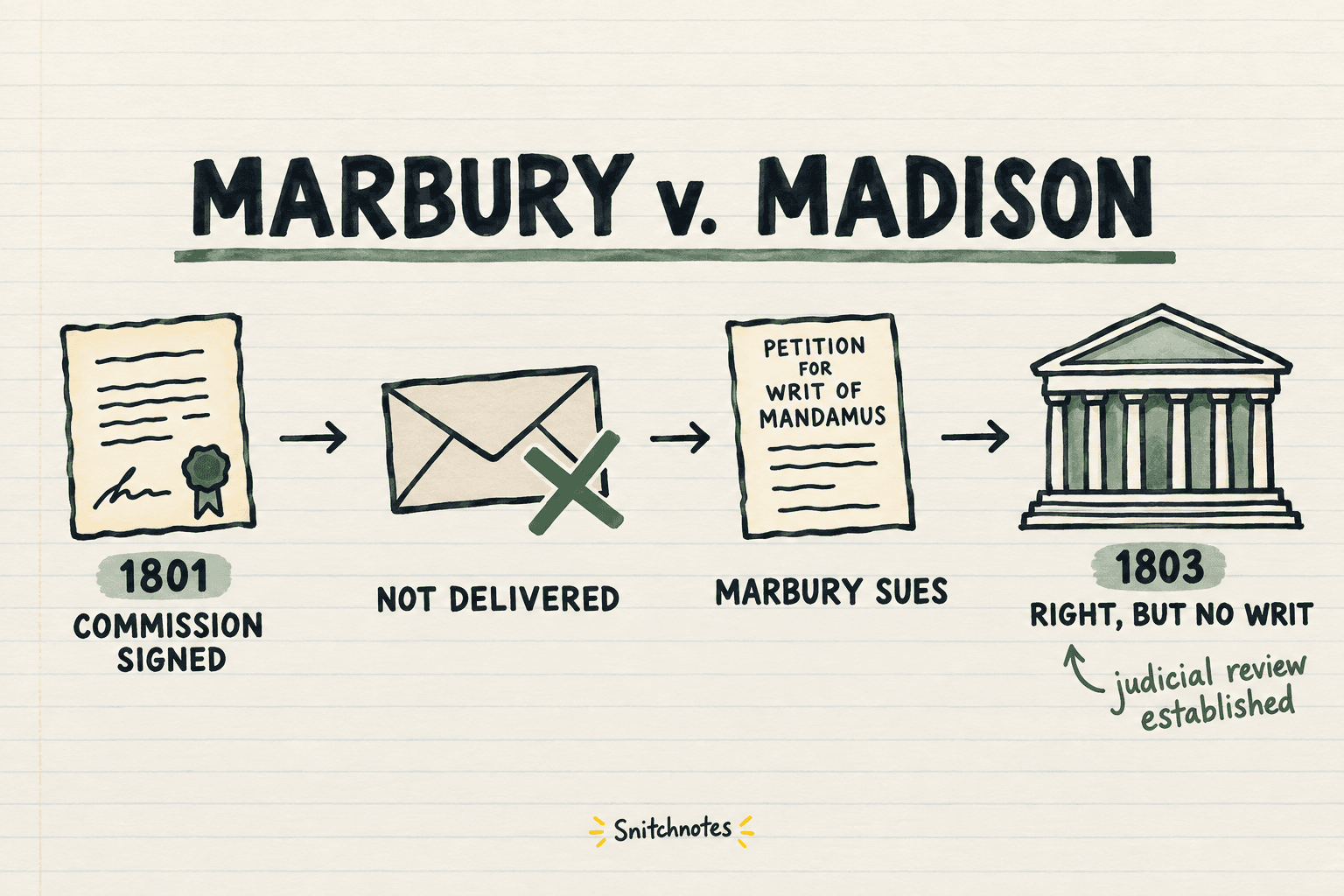
The foundational U.S. case is Marbury v. Madison, decided in 1803. William Marbury had been appointed a justice of the peace near the end of President John Adams's administration, but his commission was not delivered. Marbury asked the Supreme Court to order Secretary of State James Madison to deliver it through a writ of mandamus.
Chief Justice John Marshall's opinion concluded that Marbury had a right to the commission and that withholding it violated that right. Yet the Court also held that the statutory provision used to seek the writ improperly expanded the Supreme Court's original jurisdiction beyond Article III. The Court therefore could not grant Marbury the requested writ, and it treated the conflicting provision as void.
The U.S. Constitution does not contain a sentence that simply says “the Supreme Court has judicial review.” The Supreme Court explains that the function was anticipated before ratification but confirmed in Marbury. The decision established the Court's authority to decline to enforce federal legislation that conflicts with the Constitution.
Judicial review versus an appeal
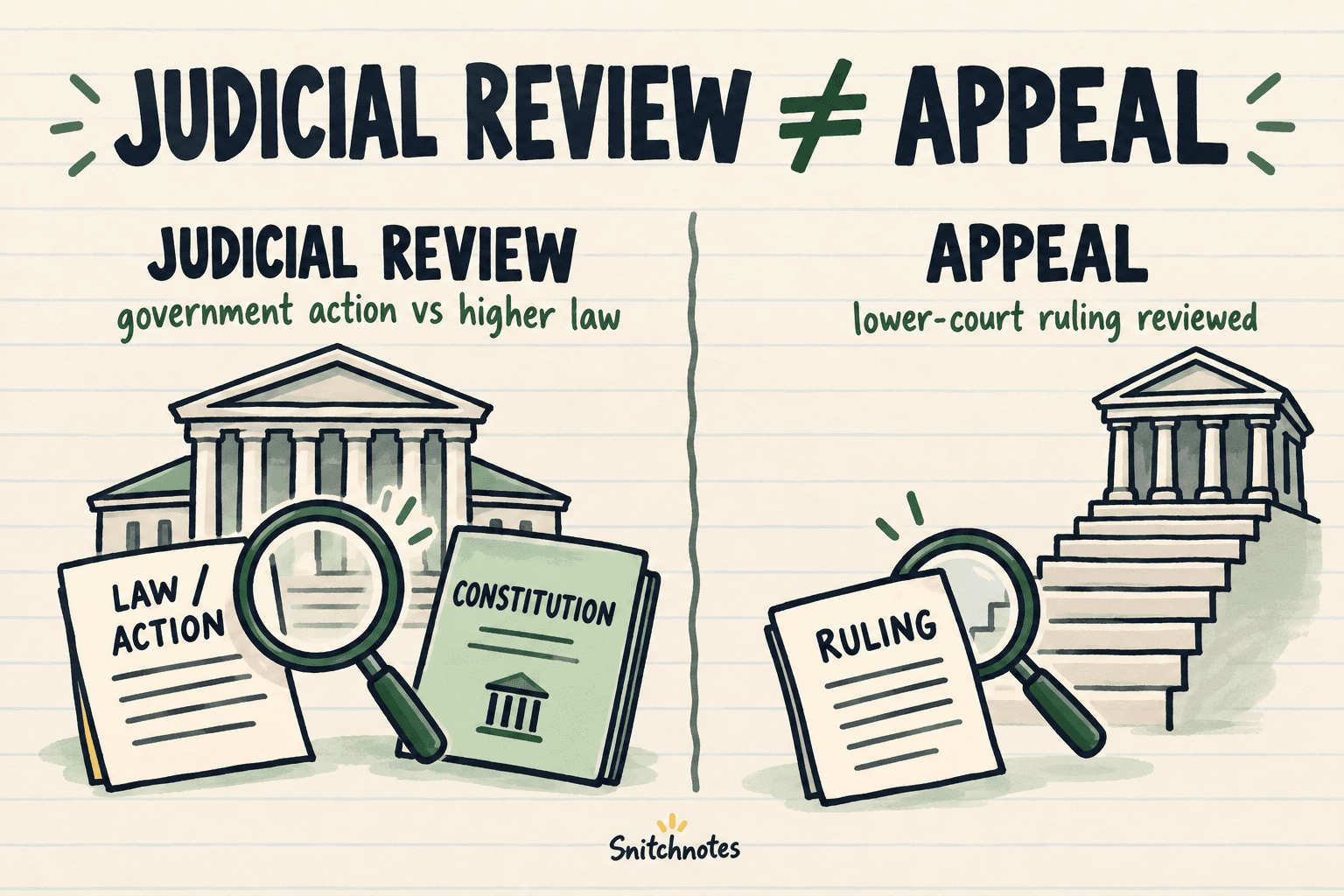
Judicial review and appeal are related but not identical. An appeal asks a higher court to review a lower court's decision for legal error. Judicial review asks whether government action complies with a superior legal rule. A constitutional challenge may reach an appellate court, so one case can involve both processes at once.
Another common misconception is that only the U.S. Supreme Court exercises judicial review. Lower federal courts and state courts also decide constitutional questions within their jurisdiction. The Supreme Court is especially important because it is the highest federal court and its constitutional rulings are effectively final unless later doctrine or a constitutional amendment changes the rule.
Check your understanding
Does judicial review always strike down a law?
No. Review means examination. A court can uphold the challenged action, reject the claim on procedural grounds, interpret the action narrowly, or invalidate some or all of it.
Why did Marbury lose if the Court said his right was violated?
The Supreme Court concluded that it lacked constitutional authority to issue the requested writ in that proceeding. Marbury had a right, but the Court could not provide that particular remedy under the conflicting jurisdictional statute.
What is the shortest useful definition?
Judicial review is a court's examination of government action to determine whether it complies with the Constitution or another controlling law.
Related concepts
- Checks and balances: mechanisms through which branches limit and influence one another.
- Separation of powers: assigning legislative, executive, and judicial functions to different branches.
- Constitutional supremacy: the Constitution controls when an ordinary law conflicts with it.
- How to analyze primary sources like a historian
Sources
Cornell Law School Legal Information Institute: Judicial review
National Archives: Marbury v. Madison (1803)
Supreme Court of the United States: The Court and Constitutional Interpretation
講義をテスト対策バッチリの教材に。
ノート、クイズ、ポッドキャスト、フラッシュカード、チャット — アップロード1回で全部。
最初のノートを無料で試す