
Snitchnotes Team
Parliamentary vs Presidential Systems: Key Differences
Parliamentary vs Presidential Systems: Key Differences
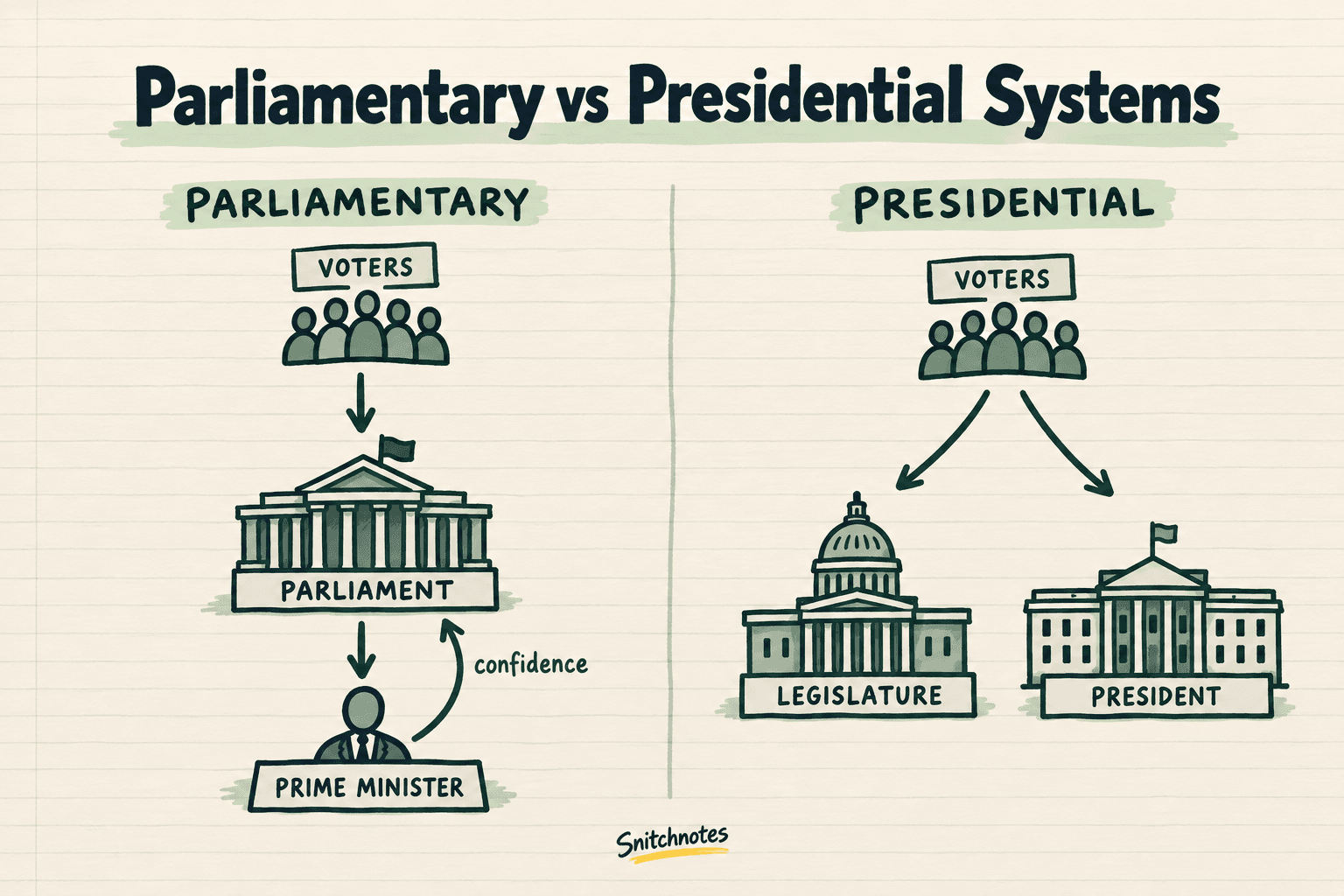
The main difference between a parliamentary and presidential system is the relationship between the executive and the legislature. In a parliamentary system, the government is formed through parliament and remains in office only while it has parliament's confidence. In a presidential system, the president and legislature receive separate electoral mandates, and the president normally serves a fixed term.
That structural choice changes how leaders are selected, how laws are negotiated, and how an unpopular or ineffective executive can be removed. Neither label by itself tells you whether a country is more democratic or better governed; constitutions, electoral rules, parties, courts, and political practice all matter.
Parliamentary vs presidential system at a glance
- Executive selection: a parliamentary government emerges from the legislature; a president is elected separately from the legislature, directly or through a distinct electoral process.
- Executive-legislative relationship: parliamentary systems fuse political leadership across the two branches; presidential systems separate their mandates and institutional survival.
- Tenure: a prime minister's government depends on continuing legislative confidence; a president usually has a constitutionally fixed term.
- Removal: parliament may withdraw confidence for political reasons, while removing a president before the term ends generally requires an exceptional constitutional process such as impeachment.
These distinctions matter because they determine where political deadlock is likely to appear. Parliamentary government often links executive survival to a working legislative majority. Presidential government can leave the president and legislature in office even when rival parties control them, so compromise may be necessary without either branch being able to dismiss the other.
Who selects the executive?
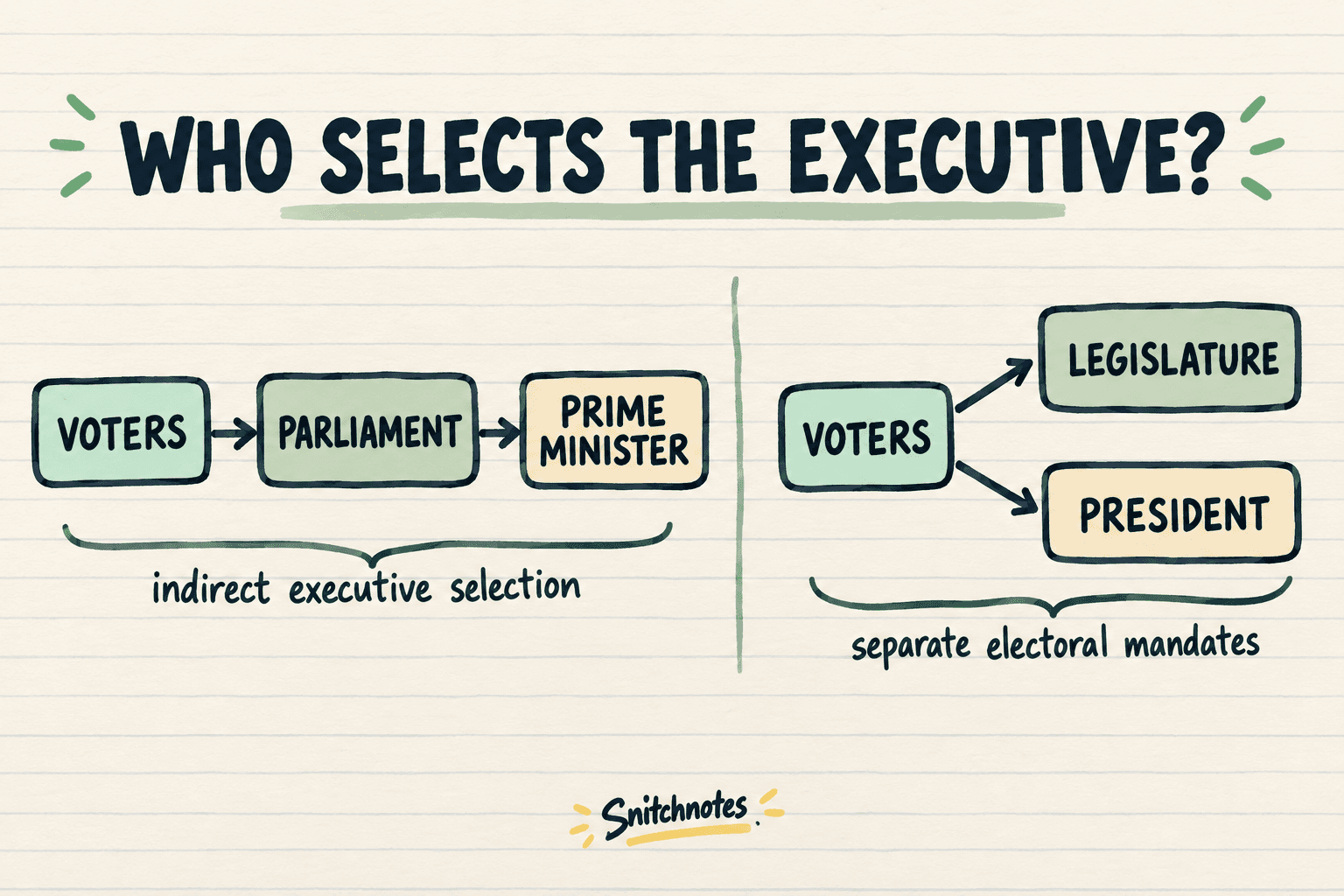
In a parliamentary democracy, voters elect members of parliament. A party with a majority, or several parties able to form a coalition, then supports a prime minister and cabinet. International IDEA describes parliamentary governments as selected indirectly by or through parliament, responsible to parliament, and removable by a parliamentary vote of no confidence.
In a presidential system, the presidency is institutionally separate from the legislature. Voters may choose both on the same day, but one election does not automatically decide the other. This creates two sources of democratic legitimacy: a president can claim a mandate from the presidential election, while legislators can claim mandates from their own constituencies.
Example: the same split vote, two different outcomes
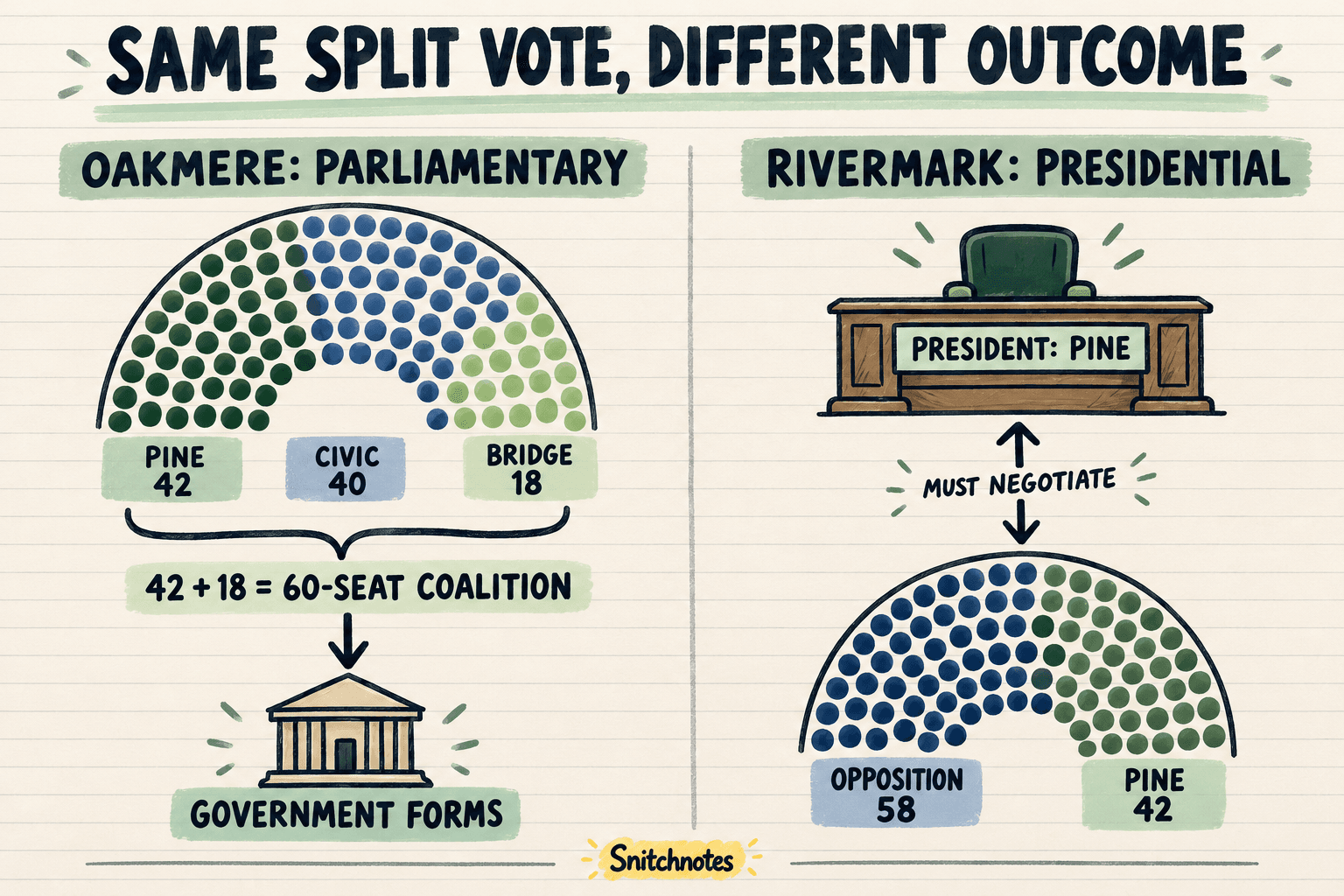
Imagine two fictional countries with 100-seat legislatures. In parliamentary Oakmere, the Pine Party wins 42 seats, the Civic Party 40, and the Bridge Party 18. Nobody has the 51 seats needed for a majority. Pine and Bridge negotiate a shared program and cabinet positions; together their 60 seats can support a prime minister and form a coalition government.
In presidential Rivermark, a Pine president has already won a separate election. Pine holds 42 legislative seats, while opposition parties hold 58. The president stays in office despite lacking a legislative majority, and the opposition legislature stays too. To pass a budget or major law, they must bargain, revise proposals, or accept stalemate.
The election result is similarly fragmented, but the constitutional response differs. Oakmere assembles a majority that creates and sustains the executive. Rivermark preserves two separately elected institutions and asks them to work across divided government. A coalition is not guaranteed in every parliamentary system, and gridlock is not guaranteed in every presidential one; party discipline and electoral rules affect both.
Terms and legislative accountability
A parliamentary government's time in office is politically conditional. Canada's House of Commons explains that the prime minister and cabinet must retain the confidence of a majority of members. If the government loses a confidence question, the expected outcome is resignation or a request to dissolve parliament for a general election. Exact rules vary: some constitutions require a constructive vote of no confidence, meaning parliament must choose a replacement rather than merely reject the current government.
A presidential term is usually fixed independently of the legislature. The United States Constitution, for example, gives the president a four-year term, while members of Congress have their own terms. A legislature's rejection of a president's bill does not normally remove the president, and a president's veto does not dissolve the legislature. Separation can protect continuity, but it can also keep a disagreement alive until compromise or the next election.
Confidence votes and impeachment are not equivalents
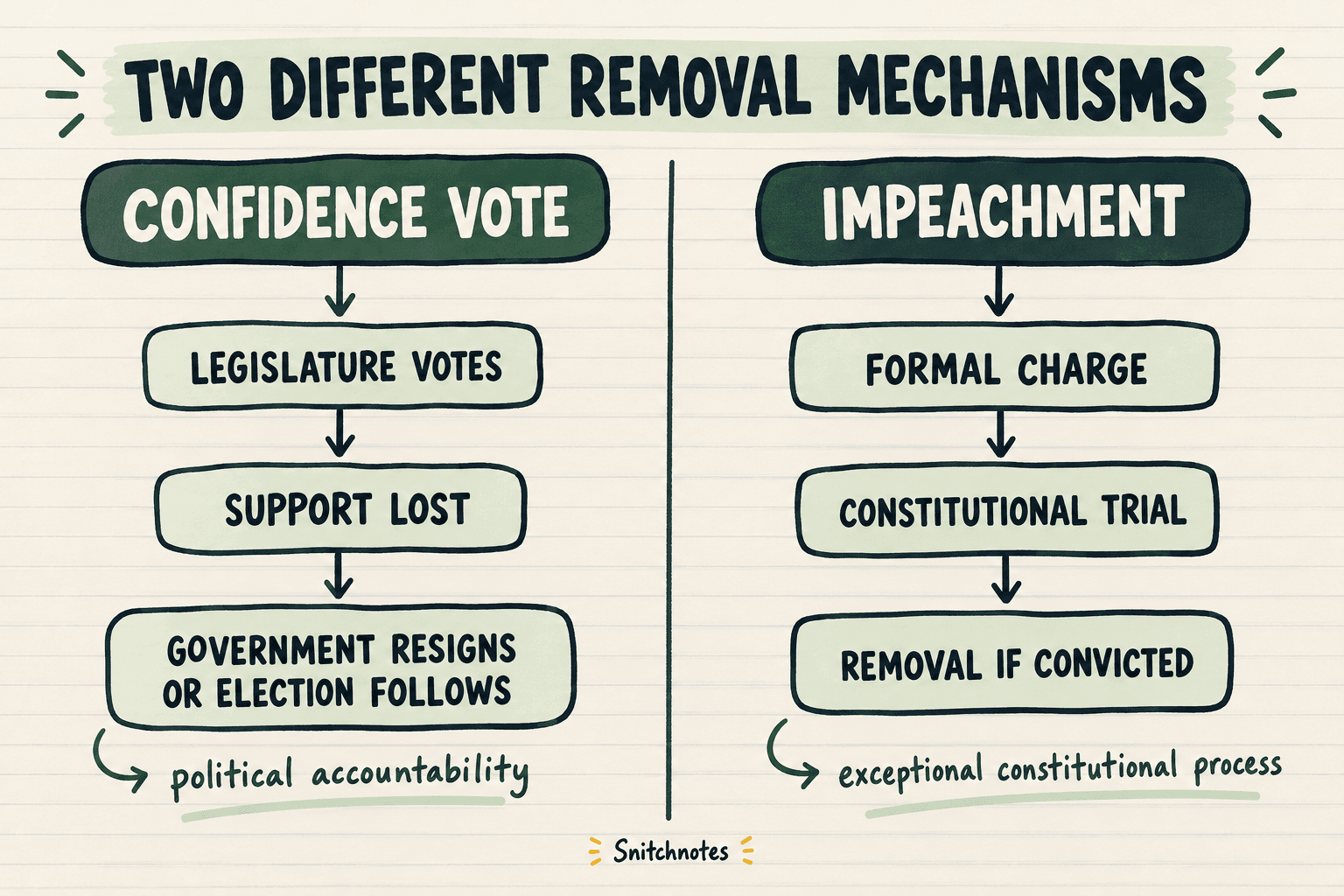
A no-confidence vote is a test of whether a parliamentary government still has enough political support to govern. Legislators may withdraw that support because of policy, coalition breakdown, leadership, or another political dispute. It is a regular accountability mechanism within parliamentary government, even if it is used infrequently.
Impeachment is not a presidential version of an ordinary no-confidence vote. It is a special constitutional procedure tied to alleged wrongdoing or specified grounds. In the United States, the House of Representatives approves articles of impeachment by a simple majority, but the Senate requires a two-thirds vote of members present to convict; conviction removes the official. Other presidential constitutions define different grounds and procedures, so the U.S. rule is an example, not a universal template.
Misconceptions and boundaries
First, parliamentary does not mean a country has no president. Some parliamentary republics have a mostly ceremonial president alongside a prime minister, while constitutional monarchies have a monarch as head of state. The key question is who runs the government and whether that government depends on legislative confidence.
Second, real constitutions do not always fit two tidy boxes. Semi-presidential systems combine a popularly elected president with a prime minister and cabinet responsible to parliament. Even within one category, presidents may have stronger or weaker vetoes, parliaments may be easier or harder to dissolve, and courts may review institutional boundaries. Compare constitutional rules, not just office titles.
Check your understanding
A cabinet loses majority support after a coalition partner leaves. Which mechanism fits?
This is characteristic of a parliamentary system. The government may face a confidence vote and could resign, be replaced, or trigger an election under that country's rules.
The president's party loses the legislative election. Does the president automatically leave office?
Normally no. In a presidential system, separate mandates allow divided government: the president and legislature can remain in office under their respective fixed terms.
Why is impeachment different from a confidence vote?
A confidence vote asks whether a parliamentary government still has political support. Impeachment applies a special constitutional process and specified grounds to possible early removal of an official.
If constitutional structures blur together in your course notes, Snitchnotes can turn your own lectures, slides, and readings into organized notes, flashcards, and quizzes for comparison practice.
Related concepts
- Separation of powers: distributing authority among institutions so that no single branch controls every governmental function.
- Coalition government: two or more parties cooperate to command legislative support and govern.
- Divided government: the executive and legislature are controlled by different parties or political alliances.
- Judicial review: how courts assess whether laws or government actions comply with a constitution.
Sources
International IDEA: Government Formation and Removal Mechanisms
House of Commons of Canada: The Confidence Convention
National Archives: The Constitution of the United States—Article II
講義をテスト対策バッチリの教材に。
ノート、クイズ、ポッドキャスト、フラッシュカード、チャット — アップロード1回で全部。
最初のノートを無料で試す