
Snitchnotes Team
How the Sodium-Potassium Pump Works
How the Sodium-Potassium Pump Works
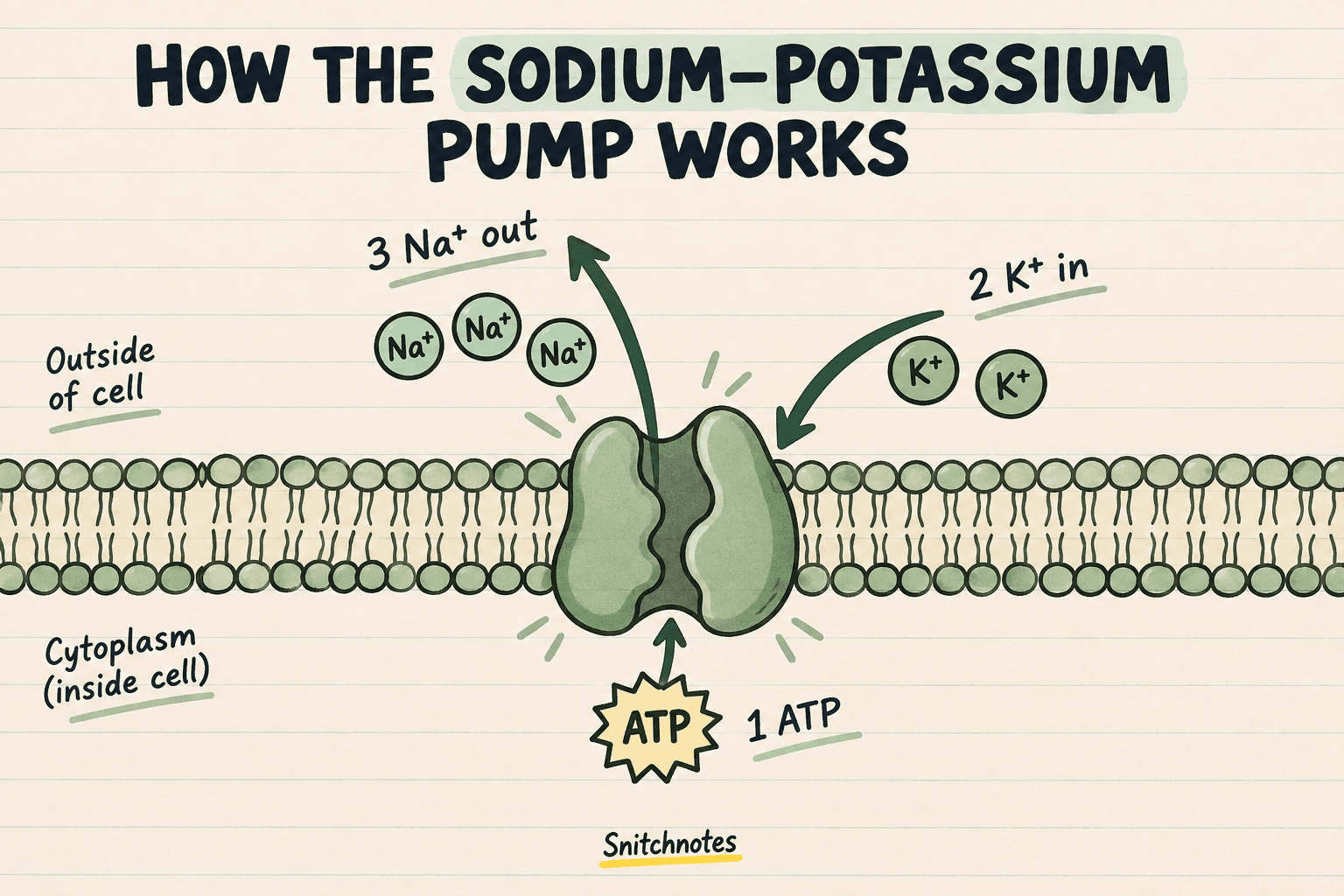
The sodium-potassium pump, or Na+/K+-ATPase, uses the energy from one ATP to move three sodium ions out of an animal cell and two potassium ions into it. It changes shape during the cycle so that its ion-binding sites face first the cytoplasm and then the extracellular fluid. Because both ions move against their electrochemical gradients, this is primary active transport.
That three-out, two-in exchange maintains the unequal ion concentrations needed for cell volume control, secondary transport, and electrical activity. The numbers are not a memory trick pasted onto the mechanism; they are the mechanism’s stoichiometry.
Why this pump matters
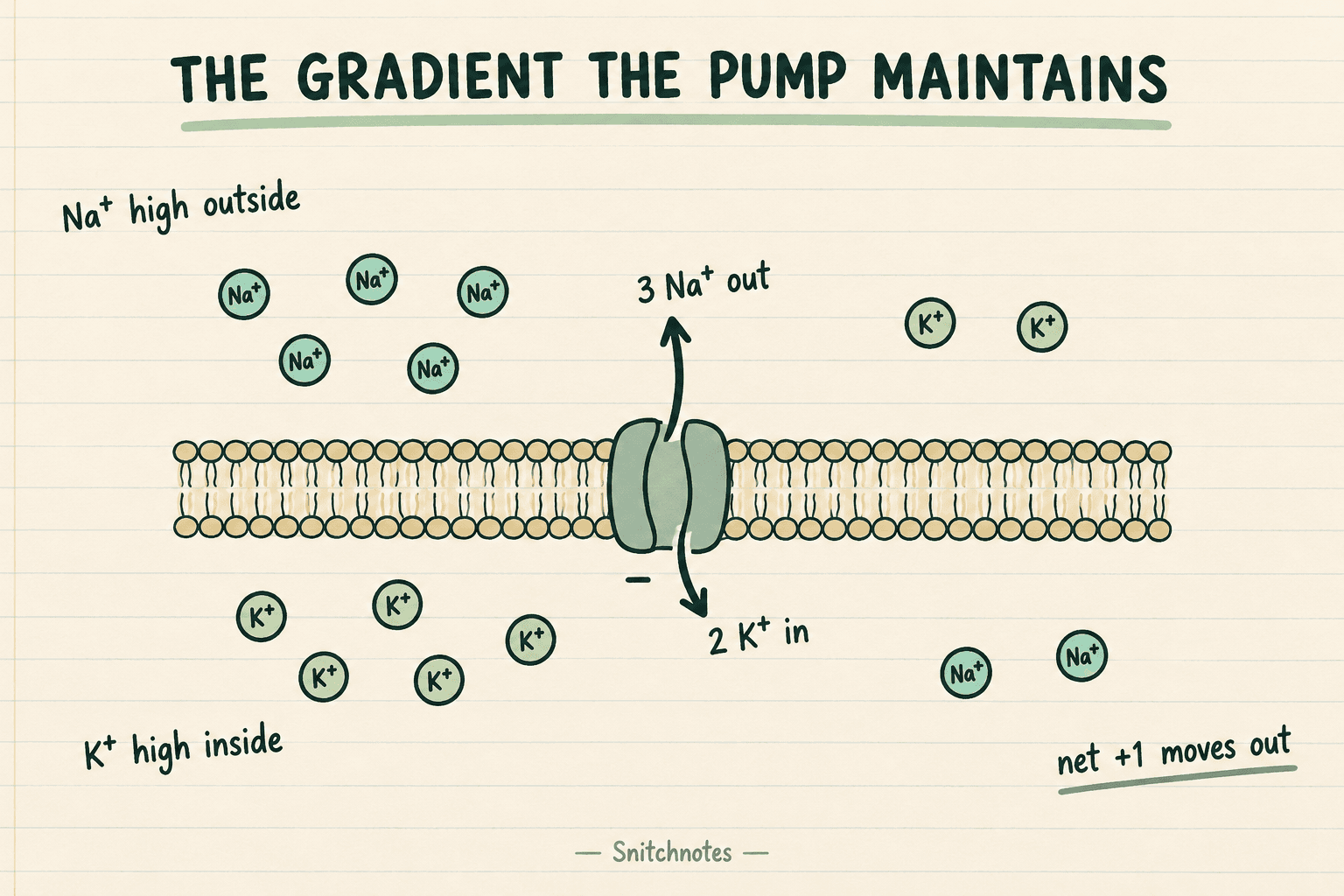
A cell membrane allows some ions to leak through channels. Without active transport, those leaks would gradually flatten the sodium and potassium gradients. The pump continually spends chemical energy to maintain the separation: sodium stays relatively concentrated outside the cell, while potassium stays relatively concentrated inside.
Those gradients store potential energy. When sodium later moves back down its gradient through another transporter, it can help bring glucose or amino acids into a cell. In excitable cells, the gradients also make rapid changes in membrane voltage possible.
The six-step cycle
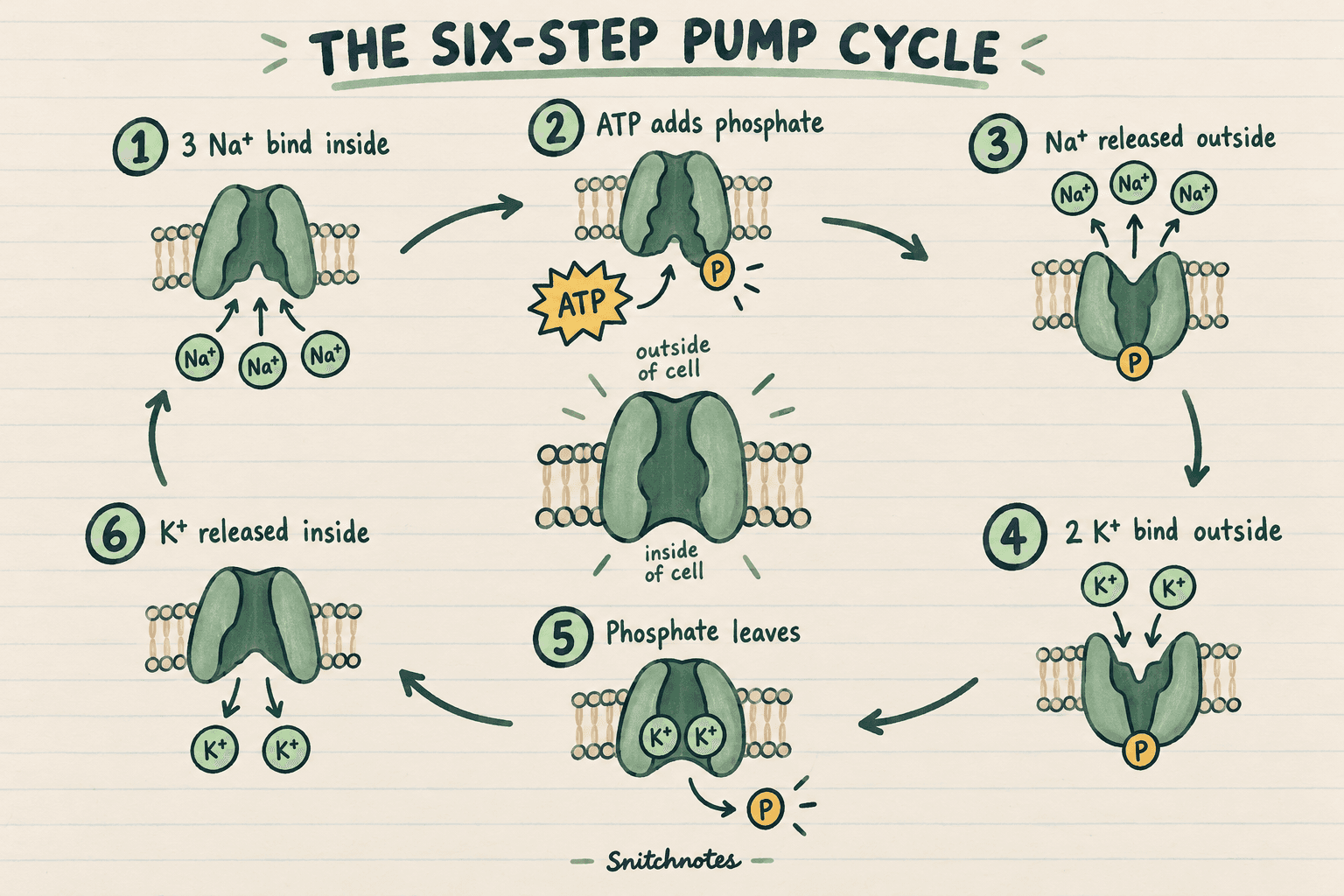
- Three Na+ ions bind to high-affinity sites exposed to the cytoplasm.
- ATP is hydrolyzed. ADP leaves, while a phosphate group becomes temporarily attached to the pump.
- Phosphorylation favors a new conformation. The pump closes toward the cytoplasm, opens toward the outside, loses affinity for Na+, and releases all three sodium ions.
- Two K+ ions bind from the extracellular side, where the outward-facing pump now has higher affinity for potassium.
- Potassium binding promotes removal of the phosphate group. The pump begins returning to its inward-facing conformation.
- The inward-facing pump has lower affinity for K+, so the two potassium ions are released into the cytoplasm. The binding sites are ready for three more Na+ ions.
Researchers often summarize these conformations as E1 and E2 states. E1 favors sodium binding from inside; E2 favors potassium binding from outside. The protein never opens a continuous pore across the membrane. It alternates access, exposing the binding sites to one side at a time.
How ATP changes the pump’s shape
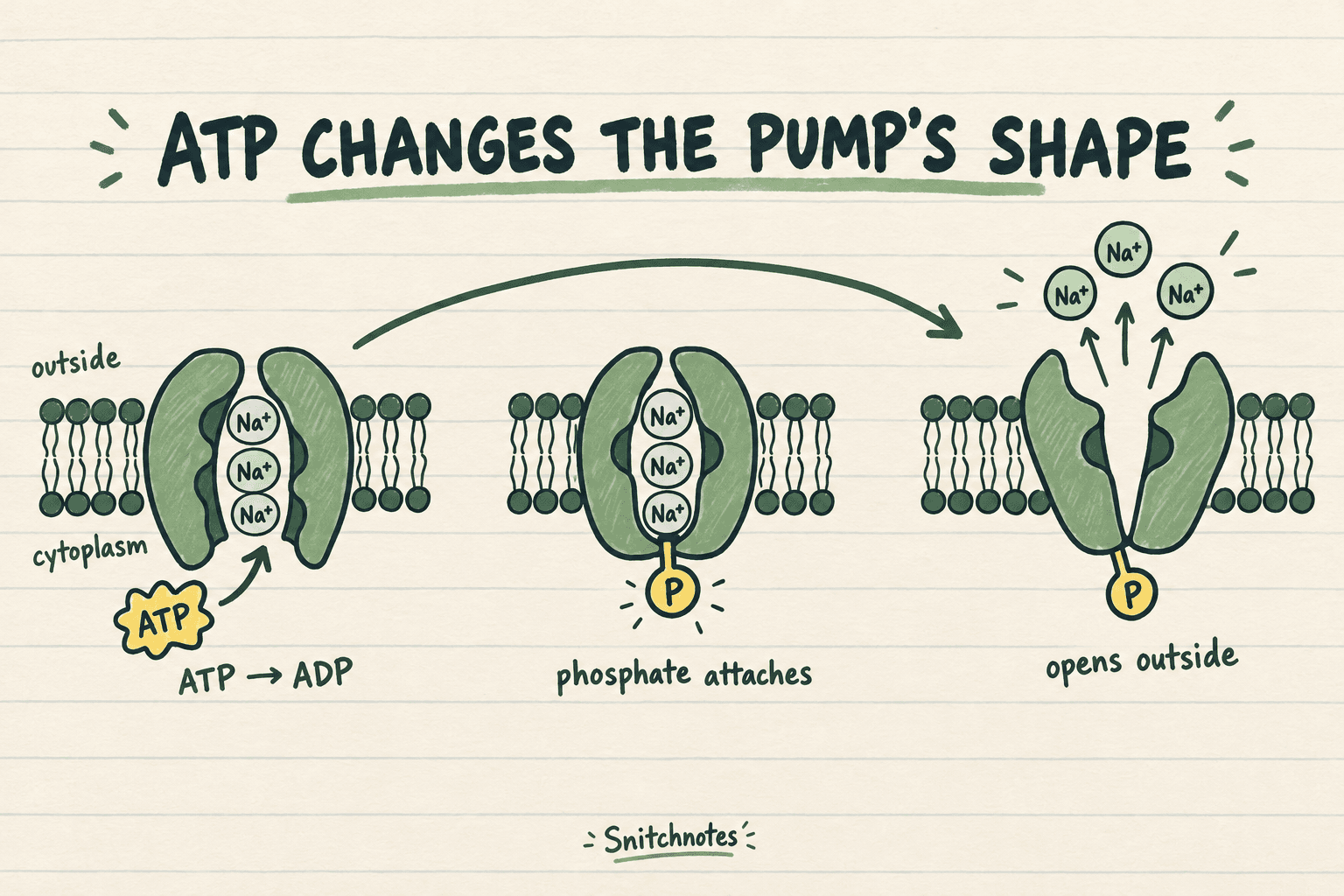
ATP does not shove ions through the membrane like a piston. Its terminal phosphate is transferred to a conserved site on the pump’s catalytic alpha subunit. That phosphorylation rearranges the protein’s cytoplasmic and membrane-spanning regions, changing which side can reach the ion-binding sites and which ions those sites prefer.
After extracellular K+ binds, dephosphorylation helps reverse the conformational change. This coupling is what makes the cycle directional: ion binding, phosphorylation, shape change, ion release, new ion binding, and dephosphorylation occur in an ordered sequence.
A concrete way to remember the exchange
Put three blue counters on the inside edge of a notebook and two green counters on the outside edge. Spend one pretend ATP token, move the three blue counters out, then bring the two green counters in. After ten cycles, the pump has moved 30 sodium ions out and 20 potassium ions in while using 10 ATP molecules.
The unequal count also means each cycle transfers one net positive charge outward. For that reason the pump is electrogenic. It contributes to the voltage across the membrane, although ion channels and other processes also shape the actual membrane potential.
What the gradient accomplishes
The pump does not create a motionless final state. It maintains a dynamic steady state while ions continue to cross through channels and transporters. Sodium’s inward electrochemical gradient can power secondary active transport, and potassium’s distribution strongly influences membrane voltage. The pump also helps regulate osmotic balance by preventing sodium from simply accumulating inside and drawing excessive water with it.
Why the pump matters in neurons
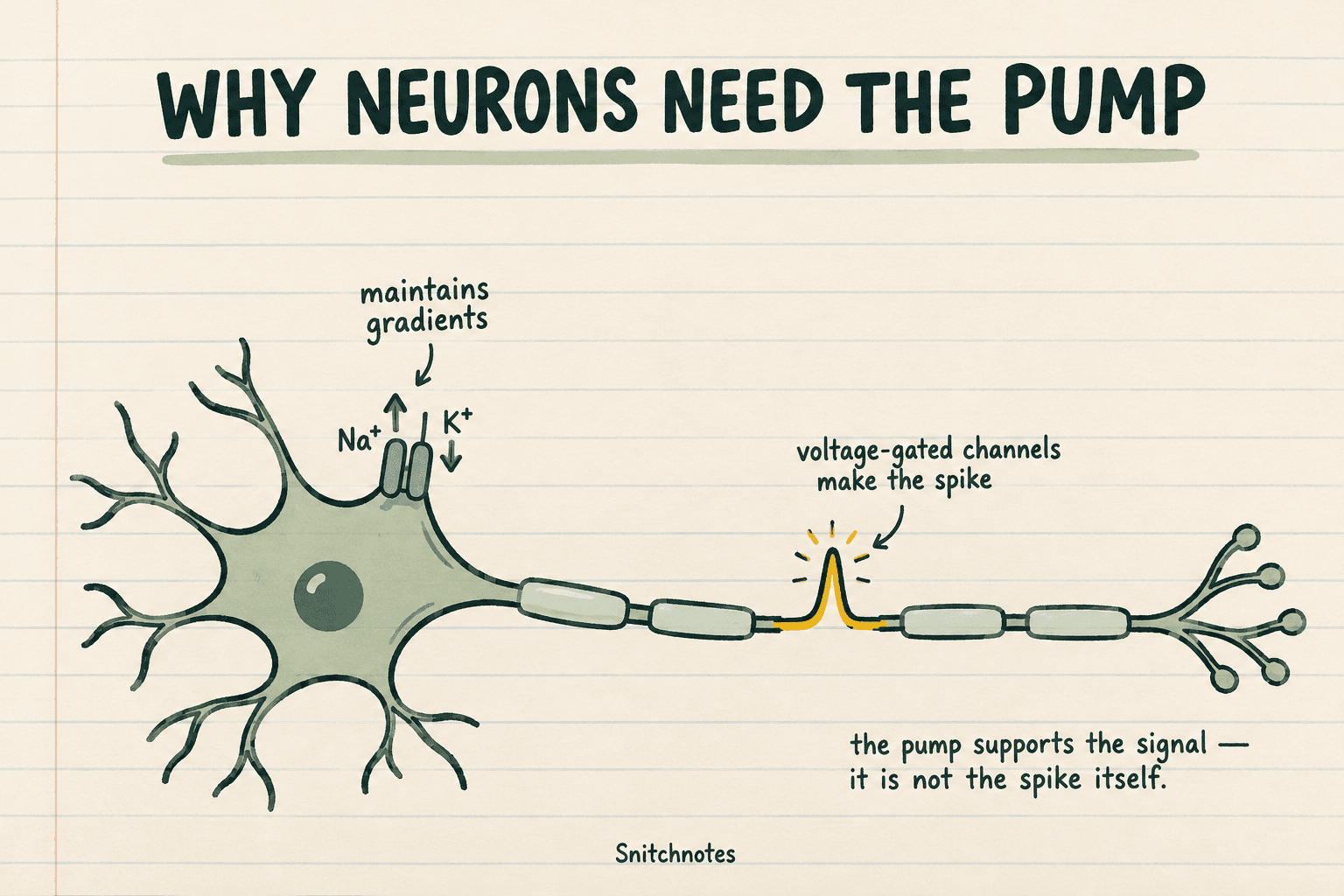
Neurons depend on steep sodium and potassium gradients, but the pump should not be confused with the action potential itself. During the rapid spike, voltage-gated sodium and potassium channels open and close on a much faster timescale. The pump maintains and gradually restores the long-term ion conditions that make repeated signaling possible.
Its three-for-two exchange also produces a small outward current that contributes directly to the cell’s electrical state. The clean distinction is this: channels generate the fast spike; the pump maintains the ion gradients and adds a slower electrogenic influence.
Common misconceptions
- The pump does not move sodium and potassium down their gradients. It spends ATP to move both against their electrochemical gradients.
- It is not an always-open channel. Alternating conformations prevent a free path through the membrane.
- One ATP powers one complete three-Na+-out, two-K+-in transport cycle, not one ATP per ion.
Check your understanding
What enters and leaves in one cycle?
Three Na+ leave the cell, two K+ enter it, and one ATP is hydrolyzed. The unequal exchange moves one net positive charge outward.
Why is this primary active transport?
The pump uses ATP directly to drive ions against their electrochemical gradients. Secondary active transport instead uses a gradient that another process, such as this pump, has already established.
Does the pump fire a neuron?
Not directly. Voltage-gated channels create the rapid action potential. The pump maintains the sodium and potassium gradients needed for continued electrical signaling.
If a membrane-transport diagram still feels like a blur of arrows, Snitchnotes can turn your lecture slides or biology notes into clearer study notes, flashcards, quizzes, and audio review.
Related concepts
- Electrochemical gradient: the combined concentration and electrical forces acting on an ion.
- Primary versus secondary active transport: direct ATP use versus transport powered by a stored ion gradient.
- Membrane potential and action potentials: electrical effects that depend on ion gradients and selective permeability.
- How to study biochemistry: a practical guide for learning connected molecular mechanisms.
Sources
National Center for Biotechnology Information: Physiology, Sodium Potassium Pump
講義をテスト対策バッチリの教材に。
ノート、クイズ、ポッドキャスト、フラッシュカード、チャット — アップロード1回で全部。
最初のノートを無料で試す