
Snitchnotes Team
Why Do Groups Make More Extreme Decisions?
Why Do Groups Make More Extreme Decisions?
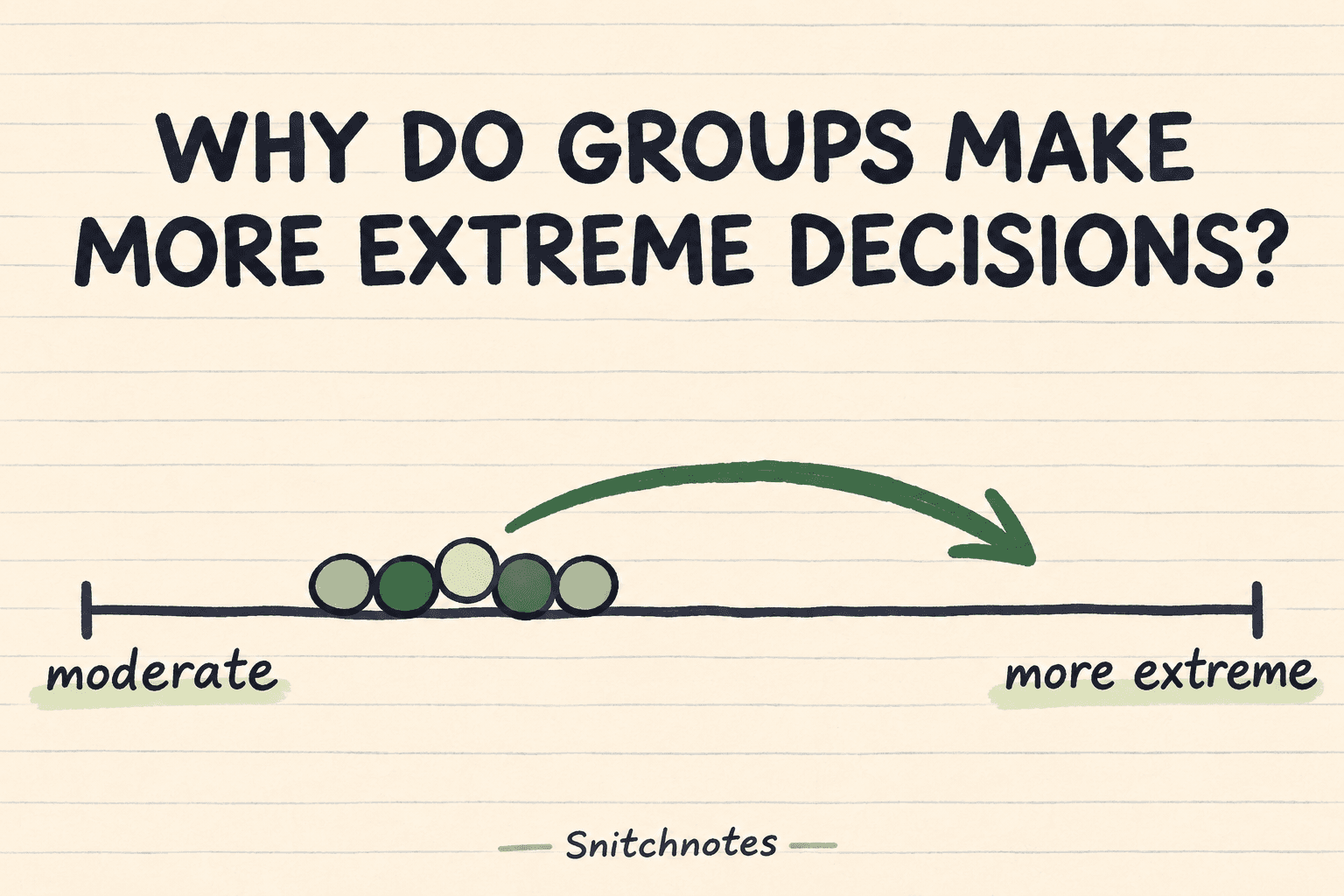
Groups can make more extreme decisions because discussion often strengthens the direction members already leaned. Psychologists call this group polarization. People hear additional arguments supporting the popular side, notice where others stand, and sometimes shift to match or slightly exceed what seems normal for the group. The result is not necessarily unanimity: the group's average position simply moves farther in its initial direction.
That is why a room of mildly cautious people can become very cautious, while a room of mildly risk-friendly people can become bolder. The mechanism matters in student clubs, juries, committees, teams, investment groups, and online communities—anywhere discussion is expected to improve a decision but can instead amplify its starting tilt.
What group polarization means
Group polarization is a change from members' positions before discussion toward a more extreme version of the group's average pre-discussion preference. Direction is the crucial detail. If members initially favor taking a risk, discussion may make them more risk-seeking. If they initially favor caution, discussion may make them more cautious. Early research focused on a risky shift, but later work showed that groups do not always move toward risk.
Polarization describes a shift, not whether the final choice is wise, harmful, or factually wrong. A group can move more strongly toward a sensible position after exchanging good evidence. The term also does not mean every person ends at the same point. Researchers can observe polarization when individual positions still differ but the average moves outward.
A five-member club example
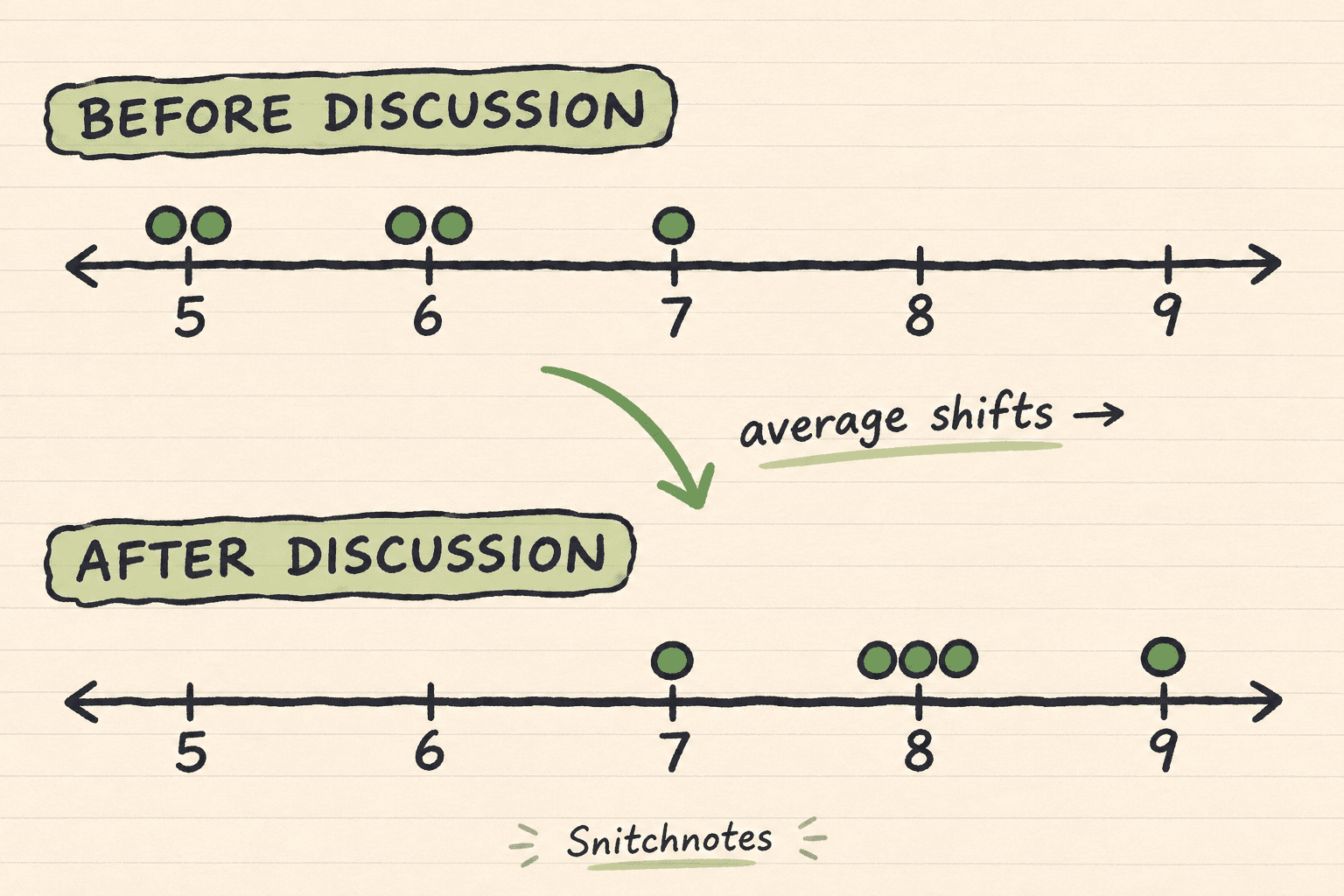
Imagine five club members deciding whether to spend most of their annual budget on an ambitious outdoor event. On a risk scale from 1 to 10, their private ratings are 5, 5, 6, 6, and 7. The average is 5.8: a modest lean toward taking the risk, not a room full of daredevils.
During discussion, members hear benefits they had not considered: early booking could reduce costs, the event might attract new members, and a sponsor may cover one expense. They also hear enthusiastic peers speak as if a score of 7 is merely reasonable. Afterward, the ratings are 7, 8, 8, 8, and 9, for an average of 8.0. This is a teaching example, not a prediction that real groups always shift by 2.2 points. It shows how the average can become more extreme even though members still disagree.
Why discussion can push the group farther
Persuasive arguments add weight to the popular side
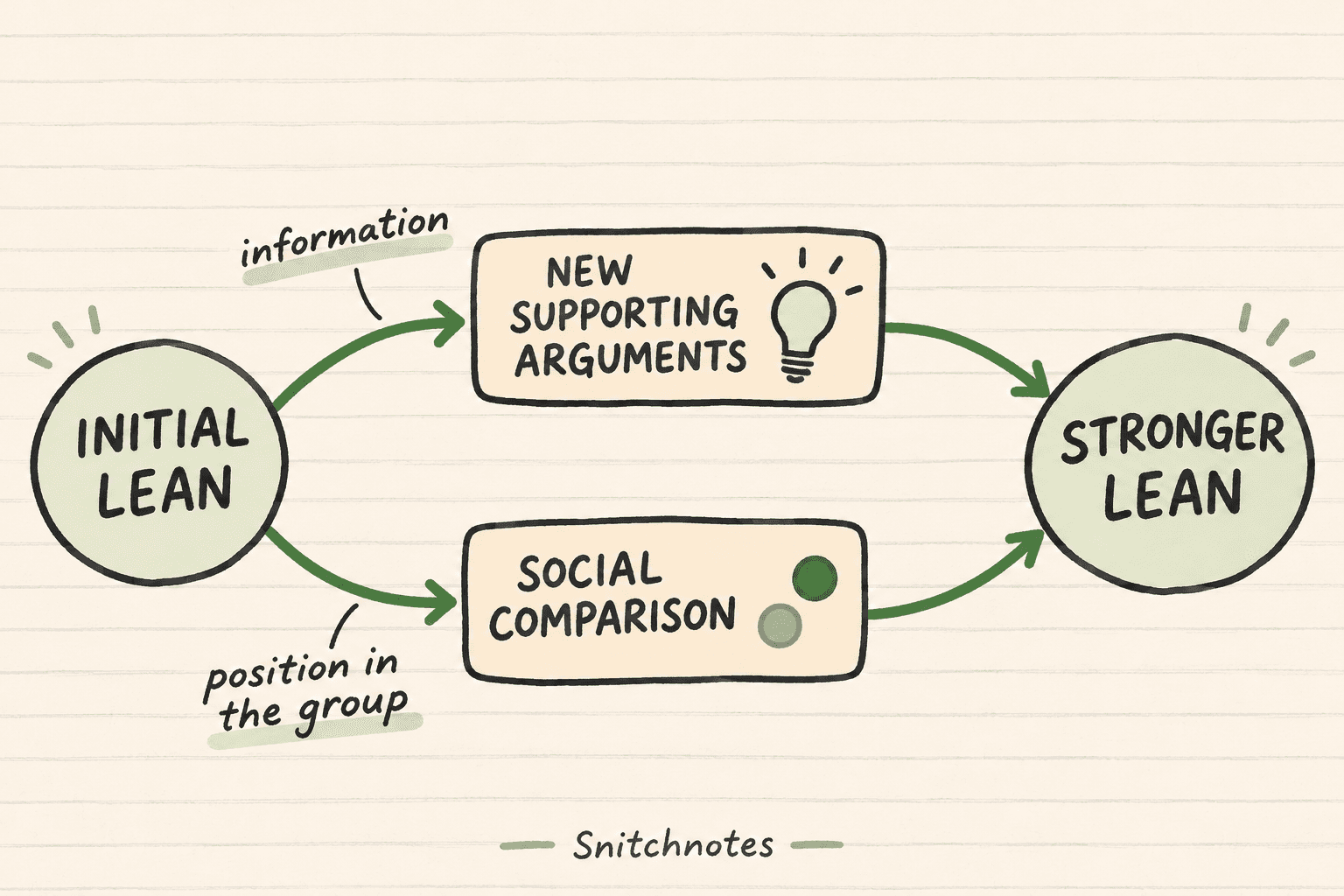
Before a meeting, each person knows only part of the case. If most members already lean one way, the discussion is likely to contain more arguments supporting that direction. Some will be new to particular listeners. Hearing several distinct, credible reasons can make the favored option seem better supported than it did privately. This is the core of persuasive arguments theory.
Social comparison changes what feels normal
People also use other members' positions as information about the group norm. Someone who thought a score of 6 showed enthusiasm may discover that respected peers chose 7 or 8. If supporting the event is valued, that person may move outward to remain aligned with the group or to express the valued attitude clearly. Experiments and later reviews find evidence for both persuasive argumentation and social comparison, rather than one universal cause.
A 2019 series of experiments adds an important refinement: which pathway matters more can depend on people's ability and motivation to process information. Brief information about others' positions had more influence under lower processing effort, while the quality of arguments mattered more when people could and wanted to examine them.
When polarization is less likely
Group discussion does not contain a built-in extremity switch. Polarization is less likely when members begin with no clear shared lean, when the conversation introduces strong arguments on both sides, or when people revise their views privately rather than performing a position for the room. A group can also depolarize if credible new information challenges its initial preference.
The quality of the discussion therefore matters. A like-minded group that repeats supporting reasons creates different conditions from a diverse group that tests assumptions and gives minority evidence a fair hearing. The useful question is not simply whether people talked, but what information and social signals the discussion made available.
Group polarization is not groupthink
Group polarization and groupthink can appear together, but they describe different things. Polarization is movement toward a more extreme version of an initial tendency. Groupthink concerns defective decision processes in a highly cohesive group, such as suppressing doubts, failing to examine alternatives, and prioritizing agreement. A debate can be lively and still polarize; a group can also show groupthink without making a more extreme choice.
How to make a group decision less vulnerable
Start by recording private judgments before discussion. That preserves the baseline and prevents the first confident speaker from becoming the unofficial scale. Then ask members to list evidence that would favor the opposite choice, invite someone with relevant contrary knowledge, and separate idea generation from the final vote.
For the club, that could mean writing down risk scores first, calculating the initial average, and assigning one pair to test the sponsor and weather assumptions. After the evidence is reviewed, members rate the plan privately again. The goal is not to freeze everyone at the starting point. It is to make any movement traceable to better information rather than momentum alone.
Check your understanding
If a cautious group becomes more cautious, is that polarization?
Yes. Polarization follows the group's initial direction; it does not always mean becoming riskier.
Does every member have to adopt the same opinion?
No. The members can remain spread across several positions while the group's average shifts toward an extreme.
What are the two main pathways in this explanation?
Persuasive arguments add new supporting reasons, while social comparison changes what position seems normal or valued within the group.
If social-psychology mechanisms blur together in your lecture notes, Snitchnotes can turn your slides, PDFs, and notes into clearer study notes, flashcards, quizzes, and audio for review.
Related concepts
- Informational influence: changing a judgment because other people provide evidence or arguments that seem valid.
- Normative influence: adjusting a position partly in response to what seems accepted or valued by a group.
- Cognitive dissonance explained with a real-life example: how tension between beliefs and actions can motivate attitude change.
- Why memories change during recall: how retrieving a memory can make it open to updating.
Sources
講義をテスト対策バッチリの教材に。
ノート、クイズ、ポッドキャスト、フラッシュカード、チャット — アップロード1回で全部。
最初のノートを無料で試す