
Snitchnotes Team
Why Does Ice Float on Water?
Why Does Ice Float on Water?
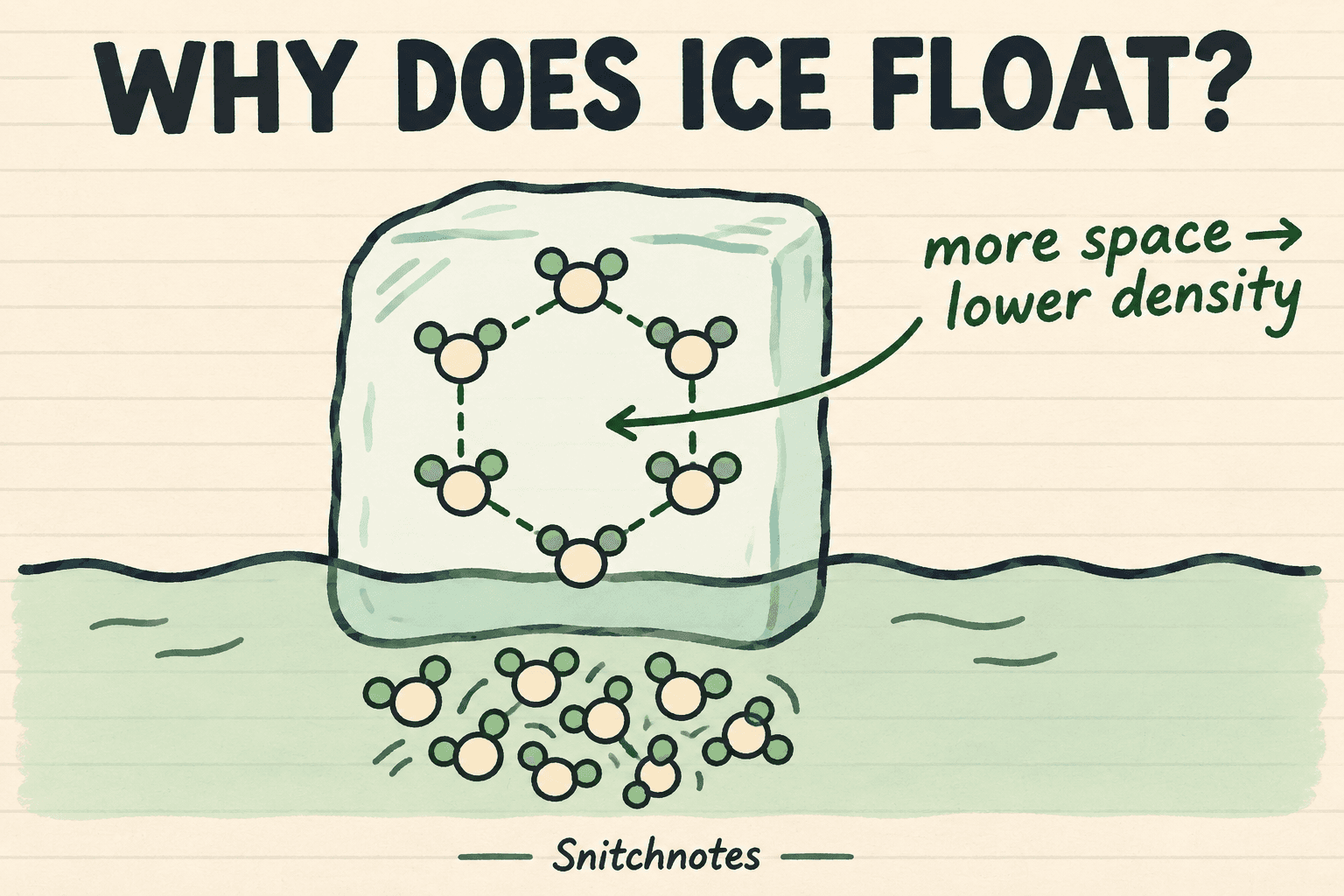
Ice floats on water because ordinary ice is less dense than liquid water. Hydrogen bonds lock water molecules into a spacious crystal lattice when water freezes. The same mass therefore occupies more volume as ice, so a piece of ice displaces its own weight of water before it becomes fully submerged. Buoyancy then balances its weight and leaves part of the ice above the surface.
This is unusual. Most substances pack more tightly when they solidify, making the solid denser than the liquid. Water reverses that pattern near its freezing point. If you want to understand why an ice cube, lake ice, or an iceberg stays up, the key chain is: molecular polarity → hydrogen bonding → open crystal structure → lower density → floating.
The mechanism in one minute
- A water molecule is polar: its oxygen side is slightly negative and its hydrogen sides are slightly positive.
- Opposite partial charges attract, producing hydrogen bonds between neighboring water molecules.
- In liquid water, molecules move and hydrogen bonds continually form and break, allowing molecules to fit relatively close together.
- When water freezes into ordinary hexagonal ice, hydrogen bonds organize molecules into an open lattice with more empty space.
- More volume for the same mass means lower density. Because ice is less dense than the surrounding liquid, it floats.
The U.S. Geological Survey reports that freezing lowers ice's density by about 9 percent. That small-looking difference is enough to determine whether the solid sinks or stays at the surface.
How hydrogen bonds make ice less dense
Water is H₂O, but its atoms do not share electrons evenly. Oxygen attracts the shared electrons more strongly, so the oxygen end carries a partial negative charge while the hydrogen ends carry partial positive charges. A hydrogen on one molecule is attracted to the oxygen on another. That intermolecular attraction is a hydrogen bond.
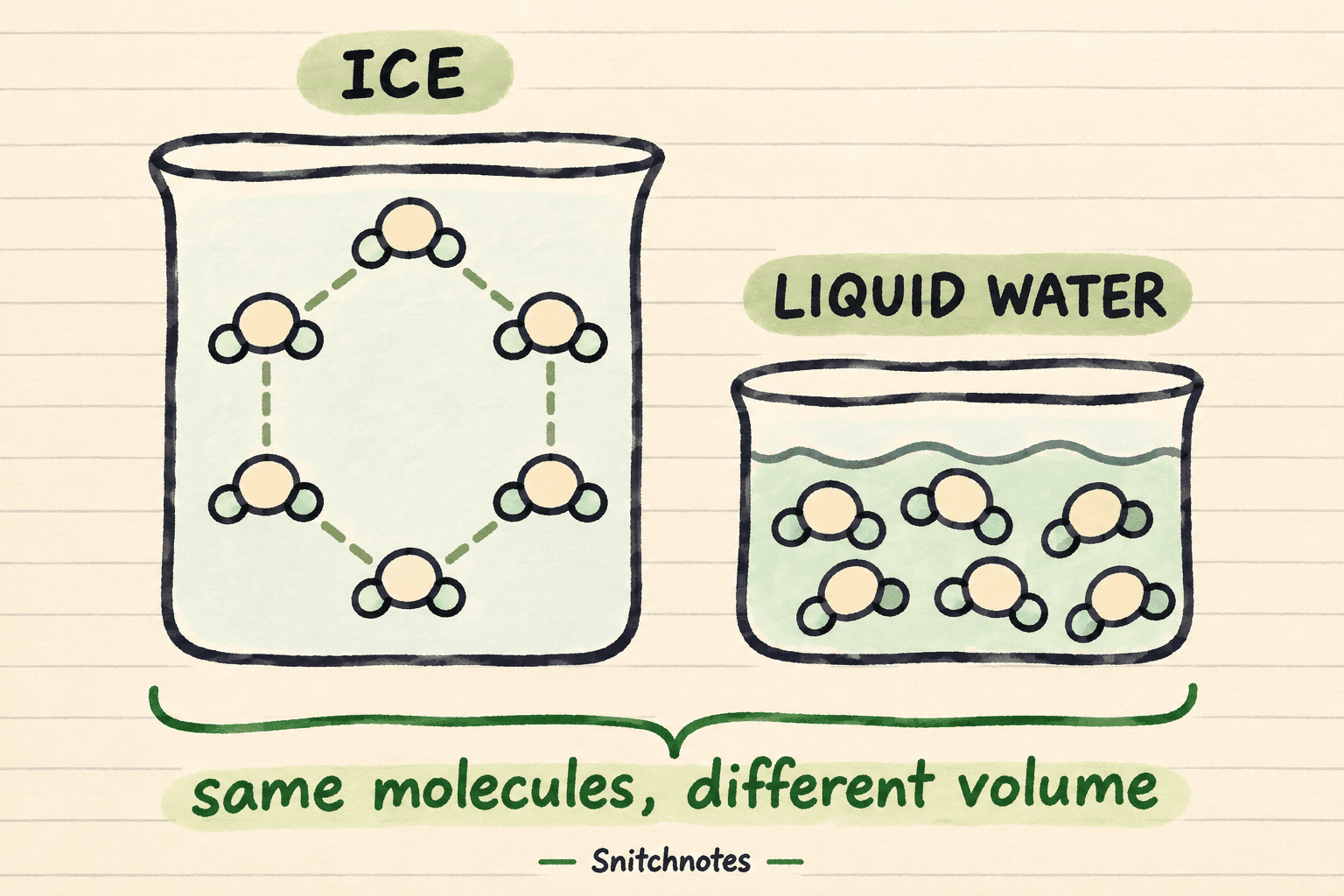
Liquid water has plenty of hydrogen bonds; freezing does not suddenly invent them. The difference is organization. In the liquid, thermal motion constantly rearranges the network, and molecules can slip into some of its gaps. In common ice Ih, the bonds favor a more orderly, roughly tetrahedral network containing open hexagonal rings. The molecules are held farther apart on average than they are in the liquid.
Picture six desks arranged around the edge of an empty study circle. The arrangement is stable and tidy, but it uses more floor space than the same desks pushed into a loose cluster. Ice's lattice works similarly: the open spaces are part of the structure, not air bubbles that make the ice hollow.
How lower density becomes floating
Density is mass divided by volume. Near 0°C, pure liquid water has a density close to 1.000 gram per cubic centimeter, while ordinary ice is about 0.917 gram per cubic centimeter. Put equal-sized pieces of each on a scale and the ice contains less mass. Compare equal masses instead and the ice takes up more space.
Floating itself is a buoyancy problem. As an ice cube enters water, it pushes water aside. The displaced water exerts an upward buoyant force. The cube settles at the depth where that upward force equals the cube's weight. Because the cube is less dense than water, this balance occurs before the whole cube goes under.
A useful rule for a floating object is that the submerged fraction is approximately the object's density divided by the fluid's density. The lower the object's density relative to the fluid, the less of it needs to sit below the surface.
A 100-gram ice cube: the numbers
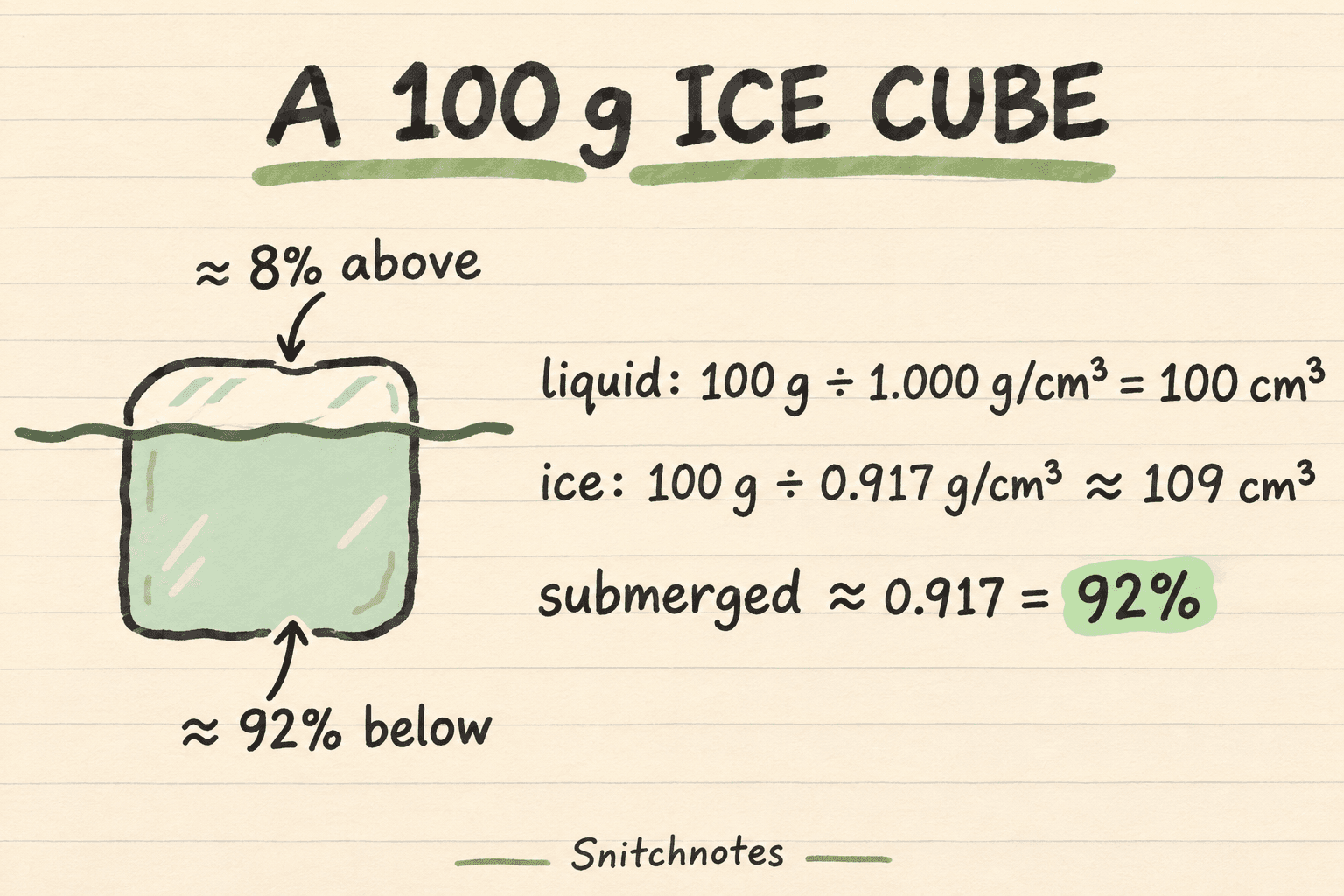
Take 100 grams of pure liquid water and 100 grams of ordinary ice. Using the rounded liquid-water density of 1.000 g/cm³, the liquid occupies 100 ÷ 1.000 = 100 cm³. Using 0.917 g/cm³ for ice, the solid occupies 100 ÷ 0.917 ≈ 109 cm³. The mass is identical, but freezing adds about 9 cm³ of volume in this simplified comparison.
Now place that ice in fresh water. The submerged fraction is approximately 0.917 ÷ 1.000 = 0.917, or about 92 percent. Roughly 8 percent remains above the surface. Real cubes vary with temperature, trapped air, cracks, dissolved substances, and water density, so 92 percent is a useful prediction rather than a promise about every freezer tray.
The common misconception: it is not surface tension
Surface tension can support a carefully placed needle or a water strider because the surface bends without breaking. That is not the main reason a normal ice cube floats. An ice cube can bob, tilt, or be pushed below the surface and still rise because buoyancy depends on displaced water and the density difference throughout the fluid.
It is also incomplete to say that ice floats because it is “lighter.” A large ice block can be much heavier than a glass of water. The meaningful comparison is density—mass per unit volume—not total mass. A huge low-density object can float while a tiny high-density object sinks.
Why floating ice matters
Fresh water reaches its maximum density near 4°C. As a lake cools, denser water sinks until the surface layer becomes colder and less dense. Ice then forms at the top and floats. That surface layer slows heat transfer between the water below and the cold air above, helping a lake remain liquid beneath the ice instead of freezing solid from the bottom upward.
The same mechanism shapes sea ice and icebergs, although salt changes seawater's density and freezing point. The National Oceanic and Atmospheric Administration notes that salt is mostly excluded from the growing ice crystal, leaving denser brine below. The chemistry of one small hydrogen bond therefore scales up into lake habitats, polar oceans, and the visible tip of an iceberg.
Check your understanding
Why does freezing make water less dense?
Hydrogen bonds organize water molecules into an open crystal lattice. The same mass occupies more volume, so its mass per unit volume—its density—decreases.
Why is most of an ice cube underwater?
Ice is only about 8 to 9 percent less dense than liquid water. It must displace nearly its own volume of water before the buoyant force matches its weight, leaving about 92 percent submerged.
Does liquid water have hydrogen bonds?
Yes. Liquid water has a shifting hydrogen-bond network. Ice differs because the network becomes an ordered, open lattice that holds molecules farther apart on average.
If molecular structures get lost in a page of lecture notes, Snitchnotes can turn your own slides, PDFs, and readings into organized notes, flashcards, and quizzes for review.
Related concepts
- Why metal feels colder than wood: temperature can stay the same while heat transfer changes what you feel.
- Ionic vs covalent bonds: compare the intramolecular bonds inside substances before studying weaker attractions between molecules.
- Hydrogen bonding: an intermolecular attraction that helps explain water's boiling point, surface tension, heat capacity, and unusual density behavior.
Sources
U.S. Geological Survey: Water Density
Zamień wykłady w materiały gotowe na egzamin.
Notatki, quizy, podcasty, fiszki i czat — z jednego uploadu.
Stwórz pierwszą notatkę za darmo