
Snitchnotes Team
How Do Recommendation Algorithms Create Feedback Loops?
How Do Recommendation Algorithms Create Feedback Loops?
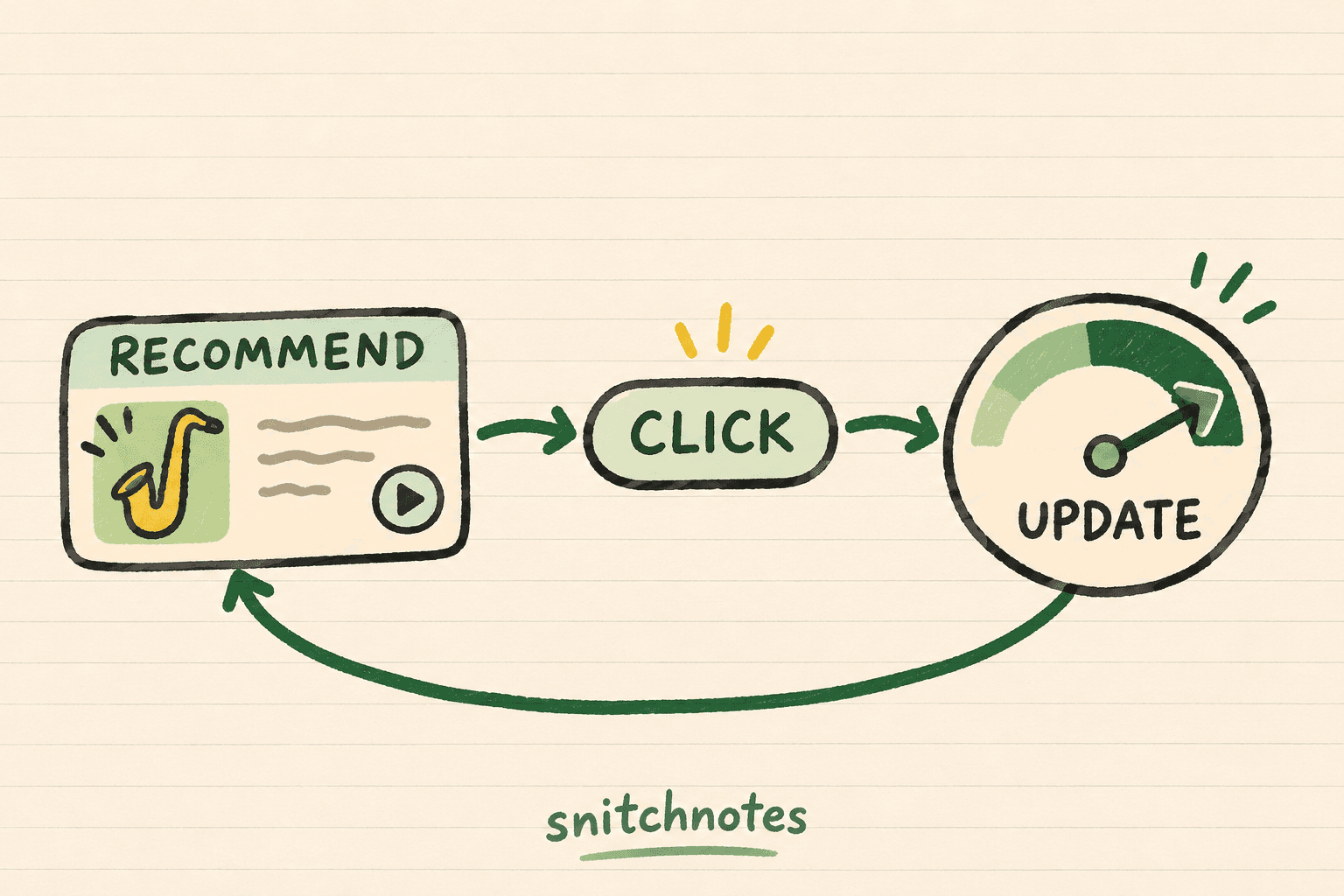
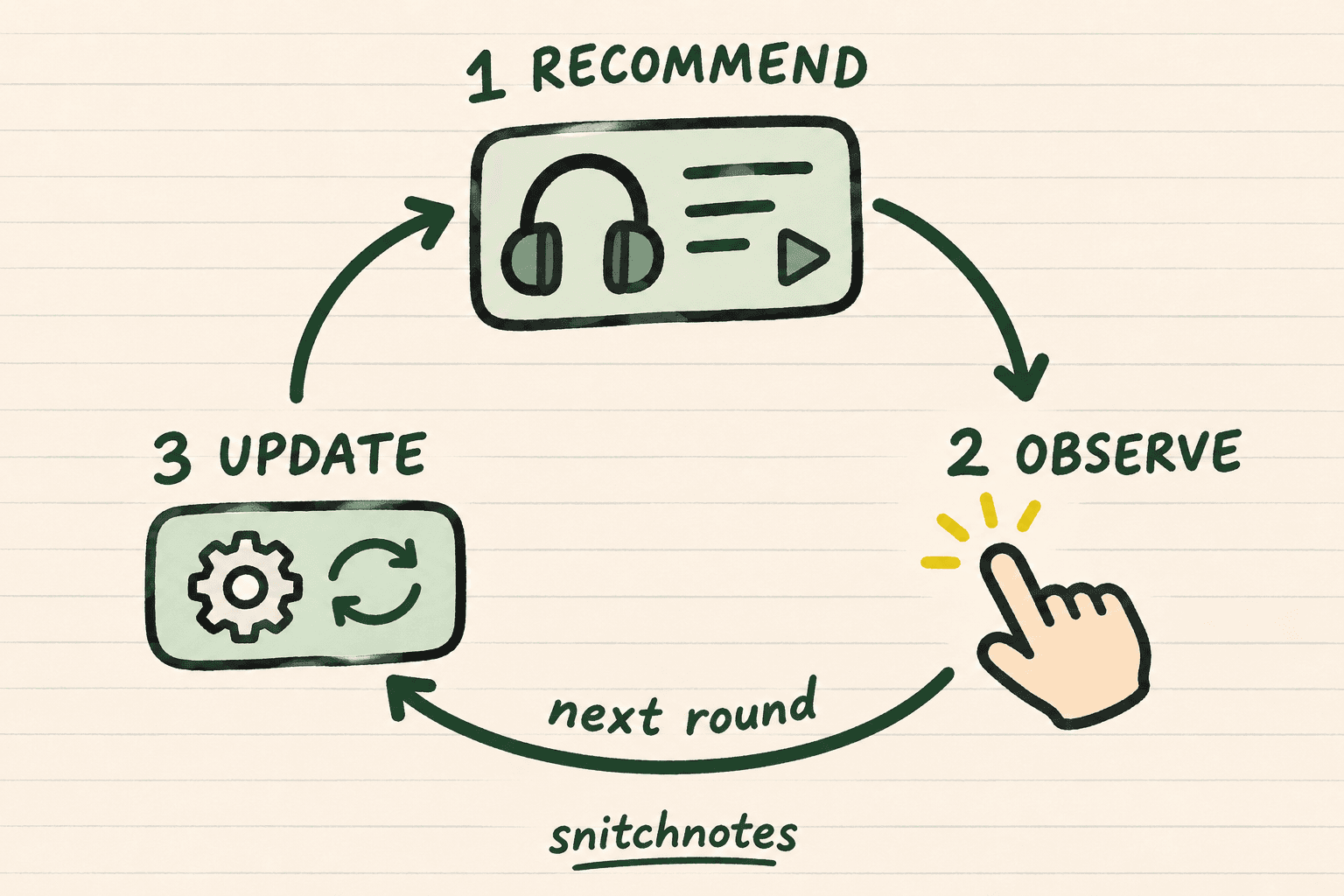
Recommendation algorithms create feedback loops when they use people's responses to earlier recommendations as evidence for what to show next. The system recommends an item, observes a click, play, skip, purchase, or watch-time signal, updates its estimate of what the person may want, and then makes another recommendation. Because the system helped choose what the person could respond to, its output becomes part of its next input.
That loop can make a feed more useful, but it can also become self-reinforcing. If one jazz click produces more jazz exposure, there are now more chances to click jazz again and fewer chances to reveal an interest in classical music. This explanation is for anyone who wants the mechanism without assuming that every personalized feed inevitably becomes a filter bubble.
How the recommend-observe-update cycle works
- Recommend: the system selects and ranks a small set of items from a much larger catalog. Real systems may separate this work into multiple stages, such as first gathering plausible candidates and then ranking a much smaller set for display.
- Observe: the platform records available signals, such as whether an item was clicked, played, skipped, saved, or watched for a certain duration. These are behavioral traces, not a direct reading of someone's preferences.
- Update: the system uses new interaction data to retrain a model, adjust a user representation, or update a score. The next ranked list can therefore differ from the previous one.
Then the cycle repeats. The important detail is that the observation is conditional on exposure: a person cannot click a song that was never shown. A click therefore means “chosen from this displayed set,” not necessarily “the person's favorite item in the whole catalog.”
Why the loop can narrow future recommendations
Suppose the model gives jazz a slightly higher score than three other genres. If the system mostly shows its highest-scoring items, jazz receives more screen space. More exposure creates more opportunities for jazz interactions, and those interactions can raise the score again. Meanwhile, the system collects little evidence about the genres it rarely displays. This is sometimes called exposure or presentation bias.
The resulting data are not a neutral sample of everything the user might have selected. They are partly produced by earlier rankings. Allison J. B. Chaney, Brandon M. Stewart, and Barbara E. Engelhardt used simulations to study this algorithmic confounding and found that repeated retraining on recommendation-shaped data could homogenize behavior without improving user utility in their model. That is a demonstrated risk under particular assumptions, not a law that every recommender must follow.
A five-round music example
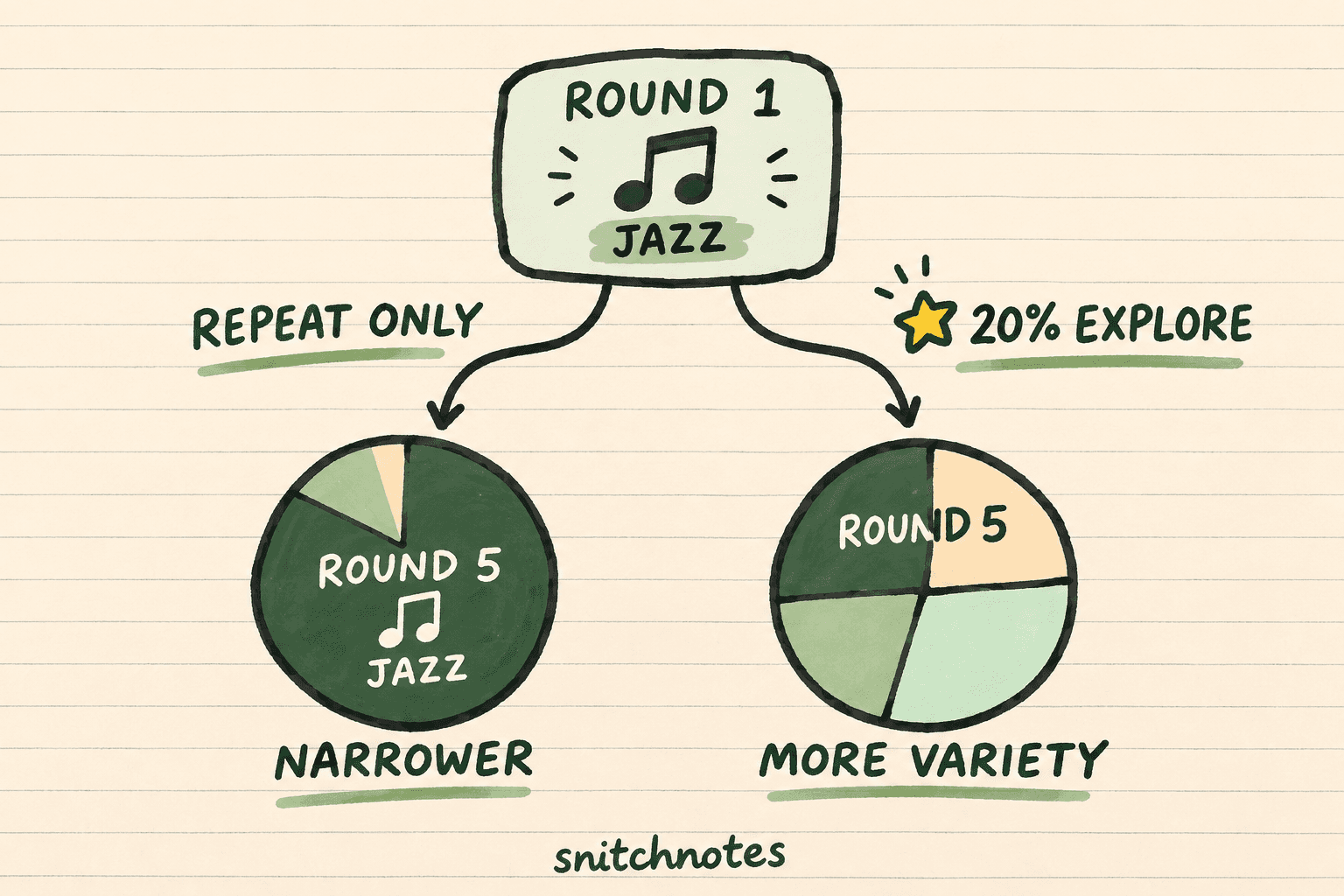
Consider a deliberately simple music account with 10 recommendation slots per round. At the start, it has no listening history, so round 1 contains a broad mix. The listener clicks one jazz track. We will compare two toy policies over five rounds while keeping the arithmetic easy to see. These numbers illustrate a mechanism; they are not measurements from Spotify, YouTube, or another real platform.
Path A: repeat only the highest-scoring genre
After the first jazz click, this policy fills more slots with whichever genre currently scores highest. Jazz occupies 4 of 10 slots in round 2, then 6, 8, and 9 slots in rounds 3, 4, and 5. If the listener keeps choosing one of the plentiful jazz options, each round supplies evidence that appears to confirm the previous ranking. By round 5, only one slot remains for every other genre combined.
Path B: reserve 20% of slots for exploration
This policy uses 8 of 10 slots for its best current predictions and reserves 2 slots for genres that are not currently on top. Jazz still grows after the click, but alternatives remain visible in every round. Imagine the listener discovers and plays a classical track in round 3. The model now receives evidence it could never have collected in the repeat-only path, so round 5 might contain 6 jazz slots, 2 classical slots, 1 pop slot, and 1 electronic slot.
Exploration does not guarantee a perfectly diverse feed, and 20% is not a universal ideal. It simply buys information by occasionally showing uncertain options. Spotify Engineering describes a related production trade-off between exploitation—using previous selections—and exploration—learning from uncertain recommendations. Different systems balance relevance, novelty, safety, business goals, and user control in different ways.
Why feedback loops matter
- Learning quality: treating displayed-item clicks as if they were unbiased preference data can teach the model from evidence it helped create.
- Discovery: repeatedly exploiting known interests can reduce opportunities to discover a new genre, creator, product, or viewpoint.
- Provider exposure: early ranking advantages can give already visible items more interactions, which may help them remain visible.
- Evaluation: a short-term rise in clicks may not reveal whether the feed became repetitive or whether long-term satisfaction improved.
Designers can interrupt or measure these effects with randomized exploration, diversity-aware ranking, explicit preference controls, causal or counterfactual evaluation, and metrics that look beyond immediate engagement. Karl Krauth's University of California, Berkeley dissertation examines recommender evaluation under distribution shifts and feedback loops, underscoring why a model cannot be judged only as if its data stayed fixed. Each method has trade-offs: exploration can show less relevant items, while stronger diversification can reduce the accuracy of the next-click prediction.
Feedback loop does not automatically mean filter bubble
A feedback loop is the mechanism: recommendations affect behavior, and behavior affects later recommendations. A filter bubble is a stronger outcome claim about restricted exposure. The two should not be treated as synonyms. A theoretical analysis by Ray Jiang and colleagues separates limited selection by the system from changes in a user's interests, and notes that empirical studies have reported conflicting results.
User choice, social connections, search, subscriptions, multiple devices, and deliberate exploration can all change the path. A systematic review led by Qazi Mohammad Areeb found evidence of filter bubbles and several contributing biases, while also emphasizing mitigation through diversity and user control. The careful conclusion is conditional: feedback loops can narrow exposure, especially when the system repeatedly exploits recommendation-shaped data, but the outcome depends on the algorithm, interface, content, user behavior, and time horizon.
Check your understanding
Why is a click not a pure measure of preference?
Because the user chooses from items the system exposed. The click reveals something about that displayed set, but it does not tell us what the user would have chosen from every item that was hidden.
How can exploration weaken a narrowing loop?
By showing some uncertain or underrepresented items, exploration creates opportunities to collect evidence outside the current top prediction. That evidence may confirm the existing preference or reveal another one.
Does every recommendation feedback loop create a filter bubble?
No. The loop is present whenever outputs influence later training signals. Whether exposure actually narrows depends on the recommendation policy, user behavior, diversity mechanisms, available content, and how the effect is measured over time.
If machine-learning mechanisms become a blur in long lecture notes, Snitchnotes can turn your own slides, PDFs, and readings into organized notes, flashcards, and quizzes for review.
Related concepts
- Exploration versus exploitation: choosing between the best-known option and gathering information about uncertain alternatives.
- Selection bias: data can be systematically shaped by which people or items had a chance to be observed.
- Error correction in QR codes: another technology case where the visible output depends on how a system handles incomplete signals.
- Public-key encryption: a simple example of how inputs, transformations, and outputs fit together in a technical system.
Sources
Jiang et al.: Degenerate Feedback Loops in Recommender Systems
Krauth: The Dynamics of Recommender Systems
Spotify Engineering: For Your Ears Only—Personalizing Spotify Home with Machine Learning
Areeb et al.: Filter Bubbles in Recommender Systems—Fact or Fallacy? A Systematic Review
講義をテスト対策バッチリの教材に。
ノート、クイズ、ポッドキャスト、フラッシュカード、チャット — アップロード1回で全部。
最初のノートを無料で試す