
Snitchnotes Team
SN1 vs SN2 Reactions: Differences and Worked Examples
SN1 vs SN2 Reactions: Differences and Worked Examples
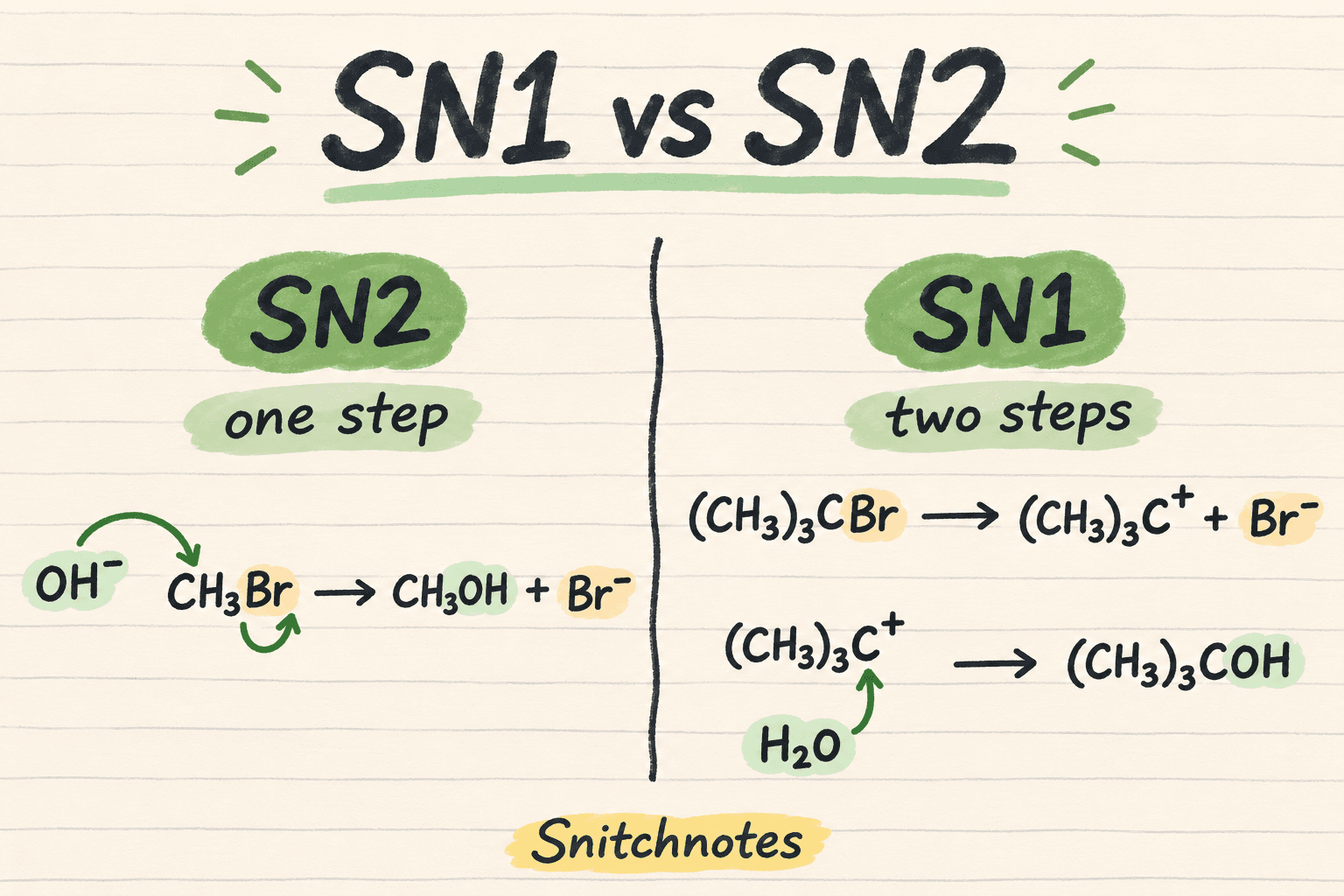
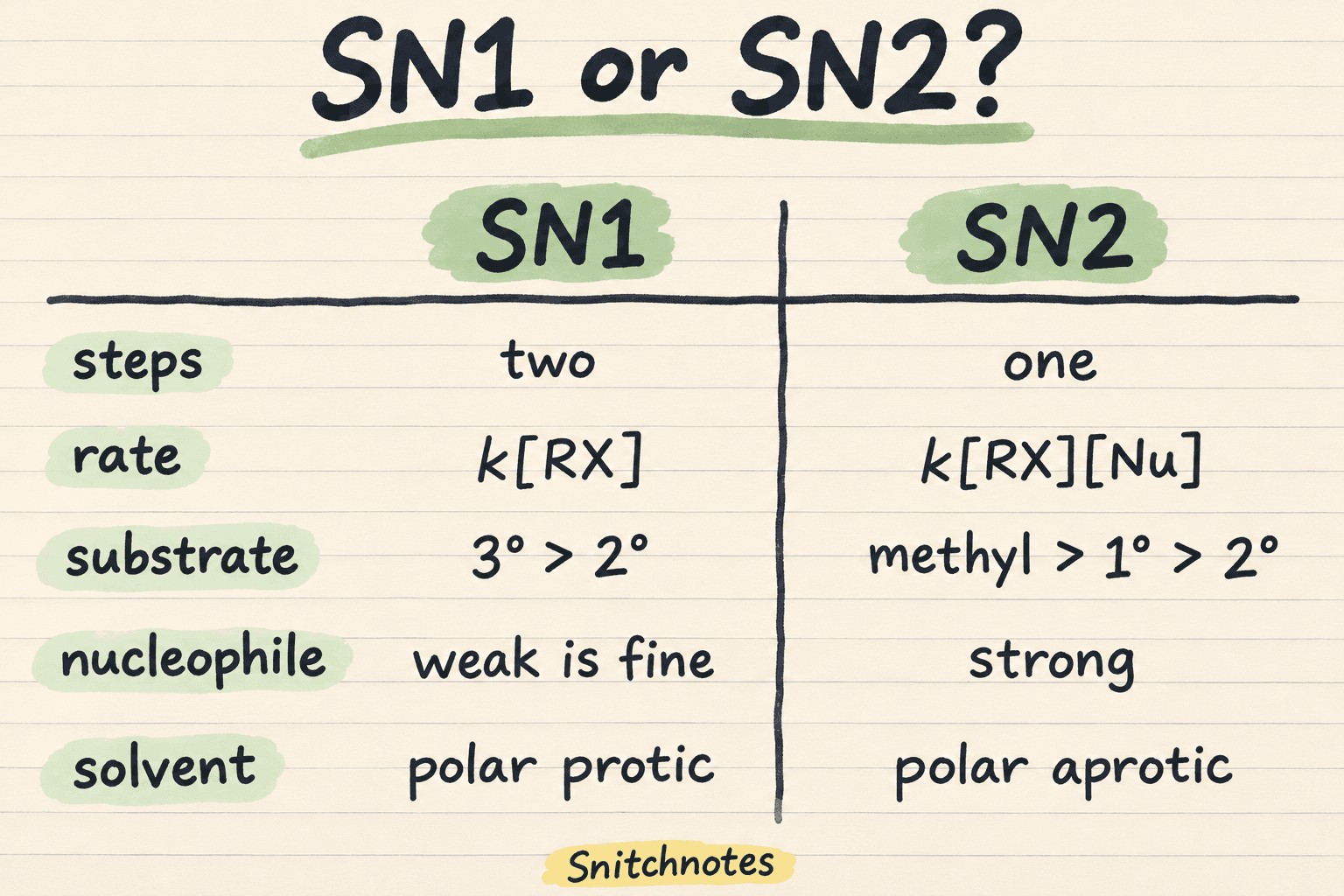
SN1 and SN2 are nucleophilic substitution mechanisms, but they replace a leaving group in different ways. SN1 is a stepwise, first-order pathway that forms a carbocation; SN2 is a one-step, second-order pathway in which the nucleophile attacks as the leaving group departs. Tertiary substrates, weak nucleophiles, and polar protic solvents tend to support SN1. Methyl or primary substrates, strong nucleophiles, and polar aprotic solvents tend to support SN2.
That is the short answer. To predict a real reaction, inspect the substrate first, then the nucleophile, solvent, rate law, and stereochemical outcome. These clues work together; no single mnemonic can rescue a choice that ignores the structure around the reacting carbon.
SN1 vs SN2 at a glance
- SN1: multiple steps, a carbocation intermediate, rate = k[substrate], and a tendency toward racemization at a chiral reaction center.
- SN2: one concerted step, no intermediate, rate = k[substrate][nucleophile], and inversion at the reacting stereocenter.
- SN1 usually favors tertiary substrates and polar protic media; SN2 usually favors methyl or primary substrates and polar aprotic media.
The numbers 1 and 2 describe molecularity in the rate-determining event, not the total number of steps. IUPAC distinguishes SN1 as unimolecular and SN2 as bimolecular. In practical kinetics, that difference appears in which concentrations enter the observed rate law.
Why the mechanisms differ
SN2: attack and departure happen together
In an SN2 reaction, the nucleophile approaches the electrophilic carbon from the side opposite the leaving group. The new bond forms while the old carbon–leaving-group bond breaks. Because both reactants participate in this single rate-determining step, doubling either the substrate concentration or the nucleophile concentration doubles the rate when everything else is unchanged.
Backside attack also explains the stereochemistry. If the reacting carbon is chiral, its configuration inverts, often compared to an umbrella turning inside out. Crowding blocks that approach, so methyl and primary substrates react most readily by SN2, secondary substrates are conditional, and tertiary centers are generally too hindered.
SN1: the leaving group departs first
In an SN1 reaction, the slow step is ionization: the leaving group departs and a carbocation forms. The nucleophile attacks that intermediate in a faster step, followed by deprotonation when a neutral nucleophile such as water is involved. Because the nucleophile is absent from the slow step, the rate law contains only the substrate concentration: rate = k[substrate].
Carbocation stability reverses the substrate preference. Tertiary carbocations are more stabilized than ordinary secondary or primary carbocations, so tertiary substrates are strong SN1 candidates. A planar carbocation can be attacked from either face, giving a tendency toward racemization. Complete 50:50 racemization is not guaranteed, however, because the departing ion can partly shield one face and produce extra inversion.
How to predict SN1 vs SN2
Start with the carbon bearing the leaving group. A methyl group strongly indicates SN2; a tertiary center rules out ordinary SN2 and makes SN1 plausible if the conditions are not strongly basic. Primary substrates normally favor SN2. Secondary substrates sit in the awkward middle, so the remaining conditions matter much more. Allylic and benzylic substrates deserve special care because resonance can stabilize a carbocation or accelerate substitution.
Next inspect the nucleophile. A strong, usually negatively charged nucleophile such as OH−, RO−, CN−, or N3− supports SN2 because it must attack in the rate-determining step. SN1 can work with weaker neutral nucleophiles such as water or an alcohol because nucleophilic attack happens after the carbocation has formed.
Finally, check the solvent. Polar protic solvents such as water and alcohols stabilize developing ions and commonly support SN1. They also hydrogen-bond to many anionic nucleophiles, reducing their SN2 reactivity. Polar aprotic solvents such as acetone, dimethyl sulfoxide, and dimethylformamide leave anionic nucleophiles more available and commonly favor SN2.
Worked examples: choose the mechanism
Example 1: tert-butyl bromide in water
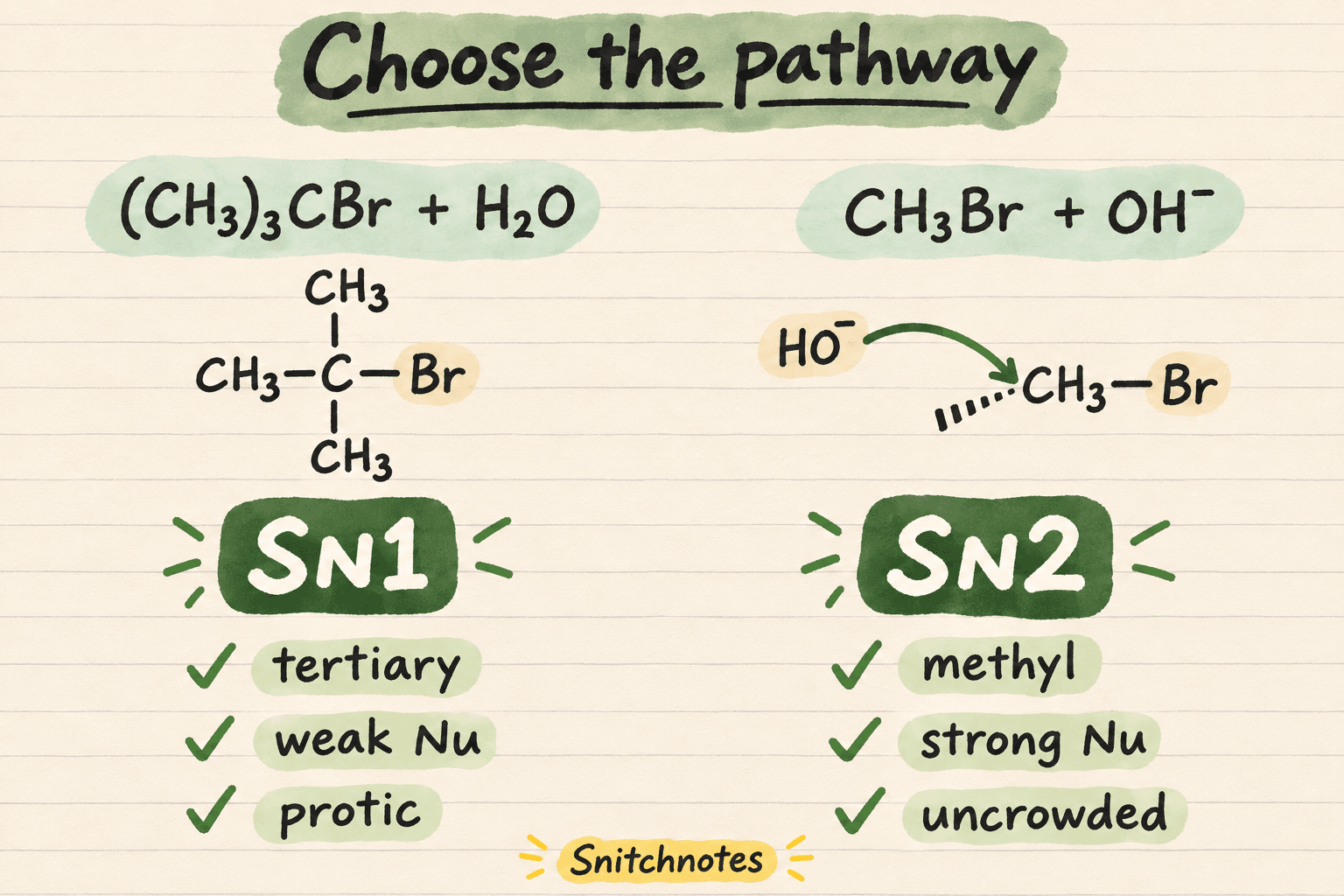
Tert-butyl bromide, (CH3)3CBr, has a tertiary carbon bonded to bromine. A direct backside attack would be badly crowded, so SN2 is effectively blocked. Water is a weak nucleophile and a polar protic solvent, but those are acceptable SN1 conditions. Bromide leaves in the slow step to form the stabilized tert-butyl carbocation; water attacks, then loss of a proton gives tert-butanol. The predicted substitution pathway is SN1, with rate = k[tert-butyl bromide].
Example 2: methyl bromide with hydroxide
Methyl bromide, CH3Br, is the least crowded possible alkyl halide, and hydroxide is a strong nucleophile. Forming a methyl carbocation would be extremely unfavorable, so SN1 is not a realistic route. Hydroxide attacks the carbon from the side opposite bromine while bromide leaves, producing methanol in one concerted step. The predicted pathway is SN2, with rate = k[CH3Br][OH−].
Notice how the same leaving group does not decide the mechanism. Bromide can leave in either pathway. What changes is the substrate geometry and stability, the nucleophile, and the solvent environment.
Misconceptions and boundaries
- SN1 does not simply mean two steps, and SN2 does not mean two steps. The number refers to the molecularity of the rate-determining event.
- A secondary substrate is not automatically SN1 or SN2. Nucleophile strength, solvent, temperature, and competition from elimination must be considered.
- A strong base can shift the reaction toward E2 elimination, especially with secondary or tertiary substrates. Under neutral protic conditions, SN1 and E1 can occur together.
- Good leaving groups help both mechanisms; they do not distinguish SN1 from SN2 by themselves.
Check your understanding
Why does doubling the nucleophile concentration speed up SN2 but not SN1?
The nucleophile participates in the single rate-determining SN2 event, so its concentration appears in the rate law. In SN1, carbocation formation is the slow step and happens before nucleophilic attack.
Which stereochemical clue points most clearly to SN2?
Inversion at the reacting stereocenter points to backside attack and therefore SN2. SN1 more often gives substantial racemization, sometimes with a modest excess of inversion.
What should you inspect first on an exam?
Inspect the substrate carbon first: methyl, primary, secondary, or tertiary. That immediately rules out implausible pathways, after which the nucleophile, solvent, and competing elimination conditions refine the prediction.
Related concepts
- Ionic vs covalent bonds: compare how electrons are transferred or shared.
- The Haber process: see how conditions change the rate and equilibrium of an industrial reaction.
- E1 and E2 elimination compete with substitution by removing a proton and leaving group to form an alkene.
Sources
International Union of Pure and Applied Chemistry Gold Book: nucleophilic substitution
OpenStax Organic Chemistry: The SN2 Reaction
OpenStax Organic Chemistry: The SN1 Reaction
Michigan State University Organic Chemistry: Alkyl Halide Reactivity and Nucleophilic Substitution
MIT OpenCourseWare Organic Chemistry I: Nucleophilic Substitution and Elimination
講義をテスト対策バッチリの教材に。
ノート、クイズ、ポッドキャスト、フラッシュカード、チャット — アップロード1回で全部。
最初のノートを無料で試す